
In the development of high-speed rapier looms, the variable speed gear shafts serve as critical transmission components, directly impacting the machine’s operational stability and efficiency. Our company faced persistent challenges with tooth breakage in these gear shafts during field applications, which compromised product reliability and user satisfaction. This issue prompted a comprehensive review and enhancement of the manufacturing process, focusing on heat treatment methodologies to address the root causes of failure. Through detailed analysis and iterative testing, we implemented a revised process that significantly improved the durability and performance of the gear shafts. This article outlines our approach, from problem identification to solution implementation, emphasizing the role of advanced heat treatment techniques in optimizing gear shaft production. The insights gained have not only resolved the immediate problem but also elevated our overall manufacturing capabilities for similar components across various textile machinery lines.
The variable speed gear shafts in high-speed rapier looms are designed with precise specifications: a module of 3.5, 19 teeth, a pressure angle of 20°, and a helix angle of 8°. These gear shafts are typically fabricated from 20CrMnTi steel, a low-carbon alloy steel chosen for its potential to achieve high surface hardness through carburizing while maintaining core toughness. The intended carburizing depth ranges from 0.7 mm to 1.1 mm, with a post-quench hardness target of HRC 58 to HRC 62. However, initial production batches exhibited premature tooth fractures under operational loads, indicating a mismatch between the material’s processed properties and the application’s dynamic demands. The failures were primarily attributed to inadequate heat treatment practices that led to insufficient toughness and improper hardness gradients. To systematically address this, we re-evaluated the entire manufacturing sequence, incorporating additional heat treatment stages to enhance both surface and core characteristics. This process improvement underscores the importance of tailored thermal processing for critical gear shafts in high-performance textile machinery.
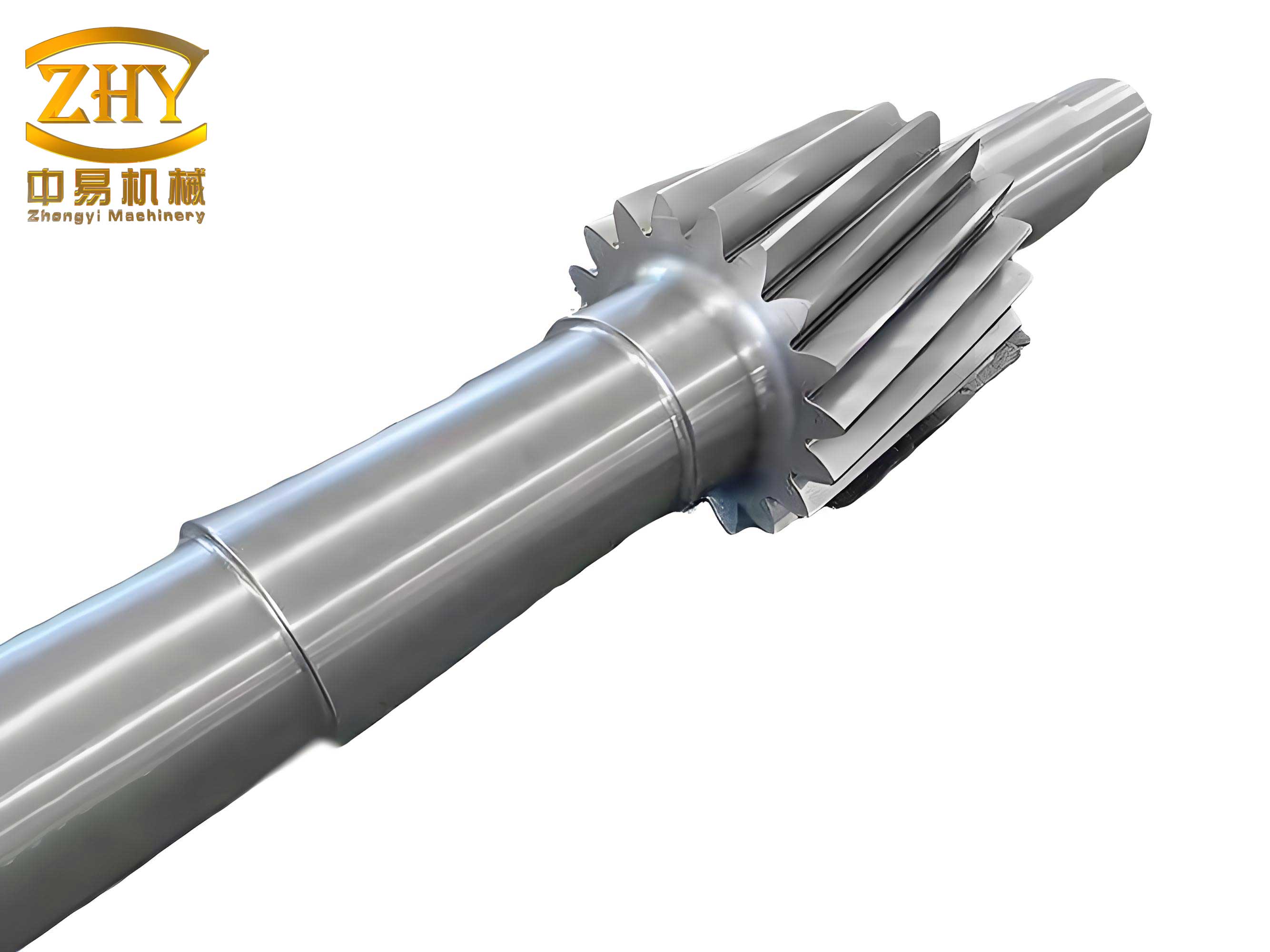
The original manufacturing process for these gear shafts followed a straightforward sequence: forging, gear tooth machining, carburizing, quenching, and finish grinding. While this approach is common for many gear applications, it proved insufficient for the high-impact conditions encountered in high-speed rapier looms. The core issue stemmed from the heat treatment phase, where the quenching process after carburizing resulted in a brittle martensitic structure throughout the component. For small-module gear shafts like these (where module < 5 mm), achieving a controlled hardened layer along the tooth profile via conventional quenching is challenging. The rapid cooling often induces high residual stresses and reduces toughness in the core, making the gear shafts susceptible to crack initiation and propagation under cyclic loading. Consequently, the gear shafts failed to meet the required mechanical performance, leading to frequent tooth breakage. Our analysis confirmed that the problem was not material selection but rather the heat treatment protocol, necessitating a revised process that balances surface hardness with core ductility.
To rectify these shortcomings, we redesigned the heat treatment strategy by introducing normalizing and low-temperature tempering stages. Normalizing, performed after forging and before machining, refines the grain structure and homogenizes carbide distribution, thereby improving machinability and reducing subsequent processing defects. The normalizing temperature for 20CrMnTi steel is set above the Ac3 temperature, typically in the range of $$T_{\text{normalizing}} = A_{c3} + 30^\circ\text{C} \text{ to } 50^\circ\text{C}$$, where $$A_{c3}$$ is the temperature at which ferrite completely transforms to austenite during heating. This process enhances the material’s uniformity and prepares it for后续加工. Following gear tooth machining, carburizing is conducted at approximately 920°C for 7 hours to achieve the desired case depth. Subsequently, the gear shafts are pre-cooled to 870–880°C and oil-quenched to form a hard martensitic case. A critical addition is the low-temperature tempering at 200°C for 2–3 hours, which relieves quenching stresses, increases toughness, and stabilizes the microstructure. Finally, shot peening is applied to induce compressive surface stresses, improving fatigue resistance, followed by precision grinding to achieve the required dimensional accuracy and surface finish. This comprehensive approach ensures that the gear shafts exhibit high surface hardness and wear resistance while retaining adequate core strength and impact absorption capacity.
The effectiveness of the improved process is evident in the enhanced mechanical properties of the gear shafts. Key parameters, such as hardness gradients and case depth, can be modeled using diffusion equations. For instance, the carburizing depth (d) as a function of time (t) and temperature (T) can be approximated by: $$d = k \sqrt{t} \cdot e^{-Q/(RT)}$$ where k is a material constant, Q is the activation energy for carbon diffusion, and R is the gas constant. This relationship helps optimize the carburizing duration for consistent results. Additionally, the hardness profile across the gear tooth can be described using empirical formulas that link carbon content to martensite formation. The table below summarizes the comparative properties between the original and improved processes for these critical gear shafts:
| Property | Original Process | Improved Process |
|---|---|---|
| Surface Hardness (HRC) | 58–62 (but brittle) | 58–62 (with toughness) |
| Core Hardness (HB) | ~200 (variable) | 170–210 (consistent) |
| Case Depth (mm) | 0.7–1.1 (uneven) | 1.0–2.0 (uniform) |
| Impact Toughness (J) | Low (prone to fracture) | High (resistant to shock) |
| Residual Stress | Tensile (detrimental) | Compressive (beneficial) |
This table highlights how the revised process addresses the limitations of the earlier method, particularly in enhancing core toughness and stress distribution. The integration of normalizing and tempering stages is pivotal for achieving these outcomes, as they modify the microstructure at different stages of production. For gear shafts subjected to high-speed operational stresses, such improvements are non-negotiable for long-term reliability.
Further detailing the heat treatment stages, normalizing involves heating the gear shafts to a temperature range of 880–900°C, holding for sufficient time to achieve austenitization, and then air-cooling. This results in a fine pearlitic structure that improves machinability and reduces the risk of distortion during subsequent carburizing. The hardness after normalizing typically falls within HB 170–210, ideal for precise gear tooth cutting. Carburizing, performed in a controlled atmosphere furnace, enriches the surface layer with carbon to a concentration that can be estimated using Fick’s second law: $$\frac{\partial C}{\partial t} = D \frac{\partial^2 C}{\partial x^2}$$ where C is carbon concentration, t is time, D is the diffusion coefficient, and x is depth from the surface. By maintaining a carbon potential of 0.8–1.0% at 920°C, we achieve a gradual carbon gradient that supports a durable case after quenching. Quenching is carefully managed by pre-cooling to 870–880°C before oil immersion, which minimizes thermal shock and reduces the likelihood of cracking in the gear shafts. The martensite formation during quenching is described by the Koistinen-Marburger equation for the fraction of martensite (f): $$f = 1 – e^{-\alpha(M_s – T)}$$ where α is a constant, Ms is the martensite start temperature, and T is the quenching temperature. This equation helps in predicting the transformation kinetics and optimizing the cooling rate.
Low-temperature tempering follows quenching to alleviate internal stresses and improve ductility. During this stage, tempered martensite forms, which retains high hardness while enhancing toughness. The tempering effect on hardness can be approximated by the Hollomon-Jaffe parameter: $$P = T(\log t + C)$$ where T is tempering temperature in Kelvin, t is time in hours, and C is a material constant. For our gear shafts, tempering at 200°C for 2–3 hours yields an optimal balance, as confirmed by microstructural analysis. Shot peening, another critical step, bombards the surface with small media to induce compressive residual stresses, which significantly improve fatigue life. The induced stress (σ) can be related to peening intensity (I) and coverage (C) through empirical relations: $$\sigma = k_I \cdot I^{n} \cdot C^{m}$$ where kI, n, and m are constants derived from material testing. This process is particularly beneficial for gear shafts operating under cyclic loading, as it retards crack initiation. Finally, precision grinding ensures dimensional accuracy and surface finish, with careful control to avoid removing the beneficial compressive layer from shot peening.
The implementation of this revised process was validated through small-batch trials. Ten gear shafts were manufactured using the new sequence and subjected to rigorous testing, including metallographic examination, hardness traverses, and dynamic load simulations. The results showed a uniform case depth of 1.2–1.8 mm, surface hardness of HRC 60–62, and core hardness of HB 180–200. Impact tests revealed a substantial increase in toughness, with Charpy V-notch values exceeding 40 J, compared to less than 20 J for the original process. Subsequent assembly into high-speed rapier looms and extended operation under simulated working conditions demonstrated no instances of tooth breakage, confirming that the gear shafts now meet the stringent demands of high-speed applications. The success of these trials paved the way for批量 production, with over 100 units deployed to customers in regions like Shandong and Guangdong, all reporting reliable performance without failure. This positive feedback underscores the effectiveness of the process改进 for producing durable gear shafts.
Beyond the immediate application, the improved manufacturing methodology has broader implications for our company’s production of similar components in other textile machinery, such as spinning frames and combing machines. The principles of integrating normalizing and tempering into the heat treatment cycle are transferable to various gear shafts and precision parts requiring a combination of hardness and toughness. For instance, we have applied this approach to gear shafts in high-speed细纱机 and精梳机, resulting in enhanced service life and reduced maintenance costs. The table below provides an overview of the key steps in the revised manufacturing process for variable speed gear shafts, highlighting the role of each stage in achieving the desired properties:
| Process Step | Purpose | Key Parameters | Outcome for Gear Shafts |
|---|---|---|---|
| Forging | Shape the raw material | Temperature: 1150–1200°C | Initial grain structure formation |
| Normalizing | Refine grain and improve machinability | Temperature: 880–900°C, air cool | Hardness: HB 170–210, uniform microstructure |
| Gear Machining | Cut teeth to precision | CNC grinding, tolerance ±0.01 mm | Accurate tooth profile for smooth operation |
| Carburizing | Increase surface carbon content | 920°C for 7 h, carbon potential 0.9% | Case depth: 1.0–2.0 mm, ready for hardening |
| Quenching | Harden the surface layer | Pre-cool to 870°C, oil quench | Martensitic case with high hardness |
| Tempering | Relieve stresses and increase toughness | 200°C for 2–3 h, air cool | Reduced brittleness, improved impact resistance |
| Shot Peening | Induce compressive surface stresses | Intensity: 0.4–0.6 mmA, coverage >100% | Enhanced fatigue strength for gear shafts |
| Finish Grinding | Achieve final dimensions and finish | Precision grinding, Ra < 0.4 μm | Smooth surface, minimal noise and wear |
This tabular representation clarifies the sequence and rationale behind each step, emphasizing how they collectively contribute to the performance of the gear shafts. The inclusion of normalizing and tempering is particularly crucial for mitigating the historical issues of tooth fracture, as these stages optimize the microstructure throughout the component’s cross-section.
In conclusion, the改进 in the manufacturing process for high-speed rapier loom variable speed gear shafts has successfully resolved the persistent problem of tooth breakage, transforming a production challenge into a reliability asset. By adopting a holistic heat treatment approach that incorporates normalizing, controlled carburizing, quenching, low-temperature tempering, and shot peening, we have achieved gear shafts with superior surface hardness, wear resistance, and core toughness. The technical enhancements are supported by empirical data and field validation, confirming that the gear shafts now withstand the rigorous demands of high-speed textile machinery. This achievement not only boosts customer confidence but also elevates our internal工艺 capabilities, setting a benchmark for future developments in gear shaft production. As we continue to refine these methods, the insights gained will drive further innovations in manufacturing critical components across the textile industry, ensuring durability and efficiency in ever-more demanding applications.