
In the field of gear transmission, the hypoid gear stands out due to its ability to transmit power between non-intersecting and non-parallel axes, offering advantages such as smooth operation, high load capacity, and compact design. These gears are extensively used in automotive industries, particularly in differential systems, where efficiency and durability are paramount. My research focuses on the geometric parameter calculation of the pitch cone for curved tooth hypoid gears, specifically those with epicycloid tooth profiles. The accurate determination of these parameters is foundational for subsequent design steps, including selection of modification coefficients, checking for undercutting, tip sharpening, and blank dimension calculation. For large pitch cone angle epicycloid hypoid gears, secondary cutting checks are also necessary. However, existing calculation methods across different tooth systems—such as the Gleason system for curved teeth, and the Oerlikon and Klingelnberg systems for epicycloid teeth—exhibit significant variations and approximations. This paper investigates the underlying principles of pitch cone geometric parameter calculation for hypoid gears and proposes a novel, precise method tailored for epicycloid hypoid gears, ensuring conjugate action and symmetric meshing on both tooth flanks.
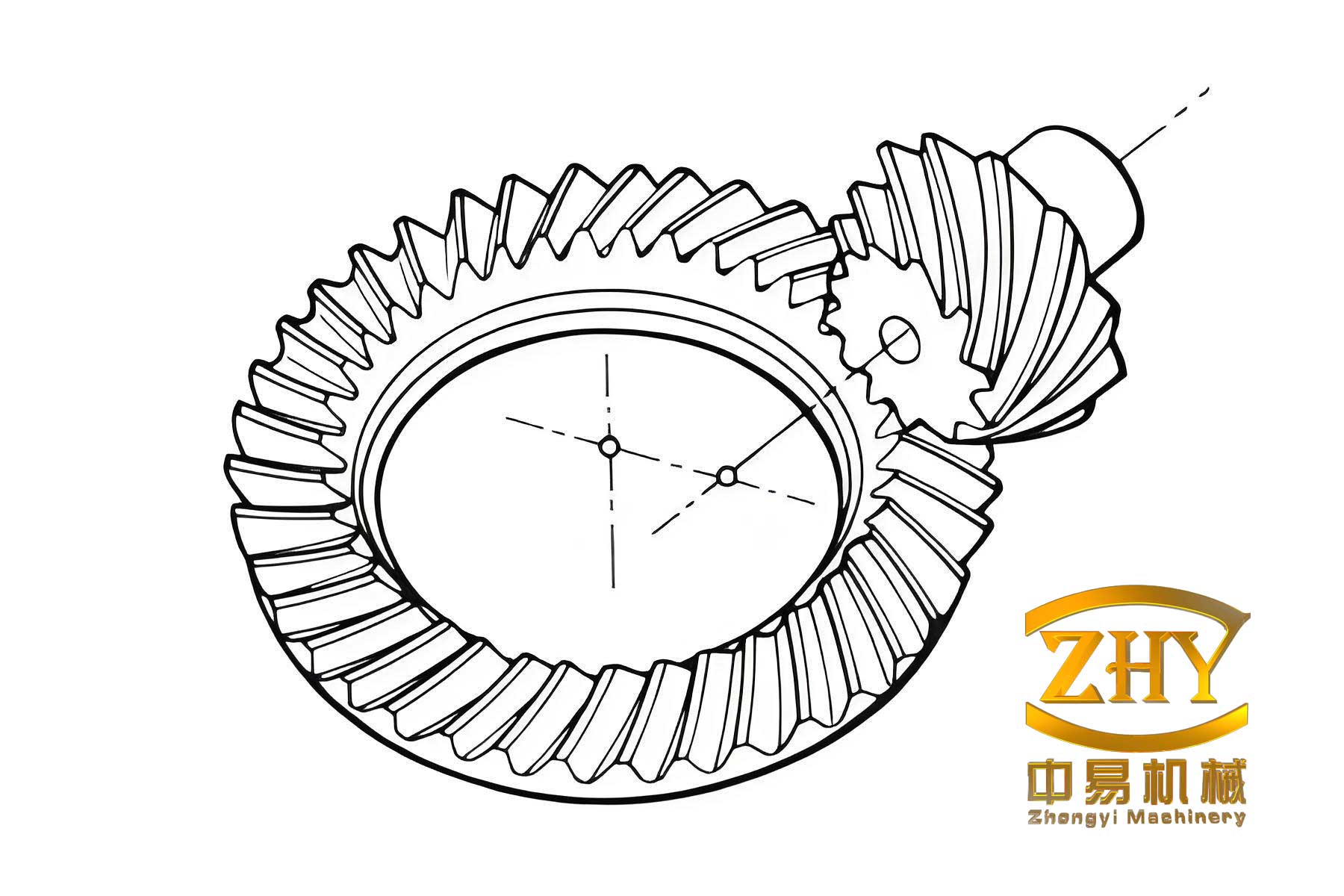
The geometry of a hypoid gear pair is defined by several key parameters that influence its performance and manufacturability. These include the shaft angle $\Sigma$, offset distance $E$, gear ratio $i_{12} = z_2 / z_1$ (where $z_1$ and $z_2$ are the tooth numbers of the pinion and gear, respectively), and the position of the reference point $M$. At point $M$, the pitch cone parameters are determined: pitch radii $r_{m1}$ and $r_{m2}$, pitch cone angles $\delta_1$ and $\delta_2$, and spiral angles $\beta_{m1}$ and $\beta_{m2}$. For a hypoid gear pair to function correctly, the tooth surfaces must be conjugate at the reference point, leading to three fundamental relationship equations among these nine parameters. Additionally, if symmetric meshing on both tooth flanks is desired, a fourth constraint equation is introduced. Therefore, five parameters must be specified to solve for the remaining four. Typically, based on structural and strength considerations, the given parameters are $\Sigma$, $E$, $z_1$, $z_2$, $d_{e2}$ (the outer pitch diameter of the gear), $b_2$ (the gear face width), and either $\beta_{m2}$ for epicycloid hypoid gears or $\beta_{m1}$ for curved tooth hypoid gears. If an initial value for the gear pitch cone angle $\delta_2$ is assumed, then $r_{m2} = (d_{e2} – b_2 \sin \delta_2)/2$. With six parameters known, an iterative approach is required, using $\delta_2$ as the iteration variable to satisfy all conditions.
To ensure conjugate action at the reference point $M$, given $\delta_2$, an inner iteration loop solves for $\delta_1$, $r_{m1}$, and $\beta_{m1}$. Starting with an initial guess $\delta_1 = \delta_{10}$, the following formulas are used:
First, the relative spiral angle $\beta_\Delta$ is computed:
$$ \beta_\Delta = \beta_{m1} – \beta_{m2} = \arccos(\tan \delta_1 \cdot \tan \delta_2 + \cos \Sigma \cos \delta_1 \cos \delta_2) $$
Then, the pinion spiral angle is:
$$ \beta_{m1} = \beta_\Delta + \beta_{m2} \quad \text{(or } \beta_{m2} = \beta_{m1} – \beta_\Delta \text{)} $$
The pinion pitch radius is derived from the gear ratio and spiral angles:
$$ r_{m1} = r_{m2} \cdot \frac{z_1 \cos \beta_{m2}}{z_2 \cdot \cos \beta_{m1}} $$
The offset error $\Delta E$ is calculated to check for convergence:
$$ \Delta E = E – \frac{\sin \beta_\Delta}{\sin \Sigma} (r_{m1} \cos \delta_2 + r_{m2} \cos \delta_1) $$
If $|\Delta E| \leq 10^{-4}$, the iteration terminates; otherwise, $\delta_1$ is updated by $\Delta \delta_1$ for the next iteration. The increment $\Delta \delta_1$ is given by:
$$ \Delta \delta_1 = \frac{-\Delta E}{\frac{\sin \beta_\Delta}{\sin \Sigma}(r_{m2} \sin \delta_1 – \frac{\Delta r_{m1}}{\Delta \delta_1} \cos \delta_2) – \frac{E}{\tan \beta_\Delta} \cdot \frac{\Delta \beta_\Delta}{\Delta \delta_1}} $$
where the partial derivatives are:
$$ \frac{\Delta \beta_\Delta}{\Delta \delta_1} = -\frac{\pi}{180 \sin \beta_\Delta \cos^2 \delta_1} \left( \tan \delta_2 + \frac{\cos \Sigma \sin \delta_1}{\cos \delta_2} \right) $$
$$ \frac{\Delta r_{m1}}{\Delta \delta_1} = r_{m1} \tan \beta_{m1} \cdot \frac{\Delta \beta_\Delta}{\Delta \delta_1} $$
It is crucial to note that the hypoid gear pair must have opposite spiral directions, requiring $\beta_{m1} < 90^\circ$ (or $\beta_{m2} < 90^\circ$). To simplify the initial guess and accelerate convergence, an auxiliary parameter, the gear deviation angle $\varepsilon$, can be introduced. Setting $\varepsilon = 0$ initially, the following equations are used iteratively:
$$ \delta_1 = \arcsin(\cos \varepsilon \sin \Sigma \cos \delta_2 – \cos \Sigma \sin \delta_2) $$
$$ \beta_\Delta = \arcsin(\sin \varepsilon \sin \Sigma / \cos \delta_1) $$
Then, $\beta_{m1}$ (or $\beta_{m2}$), $r_{m1}$, and $\Delta E$ are computed using the earlier formulas. If $|\Delta E| > 10^{-4}$, $\varepsilon$ is updated as:
$$ \varepsilon = \arcsin\left( \frac{E}{r_{m2} + r_{m1} \cos \delta_2 \cos \delta_1} \right) $$
This approach ensures conjugate action at point $M$, provided the absolute values of the pressure angles at the reference point are equal. It is applicable to both Klingelnberg and Oerlikon epicycloid hypoid gears (where $\beta_{m2}$ is typically given) and Gleason curved tooth hypoid gears (where $\beta_{m1}$ is given).
Symmetric meshing on both tooth flanks is essential for balanced load distribution and noise reduction in hypoid gear pairs. For line-contact conjugate tooth surfaces, the meshing characteristics at point $M$ are described by the contact angle $\theta_{21}$, the induced normal curvature in the profile direction $K_{21G}$, the induced normal curvature in the line direction $K_{21v}$, and the induced geodesic torsion $\tau_{21v}$. The formulas are:
$$ \tan \theta_{21} = \frac{K_{2v} – Q}{\tau_{2v} + S_a \cdot W \cdot E \sin \Sigma} $$
$$ K_{21G} = \frac{(\tau_{2v} + S_a \cdot W \cdot E \sin \Sigma)^2}{K_{2v} – Q} + W c_o \sin(\alpha_n – \alpha_o) $$
$$ K_{21v} = K_{21G} \tan^2 \theta_{21} $$
$$ \tau_{21v} = K_{21G} \tan \theta_{21} $$
where:
$$ c_o = a_o^2 + b_o^2 $$
$$ W = \frac{\cos \beta_{m1} \cos \beta_{m2}}{r_{m1} \cdot r_{m2} \cdot \sin^2 \beta_\Delta} $$
$$ a_o = r_{m1} \sin \beta_{m1} \sin \delta_2 – r_{m2} \sin \beta_{m2} \sin \delta_1 $$
$$ b_o = \cos \beta_\Delta (r_{m1} \cos \delta_2 + r_{m2} \cos \delta_1) $$
$$ \alpha_o = \arctan(a_o / b_o) $$
Here, $\alpha_o$ is the limit pressure angle, $K_{2v}$ and $\tau_{2v}$ are the normal curvature and geodesic torsion of the gear tooth surface $\Sigma_2$ along the tooth line direction at point $M$. For left-hand drives (pinion left-hand, gear right-hand), $S_a = 1$; for right-hand drives, $S_a = -1$. The pressure angle $\alpha_n$ is positive for the gear convex side and pinion concave side, and negative for the gear concave side and pinion convex side. The term $Q$ is transformed to:
$$ Q = K_{jv} \cdot \cos \alpha_n \cos \alpha_o – W e_o \sin(\alpha_n – \alpha_o) \cos \alpha_o $$
with:
$$ e_o = \sin \beta_\Delta (r_{m1} \cos \delta_2 \tan \beta_{m2} + r_{m2} \cos \delta_1 \tan \beta_{m1}) $$
$$ K_{jv} = \cos \alpha_o \sin \beta_\Delta \left( \frac{\sin \delta_1 \cos \beta_{m2}}{r_{m1}} – \frac{\sin \delta_2 \cos \beta_{m1}}{r_{m2}} \right) – e_o W \sin \alpha_o $$
$K_{jv}$ is the limit normal curvature. Substituting $Q$ into the expressions for $\tan \theta_{21}$ and $K_{21G}$ yields:
$$ \tan \theta_{21} = \frac{K_{2v} \cos \alpha_o – K_{jv} \cos \alpha_n + W e_o \sin(\alpha_n – \alpha_o)}{\cos \alpha_o (\tau_{2v} + S_a \cdot W \cdot E \cdot \sin \Sigma)} $$
$$ K_{21G} = \frac{\cos \alpha_o (\tau_{2v} + S_a \cdot W \cdot E \cdot \sin \Sigma)^2}{K_{2v} \cos \alpha_o – K_{jv} \cos \alpha_n + W (e_o + c_o) \sin(\alpha_n – \alpha_o)} $$
For symmetric meshing, the convex and concave flanks of the same tooth should have contact angles and induced curvatures equal in magnitude but opposite in sign, i.e., $\theta_{21i} = -\theta_{21e}$, $K_{21Gi} = -K_{21Ge}$, $K_{21vi} = -K_{21ve}$, and the induced geodesic torsions should be equal, $\tau_{21vi} = \tau_{21ve}$. From the above equations, this requires three conditions:
1. $\alpha_{ni} – \alpha_o = -(\alpha_{ne} – \alpha_o)$, leading to pressure angles for the gear convex and concave flanks:
$$ \alpha_{ni} = \alpha_\Delta / 2 + \alpha_o $$
$$ \alpha_{ne} = -\alpha_\Delta / 2 + \alpha_o $$
where $\alpha_\Delta$ is the sum of the absolute pressure angles on both flanks. Typically, $\alpha_o < 0$, so $\alpha_{ni} < |\alpha_{ne}|$.
2. $K_{2vi} \cos \alpha_o – K_{jv} \cos \alpha_{ni} = K_{jv} \cos \alpha_{ne} – K_{2ve} \cos \alpha_o$. Substituting $\alpha_{ni}$ and $\alpha_{ne}$ gives the average curvature $K_o$ along the tooth line at point $M$:
$$ K_o = \frac{K_{2vi} + K_{2ve}}{2 \cos(\alpha_\Delta / 2)} = K_{jv} $$
3. $\tau_{2vi} = \tau_{2ve}$.
Thus, for symmetric meshing, the pressure angles and average curvature at the reference point are determined by the pitch cone geometric parameters, which in turn define the cutter blade angles and cutter radius. The condition $\tau_{2vi} = \tau_{2ve}$ is automatically satisfied if the tooth line direction is a principal direction, resulting in $\tau_{2vi} = \tau_{2ve} = 0$.
For epicycloid hypoid gears, the curvature $K_o$ at point $M$ is calculated based on the cutter setup. Given the number of blade groups $z_o$ and nominal cutter radius $r_o$, $K_o$ is:
$$ K_o = \frac{1}{r_b} \left( 1 + \frac{E_b \cdot \sin \Delta}{r_b (1 + i_{jo})} \right) $$
where:
$$ r_b = r_o \cos \delta_o – E_b \sin \Delta $$
$$ \delta_o = \arcsin\left( \frac{z_o \cdot m_n}{2 r_o} \right) $$
$$ m_n = \frac{2 r_{m2} \cos \beta_{m2}}{z_2} $$
$$ \Delta = \arcsin\left[ \frac{1}{E_{x2}} (r_o \cdot \cos \delta_o – R_{m2} \sin \beta_{m2}) \right] $$
$$ R_{m2} = r_{m2} \sin \delta_2, \quad E_b = \frac{i_{jo} E_{x2}}{1 + i_{jo}} $$
$$ E_{x2} = \sqrt{R_{m2}^2 + r_o^2 – 2 R_{m2} \cdot r_o \sin(\beta_{m2} – \delta_o)} $$
$$ i_{jo} = z_o / z_{p2}, \quad z_{p2} = z_2 / \sin \delta_2 $$
An outer iteration loop adjusts $\delta_2$ until $K_o = K_{jv}$, with tolerance $\Delta \rho = |1/K_o – 1/K_{jv}| \leq 10^{-3}$.
To contextualize the proposed method, I analyze three established tooth systems for hypoid gear calculation. Each system has its own approach, but all aim to ensure conjugate action and symmetric meshing.
| Aspect | Gleason System (Curved Tooth) | Klingelnberg System (Epicycloid) | Oerlikon System (Epicycloid) |
|---|---|---|---|
| Application | Widely used for automotive hypoid gears with $\Sigma = 90^\circ$. | Used for epicycloid hypoid gears, focusing on precise geometry. | Used for epicycloid hypoid gears, with software-based calculations. |
| Pitch Cone Calculation | Accurate but complex formulas; ensures symmetric meshing via cutter radius iteration. | Inner iteration similar to proposed method; outer iteration uses approximate meshing line angle. | Complex formulas, approximate for $\Sigma \neq 90^\circ$; uses condition on pinion cone apex location. |
| Symmetric Meshing | Achieved by selecting cutter radius $r_o$ to satisfy $K_{jv} = 1/r_o$. | Seeks to align tooth line curvature with limit curvature, but with approximations. | Partially addresses pressure angle correction, but overlooks curvature matching, leading to asymmetry. |
| Key Formulas | Based on conjugate conditions and cutter geometry; pressure angles from $\alpha_{ni} = \alpha_\Delta/2 + \alpha_o$, $\alpha_{ne} = -\alpha_\Delta/2 + \alpha_o$. | Uses $\tan \theta^*_m = \sin \delta_2 \tan \varepsilon$ for meshing line angle; iterates for curvature matching. | Uses $\tan \phi^*_{12} = \sin \Sigma \tan q_2 / \sin \delta_2$ to enforce pinion apex alignment. |
The Gleason system provides reliable calculations for hypoid gear with shaft angle $\Sigma = 90^\circ$, ensuring symmetric meshing through iterative determination of the cutter radius. The Klingelnberg method for epicycloid hypoid gear aligns closely with my proposed approach, as it also targets symmetric meshing by matching tooth line curvature with the limit curvature. However, it employs an approximate formula for the meshing line angle $\theta_m$, given by:
$$ \tan \theta^*_m = \sin \delta_2 \tan \varepsilon $$
In contrast, the exact expression derived from conjugate conditions is:
$$ \tan \theta_m = \eta_2 \frac{\cos \beta_{m1} \sin \beta_\Delta}{\cos \beta_{m2}} – \tan \beta_{m2} $$
where $\eta_2 = \frac{1}{b_o} \left( \frac{K_{2v} \cos \alpha_o – K_{jv} \cos \alpha_n}{W \sin(\alpha_n – \alpha_o)} + e_o \right)$. Under symmetric meshing conditions, $\theta_m$ is identical for both flanks. The Klingelnberg approximation introduces errors, though minor, and complicates the iteration process.
The Oerlikon system, whether using CDS software or manual calculations, relies on cumbersome formulas that are approximate for non-90° shaft angles. It imposes a condition to ensure the pinion cone apex lies on the line connecting the gear cone apex and the cutter center. This condition is expressed as:
$$ \tan \phi^*_{12} = \frac{\sin \Sigma \tan q_2}{\sin \delta_2} $$
with $q_2$ defined by cutter geometry:
$$ \tan q_2 = \frac{r_o \cos(\beta_{m2} – \delta_o)}{R_{m2} – r_o \sin(\beta_{m2} – \delta_o)} $$
However, the correct geometric relationship should be:
$$ \tan \phi_{12} = \tan q_2 \sin \delta_2 $$
which matches $\tan \phi^*_{12}$ only when $\Sigma = 90^\circ$. More critically, the Oerlikon method does not fully account for symmetric meshing; it adjusts pressure angles but neglects the curvature condition $K_o = K_{jv}$, leading to significant asymmetry in meshing characteristics.
To illustrate the differences, consider a numerical example of an epicycloid hypoid gear pair with parameters: $\Sigma = 90^\circ$, $E = 40 \, \text{mm}$, $z_1 = 12$, $z_2 = 49$, $d_{e2} = 400 \, \text{mm}$, $b_2 = 60 \, \text{mm}$, $\beta_{m2} = 30^\circ$ (giving $m_n = 6.0654 \, \text{mm}$), $z_o = 5$, $r_o = 135 \, \text{mm}$, and $\alpha_\Delta / 2 = 20^\circ$. The geometric parameters are calculated using three methods: the proposed precise method, the Klingelnberg method, and the Oerlikon method. The results are summarized below:
| Parameter | Symbol | Proposed Method | Klingelnberg Method | Oerlikon Method |
|---|---|---|---|---|
| Gear Pitch Cone Angle (°) | $\delta_2$ | 71.3468 | 71.2613 | 70.3260 |
| Gear Pitch Radius (mm) | $r_{m2}$ | 171.5758 | 171.5902 | 171.7513 |
| Pinion Pitch Cone Angle (°) | $\delta_1$ | 18.2124 | 18.2962 | 19.2130 |
| Pinion Spiral Angle (°) | $\beta_{m1}$ | 42.9218 | 42.9213 | 42.9176 |
| Pinion Pitch Radius (mm) | $r_{m1}$ | 49.6927 | 49.6965 | 49.7401 |
| Normal Module at Ref. Point (mm) | $m_n$ | 6.0649 | 6.0654 | 6.0711 |
| Cutter Orientation Angle (°) | $\delta_o$ | 6.4486 | 6.4492 | 6.4552 |
| Limit Pressure Angle (°) | $\alpha_o$ | -1.7251 | -1.6806 | -1.1934 |
| Limit Normal Curvature (1/mm) | $K_{jv}$ | 7.8809 × 10⁻³ | 7.9562 × 10⁻³ | 8.7782 × 10⁻³ |
| Meshing Line Angle (°) | $\theta_m$ | 11.4338 | 11.4267 | 11.3504 |
| Tooth Line Curvature (1/mm) | $K_o$ | 7.8809 × 10⁻³ | 7.8802 × 10⁻³ | 7.8720 × 10⁻³ |
| Curvature Error (1/mm) | $\Delta K = K_o – K_{jv}$ | -2.2 × 10⁻⁸ | 7.6 × 10⁻⁵ | 9.1 × 10⁻⁴ |
| Curvature Radius Error (mm) | $\Delta \rho = |1/K_o – 1/K_{jv}|$ | 3.6 × 10⁻⁴ | 1.2120 | 13.1149 |
The proposed method achieves nearly perfect curvature matching ($\Delta \rho = 3.6 \times 10^{-4} \, \text{mm}$), ensuring symmetric meshing. The Klingelnberg method shows a small error ($\Delta \rho = 1.2120 \, \text{mm}$) due to its approximations, while the Oerlikon method yields a large discrepancy ($\Delta \rho = 13.1149 \, \text{mm}$), indicating poor symmetry. This asymmetry is detrimental for epicycloid hypoid gears manufactured via dual-face cutting, as contact patterns cannot be adjusted separately for each flank, potentially leading to uneven wear and noise.
In conclusion, the accurate calculation of geometric parameters for hypoid gear is critical for optimal performance. The proposed method offers a precise and unified approach for epicycloid hypoid gear, based on fundamental conjugate conditions and symmetric meshing requirements. It addresses the limitations of existing systems: the Gleason system is restricted to $\Sigma = 90^\circ$, the Klingelnberg system uses approximations, and the Oerlikon system neglects curvature matching. By ensuring $K_o = K_{jv}$ and deriving exact formulas for parameters like $\theta_m$, this method enhances design accuracy and manufacturability. Future work could extend this approach to hypoid gear with non-standard offsets or materials, further advancing gear technology. The hypoid gear, with its unique geometry, continues to be a vital component in power transmission, and precise calculation methods are essential for harnessing its full potential.