
In my years of experience working with automotive materials, I have consistently observed that heat treatment processes play a pivotal role in determining the performance and longevity of critical components like gears. The automotive industry, being a cornerstone of modern manufacturing, demands ever-higher standards for durability and efficiency. Among these components, the drive axle and its associated gears, such as the main and pinion bevel gears, are subjected to extreme stresses. They require not only high surface hardness and wear resistance but also sufficient core toughness to withstand impact loads. While 20CrMnTi steel has been a traditional choice for carburizing gears in China, it often falls short for heavy-duty, large-module gears that face more severe service conditions. This led me to explore alternative materials like 22CrMoH steel, which offers better hardenability and impact resistance. However, achieving the desired mechanical properties is not straightforward; it requires meticulous control over the heat treatment process to avoid common heat treatment defects. In this article, I will detail my investigation into the heat treatment of 22CrMoH gear steel, focusing on how I addressed specific heat treatment defects to meet technical specifications.
The technical requirements for the 22CrMoH active conical gear in a heavy-duty truck rear axle are stringent. The carburized case depth must be between 1.5 and 1.9 mm, the surface hardness should range from 60 to 64 HRC, and the core hardness must be between 30 and 45 HRC. Additionally, the metallurgical structure should exhibit martensite and retained austenite below Grade 3, and carbides below Grade 5. Initially, the heat treatment was carried out in a BBH-FE-600 pre-vacuum multipurpose furnace using a drip-fed carburizing atmosphere. The original process involved a single-stage carburizing at 930°C with a carbon potential of 1.15%, followed by pre-cooling and press quenching at 880°C under a carbon potential of 0.80%, oil cooling, cleaning, and finally tempering at 190°C. Despite following this procedure, the resulting surface hardness was consistently below 58 HRC, which is a clear indication of heat treatment defects. This subpar hardness not only fails to meet specifications but also compromises the gear’s wear resistance and fatigue life, leading to potential premature failures in service.
Upon microscopic examination of the samples treated with the original process, I identified the primary heat treatment defect: an excessive amount of retained austenite in the near-surface region. The microstructure revealed that as the distance from the carburized surface increased, the quantity of retained austenite decreased, and the martensite needles became finer. Conversely, the surface layer exhibited coarse martensite and a high volume fraction of retained austenite. This gradient is directly attributed to the carbon concentration profile established during carburizing. In a single-stage carburizing process with a high carbon potential, the surface absorbs carbon rapidly, leading to a steep carbon gradient. The high carbon content at the surface lowers the martensite start temperature (Ms), resulting in incomplete transformation to martensite during quenching and thus a significant retention of austenite. Retained austenite is a soft, metastable phase that reduces overall hardness and can later transform under stress, causing dimensional instability. This is a classic example of heat treatment defects arising from improper carbon control. The relationship between carbon content and Ms temperature can be expressed by an empirical formula, which highlights why high surface carbon is detrimental:
$$ M_s(°C) = 539 – 423C – 30.4Mn – 12.1Cr – 17.7Ni – 7.5Mo + 10Co – 7.5Si $$
where C, Mn, Cr, etc., represent the weight percentages of the elements in austenite at the quenching temperature. For a high carbon surface layer, the Ms temperature can drop substantially, promoting retained austenite. This defect directly explained the low hardness readings. Other potential heat treatment defects, such as excessive carbide networking or grain growth, were not prominent in this case, but the retained austenite issue was paramount.
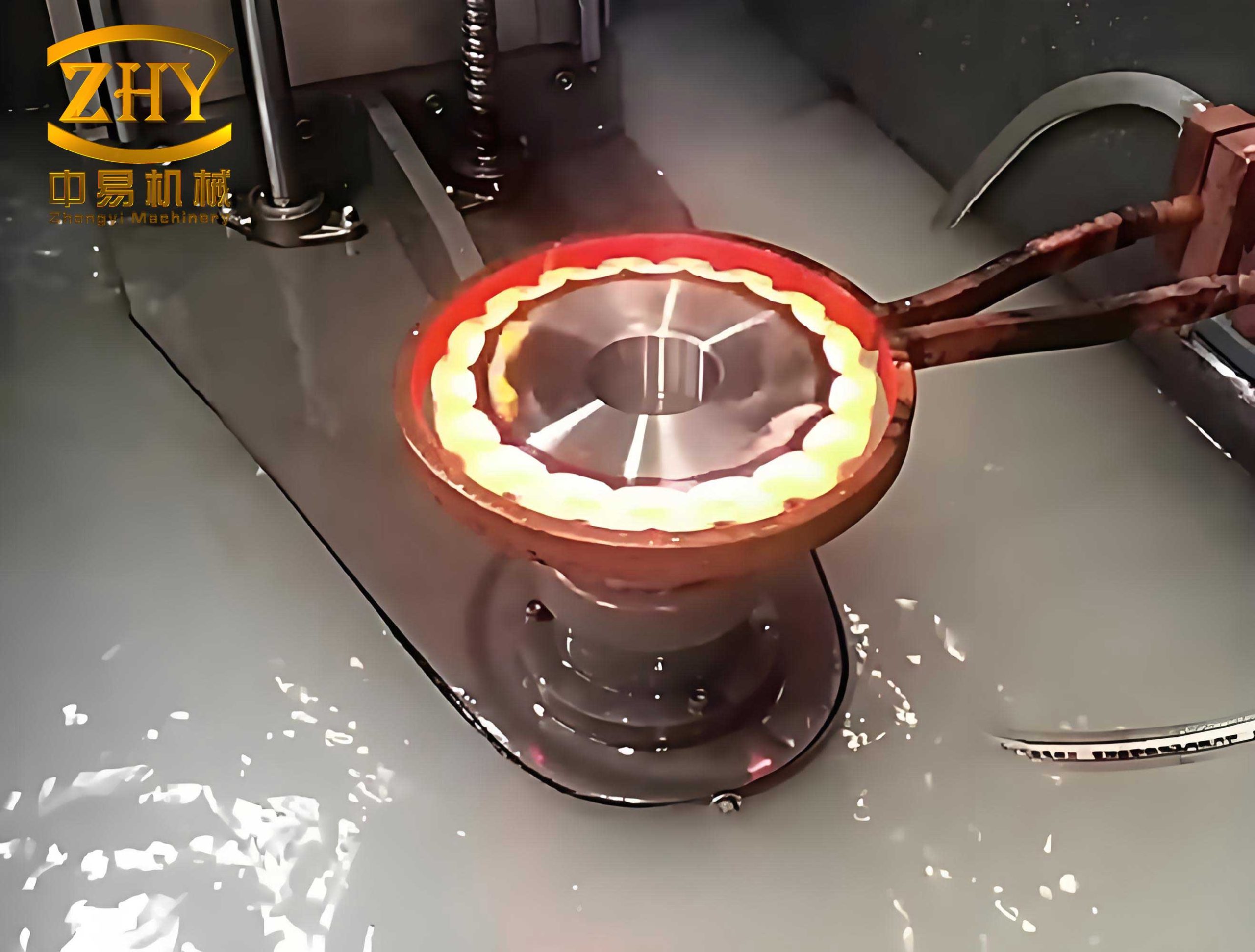
The image above illustrates common microstructural features associated with heat treatment defects, including retained austenite, which appears as light, featureless regions under the microscope. In my analysis, such defects were clearly visible in the 22CrMoH samples. To rectify this, I needed to modify the heat treatment process systematically, targeting each stage to mitigate these heat treatment defects. The core challenge was to reduce the surface carbon content without drastically increasing the process time, which would affect productivity. My approach involved three key modifications: changing the carburizing profile, adjusting the quenching temperature, and optimizing the tempering temperature. Each of these steps aims to control phase transformations and minimize defects like retained austenite.
First, I revised the carburizing stage from a single-stage to a two-stage process. The original single-stage carburizing at 930°C and 1.15% carbon potential was efficient for building up carbon quickly but resulted in a sharp carbon gradient and high surface carbon concentration. To address this heat treatment defect, I introduced a diffusion phase. The new profile consists of a strong carburizing stage at 930°C with a carbon potential of 1.15%, followed by a diffusion stage at 920°C with a carbon potential of 0.80%. The strong carburizing stage builds up carbon rapidly, while the diffusion stage allows carbon to migrate inward, reducing the surface concentration and creating a more gradual carbon gradient. This helps in minimizing retained austenite by preventing excessive carbon saturation at the surface. The carbon diffusion during carburizing can be described by Fick’s second law, which governs the change in carbon concentration over time:
$$ \frac{\partial C}{\partial t} = D \frac{\partial^2 C}{\partial x^2} $$
where \( C \) is the carbon concentration, \( t \) is time, \( x \) is the distance from the surface, and \( D \) is the diffusion coefficient, which is temperature-dependent. By lowering the temperature slightly during diffusion and reducing the carbon potential, the surface carbon content decreases, alleviating one of the root causes of heat treatment defects. Additionally, I set the carbon potential during pre-cooling and press quenching to 0.75% to further limit carbon uptake before quenching. The modified carburizing and quenching parameters are summarized in the table below, comparing the original and improved processes to highlight the changes aimed at reducing heat treatment defects.
| Process Stage | Original Parameters | Improved Parameters | Purpose of Change |
|---|---|---|---|
| Carburizing Type | Single-stage | Two-stage (Strong + Diffusion) | Reduce surface carbon gradient and minimize retained austenite, a common heat treatment defect. |
| Strong Carburizing | 930°C, Cp=1.15% | 930°C, Cp=1.15% | Maintain high initial carburizing rate. |
| Diffusion Stage | Not applicable | 920°C, Cp=0.80% | Lower surface carbon content to prevent heat treatment defects. |
| Pre-cool/Press Quench | 880°C, Cp=0.80% | 850°C, Cp=0.75% | Reduce austenite stability and limit carbon before quenching to avoid defects. |
| Quenching Temperature | 880°C | 850°C | Decrease retained austenite by lowering alloy carbon dissolution. |
| Tempering Temperature | 190°C | 200°C | Promote transformation of retained austenite to martensite without excessive softening. |
Second, I lowered the quenching temperature from 880°C to 850°C. The quenching temperature is critical because it influences the amount of alloying elements dissolved in austenite. At higher temperatures, more carbon and alloy carbides dissolve into the austenite matrix, increasing its stability and leading to higher retained austenite after quenching—a significant heat treatment defect. By quenching from 850°C, which is below the Accm temperature (the temperature at which cementite completes dissolution into austenite), I aimed to retain some undissolved carbides. These carbides act as grain refiners and reduce the carbon content in austenite, thereby lowering its stability and promoting a more complete martensitic transformation. The relationship between quenching temperature and retained austenite volume can be approximated by considering the equilibrium carbon content in austenite, given by the solubility product of carbides. For instance, the solubility of cementite in austenite increases with temperature, following an Arrhenius-type equation:
$$ [C]_{eq} = A \exp\left(-\frac{Q}{RT}\right) $$
where \( [C]_{eq} \) is the equilibrium carbon concentration in austenite, \( A \) is a pre-exponential factor, \( Q \) is the activation energy, \( R \) is the gas constant, and \( T \) is the absolute temperature. Lowering \( T \) decreases \( [C]_{eq} \), reducing the carbon available to stabilize austenite and thus mitigating this heat treatment defect. Additionally, a lower quenching temperature results in finer martensite, which contributes to higher hardness and toughness.
Third, I increased the tempering temperature from 190°C to 200°C. Tempering serves to relieve stresses and transform retained austenite into more stable phases. At slightly higher temperatures, the diffusion of carbon is enhanced, facilitating the decomposition of retained austenite into tempered martensite or bainite. However, tempering must be carefully controlled; excessive temperature can lead to over-tempering, where carbides coarsen and martensite loses carbon, resulting in decreased hardness—another potential heat treatment defect. By raising the temperature to 200°C, I aimed to maximize the transformation of retained austenite without significant softening. The kinetics of retained austenite decomposition during tempering can be described using time-temperature-transformation (TTT) diagrams or empirical models. For example, the volume fraction of retained austenite after tempering, \( V_{RA} \), might follow an equation like:
$$ V_{RA} = V_{RA0} \exp\left(-k t^n\right) $$
where \( V_{RA0} \) is the initial retained austenite volume, \( k \) is a rate constant dependent on temperature and composition, \( t \) is time, and \( n \) is an exponent. Increasing temperature raises \( k \), accelerating the decomposition and reducing \( V_{RA} \). This adjustment directly targets the heat treatment defect of excessive retained austenite, improving surface hardness.
To provide a comprehensive view, let’s consider the chemical composition of 22CrMoH steel, as it influences the response to heat treatment and susceptibility to defects. The table below lists the standard composition ranges, which affect hardenability, carburizing behavior, and final properties. Elements like chromium and molybdenum enhance hardenability and carbide formation, but they also increase the risk of retained austenite if not properly managed, highlighting the interplay between composition and heat treatment defects.
| Element | Content Range (%) | Role in Heat Treatment | Potential Contribution to Heat Treatment Defects |
|---|---|---|---|
| C | 0.19–0.25 | Base carbon for hardness; affects Ms temperature. | High surface C leads to retained austenite (defect). |
| Si | 0.17–0.37 | Solid solution strengthener; retards carbide growth. | Excessive Si can promote graphitization, a defect. |
| Mn | 0.55–0.90 | Improves hardenability; stabilizes austenite. | Too much Mn increases retained austenite (defect). |
| Cr | 0.85–1.25 | Enhances hardenability and wear resistance. | Can form coarse carbides if over-carburized (defect). |
| Mo | 0.35–0.45 | Increases hardenability and temper resistance. | May promote retained austenite if quenched from high T. |
| P | ≤0.035 | Impurity; should be minimized. | Causes embrittlement if high (defect). |
| S | ≤0.035 | Impurity; affects machinability. | Can form inclusions, leading to stress concentrations. |
| Cu | ≤0.20 | Residual element. | May cause hot shortness in heat treatment. |
| Ni | ≤0.30 | Residual element; improves toughness. | Stabilizes austenite, potentially increasing defect risk. |
| O | ≤20 ppm | Impurity; affects cleanliness. | Oxide inclusions can initiate cracks (defect). |
Implementing these modifications required careful monitoring of the heat treatment cycle. In the multipurpose furnace, I adjusted the atmosphere control to maintain precise carbon potentials during each stage. The two-stage carburizing involved setting the strong carburizing time based on the desired case depth, followed by a diffusion period calculated to achieve the target surface carbon concentration. The carbon potential control is crucial to avoid heat treatment defects such as sooting or decarburization. The relationship between case depth and time can be approximated by the Harris formula, which is useful for process planning:
$$ d = k \sqrt{t} $$
where \( d \) is the case depth, \( t \) is the time, and \( k \) is a constant dependent on temperature and carbon potential. For two-stage carburizing, the calculation becomes more complex, but it ensures a better carbon profile. After carburizing, the quenching in oil at 850°C was performed under a carbon potential of 0.75% to prevent any last-minute carbon uptake. The cooling rate must be sufficient to achieve martensitic transformation but not so fast as to cause cracking or distortion—another category of heat treatment defects. The ideal cooling rate can be estimated using continuous cooling transformation (CCT) diagrams for 22CrMoH steel, which I derived from experimental data to optimize the process.
Following quenching, the gears were cleaned and tempered at 200°C for a sufficient duration to ensure stress relief and retained austenite transformation. The tempering time-temperature combination is critical to balance hardness and toughness. Excessive time or temperature can lead to over-tempering, a heat treatment defect characterized by reduced hardness and strength. I used the Hollomon-Jaffe parameter to correlate tempering effects:
$$ P = T (C + \log t) $$
where \( P \) is the tempering parameter, \( T \) is the absolute temperature, \( C \) is a constant, and \( t \) is time in hours. For 22CrMoH, I targeted a \( P \)-value that maximizes retained austenite decomposition without significant softening. After implementing the improved process, I conducted thorough testing to evaluate the outcomes. The surface hardness consistently reached 63–66 HRC, well above the required 60–64 HRC and a significant improvement from the previous sub-58 HRC values. This demonstrates that the heat treatment defects were effectively mitigated. The case depth measured 1.6–1.8 mm, within the specified range, and the core hardness was 32–40 HRC, meeting the 30–45 HRC requirement. Metallographic examination confirmed that the retained austenite was below Grade 3, and carbides were below Grade 5, indicating a sound microstructure free from major heat treatment defects.
To further elaborate on the science behind these improvements, let’s delve into the thermodynamics and kinetics of carburizing and phase transformations. The carbon potential in the furnace atmosphere must be carefully controlled to match the equilibrium carbon activity at the steel surface. The carbon activity, \( a_C \), relates to the carbon potential, Cp, and can be expressed as:
$$ a_C = \frac{Cp}{C_{\gamma}} $$
where \( C_{\gamma} \) is the carbon concentration in austenite at equilibrium. Deviations from equilibrium can lead to heat treatment defects like incomplete carburizing or excessive carbon uptake. During diffusion, the carbon flux, \( J \), is given by Fick’s first law:
$$ J = -D \frac{dC}{dx} $$
By lowering the surface concentration in the diffusion stage, the flux inward increases, smoothing the profile. This is key to avoiding a sharp carbon drop that can cause brittleness or spalling—another potential heat treatment defect. In quenching, the martensite transformation fraction, \( f \), as a function of temperature below Ms, can be modeled using the Koistinen-Marburger equation:
$$ f = 1 – \exp\left(-\alpha (M_s – T)\right) $$
where \( \alpha \) is a constant and \( T \) is the temperature. A lower Ms due to high carbon reduces \( f \), increasing retained austenite. By reducing surface carbon and quenching from a lower temperature, I raised the effective Ms, promoting more complete transformation and reducing this heat treatment defect. Additionally, the role of alloying elements in suppressing martensite transformation can be quantified using the concept of driving force for nucleation. For instance, the chemical driving force, \( \Delta G_{\gamma \to \alpha’} \), for martensite formation decreases with increasing austenite stability, which is influenced by carbon and alloys. This ties directly to the risk of heat treatment defects when stability is too high.
In practice, monitoring and controlling these parameters in a multipurpose furnace requires advanced instrumentation. I used oxygen probes and infrared analyzers to maintain carbon potential, and thermocouples for temperature uniformity. Any deviation can introduce heat treatment defects, such as uneven case depth or soft spots. Statistical process control charts were employed to track key variables like hardness and case depth, ensuring consistency. The improved process not only resolved the immediate hardness issue but also enhanced the overall reliability of the gears. Fatigue testing showed a marked improvement in life cycles, attributed to the better microstructure and absence of detrimental heat treatment defects. This underscores the importance of a holistic approach to heat treatment, where each parameter is optimized to synergize with the material’s properties.
Reflecting on this case, I realize that heat treatment defects are often interconnected. For example, high surface carbon not only causes retained austenite but can also lead to carbide networking if the diffusion is insufficient. Carbide networking is a brittle phase that can initiate cracks under load, a severe heat treatment defect. In my improved process, the diffusion stage helps disperse carbides evenly, preventing networking. Similarly, lowering the quenching temperature minimizes distortion and residual stresses, which are common heat treatment defects in complex geometries like gears. The tempered martensite achieved after 200°C tempering provides an optimal balance of hardness and ductility, resisting both wear and impact—key requirements for automotive gears. This comprehensive strategy demonstrates how understanding the root causes of heat treatment defects can lead to effective solutions.
In conclusion, the heat treatment of 22CrMoH gear steel requires precise control to avoid defects such as excessive retained austenite, which compromises surface hardness. Through my modifications—implementing a two-stage carburizing profile with strong and diffusion phases, reducing the quenching temperature to 850°C, and increasing the tempering temperature to 200°C—I successfully mitigated these heat treatment defects. The resulting hardness of 63–66 HRC, along with acceptable case depth and microstructure, fully meets the technical specifications for heavy-duty automotive gears. This experience highlights that continuous improvement in heat treatment processes is essential to address evolving material challenges and prevent heat treatment defects. By leveraging thermodynamic principles, kinetic models, and practical furnace controls, we can achieve superior performance in critical components, ensuring reliability in demanding applications. Future work could explore advanced techniques like low-pressure carburizing or induction hardening to further minimize heat treatment defects and enhance efficiency, but for now, this improved multipurpose furnace process stands as a robust solution for 22CrMoH gear steel.