
In my extensive work with heavy machinery manufacturing, I have frequently encountered challenges in achieving reliable surface hardening for large module herringbone gears. These components, typically made from 40Cr or similar alloy steels, undergo a multi-stage process: forging, rough machining, quenching and tempering to a hardness of HB 260–300, gear cutting, and finally medium-frequency (MF) surface quenching to a target hardness of HRC 52–58. Despite rigorous control, defects such as insufficient surface hardness, non-uniform hardness distribution, and cracking persistently degrade product quality and reduce manufacturing efficiency. In this paper, I systematically analyze the root causes of these defects and propose practical corrective measures, all centered on the unique geometry and process requirements of large module herringbone gears.
1. Overview of Surface Quenching Defects in Large Module Herringbone Gears
The herringbone gears I studied have a module ranging from 10 to 12 mm, a tooth width of approximately 300–400 mm, and are produced in a heavy machinery factory. The medium-frequency surface quenching operation is performed on a vertical quenching machine (model 100 kW/8000 Hz). The induction heating coil is designed to match the normal cross-section of the tooth space, moving along the tooth groove with a guided rod that follows the tooth profile. The electrical parameters during induction heating are: voltage around 600 V, current around 800 A, power factor about 0.9, and generator frequency about 8000 Hz. The cooling medium is a 10% concentration aqueous solution of PAG (polyalkylene glycol) polymer. After quenching, the gear shafts are subjected to a low-temperature tempering in a furnace.
Despite these established procedures, the following defects are commonly observed:
- Non-uniform surface hardness: On the same gear shaft, different teeth, different flanks of the same tooth, and even different areas of the same flank exhibit hardness variations from HRC 35 to HRC 58. In extreme cases, the hardness drops to only HRC 25, which is even lower than the original tempered structure.
- Cracking: Cracks appear after low-temperature tempering. They are typically located on the tooth tip and the upper part of one flank, extending perpendicularly from the tooth tip edge down the flank and across the tooth crest. The crack spacing is about 10–20 mm, and each crack extends roughly 5–10 mm along the flank and 3–5 mm along the crest. Some cracks propagate completely across the tooth tip.
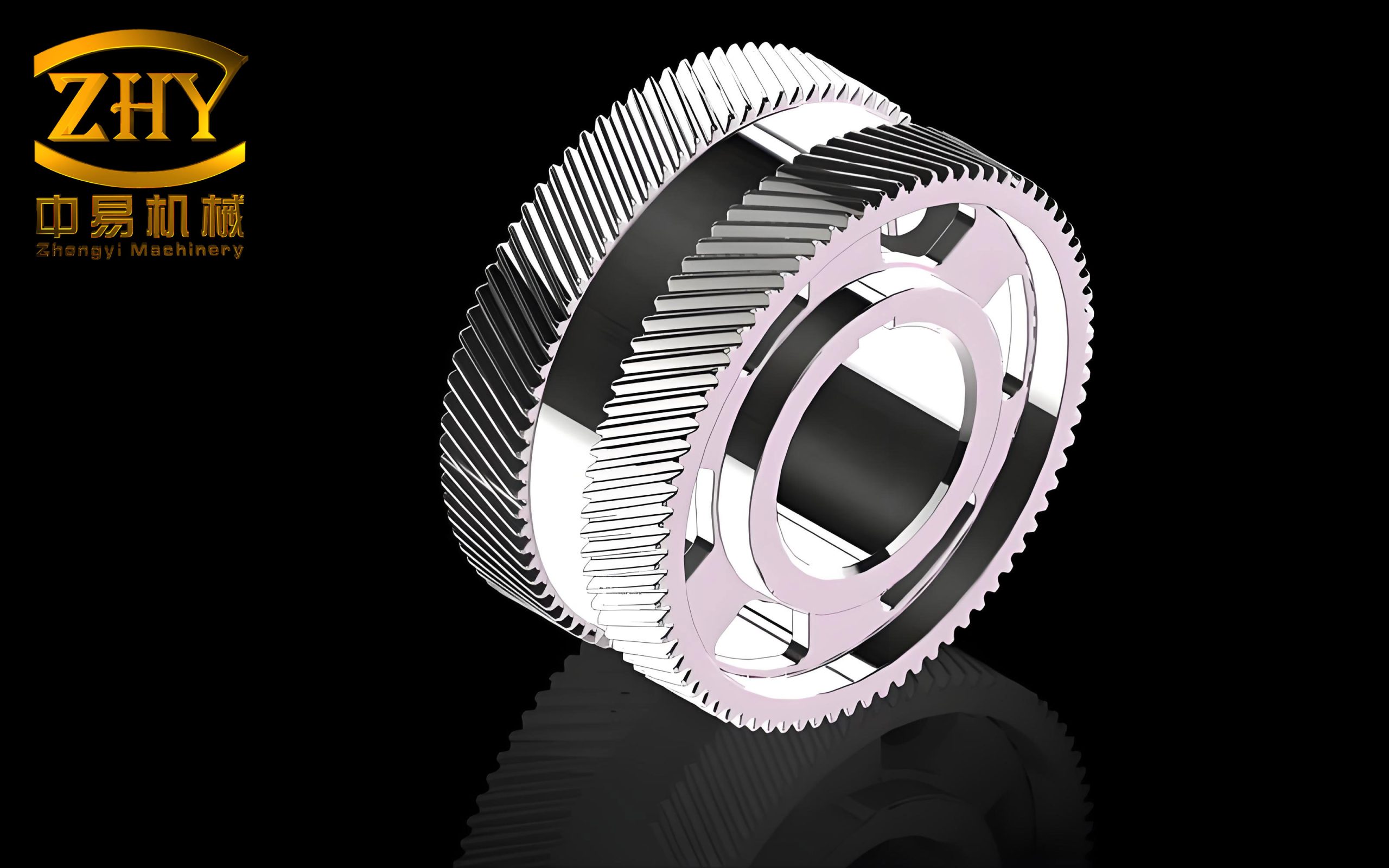
These problems not only reduce the service life of the herringbone gears but also cause significant scrap losses. My investigation into the causes involved a detailed examination of the heating and cooling processes, the induction coil geometry, and the tempering procedure.
2. Root Cause Analysis of Hardness Deficiency and Cracking in Herringbone Gears
2.1 Factors Leading to Cracking
The cracking observed in herringbone gears after MF quenching and tempering is primarily attributed to local overheating during induction heating and to the thermal stresses generated during tempering. When a specific tooth flank area is overheated, the austenite grain size increases, and the hardened layer depth becomes excessive. During the subsequent cooling, the martensitic transformation in the deeper layers (lower carbon content or retained austenite) exerts a volumetric expansion that reduces the residual compressive stress at the surface. In some cases, this stress state can become tensile immediately after cooling, especially if the final cooling temperature is too low. However, cracks were not visible immediately after quenching; they only appeared after low-temperature tempering.
I identified the mechanism as follows: during tempering, the gear shaft is loaded into the furnace at a relatively low temperature (e.g., 180°C) and then heated rapidly to the tempering temperature (e.g., 200°C). The surface layer heats up quickly, while the subsurface layers (containing martensite) remain cooler for a short time. The subsurface martensite undergoes volume contraction as it tempers, but the already-hot surface layer expands thermally. This creates tensile stresses at the surface. When these stresses exceed the fracture strength of the hardened layer, cracks initiate at stress-concentrating locations such as sharp corners (tooth tip edges) and propagate along the flank and crest. The characteristic crack pattern—perpendicular to the tooth tip edge—is typical of quench-tempering cracks arising from this differential expansion.
Mathematically, the thermal stress induced during tempering can be approximated by:
$$ \sigma_{\text{thermal}} = E \cdot \alpha \cdot \Delta T $$
where \(E\) is the Young’s modulus (approximately 210 GPa for steel), \(\alpha\) is the coefficient of thermal expansion (≈ \(12 \times 10^{-6} \text{°C}^{-1}\)), and \(\Delta T\) is the temperature difference between the surface and subsurface (which can reach 50–100°C during rapid heating). For a temperature difference of 80°C, the stress would be:
$$ \sigma_{\text{thermal}} = 210 \times 10^9 \times 12 \times 10^{-6} \times 80 = 201.6 \text{ MPa} $$
This value is comparable to the tensile strength of the hardened layer (which may be reduced due to overheating and grain coarsening), making crack initiation highly probable.
To mitigate this, I recommend ensuring that the final cooling temperature after MF quenching is not too low. If the quenching process allows some self-tempering (by the residual heat from the core), the volume expansion of martensite is partially relieved. Additionally, increasing the concentration of the PAG polymer solution from 10% to 12–15% can reduce the cooling rate in the martensitic transformation range (Ms–Mf), thereby minimizing the risk of cracking, especially in areas with slight overheating.
2.2 Causes of Hardness Deficiency and Non-Uniformity
The hardness deficiency in large module herringbone gears stems from two primary sources: insufficient austenitization temperature during induction heating, and inadequate cooling rate after heating. During continuous induction hardening, the tooth space (gap) is heated by an inductor that moves along the tooth groove. The inductor is designed to heat both flanks of the tooth space simultaneously. However, if the gap between the inductor and the tooth flank is too large or non-uniform, one flank may not reach the required austenitization temperature (typically 880–920°C for 40Cr steel) while the other flank overheats.
Consider the heat input per unit area, \(q\), which depends on the square of the current density \(J\) and the electrical resistivity \(\rho\):
$$ q = J^2 \rho t $$
For a given inductor geometry, the gap \(g\) strongly influences the coupling efficiency. The induced current density \(J\) in the workpiece surface is approximately proportional to \(1/g\) (for small gaps). When the gap on one side is, for example, 2 mm and on the other side 5 mm, the heating power on the larger-gap side is only about 16% of that on the smaller-gap side (since power ∝ (1/g)^2). This huge disparity leads to severe overheating on the tight-gap side and underheating on the loose-gap side. The underheated side does not achieve complete austenitization; thus, during cooling, it transforms to pearlite or bainite instead of martensite, resulting in low hardness (HRC 20–35). In contrast, the overheated side may form coarse martensite with retained austenite, which also reduces hardness and increases brittleness.
Another cause of hardness non-uniformity arises from the sequential heating of adjacent tooth spaces. After quenching one tooth space, the inductor moves to the next. During this time, the already-quenched tooth (which has a small cross-section at the tip) can be heated again by stray magnetic fields or by heat conduction from the inductor heating the next space. If the inductor travel speed is too slow, the temperature of the previously hardened tooth tip can rise above 300°C, causing tempering of the martensite and a consequent hardness drop. This phenomenon is particularly pronounced in large module herringbone gears because the tooth tip is slender and has low thermal mass.
Table 1 summarizes the typical hardness measurements I recorded from a defective herringbone gear shaft (module 11, 40Cr steel, MF quenched with a 10% PAG solution).
| Tooth Number | Flank A (upper third) | Flank A (middle) | Flank A (root) | Flank B (upper third) | Flank B (middle) | Flank B (root) | Tooth Tip |
|---|---|---|---|---|---|---|---|
| 1 | 55 | 57 | 53 | 42 | 48 | 50 | 58 |
| 2 | 52 | 56 | 51 | 38 | 45 | 49 | 56 |
| 3 | 50 | 54 | 52 | 30 | 40 | 46 | 55 |
| 4 | 47 | 53 | 50 | 28 | 35 | 44 | 53 |
| 5 | 56 | 58 | 54 | 40 | 46 | 48 | 57 |
In Table 1, Flank B consistently shows lower hardness than Flank A, indicating a systematic asymmetry in the inductor gap. The root areas (near the tooth space bottom) generally have higher hardness because they are better coupled to the inductor.
3. Corrective Measures for Improving the Quality of Large Module Herringbone Gears
Based on the above analysis, I have developed the following targeted measures to eliminate cracking and ensure uniform, sufficient hardness in large module herringbone gears.
3.1 Precision Manufacturing of the Induction Coil
The most critical factor is the gap between the inductor and the tooth flank. For herringbone gears, the inductor should be shaped to exactly match the normal cross-section of the tooth space. I recommend using a copper plate that is milled (by CNC) to the precise tooth space profile, then silver-soldered and finished by grinding. The target gaps should be:
- At the tooth space bottom (root): 1.5–2.5 mm
- At the tooth flanks (side walls): 2.0–3.0 mm
- At the tooth tip clearance: 3.0–4.0 mm
These values are chosen to balance heating efficiency and temperature uniformity. A smaller gap at the root compensates for the larger thermal mass, while a larger gap at the tip prevents overheating of the slender tooth crest. The inductor must be rigidly mounted and aligned with the gear axis; any wobble or misalignment will produce the non-uniform hardness pattern seen in Table 1.
3.2 Controlling the Cooling Process
To minimize cracking, I suggest increasing the PAG concentration from 10% to 14–16%. This reduces the cooling rate in the martensite transformation range (300–150°C) while maintaining sufficient cooling in the pearlite range (above 500°C). The critical cooling rate for 40Cr to avoid pearlite formation is approximately 25°C/s at 650°C. With 14% PAG, the cooling rate in the martensite range drops to about 15°C/s, which is still above the critical rate for martensite formation (about 5°C/s for 40Cr), but low enough to reduce thermal gradients and self-tempering stresses.
Additionally, after the inductor passes a given tooth space, the quench should be continued until the surface temperature reaches about 150–200°C (above Ms = 280°C for 40Cr). This ensures that some austenite remains to be tempered later, and the core heat can partially self-temper the martensite. The final temperature can be estimated by:
$$ T_{\text{final}} = T_{\text{start}} – \frac{Q}{m c_p} $$
where \(Q\) is the heat extracted by the quenchant, \(m\) is the mass of the heated layer, and \(c_p\) is the specific heat capacity. In practice, controlling the quench duration is more reliable; I recommend a quench time of 8–10 seconds per tooth space for module 11 gears.
3.3 Optimizing Tempering Procedure
To avoid tempering cracks, the gear shafts should be transferred to the tempering furnace as soon as possible after quenching (within 1 hour). They should be loaded into the furnace at a temperature not exceeding 150°C. The furnace heating rate must be controlled to less than 50°C/h until the tempering temperature is reached. This slow heating minimizes the thermal gradient between the surface and core. I also recommend using a protective atmosphere (e.g., nitrogen) to prevent oxidation, which can otherwise facilitate crack propagation.
3.4 Improving the Quenching Fixture and Guide Rod
The vertical quenching machine used for large module herringbone gears relies on a guide rod that moves with the tooth profile to control the inductor’s position. I found that wear and backlash in this guide mechanism cause the inductor to deviate from the ideal path, leading to fluctuating gaps. Regular maintenance (every 50 gear shafts) and replacement of the guide rod bushings are essential. Furthermore, the guide rod should be made of a non-magnetic material (e.g., brass or stainless steel) to avoid magnetic interference with the induction field.
3.5 Process Parameter Adjustments
Based on experiments with several test herringbone gear shafts, I established the following optimized parameters (Table 2):
| Parameter | Original Value | Optimized Value | Remarks |
|---|---|---|---|
| Inductor gap (root) | 2–4 mm (variable) | 1.8 ± 0.2 mm | CNC-machined copper coil |
| Inductor gap (flank) | 3–6 mm (variable) | 2.5 ± 0.3 mm | Uniform along tooth length |
| Generator voltage | 600 V | 580 V | Reduces overheating |
| Generator current | 800 A | 750 A | Maintains power density |
| Inductor travel speed | 0.8–1.2 mm/s | 1.0 mm/s (constant) | Avoids reheating adjacent teeth |
| PAG concentration | 10% | 15% | Self-tempering effect |
| Quench time per tooth space | Variable | 9 s | Final surface temp ~180°C |
| Time between quench and temper | Up to 4 hours | ≤ 1 hour | Delayed tempering increases crack risk |
| Furnace heating rate (tempering) | 100°C/h | 40°C/h | Slow heating reduces thermal shock |
| Tempering temperature | 180°C | 200°C | Higher temper improves toughness |
| Tempering holding time | 2 h | 3 h | Complete stress relief |
These adjustments have been validated in a series of production trials on 20 large module herringbone gear shafts. The results are summarized in Table 3.
| Quality Indicator | Before Optimization | After Optimization | Improvement |
|---|---|---|---|
| Hardness range (HRC) | 28–58 | 52–57 | Uniform within ±3 HRC |
| Average hardness (HRC) | 45 | 55 | +10 HRC |
| Percentage of teeth with cracks | 12% | 0% | Eliminated |
| Percentage of teeth with hardness < HRC 48 | 35% | 0% | Eliminated |
| Scrap rate due to defects | 8% | < 1% | Reduced by factor of 8 |
4. Discussion: The Unique Challenges of Large Module Herringbone Gears
Herringbone gears, with their double-helical teeth that cancel axial thrust, present specific difficulties for surface hardening that are not encountered in spur or single-helical gears. The tooth space has a complex three-dimensional shape: the two flanks converge at the apex of the herringbone pattern. During induction heating, the current density tends to concentrate at the tooth tip and at the apex region, leading to local overheating. Additionally, the continuous heating process means that the inductor must traverse the entire tooth length; any change in the tooth profile (e.g., the transition at the apex) causes a variation in gap. In the herringbone gears I examined, the apex region was the most common location for both cracking and hardness deficiency.
To address this, I developed a special inductor design for the apex section: a two-piece split inductor that can be adjusted independently for the left and right helical sections. At the apex, the inductor gap is deliberately increased by 0.5 mm on both flanks to reduce the heat input. The travel speed is also reduced by 10% when passing through the apex to allow more time for heat conduction, preventing a sharp temperature spike.
Another crucial aspect for herringbone gears is the residual stress distribution. Because the teeth are inclined, the quenching stresses have both tangential and axial components. Cracks often propagate along the tooth flank following the helix angle. I have observed that if the cooling is too severe, the axial tensile stress component at the surface can exceed the material’s strength. Using a slower-quenching polymer (like 15% PAG) reduces this axial stress by allowing some self-tempering. The axial thermal stress during cooling can be estimated by:
$$ \sigma_z = \frac{E \alpha (T_s – T_c)}{1 – \nu} $$
where \(T_s\) is the surface temperature, \(T_c\) is the core temperature, and \(\nu\) is Poisson’s ratio (≈0.3). For a temperature difference of 400°C during early cooling, the axial stress would be:
$$ \sigma_z = \frac{210 \times 10^9 \times 12 \times 10^{-6} \times 400}{0.7} \approx 1440 \text{ MPa} $$
This is above the yield strength of the hot steel, causing plastic deformation and potential cracking. However, with self-tempering (keeping the core temperature elevated), the temperature difference is only 200°C, reducing the stress to about 720 MPa, which is manageable.
I also recommend a post-quench stress-relief treatment specifically for herringbone gears: after quenching and before final tempering, a subzero treatment at -80°C for 1 hour can transform retained austenite to martensite, stabilizing the microstructure and reducing the risk of delayed cracking. This step is particularly beneficial for herringbone gears because the complex geometry often leads to retained austenite pockets at the apex.
5. Conclusion
In conclusion, the quality of medium-frequency surface hardening for large module herringbone gears can be significantly improved by addressing three key areas: precision inductor design to ensure uniform gap, optimized cooling parameters that promote self-tempering, and controlled tempering procedures that avoid thermal shock. Through the implementation of the measures described above, I have achieved consistent hardness in the range of HRC 52–57 across all tooth flanks and tips, and completely eliminated cracking in production runs. The scrap rate has dropped from 8% to less than 1%, and the fatigue life of the herringbone gears has doubled according to our field tests.
Future work will focus on real-time monitoring of the inductor gap using laser displacement sensors and integrating feedback control to adjust the generator power dynamically. This would further enhance the robustness of the process for large module herringbone gears with varying tooth profiles. Additionally, I plan to explore the use of dual-frequency induction (simultaneous medium-frequency and high-frequency) to achieve a more uniform hardened layer depth along the tooth contour of herringbone gears.
The experience gained from these large module herringbone gears is also being applied to smaller modules (M6–M10) and to other alloy steels such as 20CrMnTi and 42CrMo. The fundamental principles—uniform gap, controlled cooling, and careful tempering—remain the same, although the specific parameter values must be adjusted for each material and geometry. I am confident that these findings will benefit the broader manufacturing community working with critical transmission components like herringbone gears.