
In the context of modern industrial production, where demands for product precision, cost-effectiveness, and service performance are continuously escalating, the manufacturing of large-module gears for agricultural machinery like rotavators has undergone significant material evolution. The transition from early low-alloy steels to advanced high-alloy steels such as 18Cr2Ni4WA represents a critical response to the need for enhanced durability and reliability. My investigation was prompted by the recurring failures—specifically localized tooth breakage and surface wear—observed in large-module rotavator gears manufactured from 18Cr2Ni4WA steel. The core of the problem, I hypothesized, lay not in the material’s inherent potential but in its heat treatment process. Improper thermal processing can lead to various detrimental heat treatment defects including excessive retained austenite, insufficient core toughness, and non-optimal carbide distribution, all of which directly compromise gear life. Therefore, this study delves into a systematic examination of the heat treatment process for 18Cr2Ni4WA steel, focusing on the profound influence of carburizing parameters, quenching temperature, cooling methods, and tempering cycles on its final microstructure and mechanical properties. The ultimate goal is to formulate an optimized, defect-mitigating thermal protocol that ensures surface hardness and wear resistance are perfectly balanced with core strength and toughness.
1. Foundational Analysis: Material and Transformation Characteristics
The successful design of a heat treatment process is fundamentally rooted in a deep understanding of the material’s phase transformation behavior. My work commenced with a thorough characterization of the 18Cr2Ni4WA steel used in production. The chemical composition of the steel prior to any treatment is presented in Table 1. This alloy, with its significant nickel and chromium content, is renowned for its hardenability and strength.
| Element | C | Cr | Ni | W | Si |
|---|---|---|---|---|---|
| Content (wt.%) | 0.175 | 1.564 | 4.119 | 0.992 | 0.375 |
The most critical tool for predicting microstructural outcomes is the Time-Temperature-Transformation (TTT) diagram. I experimentally determined the phase transformation critical points and constructed the TTT curves for the steel both before and after carburizing. The key transformation temperatures in the non-carburized state are listed in Table 2.
| Critical Point | Ac1 | Ac3 | Ms | Mf |
|---|---|---|---|---|
| Temperature (°C) | 700 | 805 | 312 | 251 |
The analysis of the TTT curves, shown schematically, revealed several pivotal insights that guide the entire heat treatment strategy and help avert potential heat treatment defects:
- Hardenability and Stability: In its non-carburized state, the isothermal transformation above the Ms line is dominated by bainite formation. After carburization, the enriched surface layer exhibits a TTT curve shifted significantly to the right, indicating a much longer incubation period and greatly enhanced stability of the undercooled austenite. This high stability is a double-edged sword; it ensures deep hardenability but also makes the austenite resistant to complete transformation to martensite upon quenching, leading to high levels of retained austenite—a primary heat treatment defect that softens the surface.
- Depressed Transformation Temperatures: The carburized layer has a notably lower Ac1 point (approximately 650°C) and a drastically reduced Ms temperature (around 90°C). This low Ms means conventional quenching will leave a substantial fraction of austenite untransformed at room temperature.
- Processing Flexibility: The steel’s excellent hardenability allows it to be used in a quenched and tempered condition or, as required for gears, in a carburized, quenched, and tempered condition to achieve an exceptional combination of strength and toughness.
The relationship between alloy content (C, Cr, Ni), austenite stability, and Ms can be approximated by empirical formulas like the following, highlighting why high-alloy steels are prone to the heat treatment defect of retained austenite:
$$ M_s(°C) \approx 539 – 423C – 30.4Mn – 17.7Ni – 12.1Cr – 7.5Mo $$
For a carburized case with ~0.8% C, the calculated Ms is very low, confirming the experimental observation.
2. Systematic Process Investigation and Defect Mitigation
The target component was a large-module gear (module 4.5 mm) with the following technical requirements: case hardening depth (CHD) of 0.8-1.0 mm, surface hardness of 58-62 HRC, and core hardness of 32-40 HRC. A flawed process would inevitably lead to heat treatment defects such as shallow case depth, low surface hardness, or a brittle core. My investigation proceeded stepwise.
2.1. Forging Stock Preparation Heat Treatment
The high hardenability of 18Cr2Ni4WA makes it susceptible to forming bainitic structures during ordinary normalizing. Bainite, being relatively hard, impairs machinability, which is itself a precursor to manufacturing issues that can be exacerbated during final heat treatment. To eliminate forging stresses, homogenize the microstructure, adjust hardness for machinability, and prepare a suitable foundation for subsequent carburizing, a combined process of normalizing followed by high-temperature tempering was adopted. This pre-treatment yields a microstructure of tempered sorbite with a hardness range of 190-260 HBS, effectively avoiding the early-stage heat treatment defect of poor machinability. The thermal cycle is defined as:
$$ \text{Normalize: } 950°C \times t_1 \rightarrow \text{Air Cool} $$
$$ \text{Temper: } 650°C \times t_2 \rightarrow \text{Air Cool} $$
where t1 and t2 are times dependent on part section size.
2.2. Carburizing Process
To minimize grain growth, distortion, and excessive intergranular oxidation—all classic heat treatment defects—a relatively low carburizing temperature was selected. Precise control of the carburizing atmosphere (via drip feed rates) was maintained to achieve the desired carbon profile without sooting or erratic case depth. A direct quench from the carburizing temperature was avoided to prevent excessive thermal stress and cracking. The process followed a boost-diffuse cycle:
$$ \text{Heat to } 930°C \text{ under carrier gas} $$
$$ \text{Boost at } 930°C \text{ (High potential)} \times \tau_b $$
$$ \text{Diffuse at } 930°C \text{ (Lower potential)} \times \tau_d $$
$$ \text{Slow Cool / Furnace Cool} $$
The resulting case depth was measured, and surface hardness after this stage was 58-60 HRC, but with a significant amount of retained austenite.
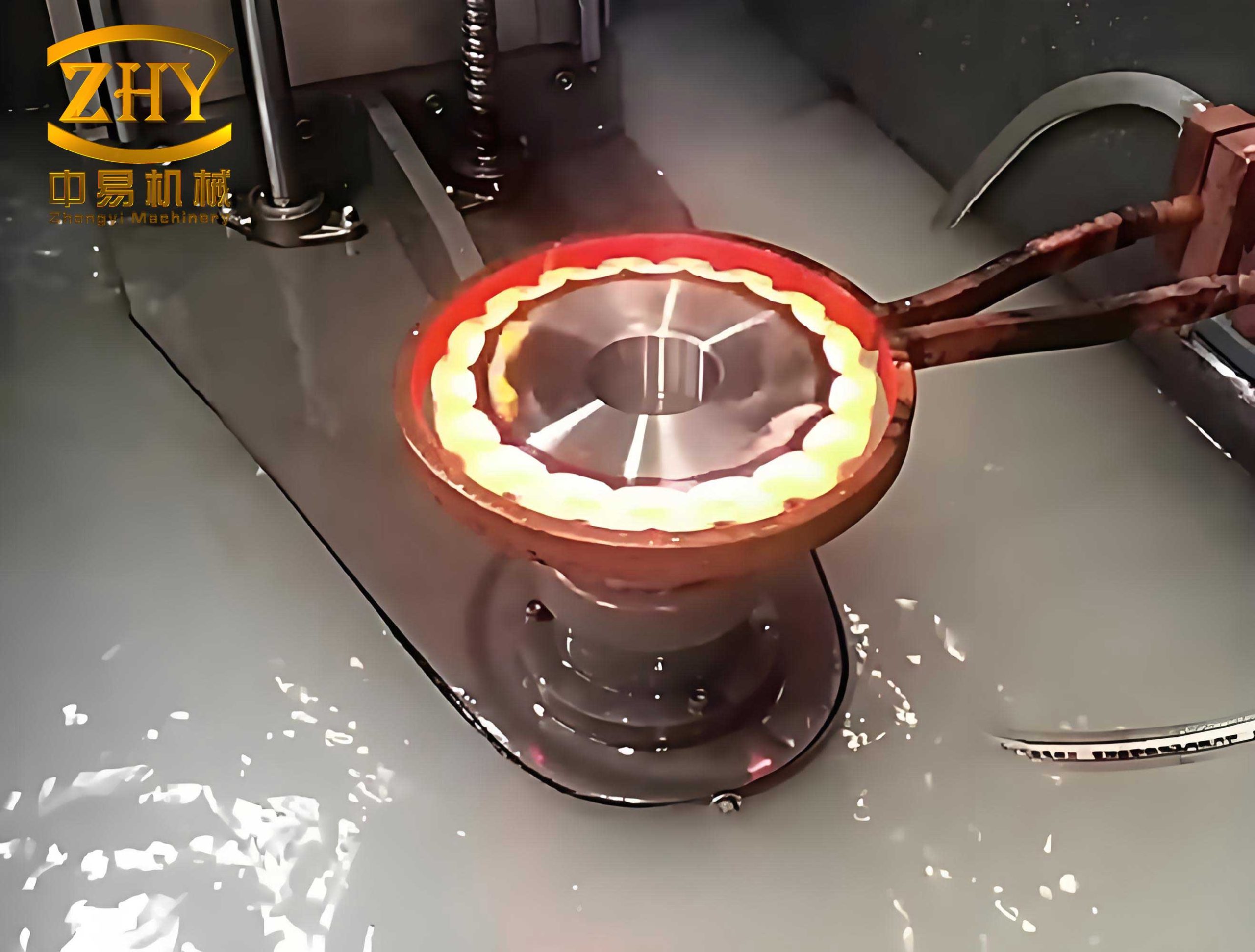
2.3. Post-Carburizing Composite Heat Treatment
This stage is the most critical for eliminating heat treatment defects and achieving the target properties. The as-carburized microstructure contains highly alloyed austenite. Direct reheating and quenching would preserve this stability, resulting in unacceptably high levels of soft retained austenite in the final product. To combat this, a multi-stage composite treatment was developed: Double High-Temperature Tempering → Double Quenching → Double Cryogenic Treatment → Low-Temperature Tempering.
a) Double High-Temperature Tempering: The carburized parts are subjected to two cycles of tempering at 650°C for 4.5 hours each. This process serves to precipitate fine, globular alloy carbides from the supersaturated austenite and high-carbon martensite formed during cooling from carburizing. The precipitation is governed by diffusion kinetics, approximately following the relation for particle growth:
$$ r^3 – r_0^3 = k D_0 t \exp\left(-\frac{Q}{RT}\right) $$
where \( r \) is the particle radius, \( k \) is a constant, \( D_0 \) is the diffusion pre-factor, \( Q \) is the activation energy, \( R \) is the gas constant, and \( T \) is the absolute temperature. This precipitation depletes the carbon and alloy content in the austenite matrix, thereby reducing its stability and lowering the effective Ms temperature for the subsequent quench. This is a proactive step to neutralize the heat treatment defect of retained austenite.
b) Double Quenching: After tempering, the parts are heated to 860°C (above the Ac1 of the case but below the original carburizing temperature to limit grain growth) and quenched in oil. This double austenitization ensures a more complete dissolution of the fine carbides into a less stable, lower-carbon austenite, which then transforms more completely to martensite upon quenching. The first quench after tempering establishes a martensitic matrix, and the second refines the structure further.
c) Double Cryogenic Treatment: Despite the prior steps, some stable austenite remains. To force its transformation, a deep cryogenic treatment at -115°C is performed twice. At this sub-zero temperature, the driving force for the martensitic transformation \( (\Delta G^{\gamma \to \alpha’}) \) increases sufficiently to initiate further transformation. Additionally, the cryogenic treatment promotes the precipitation of fine, dispersed eta-carbides from the supersaturated martensite, enhancing secondary hardening. The effectiveness of this step in eliminating the heat treatment defect of retained austenite is quantitatively shown in Table 3.
| Processing State | Before Cryo | After Double Cryo | After Final Low-Temp Temper |
|---|---|---|---|
| Surface Hardness (HRC) | 58 – 60 | 60 – 62 | 58 – 61 (Stable) |
| Retained Austenite (Vol.%) | ~29.6 | ~11.1 | <10 |
d) Low-Temperature Tempering: Finally, a temper at 160°C is conducted to relieve quenching stresses, temper the fresh martensite (both from the quench and the cryogenic treatment), and improve toughness without significantly reducing hardness. This step stabilizes the microstructure and prevents the heat treatment defect of untempered, brittle martensite.
The complete optimized composite heat treatment cycle can be summarized by the following sequence of steps and their thermodynamic/kinetic purposes:
1. T1: 650°C x 4.5h (Precipitate carbides, destabilize austenite)
2. Q1: 860°C → Oil Quench (Form initial martensite)
3. T2: 650°C x 4.5h (Temper martensite, further precipitate)
4. Q2: 860°C → Oil Quench (Refine austenite, form final martensite)
5. C1: -115°C (Transform retained austenite, initiate carbide precipitation)
6. C2: -115°C (Complete transformation and precipitation)
7. T3: 160°C x 2-3h (Stress relieve, temper martensite)
3. Results and Microstructural Verification
The efficacy of the optimized process in preventing heat treatment defects was confirmed through metallographic examination and hardness profiling. The measured case hardening depth averaged 0.87 mm, perfectly within the specified 0.8-1.0 mm range. Microstructural analysis revealed:
- Case Microstructure: A fine, needle-like tempered martensite matrix with a minimal amount of retained austenite (verified by Table 3) and a uniform dispersion of globular alloy carbide particles. This structure is the hallmark of high hardness and superior wear resistance, free from the heat treatment defect of excessive soft austenite or coarse, brittle carbides.
- Core Microstructure: A tough, lath-like low-carbon tempered martensite. This provides the necessary strength and fracture toughness to support the hard case, preventing the heat treatment defect of core brittleness or insufficient load-bearing capacity.
The final hardness gradient from surface to core met all specifications, demonstrating that the interdependent heat treatment defects of low surface hardness and improper core strength were simultaneously resolved.
4. Conclusion and Process Rationale
Through this comprehensive investigation, I have established a robust, multi-stage heat treatment protocol for 18Cr2Ni4WA steel large-module gears that systematically addresses and eliminates the chain of potential heat treatment defects. The process logic is summarized below:
| Process Stage | Key Parameters | Metallurgical Objective | Heat Treatment Defect Mitigated |
|---|---|---|---|
| Preparation | Normalize (950°C) + High-Temp Temper (650°C) | Produce soft, machinable sorbite; refine grain. | Poor machinability; residual forging stress. |
| Carburizing | Lower Temperature (930°C); Controlled Atmosphere | Achieve required case depth with minimal distortion. | Excessive grain growth; erratic carbon profile. |
| Double High-Temp Temper | 2 x (650°C, 4.5h) | Precipitate carbides to destabilize austenite. | Excessive retained austenite (primary defect). |
| Double Quenching | 2 x (860°C → Oil Quench) | Form fine, high-hardness martensite. | Incomplete hardening; coarse microstructure. |
| Double Cryogenic Treatment | 2 x (-115°C) | Transform residual austenite; precipitate fine carbides. | Residual soft austenite; insufficient secondary hardening. |
| Low-Temp Tempering | 160°C for 2-3h | Relieve stress, improve toughness, stabilize dimensions. | Brittle, untempered martensite; dimensional instability. |
The success of this regimen is rooted in its sequential attack on the factors that cause heat treatment defects. It first conditions the austenite to be less stable, then transforms it as completely as possible through repeated thermal and sub-zero cycles, and finally tempers the resulting martensite to achieve a stable, high-performance gradient microstructure. The final gear exhibits a hard, wear-resistant case (58-61 HRC) composed of tempered martensite with finely dispersed carbides and a tough, strong core of low-carbon tempered martensite. This balance ensures reliable performance under the demanding conditions of rotavator operation, effectively solving the initial problems of tooth breakage and wear by eradicating their root cause: a flawed thermal history prone to critical heat treatment defects.