
The reliable and precise transmission of motion and power in machinery fundamentally relies on gear systems. Among these, cylindrical gears represent one of the most prevalent and well-understood types. The performance of these cylindrical gears, including aspects like backlash, noise, and load distribution, is critically dependent on the accurate control of tooth thickness and its permissible variations during manufacturing. In the design, machining, and inspection phases of cylindrical gears, three primary parameters are employed to quantify and control tooth thickness: the constant chord tooth thickness, the base tangent length (commonly known as the span measurement over a number of teeth), and the measurement over pins or balls (M value).
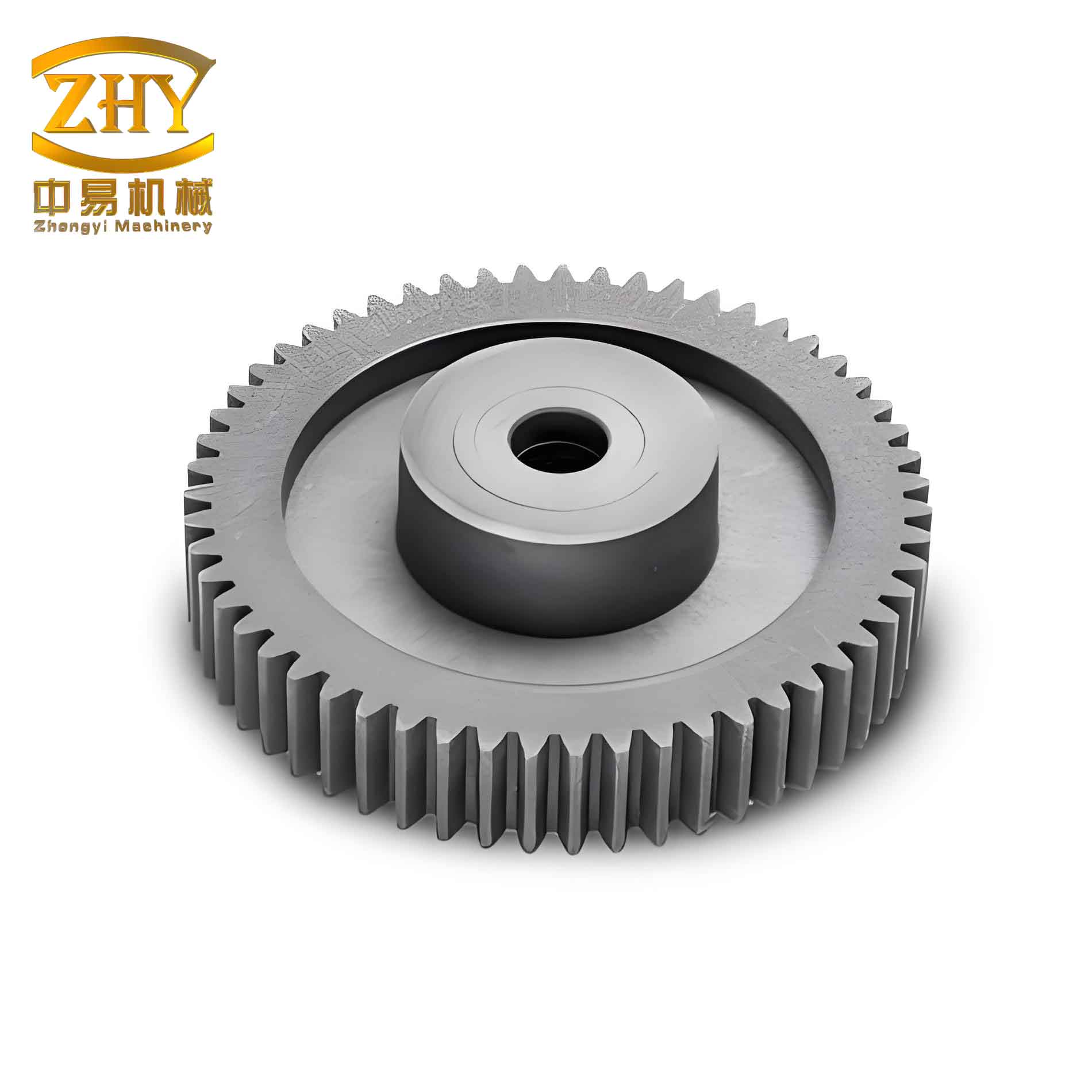
While standards and handbooks provide formulas for calculating the nominal values of these parameters, a significant practical challenge arises in coordinating their respective tolerances. Often, a tolerance is specified for one parameter (e.g., constant chord thickness), but verification in production or design cross-checking requires knowledge of the equivalent tolerance limits for the other two parameters. This necessitates a clear understanding of the increment relationships—how a small change in one tooth thickness parameter correlates to changes in the others. This article provides a comprehensive derivation and consolidation of these relationships for standard, non-profile-shifted spur cylindrical gears, culminating in practical charts and examples to facilitate engineering applications.
1. The Three Principal Tooth Thickness Measurement Methods
1.1 Measurement of Constant Chord Tooth Thickness (Sx)
The constant chord tooth thickness is defined as the chord length between two contact points when a standard basic rack tooth profile is symmetrically tangent to the gear tooth flanks. The corresponding height from this chord to the tooth tip is the constant chord tooth height (hx). For a standard cylindrical gear, these are calculated as:
$$S_x = \frac{\pi m}{2} \cos^2 \alpha_f$$
$$h_x = h_e – \frac{\pi m}{8} \sin 2\alpha_f – (R_e – R_{e’})$$
where \(m\) is the module, \(\alpha_f\) is the standard pressure angle at the reference pitch circle, \(h_e\) is the addendum, \(R_e\) is the theoretical tip radius, and \(R_{e’}\) is the actual measured tip radius. The term \((R_e – R_{e’})\) accounts for the influence of tip diameter tolerance on the measurement height.
A key feature of this method is that \(S_x\) is independent of the number of teeth \(z\). Common tools include gear tooth calipers and dedicated chordal thickness gauges. However, its accuracy is susceptible to errors in tooth alignment (tangential error), radial runout, and the accuracy of the tip diameter itself. Consequently, it is generally recommended for cylindrical gears of quality grade 7 or lower per ISO 1328-1, especially for modules greater than 1 mm.
1.2 Measurement of Base Tangent Length (Wk)
This method involves measuring the distance between two parallel planes that are tangent to opposite tooth flanks on a base circle tangent. The measured value \(W_k\) for a span over \(k\) teeth is given by:
$$W_k = m \cos \alpha_f [ (k – 0.5)\pi + z \cdot \text{inv}(\alpha_f) ]$$
where the number of teeth spanned, \(k\), is typically calculated as \(k = \frac{\alpha_f z}{180^\circ} + 0.5\), rounded to the nearest integer, and \(\text{inv}(\alpha_f) = \tan \alpha_f – \alpha_f\) (in radians) is the involute function.
The significant advantage of this method is its insensitivity to errors in the tip diameter. Furthermore, the availability of precise micrometers with resolutions of 0.01 mm or better makes it suitable for higher precision cylindrical gears, typically grade 7 and above, with modules down to about 0.5 mm.
1.3 Measurement Over Pins or Balls (M value)
This is an indirect method where precision pins or balls of diameter \(d_p\) are placed in opposite tooth spaces, and the distance \(M\) across their outer surfaces is measured. For an even number of teeth, the pins contact opposite spaces directly; for an odd number, the measurement is offset. The fundamental equations are:
For even \(z\): $$M = D_x + d_p$$
For odd \(z\): $$M = D_x \cos\frac{90^\circ}{z} + d_p$$
Here, \(D_x\) is the diameter of the circle passing through the pin centers. The pin diameter \(d_p\) and the involute pressure angle \(\alpha_x\) at the pin center are derived from solving the following transcendental equation, which ensures the pin contacts the flank at a specific desired point (often near the pitch circle):
$$d_p = \frac{\pi m \cos \alpha_f}{\text{inv}(\alpha_x) – \text{inv}(\alpha_f) + \frac{\pi}{2z}}$$
and
$$D_x = \frac{m z \cos \alpha_f}{\cos \alpha_x}$$
Although computationally more intensive, the M-value method offers distinct advantages for precision cylindrical gears: 1) It is excellent for small-module gears (m < 1 mm). 2) It is highly insensitive to tip diameter errors and gear runout. 3) It has a high sensitivity to tooth thickness variation, as a small change in tooth thickness produces a magnified change in the M value (\(\Delta M > \Delta S_x\)), making it ideal for applications requiring very tight backlash control.
2. Mathematical Derivation of Increment Relationships
The core objective is to establish the linear relationships between small deviations (increments or tolerances) of the three parameters: \(\Delta S_x\), \(\Delta W_k\), and \(\Delta M\). These relationships are crucial for tolerance conversion.
2.1 Relationship Between \(\Delta W_k\) and \(\Delta S_x\)
Consider a small increase \(\Delta S_x\) in the constant chord thickness. This increase, projected onto the direction normal to the tooth flank (which is the direction of the \(W_k\) measurement), yields the corresponding increase in base tangent length \(\Delta W_k\). From the geometry of the pressure angle at the approximate point of contact:
$$\Delta W_k = \Delta S_x \cdot \cos \alpha_f$$
This is an approximate but highly accurate relationship for standard cylindrical gears.
2.2 Relationship Between \(\Delta M\) and \(\Delta W_k\)
The analysis considers how a change \(\Delta W_k/2\) on each flank affects the pin contact point and thus the overall M dimension. For a cylindrical gear with an even number of teeth, the geometric relationship leads to:
$$\Delta M = \frac{\Delta W_k}{\sin \alpha_x}$$
For a cylindrical gear with an odd number of teeth, an additional cosine factor accounts for the angular offset of the measurement plane:
$$\Delta M = \frac{\Delta W_k}{\sin \alpha_x} \cdot \cos\frac{90^\circ}{z}$$
In these equations, \(\alpha_x\) is the pressure angle at the pin center. For practical estimation, especially when the pin contacts near the pitch circle, one can approximate \(\alpha_x \approx \alpha_f + \frac{90^\circ}{z}\) (in degrees, converted to radians for calculation).
2.3 Relationship Between \(\Delta M\) and \(\Delta S_x\)
Combining the two previous relationships provides a direct link between \(\Delta M\) and \(\Delta S_x\). Substituting \(\Delta W_k = \Delta S_x \cdot \cos \alpha_f\) into the equations for \(\Delta M\) yields:
For even \(z\): $$\Delta M = \frac{\Delta S_x \cdot \cos \alpha_f}{\sin \alpha_x}$$
For odd \(z\): $$\Delta M = \frac{\Delta S_x \cdot \cos \alpha_f}{\sin \alpha_x} \cdot \cos\frac{90^\circ}{z}$$
A widely used and simple approximation for quick estimates is:
$$\Delta M \approx \Delta S_x \cdot \cot \alpha_f$$
3. Consolidated Increment Ratio Tables and Application Charts
Based on the derived formulas, the ratios between the increments can be tabulated for common pressure angles. The following tables provide these ratios, which are essential conversion factors.
3.1 Fundamental Ratio: \(\Delta W_k / \Delta S_x\)
| Pressure Angle \(\alpha_f\) | \(\Delta W_k / \Delta S_x\) | \(\Delta S_x / \Delta W_k\) |
|---|---|---|
| 20° | 0.9397 | 1.064 |
| 15° | 0.9659 | 1.035 |
| 14.5° | 0.9681 | 1.033 |
3.2 Ratio of \(\Delta M\) to \(\Delta W_k\) for Cylindrical Gears
The following tables show how the ratio \(\Delta M / \Delta W_k\) varies with the number of teeth \(z\) and pressure angle \(\alpha_f\). Note that for a large number of teeth, the ratio for odd and even teeth converges, and the effect of the \(\cos(90^\circ/z)\) term becomes negligible.
| \(\alpha_f\) | Number of Teeth (z) | |||||
|---|---|---|---|---|---|---|
| 8 | 16 | 30 | 90 | 180 | →∞ | |
| 20° | 1.93 | 2.31 | 2.56 | 2.79 | 2.86 | 2.92 |
| 15° | 2.26 | 2.84 | 3.24 | 3.63 | 3.73 | 3.86 |
| 14.5° | 2.30 | 2.91 | 3.33 | 3.74 | 3.86 | 3.99 |
| \(\alpha_f\) | Number of Teeth (z) | |||||
|---|---|---|---|---|---|---|
| 9 | 15 | 29 | 45 | 179 | →∞ | |
| 20° | 1.97 | 2.27 | 2.54 | 2.67 | 2.85 | 2.92 |
| 15° | 2.33 | 2.78 | 3.21 | 3.42 | 3.74 | 3.86 |
| 14.5° | 2.37 | 2.84 | 3.30 | 3.52 | 3.86 | 3.99 |
3.3 Ratio of \(\Delta M\) to \(\Delta S_x\) for Cylindrical Gears
Combining the ratios from the previous sections gives the direct conversion from constant chord thickness variation to M value variation. This ratio is simply the product of the previous two: \((\Delta M / \Delta W_k) \times (\Delta W_k / \Delta S_x) = (\Delta M / \Delta S_x)\). The approximation \(\Delta M / \Delta S_x \approx \cot \alpha_f\) gives 2.747 for 20°, 3.732 for 15°, and 3.867 for 14.5°, which aligns with the large-z limits in the tables below.
| \(\alpha_f\) | Number of Teeth (z) | |||||
|---|---|---|---|---|---|---|
| 8 | 16 | 30 | 90 | 180 | →∞ | |
| 20° | 1.81 | 2.17 | 2.41 | 2.62 | 2.69 | 2.74 |
| 15° | 2.18 | 2.74 | 3.13 | 3.51 | 3.61 | 3.73 |
| 14.5° | 2.23 | 2.82 | 3.22 | 3.62 | 3.74 | 3.86 |
4. Practical Engineering Application of the Relationships
The derived relationships and the implied charts (which can be plotted from the table data) are powerful tools for design and manufacturing engineers working with cylindrical gears. Two primary applications are outlined below.
4.1 Tolerance Conversion for Drawing Specifications
Scenario: A drawing for a standard cylindrical gear specifies limits on the constant chord tooth thickness. The quality control department plans to inspect the batch using a gear micrometer for base tangent length, while the engineering team needs to specify a GO/NO-GO pin gauge limit for a quick final inspection.
Given: \(\alpha_f = 20^\circ\), \(z = 30\), \(S_x = -0.020 / -0.065 \text{ mm}\).
Find: Equivalent tolerances for \(W_k\) and \(M\).
Solution using ratios (from tables for z=30):
1. For \(W_k\): \(\Delta W_k / \Delta S_x = 0.9397\). Therefore:
Upper deviation: \(-0.020 \times 0.9397 = -0.0188 \approx -0.019 \text{ mm}\).
Lower deviation: \(-0.065 \times 0.9397 = -0.0611 \approx -0.061 \text{ mm}\).
So, \(W_k = -0.019 / -0.061 \text{ mm}\).
2. For \(M\) (even z=30): \(\Delta M / \Delta S_x \approx 2.41\). Therefore:
Upper deviation: \(-0.020 \times 2.41 = -0.0482 \approx -0.048 \text{ mm}\).
Lower deviation: \(-0.065 \times 2.41 = -0.1567 \approx -0.157 \text{ mm}\).
So, \(M = -0.048 / -0.157 \text{ mm}\). (Note: Slight variations occur based on the exact calculation of \(\alpha_x\)).
4.2 Machining Allowance Calculation During Grinding
Scenario: A precision cylindrical gear is being finish-ground. The operator stops the process to perform an intermediate M-value check to avoid over-grinding.
Given: \(\alpha_f = 14.5^\circ\), \(z = 25\) (odd), Current \(\Delta M\) measured from final target = \(+0.031 \text{ mm}\) (i.e., material left to remove).
Find: The approximate remaining stock allowance on the tooth flank in the normal direction (\(\Delta W_k\)), which relates directly to the grinding wheel infe.
Solution: For an odd-tooth gear with z=25 and \(\alpha_f=14.5^\circ\), the ratio \(\Delta M / \Delta W_k\) is approximately 3.25 (interpolated from Table 2 data).
Therefore, \(\Delta W_k = \Delta M / 3.25 = 0.031 / 3.25 \approx 0.00954 \text{ mm}\).
This means there is roughly 9.5 µm of material left to be removed in the tooth thickness/normal direction. This precise information allows for optimal control of the final grinding pass.
5. Conclusion
Effective control of tooth thickness is paramount in the manufacturing of high-quality cylindrical gears. The three common inspection parameters—constant chord thickness, base tangent length, and measurement over pins—each have their own advantages and ideal applications. The key to their interchangeable use in design and quality control lies in a firm grasp of their mutual increment relationships. This article has systematically derived the mathematical foundations for these relationships, \(\Delta W_k = \Delta S_x \cos \alpha_f\) and \(\Delta M = \Delta W_k / \sin \alpha_x\), and provided consolidated tables of conversion ratios for the most common pressure angles. By applying these relationships or the corresponding engineering charts, practitioners can seamlessly convert tolerances and allowances from one parameter to another, ensuring consistency across design documents, machining instructions, and inspection reports. This capability enhances efficiency, reduces errors, and contributes to the production of more reliable and precise cylindrical gears.