
In my extensive experience within precision machinery maintenance and repair, I have frequently encountered the critical role played by miter gears in transmitting motion between intersecting shafts. Miter gears, a specific type of straight bevel gear with a shaft angle of 90 degrees, are ubiquitous in various mechanical systems, from industrial machine tools to automotive differentials. The accurate machining and installation of these miter gears are paramount for ensuring optimal performance, minimal noise, and extended service life. One of the most challenging aspects in the repair or small-batch production of miter gears, especially in facilities lacking specialized gear manufacturing divisions, is the precise measurement of key geometric parameters. This article details a practical, indirect measurement methodology I developed to accurately determine the support end distance—a crucial dimension affecting the installation position—using common universal measuring tools.
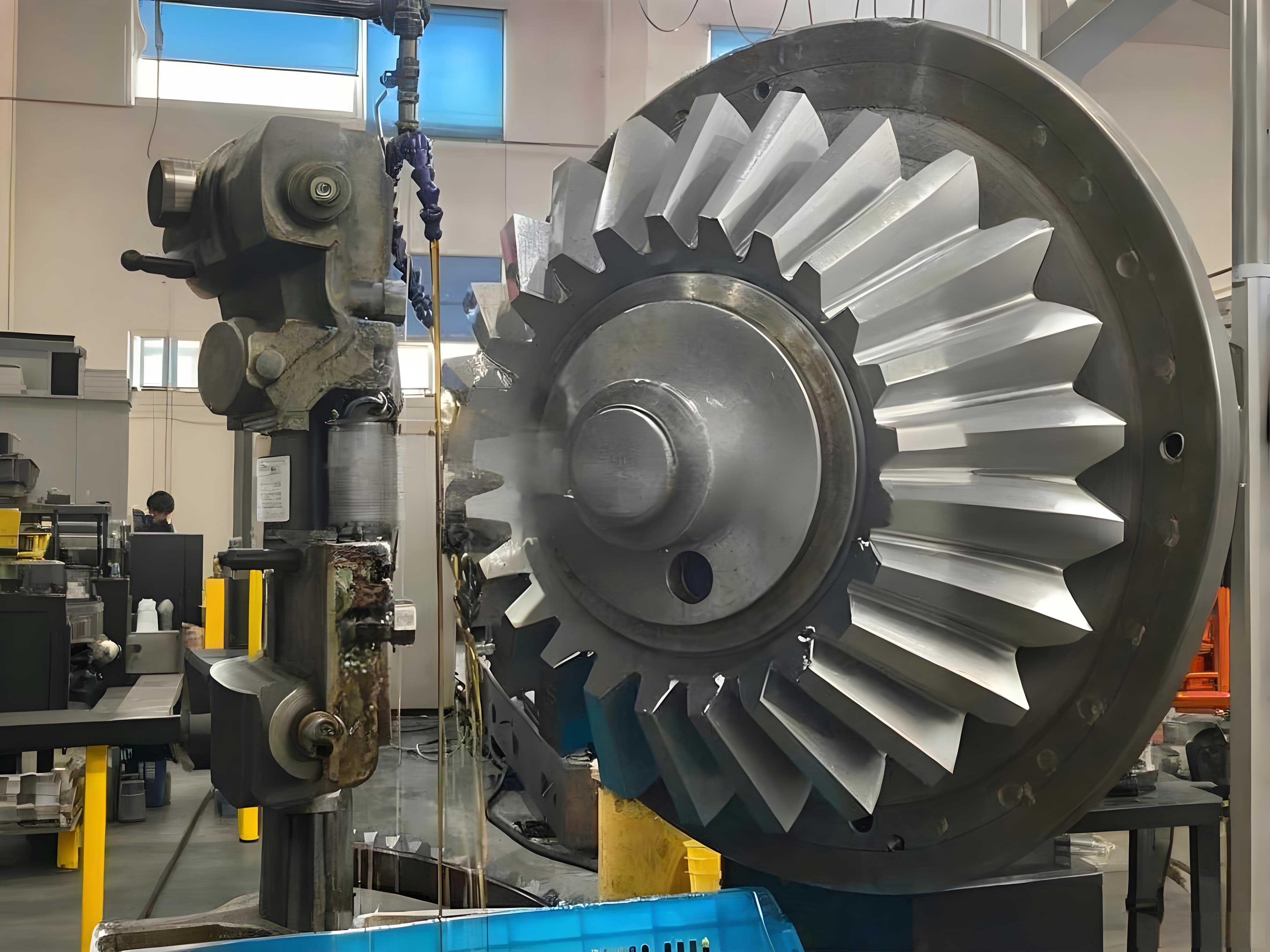
The fundamental geometry of miter gears involves several key dimensions: the pitch cone, face cone (or addendum cone), root cone, and back cone. The support end distance, often denoted as \( S_e \), is defined as the axial distance from the intersection point of the face cone (top cone) and the back cone to the supporting end face of the gear blank. This dimension directly influences the installation distance \( A \), which is the axial location of the gear relative to a datum when mounted on its shaft. An inaccurate \( S_e \) leads to an incorrect installation distance, causing misalignment, improper tooth contact patterns, interference during meshing, increased backlash, and ultimately, reduced transmission accuracy and premature failure. In standard production environments, dedicated fixtures and gear measuring instruments are used. However, in repair workshops or for one-off parts, such specialized equipment is often unavailable. Relying solely on vernier calipers or height gauges for direct measurement of \( S_e \) on miter gears proves highly inaccurate due to the difficulty in precisely locating the theoretical intersection point of the cones on the physical gear.
The core problem I aimed to solve was this measurement inaccuracy. The challenge is particularly acute for miter gears salvaged from imported precision machine tools, where original drawings might be unavailable, and the gears must be reverse-engineered and repaired. The traditional approach of using a height gauge to measure from the gear’s end face to an estimated point on the chamfer or cone is fraught with subjectivity and error. This directly translates to uncertainty in the assembly phase, where the miter gears must mesh perfectly with their counterparts to restore the machine’s original motion accuracy. After several instances of post-installation interference and readjustment cycles, I was motivated to devise a more reliable, metrologically sound method using the tools commonly available in any well-equipped toolroom: precision gauge blocks, a cylindrical inspection pin (or shaft), and a digital height gauge.
The proposed indirect measurement method is based on trigonometric relationships established between a known cylindrical pin, the gear’s known face cone angle, and a reference surface. The principle involves creating a stable setup where the pin contacts both the face cone of the miter gear and a vertical reference plane established by a gauge block. By measuring the overall height from a base plate to the top of the pin, one can calculate the elusive \( S_e \) dimension. The reliability of this method for miter gears hinges on precise knowledge of the pin’s diameter and the gear’s face cone angle.
Let us define the key parameters involved in this measurement process for miter gears:
| Symbol | Description | Typical Source |
|---|---|---|
| \( S_e \) | Support end distance (the target value) | To be calculated |
| \( \delta_a \) | Face cone angle (Addendum angle) of the miter gear | Gear drawing or measurement | \( d_p \) | Actual measured diameter of the precision inspection pin | Calibration certificate or high-accuracy micrometer |
| \( H \) | Total height measured from surface plate to top of pin | Digital height gauge reading |
| \( H_b \) | Height of the gauge block stack | Combination of gauge blocks |
| \( R \) | Distance from gear axis to contact point of pin and block | Derived from gear blank geometry |
The setup procedure is methodical. First, the miter gear is placed firmly on a Grade 00 surface plate, with its supporting end face resting squarely on the plate. Next, a gauge block of appropriate height \( H_b \) is selected and wrung against the outer cylindrical surface (the back cone reference diameter) of the gear blank. This block serves as a precise vertical reference plane tangent to the gear’s outer diameter. The selection of \( H_b \) is not arbitrary; it must be sufficient to allow the inspection pin to contact both the gear’s face cone and the gauge block’s face without interference from the gear teeth or other features. For standard miter gears, a block height slightly greater than the addendum at the heel of the tooth is a good starting point.
The heart of the setup is the inspection pin. This should be a hardened and ground precision pin, preferably with a diameter close to but not exceeding the chordal space near the top of the gear tooth at the large end. Its actual diameter \( d_p \) must be measured to a high degree of accuracy—using a micrometer capable of ±0.001 mm resolution—and this true value should be physically marked on the pin’s end face for immediate reference. The importance of using the true \( d_p \) value cannot be overstated for accurate results with miter gears. The pin is then carefully placed in the space between the gear’s face cone surface and the vertical face of the gauge block. It is manipulated until it makes simultaneous, firm contact with both surfaces. A slight roll of the pin should feel smooth against both surfaces, indicating proper tangency.
Once the pin is correctly positioned, a digital height gauge with a fine-pointed contact tip is used to measure the vertical height \( H \) from the surface plate to the very top of the inspection pin. This measurement should be repeated several times at slightly different axial positions along the pin’s crest to ensure it is level, and the average value should be taken. The stability of the entire setup—gear, block, and pin—is crucial during this measurement. Now, with the values \( d_p \), \( \delta_a \), \( H_b \), and \( H \) known or measured, we can proceed to the calculation of the support end distance \( S_e \) for the miter gear.
The geometric derivation is best understood by analyzing a cross-sectional view through the gear axis and the center of the inspection pin. Consider the right triangle formed by the following elements: the axis of the inspection pin (horizontal), the line representing the face cone surface of the miter gear, and a vertical line from the contact point on the cone down to the gear’s axis plane. In the coordinate system where the gear’s end face lies on the horizontal plane (surface plate), the relationship can be established.
Let \( C \) be the horizontal distance from the gear’s axis to the center of the inspection pin. From the geometry of the pin contacting the face cone, we have:
$$ \tan(\delta_a) = \frac{d_p / 2}{L} $$
Where \( L \) is the vertical leg of the small triangle from the pin center down to the contact point level? This direct approach is tricky. A more robust derivation considers the vertical distances. Let \( Y \) be the vertical distance from the surface plate (gear end face) to the theoretical apex of the face cone. This apex is virtual, located along the gear axis. The face cone surface can be described by the equation:
$$ y = x \cdot \tan(\delta_a) + Y $$
where \( x \) is the radial distance from the gear axis, and \( y \) is the height above the surface plate. The center of the inspection pin, with diameter \( d_p \), is located at coordinates \( (x_c, y_c) \). The pin is tangent to the face cone, meaning the perpendicular distance from the pin’s center to the cone line equals the radius \( r_p = d_p/2 \). The line representing the face cone has a slope \( m = \tan(\delta_a) \). The formula for the distance from a point \( (x_c, y_c) \) to a line \( y = m x + b \) (where \( b = Y \)) is:
$$ \frac{|m x_c – y_c + b|}{\sqrt{m^2 + 1}} = r_p $$
Furthermore, the top of the pin is at height \( H \), so \( y_c = H – r_p \). Also, the pin contacts the vertical gauge block placed at a radial distance \( R \) from the gear axis. The gauge block’s face is at \( x = R \). Since the pin is tangent to this vertical surface, the horizontal distance from the pin’s center to this line is also \( r_p \). Therefore, \( x_c = R – r_p \). The value \( R \) is simply the outer radius of the gear blank at the back cone, which is often known or can be easily measured as half of the gear blank’s outer diameter \( D_o \). Thus, \( R = D_o / 2 \).
Substituting \( x_c = R – r_p \) and \( y_c = H – r_p \) into the distance-to-line formula:
$$ \frac{|m (R – r_p) – (H – r_p) + Y|}{\sqrt{m^2 + 1}} = r_p $$
Since the pin center should lie below the cone line (for typical miter gear geometry), the expression inside the absolute value is likely positive. We can remove the absolute value by assuming the correct sign:
$$ m (R – r_p) – H + r_p + Y = r_p \sqrt{m^2 + 1} $$
Rearranging to solve for \( Y \):
$$ Y = H – m (R – r_p) – r_p + r_p \sqrt{m^2 + 1} $$
Recall that \( m = \tan(\delta_a) \) and \( r_p = d_p/2 \).
Now, the support end distance \( S_e \) is defined as the axial distance from the intersection of the face cone and back cone to the end face. The intersection point of the face cone and back cone lies on the pitch cone? Actually, for standard straight bevel gears, the back cone is perpendicular to the pitch cone. However, a more direct definition for measurement purposes: \( S_e \) is the height at which the face cone line, when extended, would reach the outer radius \( R \). In other words, at \( x = R \), the height of the face cone line is \( y_{R} = m R + Y \). But \( y_{R} \) is the height from the end face to the intersection point of the face cone and the outer cylindrical surface (which is related to the back cone). Therefore, \( S_e = y_{R} = m R + Y \).
Substituting the expression for \( Y \):
$$ S_e = m R + [H – m (R – r_p) – r_p + r_p \sqrt{m^2 + 1}] $$
Simplifying:
$$ S_e = m R + H – m R + m r_p – r_p + r_p \sqrt{m^2 + 1} $$
$$ S_e = H + m r_p – r_p + r_p \sqrt{m^2 + 1} $$
$$ S_e = H + r_p ( m – 1 + \sqrt{m^2 + 1} ) $$
Finally, substituting \( m = \tan(\delta_a) \) and \( r_p = d_p/2 \), we arrive at the master formula for calculating the support end distance of miter gears:
$$ S_e = H + \frac{d_p}{2} \left( \tan(\delta_a) – 1 + \sqrt{ \tan^2(\delta_a) + 1 } \right) $$
This formula elegantly relates the measured height \( H \), the pin diameter \( d_p \), and the face cone angle \( \delta_a \) to the desired \( S_e \). Note that the gauge block height \( H_b \) and the outer radius \( R \) do not appear in the final formula. This is because their influence is inherently captured in the measured height \( H \). However, \( H_b \) must be chosen appropriately to ensure stable contact. For practical application, one can create a pre-computed table for the bracketed term for common face cone angles of miter gears.
| Face Cone Angle \( \delta_a \) (degrees) | \( \tan(\delta_a) \) | Factor \( K(\delta_a) \) |
|---|---|---|
| 20.0° | 0.363970 | 0.221231 |
| 22.5° | 0.414214 | 0.256611 |
| 25.0° | 0.466308 | 0.292893 |
| 27.5° | 0.520567 | 0.330064 |
| 30.0° | 0.577350 | 0.368042 |
| 32.5° | 0.637070 | 0.406738 |
| 35.0° | 0.700208 | 0.446062 |
Using the table, the calculation simplifies to: $$ S_e = H + \frac{d_p}{2} \times K(\delta_a) $$. This is extremely convenient for shop-floor application when dealing with miter gears.
To illustrate with a numerical example, consider a miter gear with a face cone angle \( \delta_a = 25^\circ \). An inspection pin with a calibrated true diameter \( d_p = 8.002 \, \text{mm} \) is used. The measured total height \( H \) from the surface plate to the pin’s top is 62.517 mm. From the table, \( K(25^\circ) \approx 0.292893 \).
First, compute the pin radius contribution: $$ \frac{d_p}{2} \times K = \frac{8.002}{2} \times 0.292893 = 4.001 \times 0.292893 \approx 1.1717 \, \text{mm} $$.
Then, the support end distance is: $$ S_e = 62.517 + 1.1717 = 63.6887 \, \text{mm} $$.
We can round this to 63.689 mm for practical purposes. This calculated \( S_e \) can now be compared to the drawing specification or used to determine the required shim thickness for achieving the correct installation distance \( A \) for the miter gear pair.
The accuracy of this indirect method for miter gears depends on several factors. A comprehensive error analysis can be performed by considering the partial derivatives of \( S_e \) with respect to each input variable. Let’s denote the factor as \( K \) for brevity: \( S_e = H + (d_p/2) K \). The uncertainty \( U_{S_e} \) can be approximated by:
$$ U_{S_e} \approx \sqrt{ \left( \frac{\partial S_e}{\partial H} U_H \right)^2 + \left( \frac{\partial S_e}{\partial d_p} U_{d_p} \right)^2 + \left( \frac{\partial S_e}{\partial \delta_a} U_{\delta_a} \right)^2 } $$
Where:
$$ \frac{\partial S_e}{\partial H} = 1, \quad \frac{\partial S_e}{\partial d_p} = \frac{K}{2}, \quad \frac{\partial S_e}{\partial \delta_a} = \frac{d_p}{2} \cdot \frac{dK}{d\delta_a} $$
And
$$ \frac{dK}{d\delta_a} = \sec^2(\delta_a) + \frac{ \tan(\delta_a) \sec^2(\delta_a) }{ \sqrt{ \tan^2(\delta_a) + 1 } } = \sec^2(\delta_a) \left( 1 + \frac{ \tan(\delta_a) }{ \sqrt{ \tan^2(\delta_a) + 1 } } \right) $$
Assuming typical uncertainties: \( U_H = \pm 0.005 \, \text{mm} \) for a good height gauge, \( U_{d_p} = \pm 0.001 \, \text{mm} \) for a calibrated pin, and \( U_{\delta_a} = \pm 0.05^\circ \) (converted to radians for calculation, \( \approx \pm 0.000873 \, \text{rad} \)) from the gear specification. For our example with \( \delta_a = 25^\circ \), \( d_p = 8.002 \, \text{mm} \), \( K \approx 0.2929 \), and \( \sec(25^\circ) \approx 1.1034 \), we calculate:
$$ \frac{dK}{d\delta_a} \approx (1.1034^2) \left( 1 + \frac{0.4663}{\sqrt{0.4663^2+1}} \right) = 1.2175 \left( 1 + \frac{0.4663}{1.1068} \right) = 1.2175 \times 1.4213 \approx 1.730 $$ (per radian).
Now compute individual uncertainty contributions in mm:
1. From \( H \): \( 1 \times 0.005 = 0.0050 \, \text{mm} \)
2. From \( d_p \): \( (0.2929/2) \times 0.001 = 0.0001465 \, \text{mm} \)
3. From \( \delta_a \): \( (8.002/2) \times 1.730 \times 0.000873 \approx 4.001 \times 1.730 \times 0.000873 \approx 4.001 \times 0.001511 \approx 0.00604 \, \text{mm} \)
Combined standard uncertainty:
$$ U_{S_e} \approx \sqrt{0.0050^2 + 0.0001465^2 + 0.00604^2} = \sqrt{0.000025 + 2.15 \times 10^{-8} + 0.00003648} \approx \sqrt{0.0000615} \approx 0.00784 \, \text{mm} $$
Thus, the expanded uncertainty (with coverage factor k=2) is about ±0.0157 mm. This level of precision, around ±0.015 mm, is far superior to direct estimation methods and is generally sufficient for the installation requirements of most miter gear applications, even in precision machinery. The analysis shows that the dominant sources of error are the height gauge measurement and the uncertainty in the face cone angle, not the pin diameter. Therefore, care must be taken to measure \( H \) carefully and to obtain the most accurate value for \( \delta_a \) possible, perhaps by measuring a sample gear or consulting original specifications.
Beyond the basic calculation, this method can be adapted for various scenarios involving miter gears. For instance, if the gear is already mounted on a shaft, a similar setup can be arranged using V-blocks to support the shaft parallel to the surface plate. The gauge block can be placed against a known datum on the housing or a parallel bar. The principle remains identical: establish a vertical reference plane at a known distance from the gear axis, use a pin to bridge the cone and the plane, measure the height, and compute. This flexibility makes the technique invaluable for field repairs of machinery incorporating miter gears.
Furthermore, the methodology is not limited to miter gears with a 90-degree shaft angle. The derived formula is valid for any straight bevel gear, as it only depends on the face cone angle \( \delta_a \). For bevel gears with shaft angles other than 90 degrees, the same measurement procedure applies, provided the gear is properly referenced. However, the term “miter gears” specifically refers to the 90-degree case, and their prevalence justifies the focus. In many repair contexts, the encountered bevel gears are indeed miter gears, making this technique particularly relevant.
To ensure consistent results when measuring multiple miter gears, a standardized procedure sheet is recommended. The following table outlines a step-by-step workflow:
| Step | Action | Tool/Item | Checkpoint |
|---|---|---|---|
| 1 | Clean the miter gear, inspection pin, gauge blocks, and surface plate. | Lint-free cloth, solvent | All surfaces free of dust and oil. |
| 2 | Measure and record the true diameter \( d_p \) of the inspection pin. | Micrometer, Calibration data | Use the marked true value; verify if needed. |
| 3 | Identify and record the face cone angle \( \delta_a \) of the miter gear. | Drawing, Protractor, or Reference gear | Angle must be accurate; typical for miter gears is 20°-35°. |
| 4 | Place the miter gear on the surface plate, end face down. | Surface plate | Gear sits flat without rocking. |
| 5 | Select and wring a gauge block stack of height \( H_b \) against the gear’s outer diameter. | Gauge block set | Block is stable and perpendicular to plate; height allows pin fit. |
| 6 | Position the inspection pin between the gear’s face cone and the gauge block face. | Inspection pin, Tweezers | Pin contacts both surfaces simultaneously without force. |
| 7 | Measure the height \( H \) from the plate to the top of the pin. | Digital height gauge | Take multiple readings; ensure pin is not tilted; record average. |
| 8 | Calculate \( S_e \) using formula \( S_e = H + \frac{d_p}{2} K(\delta_a) \). | Calculator, Lookup table for \( K \) | Double-check calculations. |
| 9 | Compare calculated \( S_e \) with target value to determine installation shim requirements. | Drawing specifications | Document the result and any corrective action. |
In practice, I have applied this method to repair over a dozen different machine tools, each utilizing critical miter gear pairs in indexing heads, rotary tables, and differential feed mechanisms. Prior to adopting this indirect technique, reassembly often involved trial-and-error shimming, leading to extended downtime. After implementation, the first-time installation accuracy improved dramatically. The calculated support end distance allowed for the precise prediction of the required spacer or shim pack behind the miter gear on its shaft, ensuring the theoretical apex of the pitch cones aligned correctly, which is essential for proper tooth contact. The success of this method underscores a fundamental principle in precision metrology: even with universal tools, ingenious application of geometry can yield results approaching those of dedicated, expensive equipment.
Moreover, the philosophy behind this approach can be extended to other hard-to-measure features on bevel gears and similar components. The concept of using a precision cylinder as a tactile probe to transfer a dimension from an inclined surface to a measurable reference plane is powerful. For example, one could adapt it to measure the apex back-cone distance or even check the consistency of the face cone angle across multiple teeth of a miter gear by taking measurements at different clocking positions. The repeatability of such measurements provides a check on the gear’s manufacturing quality.
In conclusion, the indirect measurement of the support end distance in miter gears using a cylindrical pin, gauge blocks, and a height gauge is a robust, accurate, and highly practical solution for environments lacking dedicated gear measuring instruments. The key lies in meticulous setup, precise knowledge of the pin’s true diameter and the gear’s face cone angle, and the application of the derived trigonometric formula. This method transforms common workshop tools into a capable measurement system for a critical dimension, directly contributing to the successful repair and restoration of machinery dependent on the precise function of miter gears. It empowers maintenance engineers and machinists to achieve verifiable precision, reduce assembly iterations, and ensure the longevity and performance of the mechanical systems in their care. The elegance of the solution is that it demystifies a complex geometrical measurement, making it accessible and reliable for anyone working with these essential components.