
In our research, we explore the application of induction hardening technology for heavy duty gear shafts, focusing on improving surface hardness, core hardness, and overall mechanical properties. Gear shafts are critical components in mechanical transmission systems, and their performance under heavy loads depends significantly on heat treatment processes. Traditional methods like carburizing and through-hardening often lead to issues such as excessive retained austenite and reduced surface hardness. We propose a combined approach of carburizing, tempering, and induction hardening to address these challenges. This study investigates the effects of different current frequencies and cooling methods on the hardness characteristics and microstructural evolution of gear shafts made from 18Cr2Ni4WA low-alloy steel. By analyzing surface hardness, core hardness, hardness gradients, and metallographic structures, we demonstrate the feasibility and advantages of this hybrid heat treatment method. The findings provide a reliable alternative for enhancing the quality of gear shafts in heavy-duty applications, particularly for materials with high alloy content like Cr, Ni, W, and Mo.
The gear shaft, as a key transmission component, requires high surface hardness for wear resistance and adequate core hardness for bending fatigue strength. Conventional heat treatment of 18Cr2Ni4WA steel often results in surface hardness below the desired 60 HRC due to high retained austenite content. This is attributed to the high concentrations of Cr and Ni, which increase austenite stability and lower the martensite finish temperature. To overcome this, we integrated induction hardening post carburizing and tempering. Induction hardening offers rapid heating and cooling, leading to finer microstructures and reduced retained austenite. We conducted experiments with varying current frequencies and cooling media to optimize the process. The results show that lower current frequencies achieve deeper penetration, better core hardness control, and improved hardness gradients, ensuring the gear shaft meets stringent performance criteria.
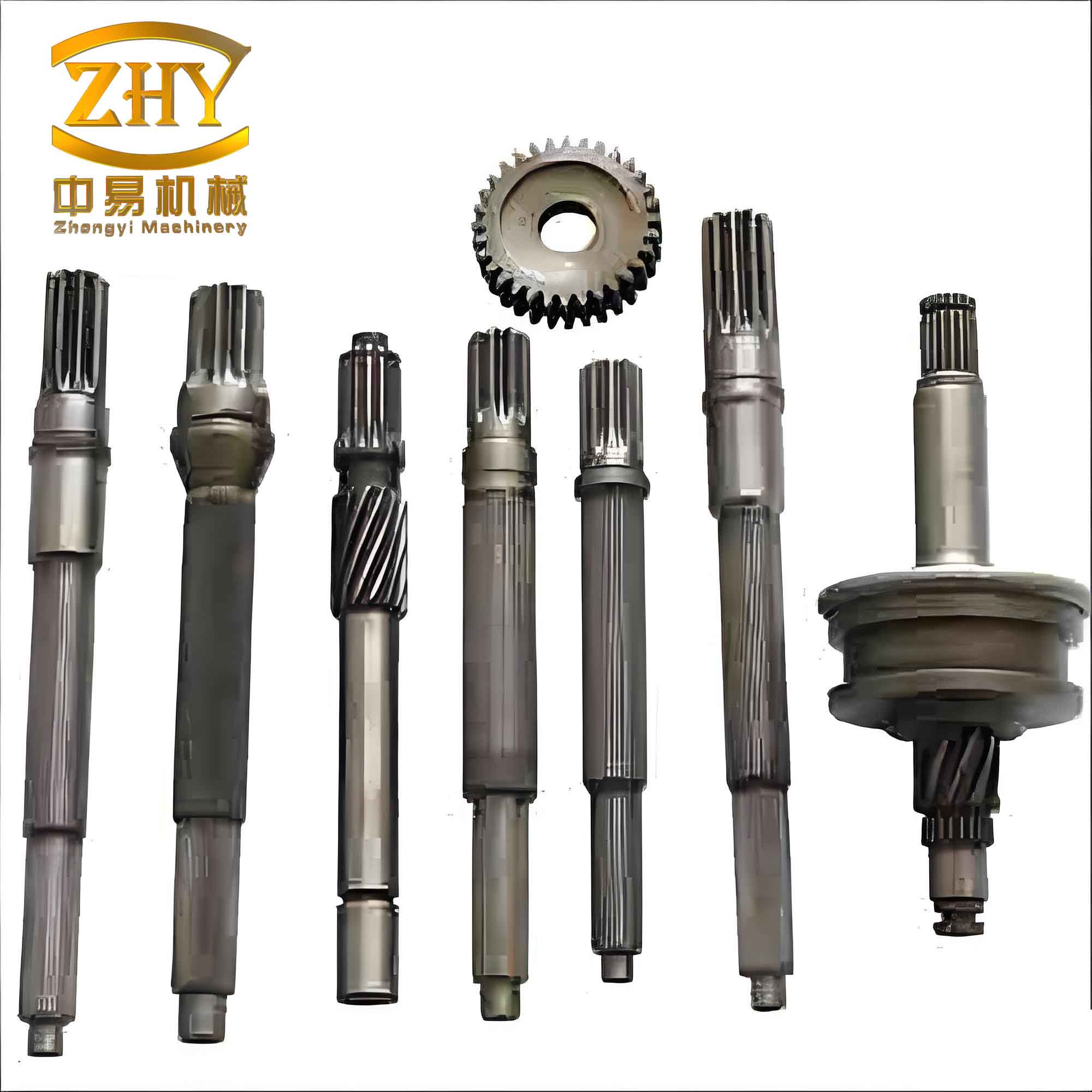
Our experimental methodology involved using 18Cr2Ni4WA steel for the gear shaft, with chemical composition detailed in Table 1. The gear parameters are listed in Table 2. The process flow included forging, normalizing, high-temperature tempering, rough machining, inspection, semi-finishing, gear hobbing, carburizing, double high-temperature tempering, quenching and tempering, induction hardening, and low-temperature tempering. The induction hardening was performed using medium-frequency equipment with parameters specified in Table 3. We employed continuous scanning heating with temperature monitoring via infrared sensors and used either fast quenching oil or aqueous polymer solution for cooling. Post-hardening, low-temperature tempering was applied to transform martensite and relieve stresses.
| Element | Measured | Standard (GB/T 3077-2015) |
|---|---|---|
| C | 0.18 | 0.13-0.19 |
| Si | 0.28 | 0.17-0.37 |
| Mn | 0.52 | 0.50-0.60 |
| Cr | 1.49 | 1.35-1.65 |
| Ni | 4.27 | 4.00-4.50 |
| W | 0.98 | 0.80-1.20 |
| Mo | 0.05 | ≤0.10 |
| Parameter | Value |
|---|---|
| Normal Module | 6 |
| Number of Teeth | 21 |
| Tip Diameter (mm) | 143 |
| Face Width (mm) | 62 |
| Pressure Angle (°) | 20 |
| Addendum Coefficient | 1.2 |
| Normal Modification Coefficient | 0.25 |
| Accuracy Grade | 6-KM |
The induction hardening process was critical for achieving the desired properties in the gear shaft. We tested four different setups, as shown in Table 3, varying current frequency and cooling method. The current frequency influences the penetration depth, which we calculated using the formula for current penetration depth Δ:
$$\Delta = 5.03 \times 10^{4} \sqrt{\frac{\rho}{\mu f}}$$
where ρ is the resistivity, μ is the permeability, and f is the current frequency. For steel at 800°C, ρ ≈ 10^{-4} Ω·cm and μ ≈ 1, allowing us to estimate Δ for different frequencies. Lower frequencies, such as 2100 Hz, resulted in deeper penetration, which is essential for achieving adequate core hardness in the gear shaft.
| Sample ID | Heating Equipment | Quenching Temperature (°C) | Current Frequency (Hz) | Scanning Rate (mm/min) | Cooling Method | Tempering Method |
|---|---|---|---|---|---|---|
| 1# | Medium Frequency | 830-850 | 4100 | 100 | Oil | Low-Temperature |
| 2# | Medium Frequency | 840-860 | 4450 | 120 | Polymer | Low-Temperature |
| 3# | Medium Frequency | 830-850 | 2100 | 100 | Oil | Low-Temperature |
| 4# | Medium Frequency | 840-860 | 2500 | 120 | Polymer | Low-Temperature |
After processing, we conducted non-destructive testing (PT inspection) on all gear shaft samples, and no cracks were detected. Hardness measurements were taken using Rockwell and micro-Vickers hardness testers. Surface hardness and core hardness results are summarized in Table 4. The gear shaft samples subjected to lower frequency induction hardening (3# and 4#) showed surface hardness above 58 HRC, meeting the design requirement of 60±2 HRC. Core hardness was optimal for sample 3#, averaging 40.1 HRC, which aligns with the recommended range for bending fatigue strength.
| Sample ID | Surface Hardness (HRC) | Core Hardness (HRC) |
|---|---|---|
| 1# | 61.3 | 34.5 |
| 2# | 60.5 | 34.4 |
| 3# | 58.9 | 40.1 |
| 4# | 59.3 | 37.5 |
Hardness gradient analysis was performed on the tooth surface and root areas, as per standards. The effective hardened layer depth was measured, and results are presented in Tables 5 and 6. For the gear shaft, the tooth surface effective depth met the design specification of 1.4±0.2 mm, with lower frequencies yielding deeper layers. The root hardened layer depth was at least 2/3 of the pitch circle depth, complying with requirements. Figure 1 illustrates the hardness gradient curves, showing a gradual decrease from surface to core, which is beneficial for fatigue resistance.
| Distance from Surface (mm) | 1# Hardness | 2# Hardness | 3# Hardness | 4# Hardness |
|---|---|---|---|---|
| 0.1 | 739 | 726 | 686 | 696 |
| 0.3 | 703 | 719 | 675 | 688 |
| 0.5 | 696 | 700 | 672 | 683 |
| 0.8 | 668 | 672 | 666 | 669 |
| 1.0 | 592 | 618 | 603 | 610 |
| 1.2 | 573 | 572 | 588 | 595 |
| 1.4 | 555 | 545 | 570 | 572 |
| 1.6 | 522 | 519 | 545 | 532 |
| 1.8 | 490 | 486 | 513 | 501 |
| Distance from Surface (mm) | 1# Hardness | 2# Hardness | 3# Hardness | 4# Hardness |
|---|---|---|---|---|
| 0.1 | 680 | 669 | 672 | 679 |
| 0.3 | 666 | 658 | 668 | 676 |
| 0.5 | 627 | 632 | 646 | 657 |
| 0.8 | 599 | 610 | 610 | 609 |
| 1.0 | 588 | 595 | 585 | 592 |
| 1.2 | 555 | 564 | 573 | 569 |
| 1.4 | 532 | 526 | 562 | 547 |
| 1.6 | 513 | 501 | 533 | 530 |
Metallographic examination revealed that all gear shaft samples had surface structures consisting of fine acicular martensite, minimal carbides, and retained austenite at level 1. The core structures varied: samples 1# and 2# exhibited tempered sorbitte, while 3# and 4# showed tempered lath martensite, indicating deeper penetration with lower frequencies. This microstructural refinement contributes to the high surface hardness and improved toughness in the gear shaft. The absence of cracks and uniform structures confirm the effectiveness of induction hardening in enhancing the mechanical integrity of the gear shaft.
In discussion, we analyze why induction hardening increases surface hardness in the gear shaft. The rapid heating rate in induction hardening promotes high nucleation density of austenite, resulting in fine grains that transform to high-carbon martensite upon quenching. Additionally, the short heating time limits carbon dissolution, reducing retained austenite and increasing hardness. The relationship between current frequency and penetration depth is crucial for controlling core hardness. Using the formula for Δ, we calculated that at 2100 Hz, the penetration depth at 800°C is approximately 11 mm, ensuring sufficient heating through the gear tooth. This deep penetration allows for optimal core hardness, which is vital for bending fatigue strength. Research indicates that core hardness around 40 HRC maximizes fatigue resistance, as illustrated by the equation for bending stress σ_b:
$$\sigma_b = \frac{K F_t}{b m_n Y}$$
where K is the load factor, F_t is the tangential force, b is the face width, m_n is the normal module, and Y is the form factor. A higher core hardness in the gear shaft reduces stress concentration and improves fatigue life.
For production validation, we applied the optimized process (sample 3# parameters) to multiple batches of gear shafts. Results, summarized in Table 7, confirm consistent surface hardness of 58.5–60.1 HRC, core hardness of 39.5–41.2 HRC, and level 1 core microstructure. This demonstrates the scalability and reliability of the induction hardening method for gear shafts in industrial settings.
| Batch | Gear Module | Number of Gear Shafts | Surface Hardness (HRC) | Root Hardness (HRC) | Core Hardness (HRC) | Core Microstructure |
|---|---|---|---|---|---|---|
| 1 | 6 | 8 | 59.2–60.1 | 58.6–59.7 | 39.8–40.3 | Level 1 |
| 2 | 6.5 | 12 | 58.7–59.6 | 58.5–60.2 | 39.5–40.2 | Level 1 |
| 3 | 7 | 6 | 58.9–59.9 | 58.6–59.6 | 39.9–41.2 | Level 1 |
| 4 | 7.5 | 10 | 58.5–59.4 | 58.3–59.5 | 39.6–40.5 | Level 1 |
In conclusion, our study establishes that carburizing, tempering, and induction hardening effectively enhance the performance of heavy duty gear shafts. The gear shaft achieves surface hardness above 58 HRC, improved hardness gradients, and refined microstructures. Lower current frequencies enable deeper penetration, optimizing core hardness for superior bending fatigue strength. This method is particularly beneficial for low-alloy steels rich in Cr, Ni, W, and Mo, offering a viable solution to manufacturing challenges. Future work could extend this approach to larger module gear shafts using very low-frequency induction hardening, further advancing heavy-duty gear technology. The gear shaft, as a central element in transmission systems, benefits immensely from this integrated heat treatment strategy, ensuring durability and efficiency in demanding applications.