
In my years of experience in the field of thermal processing, I have witnessed a significant transformation in manufacturing approaches, particularly with the integration of induction heat treatment into dedicated work cells. These cells are not merely about applying heat; they represent a holistic system that combines advanced process control, diagnostics, and factory automation to ensure precision and repeatability. The core motivation behind this evolution is to mitigate common heat treatment defects such as distortion, cracking, soft spots, and non-uniform hardness, which can compromise component integrity. In this detailed account, I will elaborate on the design, operation, and advantages of such manufacturing cells, drawing from practical implementations for high-volume gear processing and low-volume bearing race processing. I will incorporate tables and formulas to systematically summarize key parameters and relationships, emphasizing how these systems are engineered to prevent heat treatment defects.
The fundamental principle of induction heating involves generating eddy currents within a conductive material using an alternating magnetic field, leading to rapid and localized heating. This method is highly efficient and allows for precise control over the heated zone, which is crucial for minimizing heat treatment defects. When this technology is embedded within a manufacturing cell, it enables seamless integration into production lines, providing capabilities for hardening, tempering, and even in-process quality assurance. A typical cell comprises several subsystems: a power supply with frequency control, a part handling and positioning system, induction coils or inductors, quenching apparatus, a programmable logic controller (PLC) or computer numerical control, and often sophisticated monitoring sensors. The synergy of these elements is what allows for the consistent production of parts free from heat treatment defects.
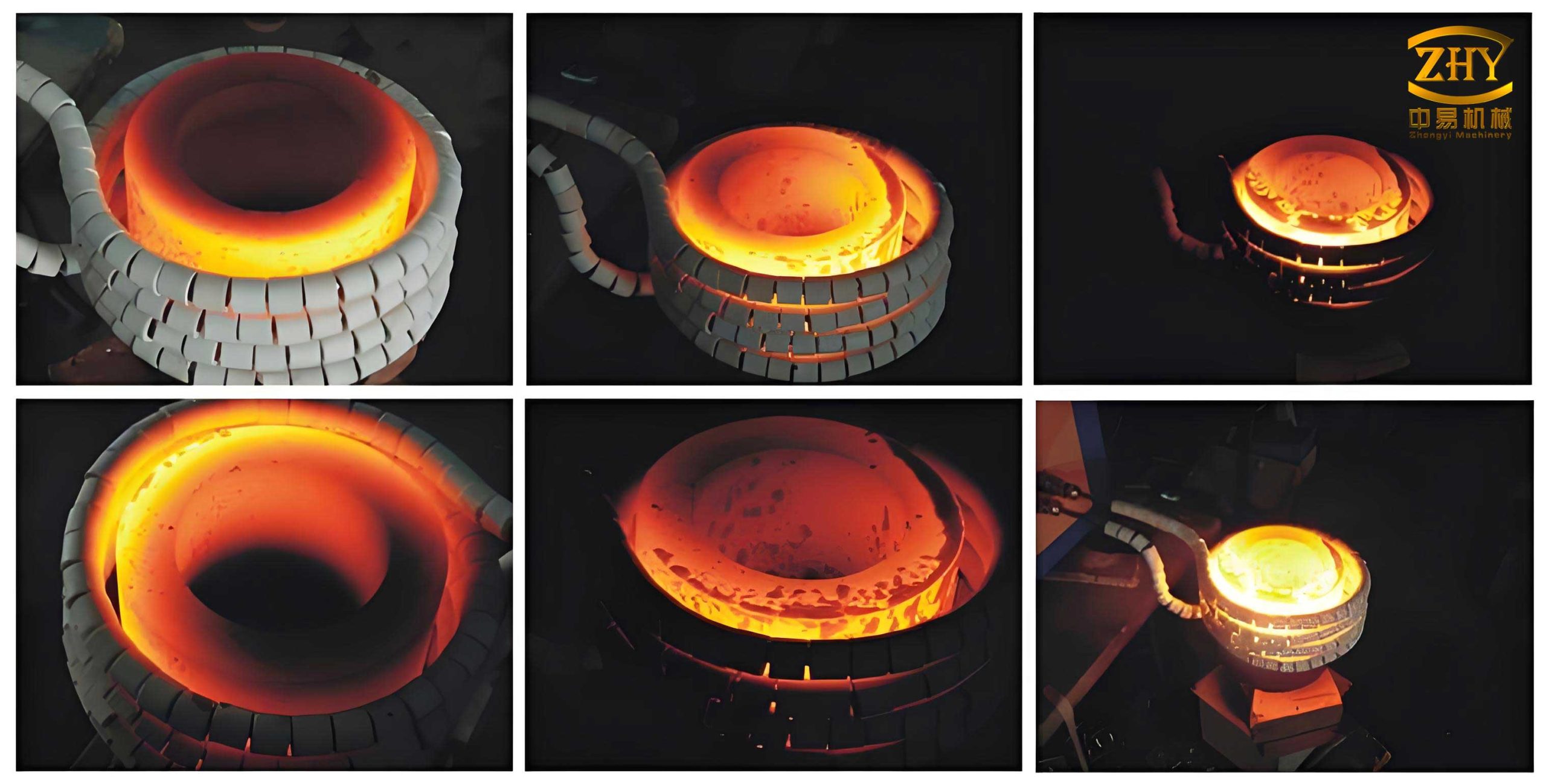
Let me begin by describing a high-volume production cell designed for gear hardening and tempering. This cell was implemented to process gears with diameters ranging from 4 to 8 cm, made from steels like SAE 4140 and 4142. The production rate requirement was 240 parts per hour, with a specified hardness of 15N82 to 15N90 at a depth of 0.5 cm below the tooth root. To achieve this consistently and avoid heat treatment defects like inadequate case depth or excessive distortion, the cell employs a four-station rotary indexing table. Parts are automatically loaded from a magazine, processed, and unloaded, ensuring minimal human intervention and thus reducing variability. The heart of the process control is a PLC that stores all parameters for different gear part numbers. Upon input of a gear code, the system automatically sets the power levels, heating times, quenching parameters, and tempering conditions. This automation is vital for preventing heat treatment defects caused by manual setting errors.
The thermal cycle for gear hardening involves rapid heating to the austenitizing temperature, followed by immediate quenching to form martensite. The tempering cycle then reduces brittleness and residual stresses. The power supplies used are critical: a 200 kW, 450 kHz unit for hardening and a 5 kW, 450 kHz unit for tempering. The high frequency allows for shallow heating concentrated on the tooth profile, which is essential for achieving contour-hardened patterns without causing heat treatment defects like burning or grain growth. The relationship between power density, heating time, and case depth can be expressed by a simplified formula for induction heating depth of penetration, often given by:
$$ \delta = \sqrt{\frac{\rho}{\pi \mu f}} $$
where $\delta$ is the depth of penetration in meters, $\rho$ is the resistivity of the material (Ω·m), $\mu$ is the magnetic permeability (H/m), and $f$ is the frequency (Hz). For steel at high temperatures, this dictates how deeply the heat penetrates, directly influencing the hardened case depth. Improper selection of frequency or power can lead to heat treatment defects such as shallow hardening or core overheating.
To ensure quality, the cell is equipped with infrared temperature sensors for both hardening and tempering stages. These sensors provide real-time feedback, allowing the PLC to adjust parameters if deviations occur. This closed-loop control is a key defense against heat treatment defects. The system also features diagnostic screens that display six critical process parameters and can halt operation if any parameter drifts beyond set limits. Furthermore, data logging via RS-232 interface supports ISO 9000 documentation requirements, enabling traceability and analysis of any potential heat treatment defects.
| Parameter | Value or Range | Role in Preventing Heat Treatment Defects |
|---|---|---|
| Gear Diameter Range | 4–8 cm | Requires tailored coil design to avoid overheating edges, a common source of heat treatment defects. |
| Material | SAE 4140, 4142 Steel | Alloy composition affects hardenability; precise control prevents soft spots or cracking (heat treatment defects). |
| Hardness Requirement | 15N82–15N90 at 0.5 cm depth | Direct target; deviation indicates heat treatment defects like insufficient quenching. |
| Production Rate | 240 parts/hour | High throughput demands consistent cycles to avoid intermittent heat treatment defects. |
| Hardening Power | 200 kW, 450 kHz | High frequency ensures shallow penetration, reducing distortion (heat treatment defects). |
| Tempering Power | 5 kW, 450 kHz | Low power for stress relief without over-tempering, which can cause softening (heat treatment defects). |
| Control System | PLC with ISO 9000 data logging | Enables real-time monitoring and correction to prevent heat treatment defects. |
Now, let me shift to the low-volume, short-run production cell designed for bearing races. This cell exemplifies flexibility, capable of handling a wide range of part sizes—outer diameters from 76 to 508 cm, thickness from 5 to 41 cm, and weights from 2.2×10³ to 5.9×10⁴ N. The materials include carbon steels (AISI 1045–1050) and medium-carbon steels like AISI 4140, 5150, etc. The challenge here is to avoid heat treatment defects across diverse geometries, which necessitates advanced features such as dual-frequency power supplies, servo-driven tracking systems, and computer-aided programming.
The cell uses a custom-designed A-frame setup with multiple independent drives and servomotors for precise positioning and rotation of bearing races. The part can be tilted up to 20 degrees vertically to ensure stability during processing, which is crucial for preventing distortion—a prevalent heat treatment defect in thin-walled components. The system employs both mechanical and servo tracking to maintain a constant gap between the induction coil and the race surface. The servo tracking uses ultrasonic linear sensors to detect positional deviations and correct them via servo motors, storing data points in the PLC. This precision is essential to avoid heat treatment defects like non-uniform hardening due to varying air gaps.
For heat treatment, a dual-frequency power supply (150 kW, switchable between 3 kHz and 10 kHz) is used. Larger races often require a preheat cycle to achieve the desired hardened layer distribution without causing thermal shocks that lead to cracking (heat treatment defects). The power and frequency selection are based on the race diameter and required case depth. The relationship between frequency and hardened depth is again governed by the penetration depth formula. For instance, lower frequencies (3 kHz) provide deeper heating for thicker sections, while higher frequencies (10 kHz) are used for shallower cases. An improper match can result in heat treatment defects such as inadequate core hardening or excessive surface overheating.
The programming system allows storage of all parameters per part number. When a part number is entered, the system automatically sets the coordinates for positioning, power levels, heating times, quenching flows, and tracking parameters. This reduces setup time and minimizes human error, a common cause of heat treatment defects. The control interface includes multiple screens for monitoring and diagnostics, such as power system status, servo control, and process run screens. These facilitate quick identification and correction of anomalies that could lead to heat treatment defects.
| Parameter | Value or Range | Role in Preventing Heat Treatment Defects |
|---|---|---|
| Outer Diameter Range | 76–508 cm | Demands adaptable coil and tracking to avoid uneven heating, a source of heat treatment defects. |
| Material Types | AISI 1045–1050, 4140, 5150, etc. | Varied hardenability requires tailored cycles to prevent cracking or soft zones (heat treatment defects). |
| Weight Range | 2.2×10³ – 5.9×10⁴ N | Heavy parts need stable handling to minimize distortion (heat treatment defects). |
| Power Supply | 150 kW, dual-frequency (3/10 kHz) | Flexibility to match case depth requirements, preventing heat treatment defects like shallow hardening. |
| Tracking System | Servo with ultrasonic sensors | Maintains consistent coil gap, crucial for uniform hardness and avoiding heat treatment defects. |
| Control System | PLC with computer interface | Stores recipes and monitors in real-time to avert heat treatment defects. |
| Quenching Method | Precise fluid application | Controlled cooling prevents martensite cracking, a severe heat treatment defect. |
In both cells, quenching is a critical phase where many heat treatment defects originate. The quenching process must be precisely controlled in terms of medium, flow rate, and duration. For gears, a polymer or oil quench might be used, while for bearing races, a directed spray is common. The cooling rate must be fast enough to form martensite but not so fast as to cause excessive stresses. The generalized quench severity can be related to the heat transfer coefficient, $h$, and the part’s geometry. A simple model for cooling time can be derived from Newton’s law of cooling:
$$ T(t) = T_{\text{amb}} + (T_0 – T_{\text{amb}}) e^{-ht/A\rho c} $$
where $T(t)$ is temperature at time $t$, $T_0$ is initial temperature, $T_{\text{amb}}$ is ambient or quenchant temperature, $A$ is surface area, $\rho$ is density, and $c$ is specific heat. Deviations from ideal cooling curves can induce heat treatment defects like quench cracks or retained austenite.
Moreover, the integration of statistical process control (SPC) and diagnostic menus in these cells enhances their ability to preempt heat treatment defects. For example, the bearing race cell includes a screen that displays real-time parameters like power, voltage, frequency, and rotational speed. If any parameter drifts, alarms trigger, and the system can auto-correct or shut down. This proactive approach is vital for maintaining quality, especially in low-volume runs where each part is valuable. The data acquisition also allows for trend analysis, helping to identify gradual changes that might lead to heat treatment defects over time.
Beyond the technical aspects, these manufacturing cells offer environmental and operational benefits. By replacing traditional furnace-based processes, they reduce energy consumption and eliminate harmful emissions associated with atmosphere gases. This aligns with modern environmental standards while still ensuring that heat treatment defects are minimized through precise control. The cells can also be linked with upstream and downstream operations, such as cleaning, grinding, or inspection, creating a fully automated line that further reduces handling-induced heat treatment defects like scratches or contamination.
To delve deeper into the science behind defect prevention, let’s consider common heat treatment defects and how induction cells address them. Distortion often arises from non-uniform heating or cooling. In induction heating, the localized nature allows for strategic heating patterns that balance thermal stresses. For gears, contour hardening focuses heat on the teeth, leaving the core relatively cool, which reduces overall distortion. The mathematical expression for thermal stress, $\sigma_{\text{thermal}}$, can be approximated by:
$$ \sigma_{\text{thermal}} = E \alpha \Delta T $$
where $E$ is Young’s modulus, $\alpha$ is the coefficient of thermal expansion, and $\Delta T$ is the temperature gradient. By minimizing $\Delta T$ through controlled heating rates and frequencies, induction cells mitigate this source of heat treatment defects.
Cracking is another severe heat treatment defect, often due to high residual stresses or martensitic transformation in brittle phases. The tempering cycle in gear cells and the preheat for bearing races help alleviate these stresses. The tempering temperature and time are optimized using formulas like the Hollomon-Jaffe parameter for tempering response:
$$ P = T(\log t + C) $$
where $P$ is the tempering parameter, $T$ is temperature in Kelvin, $t$ is time in hours, and $C$ is a material constant. Proper tempering reduces brittleness without over-softening, thus preventing heat treatment defects.
Non-uniform hardness, a common heat treatment defect, is addressed by the servo tracking and consistent power delivery. For bearing races, the tracking system ensures the coil follows the race contour precisely, maintaining a uniform air gap. The hardness profile can be modeled using diffusion-based equations for carbon migration during austenitization, but in induction hardening, it’s largely governed by the temperature profile. The hardness, $H$, after quenching can be related to the cooling rate and carbon content via empirical formulas like:
$$ H = H_0 + k \cdot \sqrt{C} $$
where $H_0$ is base hardness, $k$ is a constant, and $C$ is carbon content. Consistent heating ensures uniform austenitization, leading to even hardness and avoiding heat treatment defects.
In my experience, the success of these cells also hinges on maintenance and calibration. Regular checks of induction coils, quench nozzles, and sensors are essential to prevent gradual drifts that cause heat treatment defects. For instance, coil degradation can alter the electromagnetic field, leading to uneven heating. A simple quality check involves monitoring the power factor or impedance during operation, which can be expressed as:
$$ Z = \sqrt{R^2 + (2\pi f L)^2} $$
where $Z$ is impedance, $R$ is resistance, $L$ is inductance, and $f$ is frequency. Changes in $Z$ may indicate coil wear, prompting maintenance before heat treatment defects occur.
Looking ahead, the evolution of induction heat treatment cells is leaning towards greater integration with Industry 4.0 technologies, such as IoT sensors and AI-based predictive analytics. These advancements will further enhance the ability to detect and prevent heat treatment defects in real-time. For example, machine learning algorithms could analyze historical data to predict when parameters might drift out of spec, allowing for preemptive adjustments. This proactive stance is the ultimate defense against heat treatment defects, ensuring that every part meets stringent quality standards.
In conclusion, induction heat treatment manufacturing cells represent a pinnacle of precision engineering in thermal processing. From high-volume gear cells to flexible bearing race cells, they combine advanced mechanics, electronics, and software to deliver consistent results while minimizing heat treatment defects. Through tables and formulas, I have summarized the key aspects that make these systems effective. The emphasis on real-time control, automation, and diagnostics is what sets them apart, transforming heat treatment from a potential source of defects into a reliable, repeatable process. As technology advances, I am confident that these cells will continue to evolve, offering even greater protection against heat treatment defects and contributing to the manufacturing excellence of critical components like gears and shafts.