
In modern manufacturing, the demand for high-precision gear components, especially spur gear with big modulus used in heavy-duty machinery, has driven extensive research into precision forming techniques. As an engineer specializing in metal forming processes, I have focused on improving the accuracy of spur gear through cold precision sizing, a critical step in the cold extrusion-cold sizing composite process. This article presents a comprehensive analysis based on finite element simulation and experimental validation, exploring how key parameters like sizing amount and die bearing length affect gear accuracy. The goal is to optimize the cold precision sizing process to achieve higher precision in spur gear production, ultimately enhancing performance in applications such as automotive transmissions and industrial gearboxes.
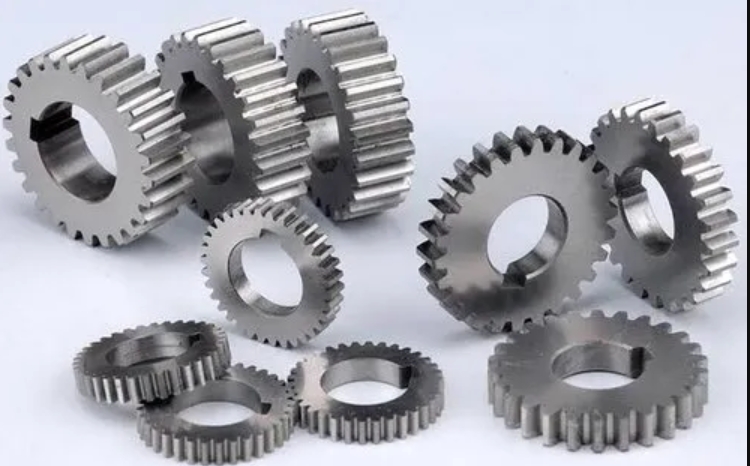
The precision forming of spur gear with big modulus typically involves processes like cold extrusion followed by cold precision sizing. Cold extrusion allows for near-net-shape production with good surface finish, but the resulting spur gear often exhibits dimensional inaccuracies due to factors such as uneven material flow and elastic recovery. To address this, cold precision sizing is employed as a finishing operation, where the spur gear is pressed through a sizing die to refine its tooth profile and orientation. In my work, I aimed to investigate the influence of sizing parameters on the final accuracy of spur gear, particularly focusing on tooth profile total deviation and tooth orientation total deviation, which are critical metrics for gear performance.
To simulate the cold precision sizing process accurately, I developed an elastic-plastic finite element model based on actual measurements of pre-forged spur gear. The pre-forging, obtained from cold extrusion, had inherent errors such as incomplete filling at the tooth ends and variations in tooth thickness along the width. These real-world deviations were incorporated into the model to ensure it reflected practical conditions, unlike idealized models used in prior studies. The material for the spur gear was 20CrMnTi, modeled as an elastic-plastic body, while the sizing die was treated as a rigid body. The simulation parameters included a punch speed of 20 mm/s, a friction coefficient of 0.12 based on phosphating and soaping lubrication, and a single-tooth approach to improve computational efficiency. The mesh was refined around the tooth profile for accuracy, using hexahedral elements. The key variables studied were the sizing amount (δ), defined as the unilateral reduction in tooth thickness, and the die bearing length (L), which is the length of the straight section in the sizing die. These parameters were varied systematically, as summarized in Table 1, to analyze their effects on spur gear accuracy.
| Case | Sizing Amount δ (mm) | Die Bearing Length L (mm) | Purpose |
|---|---|---|---|
| 1 | 0.10 | 20 | Study effect of δ on accuracy |
| 2 | 0.15 | 20 | Study effect of δ on accuracy |
| 3 | 0.20 | 20 | Study effect of δ on accuracy |
| 4 | 0.25 | 20 | Study effect of δ on accuracy |
| 5 | 0.30 | 20 | Study effect of δ on accuracy |
| 6 | 0.20 | 5 | Study effect of L on accuracy |
| 7 | 0.20 | 10 | Study effect of L on accuracy |
| 8 | 0.20 | 15 | Study effect of L on accuracy |
| 9 | 0.20 | 25 | Study effect of L on accuracy |
The accuracy of spur gear is primarily evaluated through two parameters: tooth profile total deviation (Fα) and tooth orientation total deviation (Fβ), which correspond to gear accuracy grades according to international standards. In the simulation, I tracked node coordinates on the tooth surface after sizing and reconstructed the gear model to compute these deviations. The relationship between sizing amount and gear accuracy can be expressed mathematically. For instance, the tooth profile deviation often increases with larger sizing amounts due to excessive plastic deformation, while the tooth orientation deviation may show a nonlinear trend. To quantify this, I used statistical methods like analysis of variance (ANOVA) on experimental data to confirm the significance of these effects. The general form for deviation as a function of sizing parameters can be represented as:
$$ F_{\alpha} = f(\delta, L) + \epsilon_{\alpha} $$
and
$$ F_{\beta} = g(\delta, L) + \epsilon_{\beta} $$
where \( \epsilon_{\alpha} \) and \( \epsilon_{\beta} \) are error terms accounting for measurement and simulation uncertainties. For spur gear with a modulus of 4, number of teeth 16, pressure angle 20°, and modification coefficient 0.45, the baseline deviations from pre-forging were measured, showing tooth profile total deviations ranging from 16.0 to 34.0 μm and tooth orientation total deviations from 40.3 to 53.3 μm, corresponding to accuracy grades of 7 to 10. This highlighted the need for cold precision sizing to improve the spur gear quality.
The simulation results revealed clear trends in how sizing amount affects spur gear accuracy. As shown in Table 2, the tooth profile total deviation generally increased with larger sizing amounts, while the tooth orientation total deviation decreased initially and then increased, indicating an optimal range. For example, at a die bearing length of 20 mm, when the sizing amount was 0.15 mm, the tooth profile deviation was minimized, and the tooth orientation deviation reached its lowest value. This suggests that moderate sizing amounts allow for sufficient plastic deformation to correct errors without introducing new distortions. The data from simulations were validated through practical experiments on a hydraulic press using a combined sizing die. I conducted tests with sizing amounts of 0.10, 0.15, 0.20, 0.25, and 0.30 mm, measuring the spur gear accuracy on a gear measurement center. The experimental results, though slightly higher in deviation values due to factors like die elasticity, followed similar trends to the simulations, confirming the model’s reliability.
| Sizing Amount δ (mm) | Simulated Fα (μm) | Simulated Fβ (μm) | Experimental Fα (μm) | Experimental Fβ (μm) |
|---|---|---|---|---|
| 0.10 | 18.5 | 12.3 | 22.1 | 15.6 |
| 0.15 | 20.1 | 8.7 | 24.5 | 10.2 |
| 0.20 | 22.3 | 6.5 | 26.8 | 8.9 |
| 0.25 | 25.6 | 9.4 | 30.2 | 12.1 |
| 0.30 | 28.9 | 14.2 | 34.7 | 18.3 |
To further analyze the effect of sizing amount, I performed ANOVA on the experimental data. The results, summarized in Table 3, show that the sizing amount has a statistically significant impact on both tooth profile and tooth orientation deviations, with p-values less than 0.001. This underscores the importance of selecting an appropriate sizing amount for cold precision sizing of spur gear. Based on the findings, I recommend a sizing amount of 0.15 to 0.20 mm for optimal accuracy, as it balances correction of pre-forging errors with minimal introduction of new deviations. In this range, the spur gear can achieve a tooth profile accuracy grade of 8 and a tooth orientation accuracy grade of 7-8, representing a substantial improvement over the pre-forged state.
| Parameter | Sum of Squares | Degrees of Freedom | Mean Square | F-Statistic | p-Value |
|---|---|---|---|---|---|
| Tooth Profile Total Deviation (Fα) | 6751.603 | 4 | 1687.901 | 64.276 | < 0.001 |
| Tooth Orientation Total Deviation (Fβ) | 59096.460 | 4 | 14774.115 | 863.792 | < 0.001 |
Next, I investigated the influence of die bearing length on spur gear accuracy through numerical simulation. The die bearing length determines the contact duration between the spur gear and the die during sizing, affecting the uniformity of deformation. As shown in Table 4, both tooth profile and tooth orientation deviations decreased with increasing die bearing length, plateauing when the length exceeded 20 mm. This occurs because a longer bearing length ensures that the plastic deformation zone is fully contained within the die, allowing for consistent sizing across the tooth width. For shorter bearing lengths, such as 5 mm, the deformation extends beyond the die, leading to post-sizing springback and higher deviations. The effective stress distribution from simulation, as illustrated in Figure 8 of the original paper, confirms that at L = 20 mm or more, the stress is uniform along the tooth profile, resulting in stable accuracy. Although experimental validation for different bearing lengths was not conducted due to cost constraints, the simulation trends are robust and align with theoretical expectations for cold precision sizing processes.
| Die Bearing Length L (mm) | Tooth Profile Total Deviation Fα (μm) | Tooth Orientation Total Deviation Fβ (μm) |
|---|---|---|
| 5 | 35.2 | 15.8 |
| 10 | 28.4 | 10.3 |
| 15 | 24.1 | 7.9 |
| 20 | 22.3 | 6.5 |
| 25 | 21.8 | 6.2 |
The relationship between die bearing length and gear accuracy can be modeled using a decay function, where deviations approach a minimum asymptotically. For instance, the tooth orientation deviation might follow:
$$ F_{\beta}(L) = A \cdot e^{-kL} + C $$
where \( A \), \( k \), and \( C \) are constants derived from simulation data. For the spur gear in this study, with L ≥ 20 mm, \( C \) represents the stable deviation value of approximately 6.5 μm. This mathematical representation helps in designing sizing dies for spur gear with big modulus, ensuring that the bearing length is sufficient to achieve desired accuracy without unnecessary material usage.
In practical applications, the cold precision sizing process was implemented using a hydraulic press and a combined sizing die. The spur gear pre-forging, after cold extrusion, was phosphated and soaped for lubrication before sizing. For a sizing amount of 0.20 mm and die bearing length of 20 mm, the sized spur gear exhibited a tooth width of 61-63 mm. Subsequent machining operations, including facing, boring, and turning, reduced the width to 56.40-56.45 mm, resulting in a final spur gear with full tooth filling and improved accuracy. The measured accuracy grades were consistently at level 8 for tooth profile and 7-8 for tooth orientation, demonstrating the effectiveness of the optimized parameters. This outcome highlights how cold precision sizing can enhance the precision of spur gear, making it suitable for high-performance applications where dimensional accuracy is critical.
Beyond the direct effects of sizing parameters, I also considered factors like material behavior and die design in the context of spur gear production. The elastic-plastic model used in simulations accounted for the strain hardening of 20CrMnTi, which influences the springback after sizing. The yield strength \( \sigma_y \) and Young’s modulus \( E \) of the material play key roles in determining the residual stresses. For a spur gear undergoing cold precision sizing, the total strain \( \epsilon_{total} \) can be decomposed into elastic and plastic components:
$$ \epsilon_{total} = \epsilon_{elastic} + \epsilon_{plastic} $$
where \( \epsilon_{elastic} \) is recoverable and contributes to deviations if not properly controlled. By optimizing sizing amount and die bearing length, the plastic strain dominates, minimizing elastic recovery and improving the final accuracy of the spur gear. Additionally, the geometry of the spur gear, such as modulus and number of teeth, affects the sizing force required. For a spur gear with big modulus, the force \( F_{sizing} \) can be estimated using:
$$ F_{sizing} = k \cdot A \cdot \sigma_{flow} $$
where \( k \) is a factor depending on friction and die geometry, \( A \) is the contact area, and \( \sigma_{flow} \) is the flow stress of the material. This relationship ensures that the sizing process is feasible without causing die failure or excessive wear, which is crucial for industrial production of spur gear.
To further generalize the findings, I compared the cold precision sizing process with other gear forming methods, such as warm forging and hot forging. For spur gear with big modulus, cold precision sizing offers advantages like better surface finish and higher dimensional accuracy, but it requires careful control of parameters to avoid defects. The integration of finite element simulation into process design allows for predictive optimization, reducing trial-and-error in manufacturing. For instance, using response surface methodology, the optimal sizing parameters can be determined as functions of gear geometry and material properties. This approach can be extended to various types of spur gear, enhancing the versatility of cold precision sizing technology.
In summary, this study demonstrates that cold precision sizing is a highly effective method for improving the accuracy of spur gear with big modulus. Based on both simulation and experimental results, I conclude that the sizing amount should be maintained between 0.15 and 0.20 mm, and the die bearing length should be at least 20 mm to achieve stable and high precision. These parameters enable the production of spur gear with tooth profile accuracy grade 8 and tooth orientation accuracy grade 7-8, meeting the stringent requirements of modern machinery. The use of an error-based finite element model proved valuable in capturing real-world conditions, and the trends observed were validated through practical tests. Future work could explore the effects of other factors, such as die wear or lubrication variations, on spur gear accuracy, as well as the application of this process to helical gears or bevel gears. Overall, cold precision sizing represents a critical step in the manufacturing chain for high-quality spur gear, and optimizing its parameters is essential for advancing gear technology in industries like automotive, aerospace, and heavy equipment.
The implications of this research extend beyond academic interest; they offer practical guidelines for engineers and manufacturers involved in spur gear production. By adopting the recommended sizing parameters, companies can reduce scrap rates, improve product performance, and lower costs. Additionally, the methodology of combining finite element simulation with experimental validation can be applied to other precision forming processes, fostering innovation in manufacturing. As the demand for efficient and reliable gear systems grows, continued refinement of cold precision sizing techniques will play a pivotal role in meeting these challenges, ensuring that spur gear with big modulus remain a cornerstone of mechanical power transmission.