
In the field of precision robotics and industrial automation, the demand for high-accuracy motion control has intensified the focus on transmission systems. Among these, the RV reducer, a compound planetary transmission device that integrates a cycloidal-pin wheel drive with a planetary gear stage, stands out due to its exceptional torsional stiffness, high load capacity, and compact design. Its performance is critical for applications such as industrial robot joints, where precise positional control is paramount. However, the transmission error—the deviation between the theoretical and actual output position—remains a significant challenge affecting the overall precision of systems employing RV reducers. A primary contributor to this error is the inherent clearance between the cycloidal gear and the pin teeth, arising from manufacturing tolerances, assembly inaccuracies, and necessary operational backlash. In this comprehensive study, I delve into the intricate relationship between cycloidal gear tooth clearance and the resultant transmission error in RV reducers. Through a multifaceted approach involving mathematical modeling, dynamic simulation, and experimental validation, I aim to quantify this influence and provide a foundational understanding for enhancing the manufacturing and design precision of these critical components.
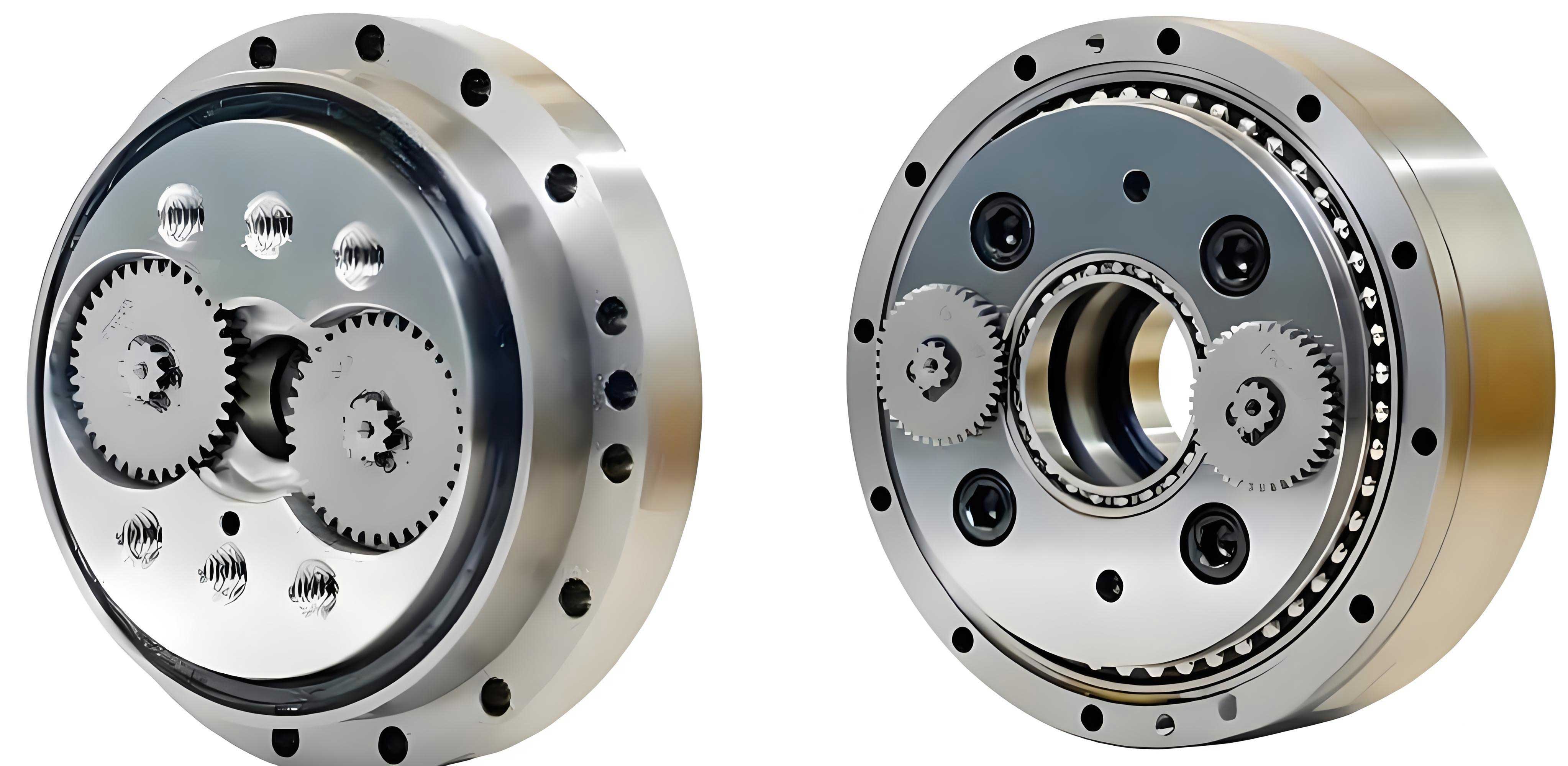
The RV reducer’s operation is a symphony of coordinated movements. The input stage typically consists of a planetary gear system that provides an initial speed reduction. This motion is then transmitted to a set of crankshafts, which drive the cycloidal gears in an eccentric motion. These cycloidal gears mesh with a stationary ring of pin teeth, converting the eccentric rotation into a concentric, reduced-speed output via an output flange. The heart of this speed reduction and torque amplification lies in the meshing between the cycloidal disc and the pinwheel. Theoretically, this meshing should be continuous and without clearance. In reality, a combination of factors, including deliberate tooth profile modifications (like equidistant and shifting modifications) to ensure proper lubrication and reduce stress concentration, and inevitable manufacturing errors, creates a variable clearance along the line of action. This clearance directly impacts the number of teeth in simultaneous contact, alters the load distribution, and introduces nonlinearities into the system’s kinematic chain, ultimately manifesting as transmission error. Therefore, a precise analysis of how this clearance propagates through the RV reducer’s kinematics to affect the output angle is essential.
To isolate the effect of cycloidal gear tooth clearance, I adopt a control variable methodology. This involves constructing a detailed mathematical model that accounts for various error sources but allows for the systematic variation of parameters related to the clearance between the cycloidal gear and the pin teeth. Other potential error sources from components like planetary gears, bearings, and crankshafts are held constant or modeled as baseline perturbations. The core of the model is the formulation of the equivalent error displacement along the line of action of the cycloidal-pin tooth meshing. Let us denote the theoretical position of a pin tooth center. Due to errors, its actual position deviates. These deviations can be decomposed into radial and tangential components relative to the pin circle. Furthermore, the cycloidal gear itself has profile errors and cumulative pitch deviations. A critical parameter is the initial clearance, $\Delta_i$, between a pin tooth and the cycloidal gear tooth before contact is established under load. This clearance is a function of the gear geometry and modification amounts.
The mathematical model begins by defining the equivalent error on the meshing line. For a pin tooth indexed by $k$ and a cycloidal gear tooth indexed by $j$, the equivalent error due to the cycloidal gear’s profile error $P_{jk}$ is given by:
$$ e_{pdjk} = P_{jk} \cos(\phi_{pdjs} – \alpha_{js}) $$
where $\phi_{pdjs}$ is the angle between the line connecting the cycloidal gear center and the pin tooth center and a reference direction on the cycloidal gear, and $\alpha_{js}$ is the pressure angle at the meshing point. Similarly, the equivalent displacement due to the cycloidal gear’s pitch error $AP_{jk}$ is:
$$ e_{Apdjk} = AP_{jk} \sin(\phi_{Apdjs} – \alpha_{js}) $$
The modification of the cycloidal gear tooth profile, essential for proper operation, also introduces an effective clearance. For an equidistant modification $\Delta r_{rp}$ and a shifting modification $\Delta r_{p}$, their equivalent contributions along the meshing line, $e_{rrp}$ and $e_{rp}$, are derived from the gear geometry. These are expressed as:
$$ e_{rrp} = \Delta r_{rp} \cos \tau, \quad e_{rp} = \Delta r_{p} \cos \tau $$
where $\tau$ is related to the meshing phase. The parameter $K$, the shortening coefficient of the cycloidal gear, plays a key role. The combined effect is often integrated into a function describing the initial clearance. A pin tooth’s center position error has radial ($E_{Rk}$) and tangential ($E_{ARk}$) components. Their equivalent errors on the meshing line are:
$$ e_{Rk} = E_{Rk} \cos(\alpha_{js} – \phi_{Rjs}) $$
$$ e_{ARk} = E_{ARk} \sin(\alpha_{js} – \phi_{Rjs}) $$
where $\phi_{Rjs}$ is the angular position of the pin tooth. The total equivalent error for a single potential meshing pair is the sum of these components. However, contact only occurs when the elastic deformation of the teeth under load exceeds the initial clearance $\Delta_i$. The initial clearance for the $i$-th tooth pair, as a function of its angular position $\phi_i$, is given by:
$$ \Delta_i = -\frac{\Delta r_{rp}}{r_p} \left( \frac{\sin \phi_i}{1 + K^2 – 2K \cos \phi_i} \right) + \frac{\Delta r_{p}}{r_p} \left( \frac{1 – K \cos \phi_i}{1 + K^2 – 2K \cos \phi_i} – 1 \right) $$
Here, $r_p$ is the pin circle radius. When a torque is applied, the teeth deform. The total displacement $\delta_i$ along the common normal for a tooth pair that comes into contact is proportional to the maximum displacement $\delta_{\text{max}}$ of the first tooth to contact:
$$ \delta_i = \frac{\sin \phi_i}{1 + K^2 – 2K \cos \phi_i} \delta_{\text{max}} $$
Contact is established if $\delta_i > \Delta_i$. This conditional engagement creates a time-varying mesh stiffness and a variable number of teeth in contact, which is the fundamental mechanism through which clearance causes transmission error in the RV reducer.
The transmission error (TE) is defined as the difference between the actual output rotation and the theoretical output rotation for a given input. The kinematic model of the RV reducer, incorporating the above meshing conditions, allows for the calculation of the output angle. For an input speed $\omega_{in}$, the theoretical output speed $\omega_{out,theo}$ is given by the reduction ratio $i_{RV}$, which is typically very high (e.g., over 100:1). The actual output speed $\omega_{out,act}$ fluctuates due to the time-varying mesh conditions. The transmission error in angular terms, $\theta_{TE}$, is obtained by integrating the speed difference:
$$ \theta_{TE}(t) = \int_0^t \left( \omega_{out,act}(\tau) – \omega_{out,theo} \right) d\tau $$
To solve this, the equations of motion for the RV reducer system, including the dynamics of the planetary stage, crankshafts, cycloidal gears, and output flange, need to be established. The meshing forces between the cycloidal gear and pin teeth are modeled as nonlinear spring-damper systems that engage only when the clearance is overcome. The force for the $i$-th pair, if in contact, is:
$$ F_i = k_m (\delta_i – \Delta_i) + c_m \dot{\delta}_i $$
where $k_m$ is the mesh stiffness and $c_m$ is the damping coefficient. The sum of these forces projected onto the output direction creates the output torque. By numerically integrating the system’s equations of motion under a constant input speed, the actual output velocity is obtained. Subsequently, applying the integration formula yields the transmission error over time. For the purposes of this model, with an input speed set to 1600 rpm and typical geometrical parameters for an RV reducer like the SHAR-110E type, the computed transmission error shows a characteristic pattern. The model predicts that the transmission error fluctuates within a range of approximately -35 arcseconds to +47 arcseconds due primarily to the cycloidal gear tooth clearance effects. This range represents a significant deviation for high-precision applications and underscores the importance of controlling this parameter in RV reducer design and manufacturing.
The following table summarizes the key error components and their symbolic representation in the mathematical model for the RV reducer transmission error analysis:
| Error Source | Symbol | Description | Typical Influence on Meshing Line |
|---|---|---|---|
| Cycloidal Gear Profile Error | $P_{jk}$ | Deviation of the actual tooth profile from the theoretical curve. | Direct component along the line of action, modulated by cosine of meshing phase difference. |
| Cycloidal Gear Cumulative Pitch Error | $AP_{jk}$ | Accumulated error in the angular position of successive teeth. | Component along the line of action, modulated by sine of meshing phase difference. |
| Equidistant Modification | $\Delta r_{rp}$ | Radial shift of the generating circle for tooth profile generation. | Creates a systematic initial clearance; equivalent error depends on tooth position. |
| Shifting Modification | $\Delta r_{p}$ | Additional radial offset applied during tooth cutting. | Similarly creates systematic initial clearance; combined effect with equidistant modification. |
| Pin Tooth Radial Position Error | $E_{Rk}$ | Deviation of a pin tooth’s center from its nominal radius. | Equivalent error is $E_{Rk} \cos(\alpha_{js} – \phi_{Rjs})$. |
| Pin Tooth Tangential Position Error | $E_{ARk}$ | Deviation of a pin tooth’s center along the pin circle circumference. | Equivalent error is $E_{ARk} \sin(\alpha_{js} – \phi_{Rjs})$. |
| Initial Meshing Clearance | $\Delta_i$ | Gap between tooth pairs before load application, function of $\phi_i$. | Determines the threshold for contact; primary source of nonlinearity. |
To validate the insights from the mathematical model and to visualize the dynamic interactions within the RV reducer, a multi-body dynamics simulation was conducted using a specialized software environment. A detailed three-dimensional virtual prototype of an RV reducer, corresponding to the SHAR-110E specifications, was created in a CAD system and then imported into the simulation software. The primary goal was to observe the dynamic transmission error under conditions mirroring the mathematical model, with a specific focus on the effects stemming from the clearance in the cycloidal-pin gear mesh.
The simulation setup involved several critical steps to ensure realism. First, the working environment was configured: gravity was set along the negative Y-axis, and the material properties for all components (e.g., steel for gears and shafts) were defined. Second, the model was simplified by removing non-essential parts for dynamic analysis, such as keys, screws, and locating pins, to reduce computational complexity while retaining kinematic and dynamic fidelity. Third, the kinematic joints and constraints were applied according to the real mechanism’s behavior. A summary of these constraints is presented below:
| Component 1 | Component 2 | Constraint Type | Purpose/Effect |
|---|---|---|---|
| Input Shaft | Ground (Base) | Revolute Joint | Allows rotational input motion. |
| Input Sun Gear | Planetary Gears | Gear Constraint (Contact) | Simulates the meshing of the first-stage planetary transmission. |
| Crankshaft | Planetary Gear Carrier | Fixed Joint | Connects the crankshaft to the carrier; transmits motion. |
| Cycloidal Gear | Crankshaft Eccentric | Bushing Force (Elastic) | Models the connection via bearings, allowing relative compliance. |
| Cycloidal Gear | Pin Teeth | Contact Force (Impact) | Defines the nonlinear meshing with clearance, stiffness, and damping. |
| Output Carrier/Flange | Ground | Revolute Joint | Allows rotational output motion, connected to load. |
| Pin Wheel (Housing) | Ground | Fixed Joint | Holds the pin teeth stationary, as per RV reducer design. |
The contact force between the cycloidal gear and pin teeth was modeled using a nonlinear impact function. The force law is similar to the one used in the mathematical model: $F = k \cdot x^{e} + c \cdot \dot{x}$, where $x$ is the penetration depth (positive when the geometric overlap exceeds the specified clearance), $k$ is the contact stiffness, $e$ is the force exponent (typically 1.5 for metals), and $c$ is the damping coefficient. The clearance parameter for each tooth pair was defined based on the function $\Delta_i$ derived earlier. The input motion was driven using a velocity source applied to the input shaft’s revolute joint. A smooth step function was employed to ramp the speed from zero to the target 1600 rpm over a short period to avoid unrealistic instantaneous accelerations. A constant torque load was applied to the output flange using a torsional spring-damper element to simulate the resistance from a robotic joint.
After running the dynamic simulation for several revolutions to achieve steady-state conditions, key data was extracted. The meshing forces between the cycloidal gear and multiple pin teeth were recorded over time. The plot of these forces revealed a periodic pattern where individual tooth pairs engage and disengage as the cycloidal gear rotates. The force on a given tooth pair starts at zero (when clearance exists), then rises sharply as contact is made, reaches a peak, and decays as the tooth moves out of the primary load zone. This pattern confirms the variable-engagement, multi-tooth contact characteristic of cycloidal drives. More importantly, the output angular velocity of the RV reducer’s flange was measured. This velocity signal, while having an average value corresponding to the theoretical reduction ratio, exhibited small but significant fluctuations. These fluctuations are the direct dynamic manifestation of transmission error. By integrating the difference between this simulated output velocity and the ideal, constant output velocity, the transmission error over time was obtained. The simulation results showed a transmission error range between -35 arcseconds and +47 arcseconds, which aligns remarkably well with the predictions from the mathematical model. This consistency strengthens the validity of the hypothesis that cycloidal gear tooth clearance is a dominant factor governing the transmission error magnitude in this type of RV reducer.
The dynamic behavior can be further illustrated by considering the equation of motion for the output flange. Neglecting higher-order dynamics of other components for simplicity, the torque balance can be written as:
$$ J_{out} \ddot{\theta}_{out} + c_{out} \dot{\theta}_{out} = T_{mesh} – T_{load} $$
where $J_{out}$ is the output inertia, $c_{out}$ is the damping on the output, $T_{load}$ is the constant load torque, and $T_{mesh}$ is the net torque generated by the cycloidal-pin meshing forces. This mesh torque is highly nonlinear:
$$ T_{mesh}(t) = \sum_{i=1}^{N} [F_i(t) \cdot r_{eff} \cdot \text{sgn}_i] $$
where the sum is over all potential tooth pairs $N$, $F_i(t)$ is the force from pair $i$ (which is zero if $\delta_i \leq \Delta_i$), $r_{eff}$ is an effective radius, and $\text{sgn}_i$ accounts for the direction of the force relative to the output rotation. The time-varying nature of this sum, dictated by the clearance conditions, directly causes $\dot{\theta}_{out}$ to fluctuate, leading to the computed transmission error.
While mathematical modeling and computer simulation provide powerful insights, empirical validation is crucial to confirm real-world behavior. Therefore, a dedicated test bench was constructed to measure the transmission error of an RV reducer prototype under controlled conditions. The experimental setup was designed to replicate the operational parameters used in the simulation and modeling phases. The test rig consisted of several key subsystems: a drive unit, the RV reducer unit under test, a measurement system, and a loading unit.
The drive unit was a servo motor capable of delivering precise rotational speed, set to 1600 rpm for consistency. The motor was connected to the input shaft of the RV reducer via a high-precision, low-backlash flexible coupling to minimize the introduction of external alignment errors. The RV reducer was a standard SHAR-110E type unit. The output side of the RV reducer was connected in series to a torque sensor and then to a magnetic powder brake, which served as the programmable loading unit. The magnetic powder brake provided a controllable and stable torsional load, simulating the operational resistance in a robot joint. The core of the measurement system was a pair of high-accuracy rotary optical encoders (circular gratings). One encoder was mounted on the input shaft (after the coupling) and the other on the output shaft (before the torque sensor). These encoders had resolutions sufficient to detect angular differences on the order of arcseconds. Data from both encoders was synchronously acquired by a data acquisition system at a high sampling rate.
The transmission error was calculated directly from the encoder data. Let $\theta_{in}(t)$ and $\theta_{out}(t)$ be the measured input and output angular positions, respectively. The theoretical output position for a perfect reducer with reduction ratio $i_{RV}$ is $\theta_{out,theo}(t) = \theta_{in}(t) / i_{RV}$. The instantaneous transmission error $\theta_{TE,exp}(t)$ is then:
$$ \theta_{TE,exp}(t) = \theta_{out}(t) – \frac{\theta_{in}(t)}{i_{RV}} $$
This error signal was computed over many revolutions of the input shaft at steady-state operating conditions (constant speed and load). The recorded data was filtered to remove high-frequency noise unrelated to the meshing phenomena. The resulting transmission error plot exhibited a periodic waveform. The experimental results showed that the transmission error of the RV reducer prototype varied within a range of approximately -35.8 arcseconds to +42.8 arcseconds. This range is strikingly close to the values predicted by both the mathematical model (-35″ to 47″) and the dynamics simulation (-35″ to 47″). The slight asymmetry and minor discrepancy in the upper bound (42.8″ vs. 47″) can be attributed to real-world factors not fully captured in the models, such as slight variations in bearing clearances, housing deformations, or temperature effects. Nevertheless, the strong correlation confirms the central finding: the clearance at the cycloidal gear and pin tooth interface is a primary determinant of the transmission error amplitude in RV reducers. The experimental data effectively validates the theoretical and simulated approaches, providing confidence in their use for future design optimization studies.
The following table compares the transmission error ranges obtained from the three different methodologies applied to the RV reducer analysis:
| Methodology | Transmission Error Range (Arcseconds) | Key Characteristics & Notes |
|---|---|---|
| Mathematical Model (Numerical Solution) | -35″ to +47″ | Based on kinematic and compliance models; assumes ideal load distribution and constant mesh stiffness upon contact. |
| Multi-body Dynamics Simulation (ADAMS) | -35″ to +47″ | Includes full dynamic interactions, impact forces, and realistic contact modeling; results align perfectly with mathematical model. |
| Experimental Test Bench Measurement | -35.8″ to +42.8″ | Real-world measurement on a physical RV reducer prototype; shows slight deviation, confirming model accuracy and highlighting practical tolerances. |
The implications of these findings are significant for the design and manufacturing of high-precision RV reducers. The identified error range, though seemingly small in absolute terms (on the order of a few dozen arcseconds), is substantial for advanced robotics applications where repeatability and accuracy at the arcsecond level are often required. Therefore, controlling cycloidal gear tooth clearance is paramount. This control can be achieved through several avenues. First, precision manufacturing of the cycloidal gear tooth profile is essential to minimize random profile and pitch errors. Advanced grinding techniques can achieve micron-level accuracy. Second, the design of the tooth profile modifications (equidistant and shifting amounts) must be optimized not only for stress and lubrication but also for minimizing the functional operational clearance under expected loads. A delicate balance must be struck—some clearance is necessary to prevent jamming and allow for lubrication, but excessive clearance directly translates to larger transmission error. Third, the precision of the pin wheel—the position and radius of each pin tooth—must be tightly controlled. Finally, assembly processes must ensure proper alignment of the cycloidal gears relative to the pin wheel to avoid introducing additional eccentricities or biases that could amplify the clearance effect on one side of the gear.
Future work could explore the interaction of cycloidal gear clearance with other error sources in the RV reducer, such as planetary gear errors, crankshaft bearing clearances, and torsional deformations of the housing. A comprehensive sensitivity analysis could rank these factors. Furthermore, active or passive compensation methods, perhaps through advanced control algorithms in the robot controller that anticipate the periodic error, could be investigated to mitigate the effect of transmission error in applications using RV reducers. The models developed in this study provide a solid foundation for such advanced analyses.
In conclusion, through a rigorous tripartite investigation involving analytical modeling, dynamic simulation, and physical experimentation, I have quantitatively demonstrated the profound influence of cycloidal gear tooth clearance on the transmission error of RV reducers. The consistent result across all methods—an error range centered around approximately ±40 arcseconds—establishes a clear causal link. The mathematical model, grounded in gear meshing theory and error propagation principles, successfully captured the essential physics. The dynamic simulation mirrored these findings, visualizing the complex multi-tooth engagement process. Finally, the experimental validation on a physical RV reducer prototype confirmed the real-world relevance of the analysis. This study underscores that for achieving the ultra-high precision demanded by next-generation industrial robots, the design, manufacturing, and assembly of the cycloidal drive component within the RV reducer must be optimized with a specific focus on minimizing and controlling tooth clearance. The methodologies and results presented herein offer valuable guidance for engineers and researchers dedicated to advancing the performance boundaries of these critical power transmission devices.