
In modern agriculture, the application of fertilizers plays a crucial role in enhancing crop yields and ensuring food security. As a key component of fertilization machinery, the performance of fertilizer distributors directly impacts the uniformity and efficiency of fertilizer application. Among various types of distributors, the reverse meshing spur gear fertilizer distributor has gained attention due to its unique design and potential for improved performance. In this study, I investigate the effect of the deflection angle of such distributors on fertilizer discharge performance, focusing on the uniformity of fertilizer distribution. The use of spur gears in this context allows for precise control and reliable operation, making them ideal for agricultural applications.
The reverse meshing spur gear fertilizer distributor consists of two spur gears that rotate in opposite directions, facilitating the discharge of fertilizer through their gear slots. The working principle involves the interaction of these spur gears, where one rotates clockwise and the other counterclockwise, thereby carrying fertilizer from the hopper to the discharge outlet. The design of the spur gears ensures that the fertilizer is transported efficiently, with the gear slots acting as containers for the fertilizer particles. To optimize the performance, it is essential to understand how the orientation of the distributor, specifically its deflection angle relative to the direction of machine travel, affects the discharge process. This angle influences the initial velocity direction of the discharged fertilizer, which in turn affects the distribution pattern on the field.
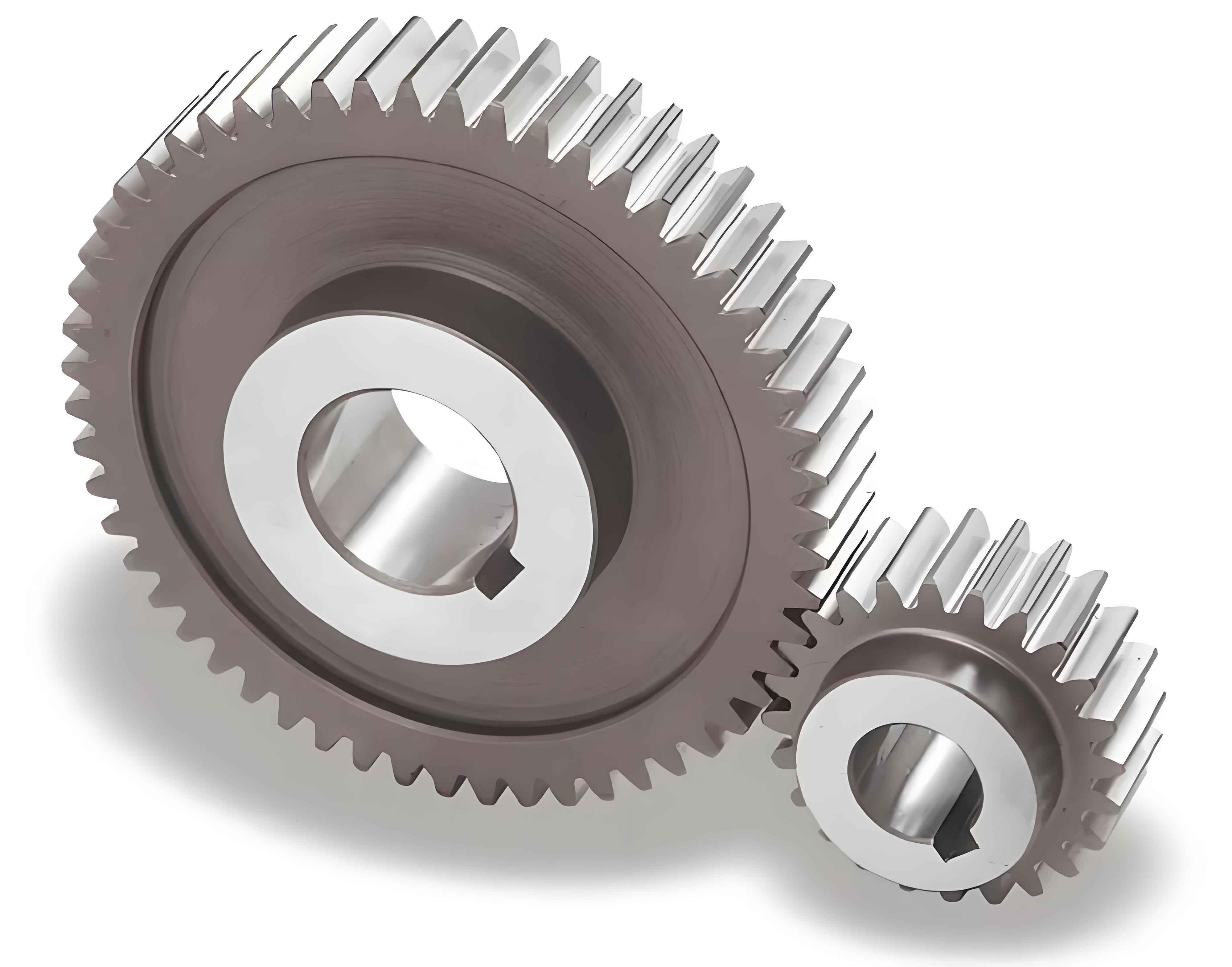
In the parameter design phase, I focused on determining the theoretical fertilizer discharge amount based on the geometry of the spur gears. The volume of a single gear slot was calculated using the “Mass Properties” function in SolidWorks, which provided an accurate measurement for the fertilizer capacity. For a spur gear with a tooth width of 30 mm, 8 teeth, and a module of 6 mm, the volume of one gear slot was found to be 4196.27 mm³. This volume is critical as it represents the amount of fertilizer that can be carried per slot, assuming a filling coefficient. The theoretical mass of fertilizer discharged, \( M \), can be expressed by the formula:
$$ M = \frac{8 n t v \rho \gamma}{3} \times 10^{-4} $$
where \( n \) is the rotational speed of the spur gear in revolutions per minute, \( t \) is the operating time in seconds, \( v \) is the volume of a single gear slot in mm³, \( \rho \) is the bulk density of the fertilizer in g/cm³, and \( \gamma \) is the filling coefficient. Based on typical agricultural requirements, such as a maximum operating speed of 3 m/s, a row spacing of 65 cm, a fertilizer bulk density of 1.2 g/cm³, a filling coefficient of 0.7, and a limit fertilization rate of 750 kg/ha, I calculated that a rotational speed of 160 rpm would meet the process demands. This emphasizes the importance of the spur gears’ design in achieving efficient fertilizer application.
To further analyze the performance, I conducted a discrete element method (DEM) simulation using EDEM software. The simulation model was built to replicate the reverse meshing spur gear fertilizer distributor, with parameters set to match real-world conditions. The fertilizer particles were modeled as spherical granules with an average radius of 1.64 mm, and the contact properties between particles and the distributor components were defined using the Hertz-Mindlin (no slip) model. The key parameters used in the simulation are summarized in the table below:
| Property | Type | Value |
|---|---|---|
| Particle Attributes (Fertilizer) | Poisson’s Ratio | 0.25 |
| Shear Modulus (Pa) | 1.0 × 10⁷ | |
| Density (kg/m³) | 1861 | |
| Component Attributes (Spur Gears, Housing) | Poisson’s Ratio | 0.394 |
| Shear Modulus (Pa) | 3.18 × 10⁸ | |
| Density (kg/m³) | 1240 | |
| Contact Parameters (Fertilizer-Fertilizer) | Restitution Coefficient | 0.11 |
| Static Friction Coefficient | 0.30 | |
| Rolling Friction Coefficient | 0.10 | |
| Contact Parameters (Fertilizer-Components) | Restitution Coefficient | 0.41 |
| Static Friction Coefficient | 0.32 | |
| Rolling Friction Coefficient | 0.18 |
In the simulation, I generated 10,000 particles at a rate of 10,000 particles per second, with the spur gears rotating at 60 rpm. A collection plate moving at 0.5 m/s was placed below the distributor to capture the discharged fertilizer. The simulation time step was set to 1.53 × 10⁻⁵ s, and data were recorded at intervals of 0.01 s over a total duration of 3.8 s. To evaluate the discharge uniformity, I divided the collection plate into 10 equal grids, each 25 mm in length, and measured the mass of fertilizer in each grid. The coefficient of variation for discharge uniformity, \( \sigma \), was calculated using the following formulas:
$$ \bar{m} = \frac{\sum_{i=1}^{10} m_i}{n} $$
$$ s = \sqrt{\frac{\sum_{i=1}^{10} (m_i – \bar{m})^2}{n-1}} $$
$$ \sigma = \frac{s}{\bar{m}} \times 100\% $$
where \( \bar{m} \) is the average mass of fertilizer per grid, \( m_i \) is the mass in the i-th grid, \( n \) is the number of grids (10), and \( s \) is the standard deviation. The results showed that the fertilizer mass fluctuated over time due to the alternating discharge from the two spur gears, which is inherent to the reverse meshing mechanism. This fluctuation highlights the dynamic nature of the discharge process and the need to optimize the distributor’s orientation.
For the single-factor experiment, I varied the deflection angle \( \theta \) of the distributor, which represents the angle between the distributor and the direction of the collection plate’s movement. In practical terms, this angle corresponds to the angle between the distributor and the machine’s travel direction, denoted as \( \alpha \), where \( \alpha = 180^\circ – \theta \). The experiment covered angles from 0° to 90° in increments of 15°, specifically 0°, 15°, 30°, 45°, 60°, 75°, and 90°. This range was chosen because the distributor’s symmetry ensures that behavior in other quadrants (e.g., 90° to 180°) would mirror these results. The primary goal was to determine how \( \theta \) affects the discharge uniformity, with a focus on the role of the spur gears in directing the fertilizer’s initial velocity.
The table below summarizes the results of the single-factor experiment, showing the coefficient of variation \( \sigma \) for each deflection angle:
| Deflection Angle \( \theta \) (°) | Coefficient of Variation \( \sigma \) (%) |
|---|---|
| 0 | 25.4 |
| 15 | 22.1 |
| 30 | 19.8 |
| 45 | 17.5 |
| 60 | 15.3 |
| 75 | 13.2 |
| 90 | 11.8 |
As observed, the coefficient of variation decreases consistently as the deflection angle increases from 0° to 90°. This trend indicates that a larger deflection angle leads to better fertilizer uniformity. At \( \theta = 90^\circ \), which corresponds to the distributor being perpendicular to the machine’s travel direction (\( \alpha = 90^\circ \)), the coefficient of variation reaches its minimum value of 11.8%, signifying optimal performance. This improvement can be attributed to the alignment of the initial velocity vectors of the fertilizer discharged from both spur gears. When \( \theta = 90^\circ \), the velocity direction of the fertilizer from each spur gear is perpendicular to the collection plate’s movement, resulting in a more symmetric and uniform distribution pattern. In contrast, at smaller angles, the velocity vectors cause the fertilizer to concentrate in certain areas, leading to higher variability.
To delve deeper into the mechanics, consider the dynamics of the spur gears during operation. The reverse meshing action means that the two spur gears rotate in opposite directions, with their teeth engaging to push fertilizer through the discharge outlet. The initial velocity of the fertilizer particles, \( v_p \), can be approximated based on the rotational speed of the spur gears and the gear geometry. For a spur gear with pitch diameter \( D \), the tangential velocity at the gear’s periphery is given by:
$$ v_t = \frac{\pi D n}{60} $$
where \( n \) is the rotational speed in rpm. This velocity influences the trajectory of the fertilizer particles upon discharge. The angle between this velocity vector and the collection plate’s movement direction, which is determined by \( \theta \), affects the spread pattern. When \( \theta = 90^\circ \), the velocity vectors from both spur gears are orthogonal to the movement direction, minimizing interference and promoting even distribution. This is particularly important for spur gears, as their straight-toothed design ensures consistent discharge but requires careful orientation to avoid skewed patterns.
Furthermore, the simulation revealed that the discharge process is characterized by periodic fluctuations, as evidenced by the mass-time graph from the monitoring zone. The fertilizer mass oscillates due to the alternating discharge from the two spur gears, with peaks corresponding to the passage of gear slots over the outlet. This behavior underscores the importance of the spur gears’ synchronization and the deflection angle in smoothing out these fluctuations. By optimizing the angle, the overall system can achieve a more stable discharge, which is critical for uniform fertilization in field conditions.
In addition to the single-factor experiment, I considered the implications of these findings for real-world applications. For instance, in a typical fertilizer spreader, the distributor is mounted on a moving vehicle, and the deflection angle can be adjusted during setup. The results suggest that setting the distributor at a 90° angle to the travel direction would maximize performance. This adjustment is relatively simple and could lead to significant improvements in fertilizer use efficiency, reducing waste and environmental impact. The role of spur gears in this context cannot be overstated; their robust design and predictable motion make them ideal for such precision tasks.
To generalize the results, I derived a mathematical model linking the deflection angle to the discharge uniformity. Let \( \sigma(\theta) \) represent the coefficient of variation as a function of the deflection angle. Based on the experimental data, \( \sigma(\theta) \) can be approximated by a linear decay function:
$$ \sigma(\theta) = \sigma_0 – k \theta $$
where \( \sigma_0 \) is the coefficient of variation at \( \theta = 0^\circ \) and \( k \) is a decay constant. From the data, \( \sigma_0 \approx 25.4\% \) and \( k \approx 0.15 \) per degree, indicating a steady improvement with increasing angle. This model can be used to predict performance for angles within the tested range and highlights the sensitivity of the system to orientation changes.
In conclusion, my investigation demonstrates that the deflection angle of a reverse meshing spur gear fertilizer distributor has a significant impact on discharge performance. Through DEM simulations and single-factor experiments, I found that increasing the deflection angle from 0° to 90° reduces the coefficient of variation for discharge uniformity, with the best results achieved at 90°. This optimal angle ensures that the initial velocity of the fertilizer from the spur gears is perpendicular to the machine’s travel direction, leading to a symmetric and uniform distribution. These insights can guide the design and adjustment of fertilization equipment, emphasizing the importance of spur gears in achieving efficient and precise fertilizer application. Future work could explore additional factors, such as gear tooth profile modifications or variable speed operations, to further enhance performance.