
In the field of precision mechanical transmissions, the strain wave gear, also known as harmonic drive, represents a pivotal technology due to its compact design, high reduction ratios, and exceptional positioning accuracy. As a researcher deeply involved in the analysis and optimization of these systems, I have focused on understanding how the geometric parameters of the flexspline tooth profile influence a critical performance metric: the no-load meshing backlash. Backlash, defined as the clearance between mating teeth, significantly impacts transmission stability, load distribution, vibration, and overall carrying capacity. A smaller and more uniformly distributed backlash is desirable for high-performance applications such as aerospace and robotics. This article presents a comprehensive investigation from my perspective, employing an exact conjugate methodology to explore the effects of flexspline double circular arc profile parameters—namely the convex arc radius, the concave arc radius, and the common tangent inclination angle—on the conjugate zone, the theoretical conjugate tooth profile of the circular spline, and ultimately, the backlash distribution. The strain wave gear principle relies on the controlled elastic deformation of the flexspline by a wave generator to achieve motion transmission, making the interplay between deformation and tooth geometry paramount.
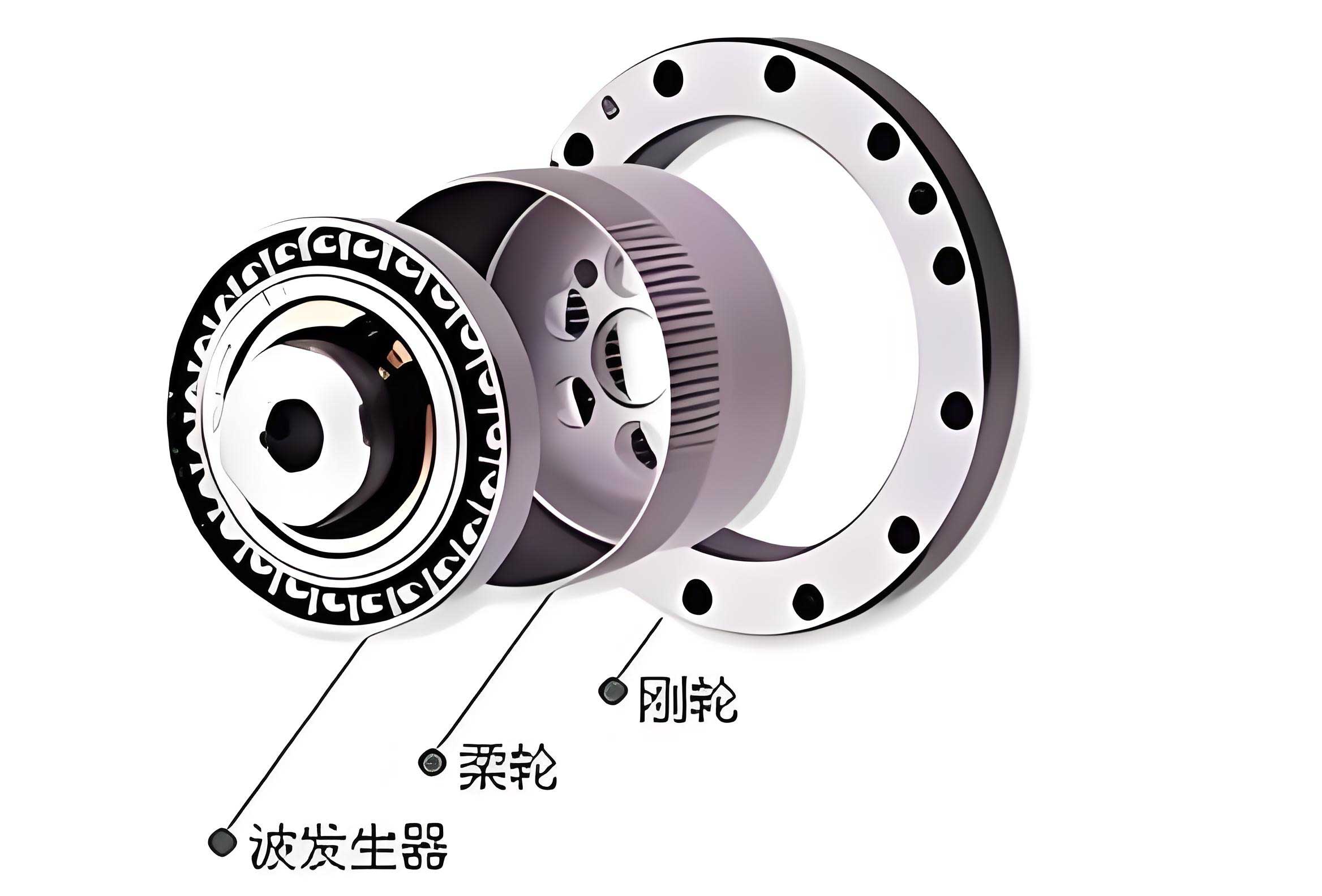
My analysis begins with establishing a precise kinematic model for the strain wave gear system. Under the assumptions of ideal light loading, in extensibility of the neutral curve of the flexspline after deformation, and perfect contact between the flexspline and the wave generator, the meshing at any cross-section can be treated as a planar gearing problem. The periodic and symmetric nature of the deformation allows the study of the entire gear ring to be simplified to analyzing a single tooth pair over one motion cycle. The core of the modeling involves defining coordinate systems and the tooth profile equations. A local coordinate system \( S_1(O_1x_1y_1) \) is attached to the flexspline tooth, with its origin \( O_1 \) on the neutral curve and the \( y_1 \)-axis aligned with the tooth’s symmetry axis. The double circular arc profile, characterized by a convex arc near the tooth tip, a concave arc near the root, and a connecting straight line segment, is parameterized by the arc length \( u \).
The profile coordinates and normal vectors for the right side of the tooth (from tip A to root D) are given in homogeneous coordinates by the following piecewise equations. For the convex arc segment AB (\( u \in (0, l_1) \)):
$$
\mathbf{r}_1(u) = \begin{bmatrix}
\rho_a \cos(\theta – \frac{u}{\rho_a}) + x_{oa} \\
\rho_a \sin(\theta – \frac{u}{\rho_a}) + y_{oa} \\
1
\end{bmatrix}, \quad \mathbf{n}_1(u) = \begin{bmatrix}
\cos(\theta – \frac{u}{\rho_a}) \\
\sin(\theta – \frac{u}{\rho_a}) \\
1
\end{bmatrix}
$$
For the straight line segment BC (\( u \in (l_1, l_2) \)):
$$
\mathbf{r}_2(u) = \begin{bmatrix}
x_B + (u – l_1) \sin \gamma \\
y_B – (u – l_1) \cos \gamma \\
1
\end{bmatrix}, \quad \mathbf{n}_2(u) = \begin{bmatrix}
\cos \gamma \\
\sin \gamma \\
1
\end{bmatrix}
$$
For the concave arc segment CD (\( u \in (l_2, l_3) \)):
$$
\mathbf{r}_3(u) = \begin{bmatrix}
x_{of} – \rho_f \cos(\gamma + \frac{u – l_2}{\rho_f}) \\
y_{of} – \rho_f \sin(\gamma + \frac{u – l_2}{\rho_f}) \\
1
\end{bmatrix}, \quad \mathbf{n}_3(u) = \begin{bmatrix}
\cos(\gamma + \frac{u – l_2}{\rho_f}) \\
\sin(\gamma + \frac{u – l_2}{\rho_f}) \\
1
\end{bmatrix}
$$
Here, \( \rho_a \) and \( \rho_f \) are the radii of the convex and concave arcs, respectively; \( \gamma \) is the inclination angle of the common tangent line (the straight segment); \( \theta = \arcsin\left(\frac{h_a + X_a}{\rho_a}\right) \); \( x_{oa} = -l_a \), \( y_{oa} = h_f + t – X_a \); \( l_1 = \rho_a (\theta – \gamma) \); \( x_B = \rho_a \cos \gamma + x_{oa} \), \( y_B = \rho_a \sin \gamma + y_{oa} \); \( l_2 = l_1 + \frac{h_l}{\cos \gamma} \); \( x_{of} = (\rho_a + \rho_f) \cos \gamma + h_l \tan \gamma – l_a \), \( y_{of} = h_f + t + X_f \); and \( l_3 = l_2 + \rho_f \left( \arcsin\left(\frac{X_f + h_f}{\rho_f}\right) – \gamma \right) \). Parameters like \( h_a \), \( h_f \), \( h_l \), \( X_a \), \( X_f \), \( l_a \), and \( t \) are derived from the basic gear geometry (module, addendum, dedendum, etc.). This parametric definition is fundamental for all subsequent conjugate analysis in the strain wave gear.
To describe the relative motion, I establish three coordinate systems: a fixed system \( S_2(O_2x_2y_2) \) attached to the circular spline, a moving system \( S(Oxy) \) attached to the wave generator with its y-axis along the major axis, and the flexspline tooth system \( S_1 \). The wave generator is considered the input, rotating counterclockwise, while the flexspline is the output, rotating clockwise, with the circular spline fixed. A key aspect of my exact method is the treatment of the flexspline neutral curve deformation. The undeformed neutral curve is a circle of radius \( r_b \), and the deformed curve, under the action of an elliptical wave generator, is described in polar coordinates \( (r(\varphi_1), \varphi_1) \) relative to the wave generator’s major axis. The condition of no elongation of the neutral curve is enforced precisely:
$$
r_b \varphi = \int_0^{\varphi_1} \sqrt{ r^2(\varphi_1) + \left( \frac{dr}{d\varphi_1} \right)^2 } \, d\varphi_1
$$
where \( \varphi \) is the angular coordinate on the undeformed circle corresponding to the point at angle \( \varphi_1 \) on the deformed ellipse. For an elliptical profile with semi-major axis \( a \) and semi-minor axis \( b \), the polar radius is \( r(\varphi_1) = a / \sqrt{1 + \varepsilon^2 \sin^2 \varphi_1} \), with \( \varepsilon \) being the second eccentricity. The derivative is \( dr/d\varphi_1 = -a \varepsilon^2 \sin \varphi_1 \cos \varphi_1 / (1 + \varepsilon^2 \sin^2 \varphi_1)^{3/2} \). The relation between \( \varphi \) and \( \varphi_1 \) involves an elliptic integral of the second kind \( E \):
$$
\varphi(\varphi_1) = \frac{a}{r_b} \left\{ E\left(\frac{\pi}{2}, e\right) – E\left( \frac{\pi}{2} – \arctan\left( \frac{a}{b} \tan \varphi_1 \right), e \right) \right\}
$$
where \( e \) is the first eccentricity. All other kinematic angles, such as the rotation angles of the wave generator \( \varphi_2 \) and the flexspline, can be expressed as functions of \( \varphi_1 \), which I choose as the independent variable for the exact conjugate solution. This approach avoids the approximations often made in traditional methods regarding arc length calculations.
The conjugate tooth profile of the circular spline is determined by solving the condition of continuous contact, which requires that the relative velocity at the contact point is orthogonal to the common normal vector. The coordinate transformation from the flexspline system \( S_1 \) to the circular spline system \( S_2 \) is given by the matrix:
$$
\mathbf{M}_{21} = \begin{bmatrix}
\cos \beta & \sin \beta & r \sin \gamma \\
-\sin \beta & \cos \beta & r \cos \gamma \\
0 & 0 & 1
\end{bmatrix}
$$
where \( \beta \) is the effective rotation angle of the flexspline tooth, \( r = r(\varphi_1) \), and \( \gamma \) here is the angle of the radial line \( OO_1 \) (not to be confused with the tooth profile angle, though the symbol is reused in context). The condition for conjugation, derived from \( \mathbf{n}_1^T \mathbf{\Phi} \mathbf{r}_1 = 0 \), where \( \mathbf{\Phi} = \mathbf{W}_{21}^T \frac{d\mathbf{M}_{21}}{d\varphi_1} \) and \( \mathbf{W}_{21} \) is the upper 2×2 block of \( \mathbf{M}_{21} \), yields a specific equation that must be satisfied for each point on the flexspline tooth profile. By discretizing the flexspline profile into \( s \) points with parameters \( u_j \), I numerically solve for the corresponding \( \varphi_{1j} \) that satisfies the conjugation condition for each point. Subsequently, the conjugate points on the circular spline are obtained via:
$$
\mathbf{r}_i^{(2)} = \mathbf{M}_{21} \mathbf{r}_i^{(1)} \quad (i=0,1,2)
$$
This process generates the theoretical conjugate tooth profile of the circular spline for the given strain wave gear configuration. A notable phenomenon in strain wave gearing is the occurrence of double conjugation, where a single point on the flexspline tooth can conjugate at two distinct wave generator positions within a cycle, leading to two separate meshing zones. This characteristic is beneficial for increasing torsional stiffness and transmission accuracy.
The calculation of backlash is performed after obtaining the conjugate profiles. Both the flexspline and circular spline tooth profiles are discretized into a dense set of points (with spacing on the order of \( 10^{-6} \) mm to minimize error). For a given meshing position (defined by the wave generator angle \( \varphi_1 \)), the flexspline profile points are transformed into the fixed coordinate system \( S_2 \). For each flexspline point, the shortest distance to the circular spline profile is computed efficiently by only considering circular spline points with greater y-coordinates. Let \( (x_{m2}, y_{m2}) \) be a flexspline point and \( (x_{n2}, y_{n2}) \) be a circular spline point. The shortest distance \( d_{mn} \) is found among all such pairs. The backlash \( \delta \) for that tooth pair is then given by:
$$
\delta = \frac{\min(d_{mn})}{\cos(\eta + \xi)}
$$
where \( \eta = \arctan(y_{m2} / x_{m2}) \) and \( \xi = \arctan((y_{n2} – y_{m2}) / (x_{n2} – x_{m2})) \). A negative backlash value indicates tooth profile interference, which is undesirable. This method allows me to map the backlash distribution across the multiple tooth pairs that are simultaneously in mesh, typically around 23 pairs on one side of the wave generator major axis in a given design.
To systematically study the influence of flexspline profile parameters, I define a baseline case with the following specifications, common in strain wave gear design: module \( m = 0.32 \) mm, radial deformation coefficient \( w_0^* = 1.0 \), total tooth height \( h = 1.5m \), addendum \( h_a = 0.6m \), dedendum \( h_f = 0.9m \), number of teeth on the circular spline \( Z_R = 160 \), and on the flexspline \( Z_G = 162 \). The derived profile parameters for the baseline are: convex arc center offset \( X_a = 0.1020 \) mm, convex arc center shift \( l_a = 0.4165 \) mm, distance from the root circle to the neutral layer \( t = 0.4185 \) mm, and common tangent longitudinal length \( h_l = 0.0400 \) mm. The three key variables under investigation are: the convex arc radius \( \rho_a \), the concave arc radius \( \rho_f \), and the common tangent inclination angle \( \gamma \). The baseline values are \( \rho_a = 0.62 \) mm, \( \rho_f = 0.62 \) mm, and \( \gamma = 11.8^\circ \). I vary each parameter individually while keeping the others at baseline to isolate their effects.
The first aspect I analyze is the influence on the conjugate zone, which is the range of the flexspline tooth profile (in terms of arc length parameter \( u \)) that can achieve conjugate contact. The results for variations in \( \rho_a \), \( \rho_f \), and \( \gamma \) are summarized qualitatively below and then supported by detailed tables. For the strain wave gear, the conjugate zone typically consists of two separate intervals corresponding to the double conjugation phenomenon. The length and position of these intervals relative to the tooth profile segments (convex arc, straight line, concave arc) are critical for ensuring continuous meshing and load sharing.
The effect of the convex arc radius \( \rho_a \) is pronounced. As \( \rho_a \) increases, the conjugate interval on the convex arc segment decreases slightly for the first conjugate zone and more significantly for the second conjugate zone. The corresponding arc length of active meshing on the convex part reduces. However, the blank zone (the non-conjugating region between the two conjugate zones) remains largely unchanged. Since the total tooth height is fixed, a reduction in the convex arc’s active length often leads to a compensatory increase in the length of the concave arc segment. Conversely, decreasing \( \rho_a \) expands the conjugate zone on the convex segment, which is beneficial for increasing the potential load-bearing area in the strain wave gear.
Variations in the concave arc radius \( \rho_f \) show a different trend. Increasing \( \rho_f \) has minimal impact on the conjugate zones associated with the convex arc and straight line segments. The conjugate zone on the concave arc itself for the second conjugation decreases gradually as \( \rho_f \) increases. The blank zone remains stable. This suggests that the concave arc radius primarily influences the meshing behavior near the tooth root in the later stage of conjugation.
The common tangent inclination angle \( \gamma \) has a substantial and complex influence. Increasing \( \gamma \) causes a reduction in the conjugate zones on the convex arc segment for both first and second conjugation, shrinking the active arc length there. The conjugate zone on the concave arc remains relatively constant in extent, but its positional arc length increases because the straight line segment’s geometry changes. Most critically, the blank zone between the two conjugate zones widens significantly as \( \gamma \) increases. A large blank zone is detrimental as it reduces the overlap of meshing and can lead to discontinuous force transmission in the strain wave gear. Therefore, a smaller \( \gamma \) is generally favorable for maximizing the conjugate zone and ensuring smoother operation.
To quantify these effects on the generated circular spline tooth profile, I perform a least-squares circular arc fit on the discrete conjugate points obtained for different flexspline parameters. The resulting circular spline profile can also be approximated as a double circular arc. The fitted parameters—radii and center coordinates for the circular spline’s concave and convex arcs—are tabulated below. These parameters determine the manufactured shape of the circular spline in a theoretical sense for a strain wave gear set.
| Flexspline Parameter Variation | Circular Spline Concave Arc Radius (mm) | Circular Spline Concave Arc Center (x, y) mm | Circular Spline Convex Arc Radius (mm) | Circular Spline Convex Arc Center (x, y) mm |
|---|---|---|---|---|
| \( \rho_a = 0.52 \) mm (Baseline: \( \rho_f=0.62, \gamma=11.8^\circ \)) | 0.5362 | (-0.4298, 25.8100) | 0.5946 | (0.6856, 25.9990) |
| \( \rho_a = 0.56 \) mm | 0.5791 | (-0.4325, 25.8091) | 0.5945 | (0.7246, 26.0071) |
| \( \rho_a = 0.60 \) mm | 0.6230 | (-0.4362, 25.8078) | 0.5969 | (0.7661, 26.0161) |
| \( \rho_a = 0.64 \) mm | 0.6666 | (-0.4397, 25.8068) | 0.5967 | (0.8050, 26.0242) |
| \( \rho_f = 0.50 \) mm (Baseline: \( \rho_a=0.62, \gamma=11.8^\circ \)) | 0.6460 | (-0.4391, 25.8069) | 0.4840 | (0.6748, 25.9983) |
| \( \rho_f = 0.54 \) mm | 0.6460 | (-0.4391, 25.8069) | 0.5226 | (0.7127, 26.0059) |
| \( \rho_f = 0.58 \) mm | 0.6460 | (-0.4391, 25.8069) | 0.5586 | (0.7481, 26.0126) |
| \( \rho_f = 0.62 \) mm | 0.6460 | (-0.4391, 25.8069) | 0.5954 | (0.7842, 26.0196) |
| \( \gamma = 11.8^\circ \) (Baseline: \( \rho_a=0.62, \rho_f=0.62 \)) | 0.6460 | (-0.4391, 25.8069) | 0.5954 | (0.7842, 26.0196) |
| \( \gamma = 12.0^\circ \) | 0.6422 | (-0.4355, 25.8081) | 0.5973 | (0.7853, 26.0245) |
| \( \gamma = 12.2^\circ \) | 0.6432 | (-0.4364, 25.8078) | 0.5981 | (0.7853, 26.0289) |
| \( \gamma = 12.4^\circ \) | 0.6419 | (-0.4352, 25.8083) | 0.5987 | (0.7851, 26.0335) |
From the tables, I observe that the convex arc radius \( \rho_a \) of the flexspline has a strong influence on the concave arc radius of the circular spline, causing it to increase nearly proportionally. It also significantly affects the x-coordinate of the circular spline’s convex arc center. The concave arc radius \( \rho_f \) of the flexspline, however, dictates the convex arc radius of the circular spline, with a clear increasing trend, while leaving the circular spline’s concave arc parameters unchanged. The inclination angle \( \gamma \) has a comparatively minor effect on the circular spline’s fitted arc parameters, causing only slight variations. This indicates that for manufacturing purposes, the choice of \( \rho_a \) and \( \rho_f \) directly and predictably shapes the mating gear’s tooth profile in a strain wave gear set, whereas \( \gamma \) primarily affects the meshing kinematics rather than the conjugate profile’s basic circular arc dimensions.
The most critical performance metric, the no-load backlash distribution, is computed for the multiple tooth pairs in mesh simultaneously. The tooth pairs are numbered from 1 to approximately 23 on one side of the wave generator major axis. The backlash values for variations in each parameter are plotted conceptually, and the key trends are extracted. To present these findings systematically, I summarize the backlash characteristics in the following table, which includes the average backlash, the range (max-min), and the standard deviation as measures of magnitude and uniformity for different parameter sets. The backlash is calculated at the initial wave generator position (major axis aligned with the circular spline tooth space symmetry axis).
| Parameter Set (Varied from Baseline) | Average Backlash (µm) | Backlash Range (µm) | Standard Deviation (µm) | Notable Distribution Trend |
|---|---|---|---|---|
| Baseline: \( \rho_a=0.62, \rho_f=0.62, \gamma=11.8^\circ \) | 5.2 | 4.1 | 1.3 | Decreases then increases, minimum near pair 11 |
| \( \rho_a = 0.56 \) mm | 6.8 | 5.7 | 1.8 | Similar trend, higher overall values |
| \( \rho_a = 0.60 \) mm | 5.9 | 4.9 | 1.5 | Trend consistent, values between baseline and smaller ρ_a |
| \( \rho_a = 0.64 \) mm | 4.3 | 3.0 | 0.9 | Most uniform, lowest values |
| \( \rho_f = 0.58 \) mm | 6.5 | 5.4 | 1.7 | Higher backlash, especially in later pairs |
| \( \rho_f = 0.62 \) mm (Baseline) | 5.2 | 4.1 | 1.3 | As above |
| \( \rho_f = 0.66 \) mm | 3.8 | 2.8 | 0.8 | Lower and more uniform backlash |
| \( \rho_f = 0.70 \) mm | 2.5 | 1.9 | 0.6 | Very low backlash, risk of interference if increased further |
| \( \gamma = 11.6^\circ \) | 4.0 | 3.2 | 1.0 | Lower and relatively uniform |
| \( \gamma = 11.8^\circ \) (Baseline) | 5.2 | 4.1 | 1.3 | As above |
| \( \gamma = 12.0^\circ \) | 7.1 | 6.3 | 2.1 | Higher backlash, increasing trend more pronounced |
| \( \gamma = 12.2^\circ \) | 9.5 | 8.9 | 2.9 | Significantly higher and less uniform backlash |
The backlash distribution typically follows a pattern: starting from tooth pair 1 (nearest the major axis), backlash is relatively high, then it decreases to a minimum around pair 10-12, before increasing again and then slightly decreasing towards the last pairs. The parameters modify this pattern’s amplitude and shape. Increasing the convex arc radius \( \rho_a \) reduces both the magnitude and the variability of backlash, leading to a more uniform distribution. This is advantageous for the strain wave gear’s smooth operation. However, as discussed earlier, a larger \( \rho_a \) reduces the conjugate zone on the convex segment, which could negatively impact load-sharing capability. Thus, a trade-off exists. Increasing the concave arc radius \( \rho_f \) also effectively reduces backlash and improves uniformity. In fact, for the given geometry, increasing \( \rho_f \) beyond approximately 0.70 mm would result in negative backlash (interference) for some tooth pairs, indicating a limit. The relation can be approximated for small changes near the baseline as \( \delta \approx k_1 / \rho_f + c_1 \), where \( k_1 \) is negative. The inclination angle \( \gamma \) exhibits a strong influence: reducing \( \gamma \) decreases backlash substantially and makes its distribution more even. The increase in backlash with \( \gamma \) is non-linear and can be approximated by \( \delta \approx k_2 \gamma^2 + c_2 \), with \( k_2 > 0 \). Moreover, a smaller \( \gamma \) reduces the blank zone between conjugate zones, promoting more continuous meshing in the strain wave gear.
To illustrate the meshing sequence and backlash variation dynamically, I simulated the relative motion of the flexspline tooth profiles with respect to the circular spline over a 90-degree rotation of the wave generator for a selected parameter set (\( \rho_a = 0.60 \) mm, \( \rho_f = 0.62 \) mm, \( \gamma = 11.8^\circ \)). The transformation of coordinates for multiple positions shows no tooth interference and a small, varying clearance. The minimum clearance observed during the motion aligns with the backlash values calculated at discrete positions. The mathematical representation of the transformed points at any wave generator angle \( \varphi_1 \) is given by the coordinate transformation applied to all discretized profile points. For a point \( \mathbf{r}_1 \) on the flexspline in \( S_1 \), its position in \( S_2 \) during motion is:
$$
\mathbf{r}_2(\varphi_1) = \mathbf{M}_{21}(\varphi_1) \, \mathbf{r}_1
$$
where \( \mathbf{M}_{21} \) depends on \( \varphi_1 \) as defined earlier. By evaluating this for a sequence of \( \varphi_1 \) values, the entire meshing cycle can be visualized, confirming the absence of collision and the presence of a small, functional clearance essential for lubrication and manufacturing tolerances in a practical strain wave gear.
From a design optimization perspective for strain wave gears, the goal is often to maximize the conjugate zone (to improve load capacity and stiffness) while minimizing and uniformizing backlash (to enhance precision and reduce vibration). My analysis reveals that these objectives can be conflicting. For instance, decreasing \( \rho_a \) increases the conjugate zone but increases backlash; increasing \( \rho_f \) decreases backlash but may slightly reduce the concave arc conjugate zone; decreasing \( \gamma \) benefits both conjugate zone (by reducing the blank zone) and backlash. Therefore, an optimal design requires a multi-variable optimization. I can formulate a simplified objective function \( F(\rho_a, \rho_f, \gamma) \) to be minimized, such as:
$$
F = w_1 \cdot \delta_{\text{avg}} + w_2 \cdot \sigma_{\delta} – w_3 \cdot L_c
$$
where \( \delta_{\text{avg}} \) is the average backlash, \( \sigma_{\delta} \) is its standard deviation, \( L_c \) is the total effective conjugate arc length (sum of lengths of both conjugate zones), and \( w_1, w_2, w_3 \) are weighting factors reflecting the design priorities for the strain wave gear. Constraints must include positive backlash (e.g., \( \delta_{\min} > \delta_{\text{allowable}} > 0 \)) and geometric limits (e.g., tooth thickness at the pitch line, avoiding undercut). Using numerical methods, one can search the parameter space to find a Pareto-optimal set.
Furthermore, the double conjugation phenomenon inherent in strain wave gears adds complexity. The two conjugate zones mean that each tooth pair engages twice per wave generator cycle, which can help average out errors and reduce sensitivity to profile deviations. The parameters influence the separation and extent of these zones. A design with well-separated but substantial conjugate zones might offer better load distribution than one with a single continuous zone. My analysis shows that a smaller \( \gamma \) brings the two zones closer, reducing the blank zone and potentially creating a more continuous engagement, which is beneficial for torque ripple reduction.
In conclusion, through this detailed investigation using an exact conjugate method, I have demonstrated that the flexspline tooth profile parameters in a double circular arc strain wave gear system have a decisive and interconnected influence on the conjugate meshing zone, the theoretical shape of the circular spline tooth, and the no-load backlash distribution. The convex arc radius \( \rho_a \) significantly affects the conjugate zone on the convex segment and the circular spline’s concave arc; reducing it enlarges the conjugate zone but increases backlash. The concave arc radius \( \rho_f \) primarily influences backlash and the circular spline’s convex arc; increasing it reduces backlash effectively. The common tangent inclination angle \( \gamma \) strongly impacts the conjugate zone separation and backlash; reducing it simultaneously increases the conjugate zone, reduces backlash, and improves uniformity, making it a highly sensitive parameter for optimization. For a high-performance strain wave gear, a balanced selection of these parameters, possibly with a smaller \( \gamma \), a moderately high \( \rho_f \), and a \( \rho_a \) chosen to balance conjugate zone and backlash, can yield a design with enhanced load capacity, transmission accuracy, and smooth operation. Future work could integrate elastic deformation of the tooth itself under load, thermal effects, and manufacturing tolerances into this exact kinematic framework to further refine the design of advanced strain wave gear systems.