
This investigation addresses the critical influence of surface topography on the contact performance of helical gears, which is paramount for the load-bearing capacity and vibration-noise characteristics of transmission systems such as automatic transmissions. Surface performance is fundamentally governed by microscopic morphological features. Therefore, studying the effect of surface topography on contact stiffness is of significant importance for enhancing the contact performance of helical gears. Based on fractal theory, the Weierstrass-Mandelbrot (W-M) fractal function is employed to characterize engineering rough surfaces possessing fractal properties. The W-M function satisfies the conditions of being continuous yet non-differentiable everywhere, exhibiting self-affinity and scale independence, making it a suitable choice for representing the tooth surface morphology of helical gears. The Majumdar-Bhushan (M-B) fractal contact model is a primary method applying fractal theory to surface contact analysis. It integrates fractal theory with Hertzian theory, providing a rational and accurate framework for analyzing gear contact performance, thereby offering a theoretical foundation for gear optimization design.
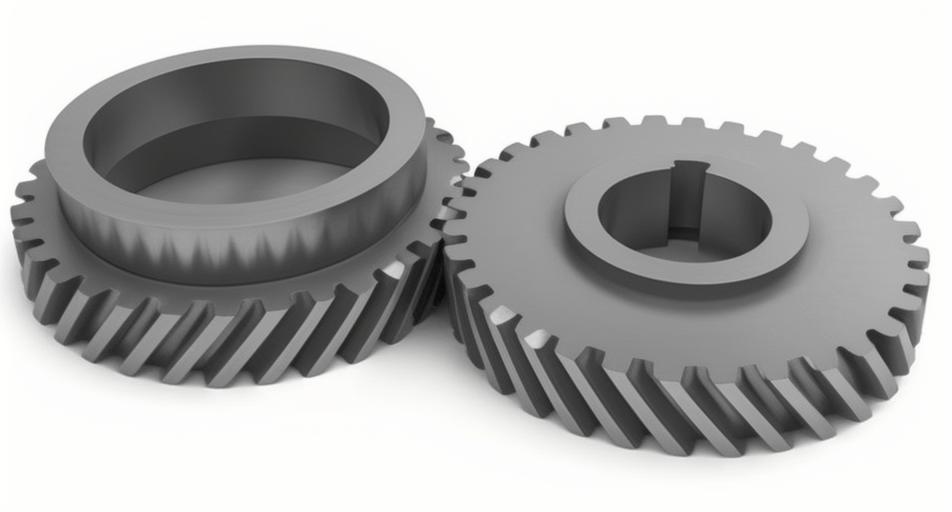
This work first utilizes an improved three-dimensional W-M fractal function to characterize the surface topography of helical gear teeth, integrating parameters from both the tooth height and tooth width directions. Subsequently, within the framework of the M-B fractal contact model, the conventional spherical asperity assumption is replaced with a conical asperity model to establish a more realistic contact mechanics model for helical gears. A surface contact coefficient is introduced into this conical-based model to modify the asperity contact area distribution function, making it applicable for the curved-surface contact scenario of meshing helical gears. Furthermore, the time-varying nature of the contact curvature radius during the meshing process of helical gears is incorporated. A comprehensive time-varying contact stiffness model is thus developed. The influences of key fractal parameters—namely the fractal dimension, characteristic scale coefficient, dimensionless real contact area, and material plasticity index—on the time-varying contact load and stiffness are systematically investigated. Finally, the differences between the conical asperity model and the classical M-B model are compared. The calculated time-varying contact stiffness is integrated into a potential energy-based time-varying mesh stiffness model and compared with results from the ISO 6336-1:2006 standard, thereby validating the rationality and accuracy of the proposed conical asperity-based time-varying contact stiffness model for helical gears.
1. Characterization of Helical Gear Surface Topography Based on the Improved W-M Fractal Function
1.1 Measurement of Helical Gear Surface Topography
The basic structure of an automatic transmission planetary gear set is considered. The primary parameters of the studied helical gears are listed in the table below.
| Parameter | Value |
|---|---|
| Driver Gear Teeth / Driven Gear Teeth | 26 / 34 |
| Module (mm) | 1.25 |
| Pressure Angle (°) | 20 |
| Addendum Coefficient | 1 |
| Face Width (mm) | 20 |
| Helix Angle (°) | 15 |
| Material | 20CrMnTi |
Wear on helical gear tooth surfaces predominantly occurs near the root and tip regions. Therefore, sample areas at the tooth root and tooth tip of a single tooth flank are selected for topography acquisition. A white light interferometer is used to measure the three-dimensional surface topography within these sample regions. Two-dimensional profiles along both the tooth height and tooth width directions are extracted for analysis.
The fractal parameters are extracted using the structure function method. The structure function for a surface profile is defined as the incremental variance of the height function:
$$S(\tau) = \langle [z(x+\tau) – z(x)]^2 \rangle = C G^{2(D-1)} \tau^{4-2D}$$
where \( x \) is the coordinate along the profile, \( \tau \) is the lag distance, \( z(\cdot) \) is the surface height, \( \langle \cdot \rangle \) denotes spatial averaging, \( D \) is the fractal dimension, \( G \) is the characteristic scale coefficient, and \( C \) is a constant dependent on \( D \) and the scale factor \( \gamma \) (typically taken as 1.5). Taking the logarithm of both sides yields a linear relationship:
$$\lg S(\tau) = (4-2D) \lg \tau + \lg \left( C G^{2(D-1)} \right)$$
The fractal dimension \( D \) and characteristic scale coefficient \( G \) are obtained from the slope and intercept of the fitted line of \( \lg S(\tau) \) versus \( \lg \tau \). The calculated fractal parameters for the two sample regions are summarized below.
| Sample Region | Direction | Fractal Parameter | Value |
|---|---|---|---|
| Region 1 | Tooth Height | Fractal Dimension \( D \) | 1.630 |
| Tooth Width | Characteristic Scale \( G \) | 7.54 × 10⁻⁸ | |
| Region 2 | Tooth Height | Fractal Dimension \( D \) | 1.638 |
| Tooth Width | Characteristic Scale \( G \) | 8.78 × 10⁻⁸ |
1.2 Fractal Characterization of Helical Gear Tooth Surface Topography
To characterize the measured topography, an improved three-dimensional W-M function is employed. Considering the directional texture induced by gear manufacturing processes and the potential for multi-fractal characteristics, a bi-directional superposition approach is adopted. The surface height \( z(x, y) \) is represented by superposing two one-dimensional W-M functions along the tooth height (y-direction) and tooth width (x-direction):
$$
\begin{aligned}
z(x, y) = & L_y \left( \frac{G_y}{L_y} \right)^{D_y-2} \sqrt{\ln \gamma} \sum_{n_y=0}^{n_{y_{\max}}} \frac{1}{\gamma^{n_y(3-D_y)}} \left[ \cos \phi_{1,n_y} – \cos\left( \frac{2\pi \gamma^{n_y} y}{L_y} – \phi_{1,n_y} \right) \right] + \\
& L_x \left( \frac{G_x}{L_x} \right)^{D_x-2} \sqrt{\ln \gamma} \sum_{n_x=0}^{n_{x_{\max}}} \frac{1}{\gamma^{n_x(3-D_x)}} \left[ \cos \phi_{1,n_x} – \cos\left( \frac{2\pi \gamma^{n_x} x}{L_x} – \phi_{1,n_x} \right) \right]
\end{aligned}
$$
where \( L \) is the sample length, \( \gamma \) is the scale factor, \( \phi \) is a random phase, and subscripts \( x \) and \( y \) denote parameters for the respective directions.
The influence of fractal parameters on the characterized topography is analyzed. Holding \( G \) constant, an increase in fractal dimension \( D \) leads to a more intricate surface texture with finer details, while the peak-to-valley height tends to decrease. Conversely, holding \( D \) constant, an increase in \( G \) results in a larger peak-to-valley height, indicating a rougher surface. Both parameters are essential for a complete characterization of the surface morphology of helical gears.
Using the extracted fractal parameters from the measurement, the characterized surface topography is generated. A comparison of key topography parameters between the measured and characterized surfaces shows relative errors ranging from 4.7% to 9.7%, confirming the effectiveness of the bi-directional W-M function for characterizing helical gear tooth surfaces.
2. Investigation of Time-Varying Contact Stiffness for Helical Gears Considering Conical Asperities
2.1 Contact Mechanics Model for Helical Gears with Conical Asperities
In the classical M-B fractal contact model, the variation in asperity contact area is equated to the curvature change of a cosine wave. However, the actual change in contact area for a surface asperity is less than that of a cosine wave, leading to discrepancies in the calculated volume and contact area of individual equivalent asperities. Since the shape of asperities on gear rough surfaces more closely resembles cones, a conical asperity contact model is adopted for calculating the contact stiffness of helical gears.
The deformation \( \delta \) of a conical asperity is related to its contact area \( a \) and fractal parameters:
$$\delta = g_1(D) a^{(3-D)/2}, \quad \text{where} \quad g_1(D) = 2^{4-D} \pi^{(D-3)/2} \sqrt{\ln \gamma} \, G^{D-2}$$
For an asperity in elastic deformation, the contact load \( F_e(a) \) is:
$$F_e(a) = 0.2 E^* \sqrt{\pi} \, g_1(D) a^{(4-D)/2}$$
where \( E^* \) is the composite elastic modulus, given by \( 1/E^* = (1-\nu_1^2)/E_1 + (1-\nu_2^2)/E_2 \).
For an asperity in fully plastic deformation, the contact load \( F_p(a) \) is:
$$F_p(a) = H a$$
where \( H \) is the hardness of the softer material, \( H = 2.8 \sigma_y \), and \( \sigma_y \) is its yield strength. The plasticity index is defined as \( \phi = \sigma_y / E^* \).
The size distribution of contact spots (asperities) follows a power law derived from the island area distribution:
$$n(a) = \frac{D}{2} \frac{a_l^{D/2}}{a^{(D/2 + 1)}}$$
where \( a_l \) is the area of the largest contact spot. The total real contact area \( A_r \) is found by integration:
$$A_r = \int_{0}^{a_l} n(a) a \, da = \frac{D}{2-D} a_l$$
For the curved-surface contact of meshing helical gears, a surface contact coefficient \( \lambda \) is introduced to modify the area distribution function:
$$n'(a) = \lambda \, n(a)$$
The coefficient \( \lambda \) accounts for the local curvature and load:
$$\lambda = \lambda_0 F^{C_2 x_h}, \quad \lambda_0 = \left[ \frac{C_1}{\pi (R_1 + R_2)} \left( \frac{4B}{\pi E^*} \sqrt{\frac{R_1 R_2}{R_1 + R_2}} \right)^{C_2} \right]^{x_h}$$
where \( F \) is the normal force, \( C_1, C_2 \) are geometry coefficients (for gears, \( C_1=1, C_2=0.5 \)), \( B \) is the effective face width, \( R_1, R_2 \) are the radii of curvature at the contact point, and \( x_h = 1/R_1 + 1/R_2 \) is the relative curvature.
The radii of curvature for helical gears vary with the meshing position (rotation angle \( \theta \)). For a point \( K \) on the line of action, the radii are:
$$
\begin{aligned}
R_1(\theta) &= r_{b2} \tan(\alpha’_{t2} + \theta) \\
R_2(\theta) &= N_1 N_2 – R_1(\theta)
\end{aligned}
$$
where \( r_{b2} \) is the base radius of the driven gear, \( \alpha’_{t2} \) is the operating transverse pressure angle, and \( N_1 N_2 \) is the total length of the line of action. This results in a time-varying (or angle-varying) surface contact coefficient \( \lambda(\theta) \) throughout the meshing cycle of a single tooth pair for helical gears.
2.2 Modeling of Normal Time-Varying Contact Stiffness
The load distribution along the contact lines of helical gears is complex. For simplicity, the percentage-of-contact-length method is used. The total contact line length \( L_z(t) \) varies with time due to the overlapping meshing of multiple teeth and the helical lead. The load \( F_i \) on an individual tooth \( i \) at time \( t \) is proportional to its instantaneous contact line length \( l_i(t) \):
$$F_i(t) = \frac{l_i(t)}{L_z(t)} F_n$$
where \( F_n \) is the total normal gear mesh force.
The total normal contact load \( F_n \) on the rough surface is the sum of elastic and plastic components from all asperities:
$$F_n = \int_{0}^{a_c} F_p(a) n'(a) da + \int_{a_c}^{a_l} F_e(a) n'(a) da$$
The critical contact area \( a_c \), marking the transition from elastic to plastic deformation, is:
$$a_c = \left( \frac{H}{0.2 E^* \sqrt{\pi} g_1(D)} \right)^{2/(2-D)} = \left( \frac{14 \phi}{\sqrt{\pi} g_1(D)} \right)^{2/(2-D)}$$
Substituting the expressions for loads and distribution, the dimensionless contact load \( F_n^* = F_n / (A_a E^*) \), where \( A_a \) is the apparent contact area, can be derived. The expression differs slightly for \( D = 2.5 \).
The contact stiffness of a single conical asperity in elastic deformation is:
$$k_n = \frac{dF_e}{da} \frac{da}{d\delta} = 0.4 \sqrt{\pi a} \, E^* \frac{4-D}{3-D}$$
The total normal contact stiffness \( K_n \) of the surface is the sum of stiffness from all elastically deforming asperities:
$$K_n = \int_{a_c}^{a_l} k_n n'(a) da$$
This integrates to:
$$K_n = \frac{0.4 \sqrt{\pi} \lambda (D-1) E^*}{2-D} a_l^{(D-1)/2} \left( a_l^{(2-D)/2} – a_c^{(2-D)/2} \right)$$
The dimensionless contact stiffness is defined as \( K_n^* = K_n / (E^* \sqrt{A_a}) \).
3. Simulation Analysis of Normal Time-Varying Contact Stiffness for Helical Gears
3.1 Influence of Fractal Parameters, Contact Area, and Material Properties on Time-Varying Contact Load
Simulations are conducted using parameters relevant to automotive transmission helical gears. The surface roughness \( R_a \) typically ranges from 0.8 to 2.0 μm for gear accuracy grades 6-8, corresponding to fractal dimensions \( D \) between approximately 2.43 and 2.55, and characteristic scale coefficients \( G \) between \( 6.0 \times 10^{-9} \) and \( 5.2 \times 10^{-8} \). The dimensionless real contact area \( A_r^* = A_r/A_a \) is varied from 0.1 to 0.25, and the plasticity index \( \phi \) from 0.7 to 2.5. The effects on dimensionless time-varying contact load \( F_n^*(\theta) \) are analyzed.
The primary trends are summarized in the table below:
| Parameter Variation | Effect on Time-Varying Contact Load \( F_n^* \)** | Primary Physical Reason |
|---|---|---|
| Increase in Meshing Angle \( \theta \) | Increases then decreases, peaking near \( \theta \approx -5.3^\circ \). Changes slowly in the central meshing zone. | Variation in contact curvature radius and load distribution. |
| Increase in Fractal Dimension \( D \) (from 2.43 to 2.55) | First decreases then increases. | Initial increase in \( a_c \) shifts more asperities to plastic deformation (decreasing load). Further increase in \( D \) significantly increases the number of contact asperities within the same area (increasing load). |
| Increase in Characteristic Scale \( G \) | Increases nonlinearly with diminishing rate. | Increase in \( a_c \) shifts more asperities to higher-load plastic deformation. |
| Increase in Dimensionless Contact Area \( A_r^* \) | Increases nonlinearly with diminishing rate. | Larger real contact area supports higher total load. |
| Increase in Plasticity Index \( \phi \) | Negligible effect. | Change in \( \phi \) affects \( a_c \), but the load integration over the area distribution shows minimal net change. |
3.2 Influence of Fractal Parameters, Contact Area, and Material Properties on Time-Varying Contact Stiffness
Using the same parameter ranges, the effects on dimensionless time-varying contact stiffness \( K_n^*(\theta) \) are analyzed. The results are summarized below:
| Parameter Variation | Effect on Time-Varying Contact Stiffness \( K_n^* \)** | Primary Physical Reason |
|---|---|---|
| Increase in Meshing Angle \( \theta \) | Increases then decreases, peaking near \( \theta \approx -6.4^\circ \). Trend follows contact load. | Stiffness is directly influenced by the load and the number of elastically deforming asperities. |
| Increase in Fractal Dimension \( D \) | Nonlinearly increases. | A higher \( D \) increases the number density of smaller, elastically deforming asperities, significantly boosting total stiffness. |
| Increase in Characteristic Scale \( G \) | Nonlinearly decreases. | Increase in \( a_c \) reduces the population of elastically deforming asperities, decreasing stiffness. |
| Increase in Dimensionless Contact Area \( A_r^* \) | Increases, but rate is small. | Larger contact area provides more potential asperities for elastic contact. |
| Increase in Plasticity Index \( \phi \) | Linearly increases. | Decrease in \( a_c \) increases the proportion of elastically deforming asperities. |
3.3 Comparative Analysis of Time-Varying Contact Stiffness Models
The proposed conical asperity model is compared with the classical spherical-based M-B fractal contact model under identical parameters. The conical model predicts lower contact stiffness values. This is attributed to the different critical area formulation and deformation mechanics of conical asperities, leading to a faster change in critical area and a consequently lower calculated stiffness for the typical surface parameters of helical gears.
To validate the overall model, the calculated time-varying contact stiffness is incorporated into a potential energy method for calculating the total time-varying mesh stiffness of the helical gear pair. This result is compared with the mesh stiffness obtained using the Hertzian contact theory and with the value calculated according to the ISO 6336-1:2006 standard.
The key comparison results are:
- The maximum mesh stiffness using the fractal (conical) contact model is 520.26 MN/m, with an average of 497.92 MN/m.
- The maximum mesh stiffness using the Hertzian contact model is 482.50 MN/m, with an average of 452.52 MN/m.
- The relative error between the two models has a maximum of 7.25% and an average of 9.12%.
- The ISO 6336-1:2006 standard calculates a mesh stiffness of 480.95 MN/m.
- The relative error between the fractal model and the ISO standard is 3.52%, while the error between the Hertzian model and the ISO standard is 6.29%.
This demonstrates that the conical asperity-based fractal contact stiffness model provides results closer to the established ISO standard for these helical gears, validating its reasonableness and potential for more accurate contact analysis in helical gears.
4. Conclusions
This study investigates the influence of surface topography fractal features on the time-varying contact stiffness of helical gears. The main conclusions are as follows:
- Surface Characterization: The improved bi-directional W-M fractal function, integrating parameters from both the tooth height and tooth width directions, effectively characterizes the three-dimensional surface morphology of helical gear teeth. The relative error between characterized and measured topography parameters is less than 10%.
- Time-Varying Contact Load: The dimensionless time-varying contact load for a meshing helical gear pair first increases and then decreases with the meshing angle, peaking near the pitch point. The load changes slowly in the central meshing region. The contact load initially decreases and then increases with increasing fractal dimension, increases with increasing characteristic scale coefficient and dimensionless real contact area, and shows negligible change with the material plasticity index.
- Time-Varying Contact Stiffness: The dimensionless time-varying contact stiffness also follows a trend of first increasing and then decreasing with the meshing angle, closely correlated with the contact load, indicating load is the primary influencing factor. The stiffness increases nonlinearly with increasing fractal dimension, increases linearly with plasticity index, increases slightly with real contact area, and decreases nonlinearly with increasing characteristic scale coefficient.
- Model Validation: The proposed contact mechanics model based on conical asperities predicts a different stiffness trend compared to the classical spherical-based M-B model, which is considered more representative of actual gear surfaces. The helical gear mesh stiffness calculated by integrating the conical-asperity-based fractal contact stiffness into a potential energy method shows good agreement with results from the ISO 6336-1:2006 standard, with a relative error of 3.52%, validating the proposed model’s rationality for analyzing helical gears.
This work provides a comprehensive framework for analyzing the contact behavior of helical gears by integrating realistic surface topography characterization with a mechanics model based on conical asperities and accounting for the time-varying geometry of the meshing process. The findings highlight the significant role of surface fractal features in determining the contact stiffness and, consequently, the dynamic performance of helical gear transmissions.