
The precision of spacecraft attitude control, encompassing both fine pointing stability and rapid slewing maneuvers, relies heavily on the performance of its actuators. Among the various options, Control Moment Gyroscopes (CMGs) stand out for their ability to generate large, efficient control torques. The accuracy of the output torque from a Single Gimbal CMG (SGCMG) is fundamentally tied to the precision with which its gimbal frame is rotated. In large-scale SGCMGs, where rotor and frame inertias are significant, achieving high-fidelity gimbal rate control at low speeds is particularly challenging due to nonlinear disturbances like friction. This analysis explores the integration of a harmonic drive gear into the gimbal servo system as a means to enhance performance. By acting as a high-ratio speed reducer, the harmonic drive gear allows the frame drive motor to operate at a higher, more efficient speed range, potentially mitigating the impact of motor-level disturbances on frame rate accuracy. However, the inherent flexibility and nonlinear friction of the harmonic drive gear introduce new dynamics that must be understood. This article details the modeling of a large-scale SGCMG with an integrated harmonic drive gear, analyzing its influence on gimbal servo control performance through comprehensive numerical simulation.
System Architecture and Working Principle of an SGCMG with Harmonic Drive
A large-scale SGCMG is primarily composed of two subsystems: the rotor system and the gimbal servo system. The rotor system includes the high-speed flywheel, its support bearings, and the drive motor. The focus here is on the gimbal servo system, which, when augmented with a harmonic drive gear, consists of the gimbal structure, its support bearings, the harmonic drive gear transmission assembly, and the gimbal drive motor. For this analysis, the rotor is assumed to operate at a constant high speed with negligible fluctuation. The operational principle of the augmented gimbal servo system is as follows: the circular spline (or rigid ring) of the harmonic drive gear is fixed to the SGCMG base. The output shaft of the gimbal motor is connected to the wave generator of the harmonic drive gear. The flexspline (or flexible ring) of the harmonic drive gear is directly coupled to the gimbal axis. Consequently, the motor drives the wave generator, and the motion is transmitted through the gear meshing to the flexspline, which in turn drives the gimbal. This configuration effectively decouples the dynamics into a motor-side and a gimbal-side, linked by the transmission model of the harmonic drive gear.
The dynamics of the motor-side can be expressed as:
$$(J_{pw} + J_{hw}) \dot{\omega}_{mp} = T_{ep} – T_{fp} – T_{fh} – \frac{1}{N_{hdt}} T_{cfs}$$
where \(J_{pw}\) is the inertia of the motor rotor, \(J_{hw}\) is the inertia of the wave generator, \(\omega_{mp}\) is the motor’s mechanical angular velocity, \(T_{ep}\) is the electromagnetic torque, \(T_{fp}\) is the motor’s internal friction, \(T_{fh}\) is the friction torque within the harmonic drive gear mesh, \(N_{hdt}\) is the gear reduction ratio, and \(T_{cfs}\) is the output torque from the flexspline.
The dynamics of the gimbal-side are given by:
$$J_{gwz} \ddot{\delta} = T_{cfs} – T_{fg} – T_{gwz}$$
where \(J_{gwz}\) is the combined inertia of the gimbal and the rotor system about the gimbal axis, \(\ddot{\delta}\) is the gimbal angular acceleration, \(T_{fg}\) is the friction torque in the gimbal support bearings, and \(T_{gwz}\) represents external disturbance torques on the gimbal axis.
Dynamic Modeling of the SGCMG System
To derive the complete dynamics, coordinate systems are defined: the base frame \(\{g_0\}\), the gimbal frame \(\{g\}\), and the rotor frame \(\{w\}\). The angular momentum of the SGCMG about the gimbal frame origin, expressed in the gimbal frame, is:
$$ \mathbf{h}_{cg}^{og} = \mathbf{R}_{gw} \mathbf{I}_w \mathbf{R}_{gw}^T (\mathbf{R}_{gg_0} \boldsymbol{\omega} + \dot{\boldsymbol{\delta}} + \mathbf{R}_{gw} \boldsymbol{\Omega}) + \mathbf{I}_g (\mathbf{R}_{gg_0} \boldsymbol{\omega} + \dot{\boldsymbol{\delta}}) $$
Applying the angular momentum theorem yields the gimbal axis equation of motion, which can be simplified to the form:
$$ J_{gw} \ddot{\delta} = T_g – T_{gw} $$
Here, \(J_{gw}\) is an effective inertia and \(T_{gw}\) encapsulates gyroscopic and other coupled dynamic terms. This torque \(T_g\) must be provided by the gimbal servo system, i.e., ultimately by the motor through the harmonic drive gear.
Component Modeling and Characteristic Analysis
Gimbal Bearing Friction
Given the typically low gimbal rates, a composite friction model combining Coulomb, viscous, and Dahl dynamic friction effects is used for the gimbal support bearings:
$$ T_{fg} = T_{cou} + T_{vis} + T_{dah} $$
$$ T_{cou} = K_c \cdot \text{sign}(\dot{\delta}), \quad T_{vis} = K_v \dot{\delta} $$
$$ \frac{dT_{dah}(\delta)}{dt} = \sigma \left[ 1 – \frac{T_{dah}}{T_{cou}} \text{sign}(\dot{\delta}) \right]^\lambda \text{sign}\left(1 – \frac{T_{dah}}{T_{cou}} \text{sign}(\dot{\delta})\right) \dot{\delta} $$
Gimbal Drive Motor and Control
A Permanent Magnet Synchronous Motor (PMSM) is employed for its smooth torque production. Its model in the d-q rotating frame includes flux, voltage, and torque equations:
$$ \psi_d = L_d i_d + \psi_f, \quad \psi_q = L_q i_q $$
$$ u_d = R_s i_d + L_d \frac{di_d}{dt} – \omega_r \psi_q, \quad u_q = R_s i_q + L_q \frac{di_q}{dt} + \omega_r \psi_d $$
$$ T_{ep} = p_n (\psi_d i_q – \psi_q i_d) $$
The motor is controlled using an \(i_d = 0\) vector control strategy with PI controllers for both speed and current loops, ensuring precise torque generation to follow the gimbal rate command.
Harmonic Drive Gear Transmission Model
The harmonic drive gear is a critical component introducing both benefits and complexities. It is modeled as a two-port system relating input (wave generator) and output (flexspline) motions and torques, incorporating transmission ratio, compliance, and loss.
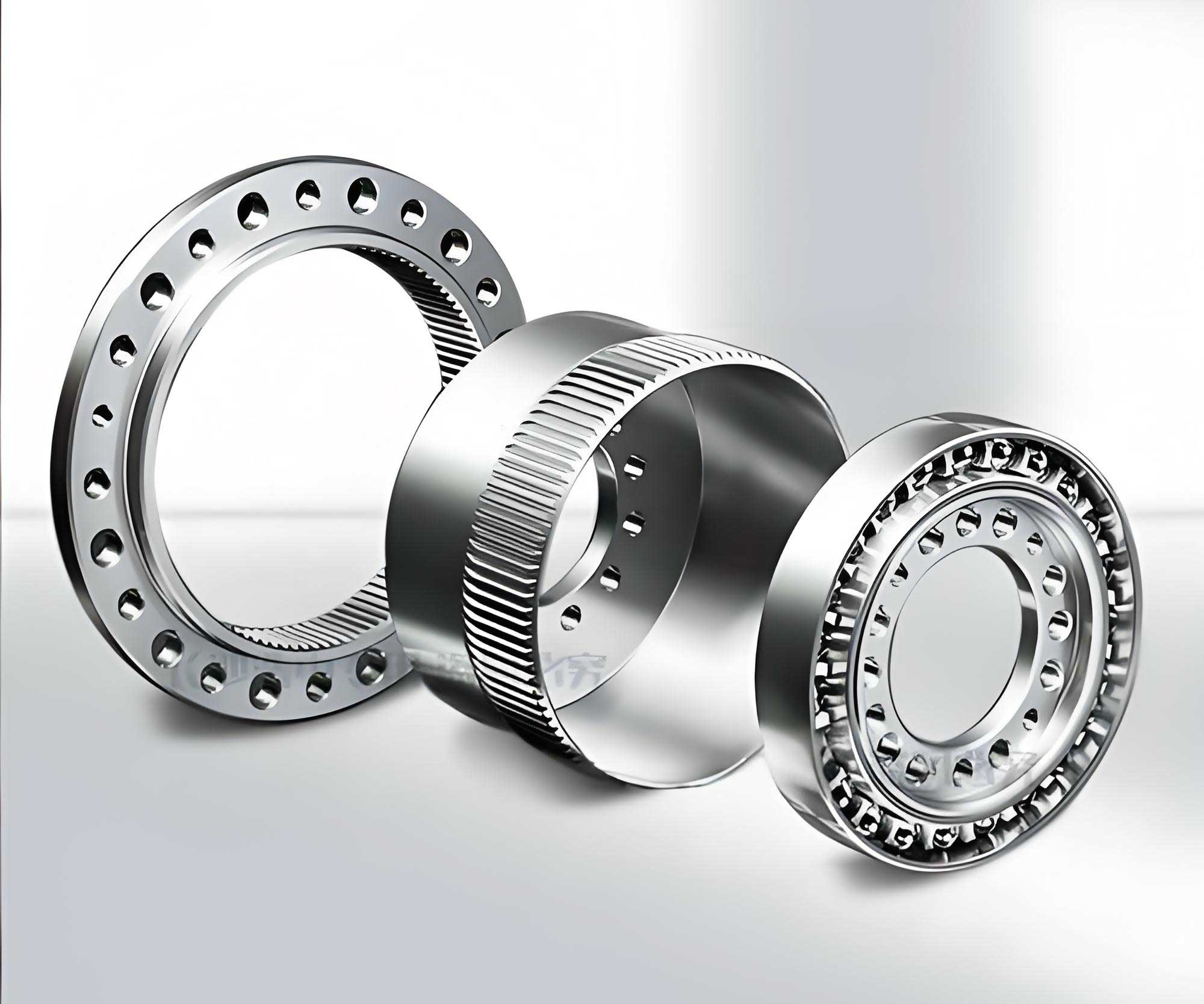
The kinematic and torque relationships are:
$$ T_{nwg} = \frac{1}{N_{hdt}} T_{nfs} + T_{fh}, \quad \theta_{nwg} = N_{hdt} \cdot \theta_{nfs} $$
$$ T_{nfs} = T_{cfs}, \quad \theta_{nfs} = \theta_{cfs} + \Delta \theta $$
where \(T_{nfs} = K_1 \Delta \theta + K_{st} |\Delta \theta|^\alpha \text{sign}(\dot{\Delta \theta})\) models the torsional stiffness and structural damping of the flexspline. The nonlinear friction torque \(T_{fh}\) within the harmonic drive gear mesh is modeled with a Stribeck effect:
$$ T_{fh} = \left[ T_c + (T_s – T_c) e^{-(|\dot{\theta}_{nwg}| / \dot{\theta}_s)^\epsilon} \right] \text{sign}(\dot{\theta}_{nwg}) + K_{vh} \dot{\theta}_{nwg} $$
This comprehensive model captures the essential behaviors of the harmonic drive gear: high reduction ratio, torsional wind-up, and nonlinear friction losses that are crucial for simulating low-speed performance.
Numerical Simulation and Performance Analysis
A high-fidelity simulation model integrating all components was developed. Key parameters are summarized below.
| Gimbal & Rotor Parameters | |
|---|---|
| Rotor Mass, \(m_w\) | 120 kg |
| Rotor Spin Rate, \(\Omega\) | 200\(\pi\) rad/s |
| Rotor Inertia, \(\mathbf{I}_w\) | diag(2, 0.5, 0.5) kg·m² |
| Gimbal Inertia, \(\mathbf{I}_g\) | diag(0.5, 0.4, 0.4) kg·m² |
| Harmonic Drive Gear Parameters | |
|---|---|
| Transmission Ratio, \(N_{hdt}\) | 120 |
| Flexspline Stiffness, \(K_1\) | 6340 N·m/rad |
| Wave Generator Inertia, \(J_{hw}\) | 0.0001 kg·m² |
| Coulomb Friction, \(T_c\) | 0.046 N·m |
| Stribeck Parameters (\(T_s, \dot{\theta}_s, \epsilon\)) | 0.03 N·m, 0.1 rad/s, 1 |
Simulations were conducted for two operational modes: constant rate tracking and sinusoidal rate tracking, comparing system performance with and without the harmonic drive gear.
Constant Gimbal Rate Command (2 deg/s)
Without the harmonic drive gear, the gimbal rate exhibits significant fluctuations and a steady-state error, primarily due to the direct impact of motor and bearing nonlinearities on the large-inertia frame. When the harmonic drive gear is integrated, the steady-state error is drastically reduced. The motor operates at a much higher speed (\(N_{hdt} \times\) gimbal rate), making its control more linear and efficient. However, the transient start-up phase shows larger oscillations, and a high-frequency resonance induced by the flexibility of the harmonic drive gear becomes evident in the gimbal rate signal.
Sinusoidal Gimbal Rate Command (10sin(πt/5) deg/s)
The performance difference is more pronounced in this dynamic tracking scenario. The system without the harmonic drive gear fails to accurately track the command, particularly near the zero-crossings where the rate is very low, showing pronounced dead-zone effects and distortion. In contrast, the system with the harmonic drive gear demonstrates excellent tracking fidelity across the entire speed range, including very low rates. This confirms that using the harmonic drive gear to elevate the motor operating speed effectively mitigates the negative impact of low-speed nonlinear friction at the gimbal. The trade-off, again, is the presence of high-frequency vibrational content superimposed on the tracked signal due to the harmonic drive gear compliance.
| Control Scenario | Without Harmonic Drive | With Harmonic Drive |
|---|---|---|
| Constant Rate (2 deg/s) | Large steady-state error & fluctuation. | Greatly reduced error; high-frequency resonance present. |
| Sinusoidal Rate (10sin(πt/5) deg/s) | Poor low-speed tracking; significant distortion. | Accurate tracking across all speeds; high-frequency resonance present. |
Conclusion
The integration of a harmonic drive gear into the gimbal servo system of a large-scale SGCMG presents a significant solution for enhancing output torque accuracy by improving gimbal rate control precision. Detailed modeling and simulation confirm its primary benefit: by allowing the frame drive motor to operate at a higher, more favorable speed through the harmonic drive gear‘s high reduction ratio, the system’s sensitivity to nonlinear disturbances like friction is substantially reduced. This is especially beneficial for low-speed gimbal operation, which is critical during precision pointing phases. The system with the harmonic drive gear successfully tracks complex, low-speed commands where the direct-drive system fails.
However, this advantage is accompanied by a critical dynamical trade-off. The inherent torsional compliance and complex friction of the harmonic drive gear introduce high-frequency resonant modes into the gimbal response. These resonances, if excited, can degrade system stability and point accuracy. Therefore, while the harmonic drive gear is highly effective for improving low-speed torque fidelity, its implementation must be paired with advanced control strategies, such as notch filtering or resonance compensation algorithms, to actively suppress the induced vibrations. Future work would focus on developing and validating such integrated mechanical and control solutions to fully harness the benefits of the harmonic drive gear in high-performance SGCMG systems.