
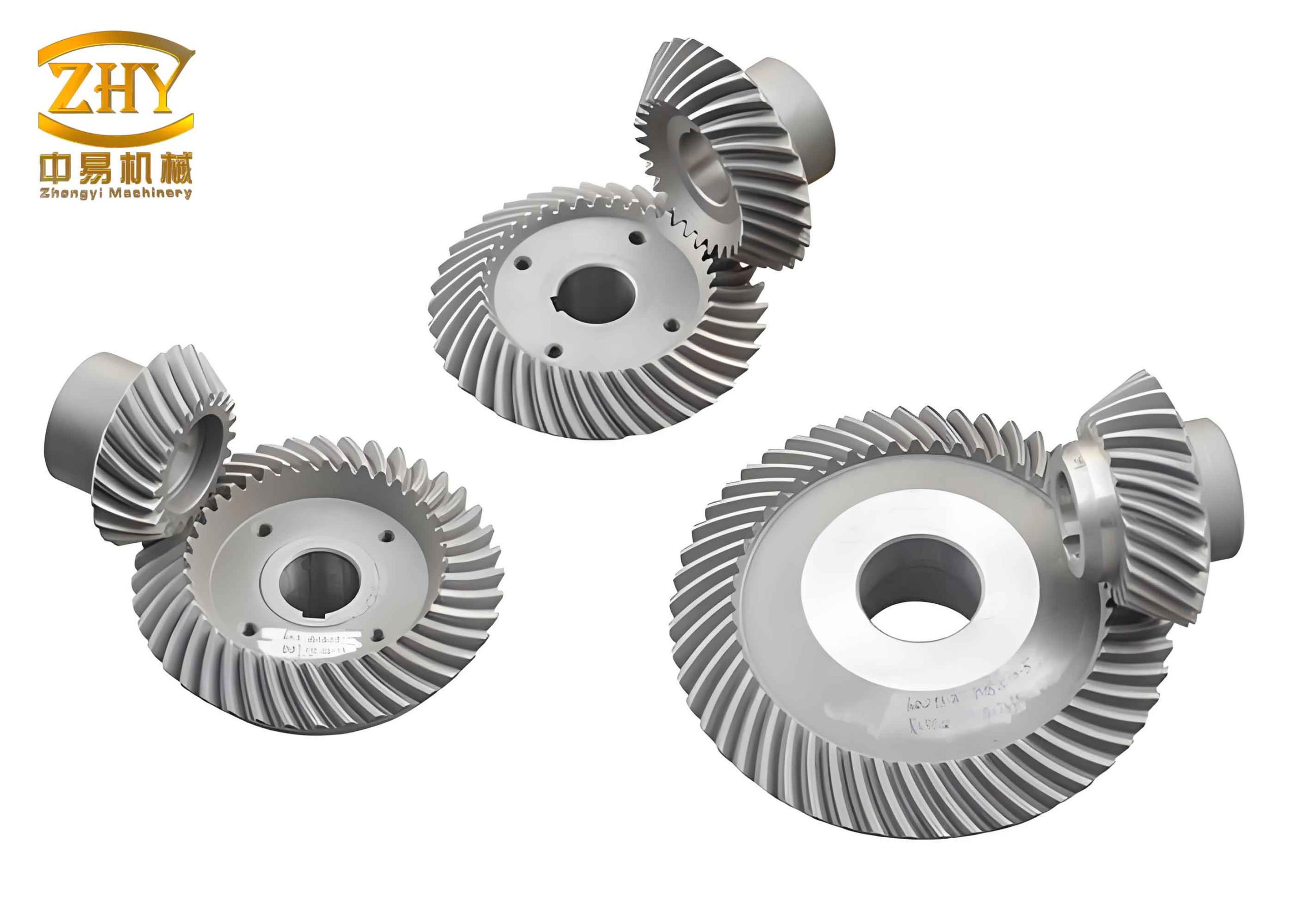
In my extensive research and practical experience within the field of gear dynamics, the quest for quieter and more efficient power transmission systems is paramount. Among various gear types, hyperboloidal gears, also known as hypoid gears, hold a critical position due to their unique ability to transmit motion between non-parallel, non-intersecting axes with a significant offset. This configuration is indispensable in automotive rear-axle drives, offering superior strength and allowing for a lower vehicle profile. However, the very complexity of their geometry and conjugate action makes them sensitive to manufacturing imperfections, often manifesting as excessive vibration and noise. The final finishing process applied to these gears is therefore a decisive factor in their functional quality. While grinding offers high precision, the industrial preference, especially for high-volume production like in the automotive sector, often leans towards lapping due to its significant cost-effectiveness and efficiency. This article delves deep into my analysis and experimental investigation of how the lapping process fundamentally alters and improves the dynamic behavior—specifically vibration and noise emission—of hyperboloidal gears.
The dynamic performance of hyperboloidal gears is intrinsically linked to their transmission error (TE). Ideally, perfectly conjugate gears would have zero TE. In practice, to accommodate deflections under load and minor misalignments, the unloaded TE is often designed to follow a parabolic profile. While this design provides a measure of tolerance, it introduces a fundamental dynamic drawback: a pronounced fluctuation in the TE curve, leading to a time-varying relative angular velocity between the mating gears. The most critical event is at the tooth pair transition, where the parabola’s apex creates an instantaneous change in kinematic conditions, resulting in impact. This impact is a primary excitation source for gear vibration and noise. The core hypothesis of my work is that the lapping process acts as a sophisticated micro-geometry correction mechanism, transforming this parabolic TE into a smoother, higher-order curve.
I conceptualize the mechanism of lapping-induced improvement as a dynamic self-correction process. During lapping under a controlled mesh, abrasive action preferentially removes material from points of highest instantaneous contact pressure. These points coincide precisely with areas of kinematic imperfection: the apex of the TE parabola and any localized high spots or edges on the tooth flanks. Consequently, the primary action of lapping is to flatten the apex and blend the transition zone between successive tooth pairs. This effect can be modeled as a transformation of the TE function from a simple parabola to a smoother polynomial of a higher degree. Let the designed parabolic transmission error be represented as:
$$ TE_{design}(\theta) = a\theta^2 + b\theta + c $$
where $\theta$ is the angular position. After lapping, the functional form evolves towards:
$$ TE_{lapped}(\theta) = \sum_{n=0}^{k} \alpha_n \theta^n, \quad \text{with } k > 2 $$
where the higher-order coefficients ($\alpha_n$ for $n \ge 3$) help create the smooth, rounded transition. The first and second derivatives of TE—representing relative angular velocity and acceleration—become less discontinuous. The reduction in the magnitude of these derivatives directly correlates to a lower impact force during mesh, governed by:
$$ F_{impact} \propto \frac{d^2(TE)}{dt^2} $$
Simultaneously, the lapping process enhances the surface finish (reducing the friction coefficient $\mu$) and improves the actual contact ratio ($\epsilon_{\gamma}$) under light loads by subtly modifying the contact path. The combined effect is a significant attenuation of the amplitude of the dominant tooth-meshing frequency ($f_m = N \cdot f_s$, where $N$ is the number of teeth and $f_s$ is the rotational frequency) and its harmonics in the vibration and noise spectrum.
To empirically validate this theoretical framework, I designed and conducted a comprehensive experimental study comparing the dynamic performance of hyperboloidal gears before and after the industrial lapping process. The core of the test setup was a back-to-back gear test rig, which allowed for controlled application of speed and load. The specific gear set used had a ratio of 43:7, a module of 6.861 mm, and a nominal offset of 25.4 mm. Three such gear sets were selected from regular production for testing to ensure statistical relevance.
| Parameter | Value |
|---|---|
| Gear Type | Hyperboloidal (Hypoid) |
| Teeth (Ring/Pinion) | 43 / 7 |
| Module | 6.861 mm |
| Offset | 25.4 mm |
| Pinion Speed Test Points | 1800, 2400, 2986 rpm |
| Ring Gear Load Torque Test Points | 28.6, 60 N·m |
Vibration was measured using a piezoelectric accelerometer mounted on the bearing housing close to the large ring gear. Due to the large pitch angle of the ring gear (approximately 71°), its axial vibration was deemed a reliable indicator of the overall mesh excitation. Noise was measured independently using a precision sound level meter positioned 25 cm above the gearbox. Data from both sensors was acquired synchronously through a high-speed data acquisition card. The signal processing and spectral analysis were performed using custom software developed for this purpose, employing Fast Fourier Transform (FFT) algorithms with appropriate windowing (Hanning) to minimize leakage.
| Test Condition (Pinion Speed / Load) | Vibration Acceleration RMS (Pre-Lap) [m/s²] | Vibration Acceleration RMS (Post-Lap) [m/s²] | Reduction |
|---|---|---|---|
| 1800 rpm / 60 N·m | 1.70 × 10⁻³ | 0.76 × 10⁻³ | ~55% |
| 2400 rpm / 60 N·m | 2.25 × 10⁻³ | 1.10 × 10⁻³ | ~51% |
| 2986 rpm / 28.6 N·m | 1.95 × 10⁻³ | 0.92 × 10⁻³ | ~53% |
The spectral analysis of the vibration signals revealed profound changes attributable to lapping. The pre-lap spectra were characterized by strong, distinct peaks at the tooth-meshing frequency $f_m$ and its higher harmonics ($2f_m$, $3f_m$, etc.). Notably, prominent half-harmonic components ($f_m/2$) were often observed, indicating significant non-linearity or period-doubling behavior likely linked to the harsh tooth pair transition. Furthermore, sideband families, spaced at the rotational frequency $f_s$ around the meshing harmonics, were clearly visible, pointing to modulation effects caused by residual assembly errors or shaft runout. In contrast, the post-lap spectra presented a dramatically different picture: the amplitudes at the fundamental $f_m$ and its harmonics were substantially reduced. The half-harmonic components were virtually eliminated. The sideband structures, while still present, were less pronounced. The total vibrational energy, represented by the integrated area under the spectrum, decreased significantly across all tested conditions.
The noise measurement results corroborated the vibration findings perfectly. The overall sound pressure level (SPL) decreased consistently after lapping for all three gear sets under every combination of speed and load. The reduction was most audible and measurable in the mid-to-high frequency range associated with gear meshing. A detailed spectral analysis of the noise provided even more insight. The pre-lap noise spectrum was rich with multiple peaks and a broad-band “haystack” characteristic around the meshing frequencies, indicative of impulsive excitation and strong modulation. The post-lap spectrum showed a marked “cleaning” effect: the amplitudes of the 4th and 5th mesh harmonics (around 810 Hz and 1040 Hz respectively for the 1800 rpm case) were notably attenuated. While some harmonic components remained, their sharpness and isolation improved, suggesting a shift from chaotic, impact-driven noise to a more predictable, smooth-mesh-related sound.
| Gear Set | Noise Level @ 1800 rpm / 60 N·m (Pre-Lap/Post-Lap) [dB(A)] | Noise Level @ 2400 rpm / 60 N·m (Pre-Lap/Post-Lap) [dB(A)] | Noise Level @ 2986 rpm / 28.6 N·m (Pre-Lap/Post-Lap) [dB(A)] |
|---|---|---|---|
| Set 1 | 82.5 / 82.0 | 88.0 / 86.0 | 90.5 / 88.0 |
| Set 2 | 82.0 / 80.0 | 88.0 / 85.5 | 90.0 / 88.0 |
| Set 3 | 81.0 / 78.0 | 83.5 / 80.0 | 86.5 / 82.5 |
The persistence of sidebands, even after lapping, warrants a detailed discussion. Their existence confirms that other periodic excitations beyond pure tooth mesh are present. These can be mathematically described as amplitude and frequency modulation of the primary meshing signal. If $A_m \sin(2\pi f_m t)$ represents the ideal mesh vibration, the modulated signal $s(t)$ considering one modulating source at shaft frequency $f_s$ can be modeled as:
$$ s(t) = A_m [1 + h_a \cos(2\pi f_s t)] \cdot \sin\left(2\pi f_m t + h_f \sin(2\pi f_s t)\right) $$
where $h_a$ and $h_f$ are the modulation indices for amplitude and frequency, respectively. Expanding this equation using Bessel functions reveals spectral components at frequencies $f = n f_m \pm m f_s$, creating the observed sideband families. Sources of this modulation include residual eccentricity (causing $h_a > 0$), periodic tooth spacing errors (causing $h_f > 0$), and even time-varying mesh stiffness. Lapping does not eliminate these root causes entirely but mitigates their effect by averaging out local tooth-to-tooth errors (reducing $h_f$) and improving overall concentricity, thereby diminishing the modulation depth. The experimental observation that sideband amplitudes reduced post-lap supports this interpretation.
Furthermore, the dynamic interaction is governed by a system of equations representing the gear pair as a parametrically excited oscillator. A simplified single-degree-of-freedom model can be expressed as:
$$ m_{eq} \ddot{x} + c \dot{x} + k(t) x = F_{TE}(t) + F_{impact}(t) $$
Here, $m_{eq}$ is the equivalent mass, $c$ is the damping, $k(t)$ is the time-varying mesh stiffness (periodic with mesh frequency), $x$ is the dynamic transmission error, $F_{TE}(t)$ is the forcing due to the kinematic transmission error, and $F_{impact}(t)$ is the impact force. Lapping directly reduces the magnitude and high-frequency content of both $F_{TE}(t)$ (by smoothing the TE curve) and $F_{impact}(t)$ (by easing the transition). It may also subtly alter the functional form of $k(t)$ by extending the contact line, potentially increasing the minimum stiffness and reducing its fluctuation amplitude, which contributes to a more stable dynamic response.
To synthesize the quantitative benefits, I propose a set of composite performance indicators that can be derived from the experimental data to assess the efficacy of lapping for hyperboloidal gears.
| Performance Indicator | Definition / Formula | Interpretation & Effect of Lapping |
|---|---|---|
| Vibration Energy Ratio (VER) | $$ VER = \frac{\int_{f_{min}}^{f_{max}} S_{vv}^{post}(f) df}{\int_{f_{min}}^{f_{max}} S_{vv}^{pre}(f) df} $$ where $S_{vv}(f)$ is the vibration PSD. |
A value < 1 indicates total vibration energy reduction. Observed values were typically between 0.45 and 0.55. |
| Dominant Harmonic Attenuation (DHA) | $$ DHA_n = 20 \log_{10}\left(\frac{A_n^{post}}{A_n^{pre}}\right) $$ for the n-th mesh harmonic amplitude $A_n$. |
Negative dB values indicate attenuation. Reductions of 5-15 dB were common for the first 3 harmonics. |
| Noise Reduction Index (NRI) | $$ NRI = SPL_{pre} – SPL_{post} $$ in dB(A). |
Positive values indicate noise reduction. Observed NRIs ranged from 0.5 to 4.0 dB(A) depending on conditions. |
| Half-Harmonic Suppression Factor (HSF) | Binary or ratio metric: Presence/Absence or amplitude ratio of $f_m/2$ component. | Lapping consistently eliminated or drastically reduced the half-harmonic, indicating suppression of non-linear impact phenomena. |
In conclusion, based on my theoretical analysis and systematic experimental investigation, the lapping process imparts a profound and multi-faceted improvement to the dynamic performance of hyperboloidal gears. The mechanism is not merely one of general surface smoothing but a targeted topological correction of the tooth flank micro-geometry. It successfully transforms a designed parabolic transmission error into a smoother, higher-order function, thereby reducing the peak kinematic acceleration and mitigating the inherent impact at tooth pair transitions. Experimentally, this manifests as a significant reduction in the amplitude of the tooth-meshing frequency and its harmonics in both vibration and noise spectra, a suppression of non-linear half-harmonics, and a decrease in the modulation effects from other periodic errors. The process effectively enhances the actual contact ratio under load and improves surface finish. Therefore, for high-volume manufacturing of automotive hyperboloidal gears where a balance between supreme precision, dynamic performance, and cost is essential, lapping remains an indispensable and highly effective final finishing operation. Future work could focus on optimizing lapping cycle parameters (abrasive type, pressure, timing) based on predictive dynamic models to tailor the TE curve for specific noise-vibration-harshness (NVH) targets.