
In the field of high-performance mechanical transmission systems, particularly within aerospace applications, spiral bevel gears are critical components due to their ability to transmit power between non-parallel intersecting shafts with high efficiency and load capacity. However, these gears are often subjected to severe cyclic loading, leading to surface failures such as micro-cracking, wear, and pitting, which ultimately limit their service life. To enhance the durability and reliability of spiral bevel gears, advanced surface enhancement techniques have been developed. Among these, Laser Shock Peening (LSP) has emerged as a promising method for introducing beneficial residual compressive stresses deep into the material subsurface, thereby improving fatigue resistance. This study investigates the influence of LSP on the peak contact stress experienced by spiral bevel gears during meshing operations. Through finite element simulation, I analyze the effects of key LSP parameters—such as laser power density and spot overlap rate—on the residual stress distribution induced on the tooth surface of spiral bevel gears. Furthermore, I explore the mechanism by which these introduced residual stresses mitigate the peak contact stresses during gear engagement, providing insights into optimizing LSP processes for spiral bevel gear applications.
The fundamental principle of Laser Shock Peening involves the application of a high-energy, short-pulse laser onto the surface of a target material, which is typically covered with an ablative layer (e.g., black paint) and a transparent confining medium (e.g., water). The rapid vaporization of the ablative layer generates a high-pressure plasma, and the confinement effect leads to the propagation of a shock wave into the material. This shock wave induces plastic deformation in the surface and subsurface regions, resulting in the generation of deep residual compressive stresses and microstructural refinement. The process can be mathematically described by models that relate laser parameters to the induced pressure. A widely accepted model is the Fabbro model, which estimates the peak pressure \(P_{\text{max}}\) generated during LSP:
$$P_{\text{max}} = 0.01 \sqrt{\frac{\alpha}{2\alpha + 3}} \cdot \sqrt{Z \cdot I}$$
Here, \(\alpha\) is the fraction of internal energy converted to thermal energy (typically between 0.01 and 0.15), \(I\) is the laser power density, and \(Z\) is the combined acoustic impedance of the target material and the confining medium, given by:
$$\frac{2}{Z} = \frac{1}{Z_0} + \frac{1}{Z_1}$$
where \(Z_0\) and \(Z_1\) are the acoustic impedances of the target material and confining medium, respectively. The spatial and temporal distribution of the laser-induced pressure wave is often assumed to follow a Gaussian profile. The pressure at any point on the surface can be expressed as:
$$P(r, t) = P(t) \cdot \exp\left(-\frac{r^2}{2R^2}\right)$$
In this equation, \(P(t)\) represents the time-dependent pressure pulse, \(r\) is the radial distance from the spot center, and \(R\) is the laser spot radius. The temporal shape of the pulse is characterized by a rapid rise and gradual decay, often modeled as a Gaussian function over time with a total duration typically 2–3 times the laser pulse width to ensure stable loading.
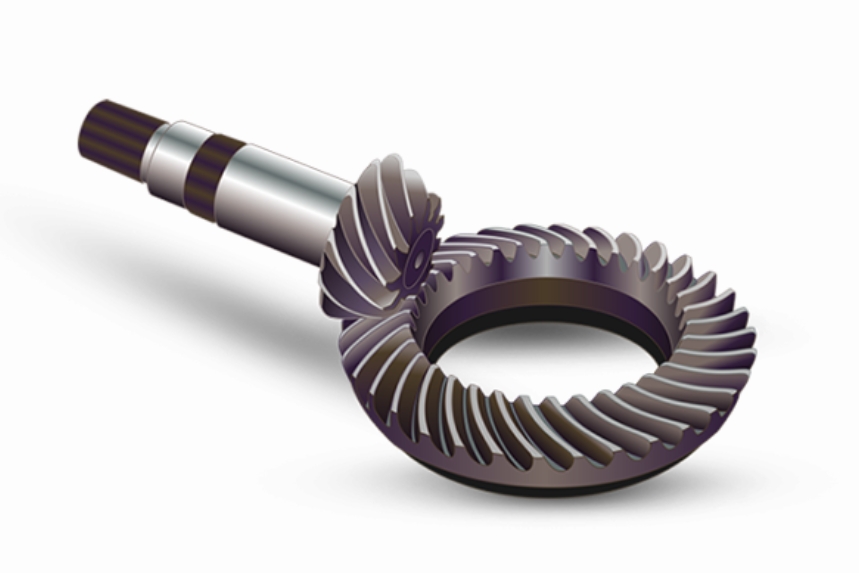
The effectiveness of LSP in enhancing the performance of spiral bevel gears hinges on the ability to tailor the residual stress field to counteract the tensile stresses generated during gear meshing. In spiral bevel gears, the contact pattern is typically elliptical, and the contact stress distribution is highly non-uniform, with peak stresses occurring at the center of the contact ellipse. The primary objective of this research is to quantify how LSP-induced residual stresses can lower these peak contact stresses, thereby extending the fatigue life of spiral bevel gears. To achieve this, I developed a comprehensive finite element model to simulate both the LSP process and the subsequent meshing of spiral bevel gears. The material selected for the spiral bevel gear in this study is 20Cr2Ni4A alloy steel, a high-strength carburizing steel commonly used in heavy-duty gear applications due to its excellent toughness and wear resistance. Its Johnson-Cook constitutive model parameters, which are essential for simulating high-strain-rate deformation during LSP, are listed in Table 1.
| Parameter | Symbol | Value |
|---|---|---|
| Elastic Modulus | \(E\) | 207 GPa |
| Poisson’s Ratio | \(\nu\) | 0.2 |
| Density | \(\rho\) | 7880 kg/m³ |
| Yield Strength (Johnson-Cook A) | \(A\) | 1330 MPa |
| Hardening Constant (B) | \(B\) | 434 MPa |
| Hardening Exponent (n) | \(n\) | 0.23 |
| Strain Rate Coefficient (C) | \(C\) | 0.668 |
| Reference Strain Rate | \(\dot{\varepsilon}_0\) | 1.0 s⁻¹ |
The Johnson-Cook material model is employed to capture the material behavior under the high strain rates (up to \(10^7\) s⁻¹) typical of LSP. The simplified Johnson-Cook equation, neglecting thermal effects due to the short process duration, is given by:
$$\sigma = \left(A + B \varepsilon^n \right) \left(1 + C \ln \frac{\dot{\varepsilon}}{\dot{\varepsilon}_0}\right)$$
where \(\sigma\) is the equivalent von Mises stress, \(\varepsilon\) is the equivalent plastic strain, and \(\dot{\varepsilon}\) is the plastic strain rate. This model accurately represents the dynamic yield and hardening response of the spiral bevel gear material under laser shock loading.
For the finite element simulation, I constructed a three-dimensional model of a spiral bevel gear pair using CAD software, focusing on a segment containing multiple teeth to reduce computational cost while maintaining accuracy. The gear geometry parameters, such as module and number of teeth, are representative of typical aerospace spiral bevel gears. The mesh was refined in the contact region of the tooth surface, with an element size of approximately 0.3 mm, which is one-fifth of the laser spot radius (1.5 mm), to ensure resolution of the stress gradients. Coarser elements were used in non-critical areas. The LSP simulation was performed using Abaqus/Explicit for the dynamic shock phase, followed by Abaqus/Standard for static springback to obtain the final residual stress state. The laser shock loading was applied as a pressure distribution over the tooth surface, with multiple spots arranged in patterns to cover the desired region. The overlap rate between adjacent laser spots, a critical parameter, is defined as:
$$\gamma = \left(1 – \frac{L}{2R}\right) \times 100\%$$
Here, \(L\) is the distance between the centers of two adjacent spots, and \(R\) is the spot radius. Various overlap rates (25%, 50%, 75%, and 90%) and laser peak pressures (ranging from 3.0 to 5.0 GPa) were simulated to study their effects on residual stress distribution. Additionally, the number of spot rows (1, 2, and 3 rows) was varied to assess the influence of coverage on the uniformity and magnitude of residual stresses.
The results from the LSP simulations reveal significant insights into the residual stress fields induced on the surface of spiral bevel gears. A key observation is that the residual compressive stress is generally higher in the direction perpendicular to the tooth surface (denoted as S22 direction) compared to the direction parallel to the tooth surface (S11 direction). For instance, at a peak pressure of 4.0 GPa and 75% overlap, the maximum residual compressive stress in the S22 direction reached approximately 562 MPa, while in the S11 direction it was about 338 MPa. This anisotropy can be attributed to the curved geometry of the spiral bevel gear tooth surface. During LSP, the laser energy distribution is less uniform along the curved surface (S11 direction) due to oblique incidence angles, whereas the energy transmission into the depth (S22 direction) is more direct and confined, resulting in higher compressive stresses. Moreover, the propagation path of the shock wave is shorter in the depth direction, leading to lower energy dissipation compared to the surface direction. This phenomenon is crucial for spiral bevel gears, as the residual compressive stresses in the depth direction are particularly effective in suppressing crack initiation and propagation from the subsurface.
The impact of laser peak pressure on the residual stress profile is summarized in Table 2. As the peak pressure increases, the magnitude of the surface residual compressive stress generally rises. However, excessive pressure (e.g., 5.0 GPa) can lead to a “residual stress cavitation” phenomenon, where the central region of the laser spot experiences a drop in compressive stress due to strong tensile waves generated during shock release. This highlights the need for optimal parameter selection in LSP for spiral bevel gears.
| Peak Pressure (GPa) | Max Residual Stress S11 (MPa) | Max Residual Stress S22 (MPa) | Observation |
|---|---|---|---|
| 3.0 | 44.3 | 65.7 | Low stress, uniform |
| 3.5 | 112.5 | 189.2 | Increasing stress |
| 4.0 | 259.2 | 375.3 | High stress, optimal |
| 4.5 | 298.7 | 410.5 | Near cavitation threshold |
| 5.0 | Variable (cavitation) | Variable (cavitation) | Cavitation occurs |
Similarly, the overlap rate plays a vital role in achieving a uniform and deep compressive layer. At a fixed peak pressure of 3.0 GPa, increasing the overlap rate from 25% to 75% enhanced the maximum residual stress in both directions, but at 90% overlap, stress cavitation was observed. This indicates that excessive overlap can cause over-processing and detrimental tensile regions. Based on these findings, an overlap rate of 75% with two rows of laser spots appears to provide the best compromise, yielding high compressive stresses without cavitation for spiral bevel gears. The effect of spot row number is further quantified in Table 3, showing that two rows produce the highest residual stresses, while three rows induce cavitation due to excessive energy accumulation.
| Number of Spot Rows | Max Residual Stress S11 (MPa) | Max Residual Stress S22 (MPa) | Uniformity |
|---|---|---|---|
| 1 | 338 | 389 | Moderate |
| 2 | 562 | 610 | High, optimal |
| 3 | Variable (cavitation) | Variable (cavitation) | Poor, cavitation |
Following the LSP simulation, the residual stress field was imported as an initial condition into a gear meshing simulation to evaluate its effect on contact stresses. The meshing model involves a pair of spiral bevel gears, with the driven gear subjected to torque loads ranging from 100 to 1000 N·m. The contact analysis was performed using Abaqus/Standard, with appropriate boundary conditions to simulate rotational motion. The contact stress and von Mises equivalent stress distributions on the tooth surface were extracted during the meshing cycle. The peak contact stress without LSP treatment, under a 1000 N·m load, was found to be approximately 3643 MPa. After applying LSP with optimal parameters (4.0 GPa peak pressure, 75% overlap, two rows), the peak contact stress reduced to about 3015 MPa, a decrease of nearly 13%. Similarly, the peak von Mises equivalent stress decreased from 3664 MPa to 2993 MPa. This reduction demonstrates the beneficial effect of LSP-induced residual compressive stresses in offsetting the tensile stresses generated by external loads during the meshing of spiral bevel gears.
The mechanism behind this stress reduction can be explained by the superposition of residual and operational stresses. During meshing, the contact region of the spiral bevel gear tooth experiences cyclic tensile and compressive stresses due to rolling and sliding contact. The residual compressive stress \(\sigma_r\) introduced by LSP effectively lowers the net stress amplitude. If \(\sigma_{\text{tp}}\) represents the peak tensile stress from the applied load, the effective stress \(\sigma_{\text{eff}}\) becomes:
$$\sigma_{\text{eff}} = \sigma_{\text{tp}} – \sigma_r$$
Consequently, the reduction in stress amplitude \(\Delta \sigma\) is given by:
$$\Delta \sigma = \sigma_p – \sigma_{\text{eff}}$$
where \(\sigma_p\) is the peak contact stress without LSP. By reducing \(\sigma_{\text{eff}}\), LSP delays the initiation of fatigue cracks and extends the service life of spiral bevel gears. This is particularly important for spiral bevel gears used in aerospace applications, where reliability and longevity are paramount.
In addition to the quantitative stress analysis, I examined the depth profile of residual stresses to assess the thickness of the compressive layer. The results indicate that LSP can introduce a compressive layer extending up to 1 mm below the surface, which is substantial for resisting subsurface-originated failures in spiral bevel gears. The depth distribution can be approximated by an exponential decay function:
$$\sigma_r(z) = \sigma_0 \cdot \exp\left(-\frac{z}{d}\right)$$
Here, \(\sigma_0\) is the surface residual stress, \(z\) is the depth from the surface, and \(d\) is a decay constant characteristic of the material and LSP parameters. For the optimal LSP case on spiral bevel gears, \(d\) was estimated to be around 0.3 mm, indicating a gradual decay of compressive stress with depth.
To further optimize the LSP process for spiral bevel gears, I conducted a parametric study using the finite element model, varying laser pulse duration, spot size, and material properties. The results suggest that shorter pulse durations (e.g., 10–20 ns) are favorable for generating higher peak pressures without excessive heat input, while larger spot sizes can improve coverage but may require higher energy. However, the curved geometry of spiral bevel gears poses challenges in maintaining uniform pressure distribution across the tooth surface. Adaptive laser scanning paths or customized beam shaping might be necessary to ensure consistent treatment of spiral bevel gears with complex tooth profiles.
Another aspect considered is the potential synergy between LSP and other surface treatments, such as carburizing or shot peening, for spiral bevel gears. Carburizing increases surface hardness, while LSP introduces compressive stresses; combining these processes could yield superior fatigue performance. Future work could explore such hybrid treatments for spiral bevel gears, leveraging the strengths of each technique.
In conclusion, this study demonstrates that Laser Shock Peening is a highly effective method for enhancing the contact fatigue resistance of spiral bevel gears. Through finite element simulation, I have shown that LSP can induce significant residual compressive stresses on the tooth surface of spiral bevel gears, with magnitudes and depths dependent on laser parameters such as peak pressure, overlap rate, and spot pattern. The optimal parameters identified—4.0 GPa peak pressure, 75% overlap, and two rows of spots—produce a compressive stress field that reduces the peak contact stress during meshing by approximately 13%. The anisotropic nature of the residual stress, with higher compressive stresses perpendicular to the tooth surface, is advantageous for counteracting the dominant tensile stresses in that direction during gear operation. These findings provide a foundation for implementing LSP in the manufacturing and maintenance of spiral bevel gears, particularly in demanding applications like aerospace transmissions. Future experimental validation on actual spiral bevel gear components is recommended to confirm these numerical predictions and refine the process parameters for industrial adoption.
The mathematical modeling and simulation approach presented here can be extended to other gear types, but the focus on spiral bevel gears highlights the unique challenges and opportunities due to their curved tooth geometry. As technology advances, the integration of LSP with digital manufacturing and real-time monitoring could enable precision surface engineering of spiral bevel gears, pushing the boundaries of performance and durability. Ultimately, the goal is to ensure that spiral bevel gears operate reliably under extreme conditions, contributing to the safety and efficiency of advanced mechanical systems.