
With the advancement of mechanical transmission systems towards high-speed, heavy-load, and low-vibration noise directions, the demands on gear performance have significantly increased. Transmission systems must not only transmit substantial power and loads but also exhibit excellent stability. Spiral bevel gears, known for their high contact ratio and load-bearing capacity, along with superior smoothness, are widely used in critical mechanical equipment across industries such as aerospace, marine, and automotive. When spiral bevel gears are in operation, their vibration characteristics profoundly impact the stability of the transmission system. Load transmission error is a primary source of gear vibration. Therefore, analyzing the variation patterns of vibration characteristics in spiral bevel gears under different load transmission errors is crucial for enhancing operational smoothness. In this study, the finite element model of a spiral bevel gear transmission system is established using MASTA software. By varying the load on the driven gear, different load transmission errors are obtained. The vibration characteristics under various loads are compared and analyzed through vibration acceleration waterfall plots, amplitude-frequency spectra, and noise curves. The results indicate that reducing the fluctuation in load transmission error tends to decrease gear vibration and noise, providing a reliable basis for improving the stability of gear transmission systems.
The design of spiral bevel gears begins with defining geometric and machining parameters. MASTA software generates gear models based on input parameters. The geometric parameters for the spiral bevel gears studied here are summarized in Table 1.
| Parameter | Pinion | Gear |
|---|---|---|
| Number of Teeth | 16 | 27 |
| Module (mm) | 4.25 | 4.25 |
| Midpoint Spiral Angle (°) | 35 | 35 |
| Normal Pressure Angle (°) | 20 | 20 |
| Shaft Angle (°) | 90 | 90 |
| Face Width (mm) | 17 | 17 |
| Hand of Spiral | Left-hand | Right-hand |
| Outer Cone Distance (mm) | 66.693 | 66.693 |
| Pitch Angle (°) | 30.6507 | 59.3493 |
| Face Angle (°) | 35.3501 | 62.2108 |
| Root Angle (°) | 27.7832 | 54.6499 |
| Dedendum (mm) | 4.68 | 2.54 |
| Addendum (mm) | 3.34 | 5.48 |
| Clearance (mm) | 0.8 | 0.8 |
The machining parameters, which influence tooth surface topology, are detailed in Table 2. These parameters include cutter radius, blade angle, and machine settings that define the gear tooth geometry.
| Parameter | Gear | Pinion Concave | Pinion Convex |
|---|---|---|---|
| Cutter Radius (mm) | 76.2 | 77.725 | 72.644 |
| Blade Angle (°) | 21.25/18.75 | 16 | 24 |
| Tip Edge Radius (mm) | 2.4 | – | – |
| Radial Distance (mm) | 64.07826 | 65.57747 | 60.38797 |
| Angular Distance (mm) | 76.9344 | 83.35 | 71.19 |
| Ratio of Roll | 1.158488 | 1.978589 | 1.898750 |
| Vertical Wheel Position (mm) | 0 | -0.30480 | -0.50800 |
| Axial Wheel Position (mm) | 0 | 0.52512 | -0.88537 |
| Bed Position (mm) | 0.00312 | -0.24516 | 0.41234 |
| Blank Installation Angle (°) | 54.6499 | 27.78 | 27.78 |
| Second-Order Modification Coefficient | 0 | -0.02201 | 0.01774 |
| Third-Order Modification Coefficient | 0 | 0.02600 | -0.03400 |
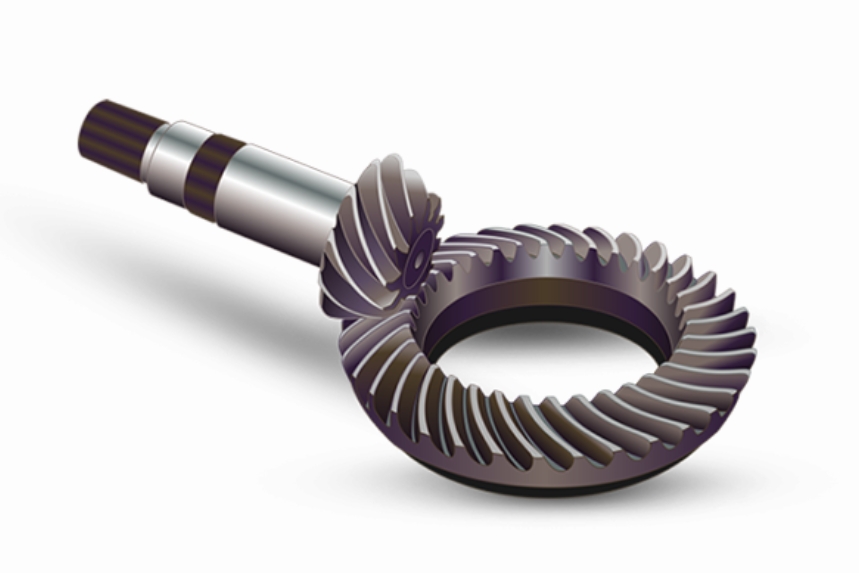
Through tooth contact analysis (TCA), the contact pattern and transmission error of the gear pair are evaluated. The geometric transmission error amplitude is found to be 10.313 arcseconds. The transmission system is then constructed by integrating shafts and bearings with the spiral bevel gears. The pinion serves as the driving gear with a specified rotational speed, while the gear is the driven component with applied loads. The finite element model is developed using condensation nodes at the input and output shafts to couple gears, shafts, and bearings. The modal superposition method is employed to compute various vibration characteristics. Condensation nodes facilitate the display of vibration responses such as displacement, velocity, and acceleration.
Load transmission error varies under different operational conditions, leading to distinct vibration behaviors. Five load cases are applied to the driven gear: 5 N·m, 10 N·m, 20 N·m, 50 N·m, and 100 N·m. The load transmission error curves for these cases are analyzed. When the load is 5 N·m, 10 N·m, or 20 N·m, the load transmission error curves remain within the geometric transmission error range, indicating normal meshing. However, at 50 N·m and 100 N·m, the curves exceed the right endpoint of the geometric transmission error, suggesting edge contact. The fluctuation in load transmission error is quantified as the difference between maximum and minimum values. The results are summarized in Table 3.
| Load | Maximum (arcsec) | Minimum (arcsec) | Fluctuation (arcsec) |
|---|---|---|---|
| 5 N·m | 15.9 | 8.976 | 6.924 |
| 10 N·m | 19.76 | 14.8 | 4.96 |
| 20 N·m | 26.68 | 24.65 | 2.03 |
| 50 N·m | 49.19 | 42.44 | 6.75 |
| 100 N·m | 75.73 | 65.37 | 10.36 |
The fluctuation values are ranked in ascending order: 20 N·m (2.03 arcsec), 10 N·m (4.96 arcsec), 50 N·m (6.75 arcsec), 5 N·m (6.924 arcsec), and 100 N·m (10.36 arcsec). This ranking is used to correlate with vibration characteristics. The natural frequencies of the spiral bevel gear transmission system are determined through modal analysis. The first 20 natural frequencies for each load case are listed in Table 4. As the load increases, the natural frequencies slightly rise due to changes in mesh stiffness. The natural frequency \( f_n \) can be expressed as:
$$ f_n = \frac{1}{2\pi} \sqrt{\frac{k}{m}} $$
where \( k \) is the mesh stiffness and \( m \) is the effective mass. However, for spiral bevel gears, the relationship is more complex due to coupled dynamics. The increase in load enhances mesh stiffness, thereby elevating natural frequencies, as observed in Table 4.
| Mode | 5 N·m | 10 N·m | 20 N·m | 50 N·m | 100 N·m |
|---|---|---|---|---|---|
| 1 | 0.6239 | 0.7079 | 0.8014 | 0.9395 | 1.0532 |
| 2 | 0.7188 | 0.8127 | 0.9150 | 1.0570 | 1.1435 |
| 3 | 0.8370 | 0.9318 | 1.0331 | 1.1744 | 1.2831 |
| 4 | 0.8569 | 0.9699 | 1.0948 | 1.2772 | 1.4257 |
| 5 | 1.3372 | 1.4949 | 1.6100 | 1.7175 | 1.7903 |
| 6 | 1.4225 | 1.5198 | 1.6609 | 1.8841 | 2.0449 |
| 7 | 1.9322 | 2.0205 | 2.1204 | 2.2654 | 2.3785 |
| 8 | 2.6321 | 2.9678 | 3.3332 | 3.8538 | 4.0598 |
| 9 | 2.7012 | 3.0475 | 3.4242 | 3.8739 | 4.2650 |
| 10 | 3.3110 | 3.4811 | 3.6453 | 3.9594 | 4.3750 |
| 11 | 3.5577 | 4.0022 | 4.4842 | 5.1534 | 5.4414 |
| 12 | 4.0876 | 4.5177 | 5.0017 | 5.4120 | 5.6128 |
| 13 | 5.3513 | 5.3647 | 5.3819 | 5.4998 | 5.6185 |
| 14 | 5.4317 | 5.4778 | 5.5384 | 5.6450 | 5.7232 |
| 15 | 5.5366 | 5.5604 | 5.5911 | 5.8396 | 6.3528 |
| 16 | 5.8754 | 5.9963 | 6.1493 | 6.4100 | 6.6584 |
| 17 | 10.1339 | 10.1370 | 10.1408 | 10.1473 | 10.1536 |
| 18 | 11.6339 | 11.7096 | 11.8062 | 11.9733 | 12.1336 |
| 19 | 11.6586 | 11.7398 | 11.8425 | 12.0169 | 12.1804 |
| 20 | 13.0645 | 13.0994 | 13.1446 | 13.2239 | 13.2876 |
Vibration acceleration waterfall plots depict the acceleration response across varying input speeds, formed by the first-order meshing frequency curves. Peaks occur when meshing frequency coincides with natural frequencies, indicating resonance. The maximum vibration acceleration values for each load are extracted and compared in Table 5. For instance, at 5 N·m, the maximum acceleration is 8588 m/s² near 4.08 kHz, aligning with the 12th natural frequency. Similar resonances are observed at other loads. The lowest maximum acceleration occurs at 20 N·m (1569 m/s²), corresponding to the smallest load transmission error fluctuation. This trend suggests that reducing fluctuation mitigates vibration amplitude during resonance.
| Load | Maximum Vibration Acceleration (m/s²) |
|---|---|
| 5 N·m | 8588 |
| 10 N·m | 6315 |
| 20 N·m | 1569 |
| 50 N·m | 7150 |
| 100 N·m | 18561 |
To analyze vibration under normal operation, amplitude-frequency spectra of vibration acceleration are examined at a constant input speed of 600 r/min (meshing frequency 0.16 kHz). The spectra for both driving and driven gears under different loads reveal that the 20 N·m case exhibits the lowest acceleration amplitudes, followed by 10 N·m, 50 N·m, 5 N·m, and 100 N·m. This order matches the ranking of load transmission error fluctuation, reinforcing that smaller fluctuation reduces vibration during steady-state operation. The relationship can be modeled by considering the dynamic excitation due to transmission error. The vibration acceleration \( a \) can be approximated as proportional to the fluctuation \( \Delta TE \):
$$ a \propto \Delta TE \cdot \omega^2 $$
where \( \omega \) is the angular frequency. However, for spiral bevel gears, the proportionality involves modal parameters and contact mechanics.
Noise curves are evaluated over an input speed range of 500 to 1000 r/min. The sound pressure level (SPL) in decibels (dB) is plotted against speed. The noise levels follow the same order as vibration acceleration: highest at 100 N·m, then 5 N·m, 50 N·m, 10 N·m, and lowest at 20 N·m. This consistency confirms that load transmission error fluctuation directly influences acoustic performance. The noise emission \( N \) can be correlated with vibration energy:
$$ N = 20 \log_{10}\left(\frac{a}{a_0}\right) + C $$
where \( a_0 \) is a reference acceleration and \( C \) is a constant accounting for radiation efficiency. For spiral bevel gears, the noise reduction achieved by minimizing fluctuation is significant for applications requiring low operational sound.
The contact ratio of spiral bevel gears also affects vibration. Under load, the contact ratio \( \varepsilon \) increases, which can be expressed as:
$$ \varepsilon = \frac{L}{p_b} $$
where \( L \) is the length of action and \( p_b \) is the base pitch. Higher contact ratio distributes load more evenly, potentially reducing transmission error fluctuation. However, excessive load may cause edge contact, increasing fluctuation. The optimal load for minimal fluctuation in this study is 20 N·m, balancing contact conditions.
The dynamic mesh stiffness \( k_m \) of spiral bevel gears varies with load and tooth position. It can be modeled as:
$$ k_m(t) = k_0 + \Delta k \sin(\omega_m t + \phi) $$
where \( k_0 \) is the mean stiffness, \( \Delta k \) is the stiffness variation, \( \omega_m \) is the meshing frequency, and \( \phi \) is phase. Load transmission error \( TE(t) \) interacts with \( k_m(t) \) to produce dynamic force \( F(t) \):
$$ F(t) = k_m(t) \cdot TE(t) $$
This force excites the system, leading to vibration. Reducing \( TE(t) \) fluctuation decreases \( F(t) \) variation, thereby lowering vibration response.
The finite element analysis using MASTA involves solving the equation of motion:
$$ M \ddot{x} + C \dot{x} + K x = F(t) $$
where \( M \), \( C \), and \( K \) are mass, damping, and stiffness matrices; \( x \) is displacement vector; and \( F(t) \) is force vector from mesh excitation. The modal superposition method projects this onto modal coordinates to compute responses efficiently.
In conclusion, this analysis demonstrates that load transmission error fluctuation significantly impacts the vibration characteristics of spiral bevel gears. By establishing a finite element model in MASTA and varying driven gear loads, different load transmission errors are obtained. The natural frequencies increase slightly with load due to stiffness changes. Vibration acceleration waterfall plots, amplitude-frequency spectra, and noise curves all indicate that smaller fluctuation in load transmission error correlates with reduced vibration and noise. Specifically, at 20 N·m load, where fluctuation is minimal (2.03 arcsec), vibration acceleration and noise are lowest. These findings provide a reliable basis for optimizing spiral bevel gear designs to enhance transmission system stability. Future work could explore additional factors such as lubrication, manufacturing errors, and housing structure to further improve vibration performance in spiral bevel gear applications.