
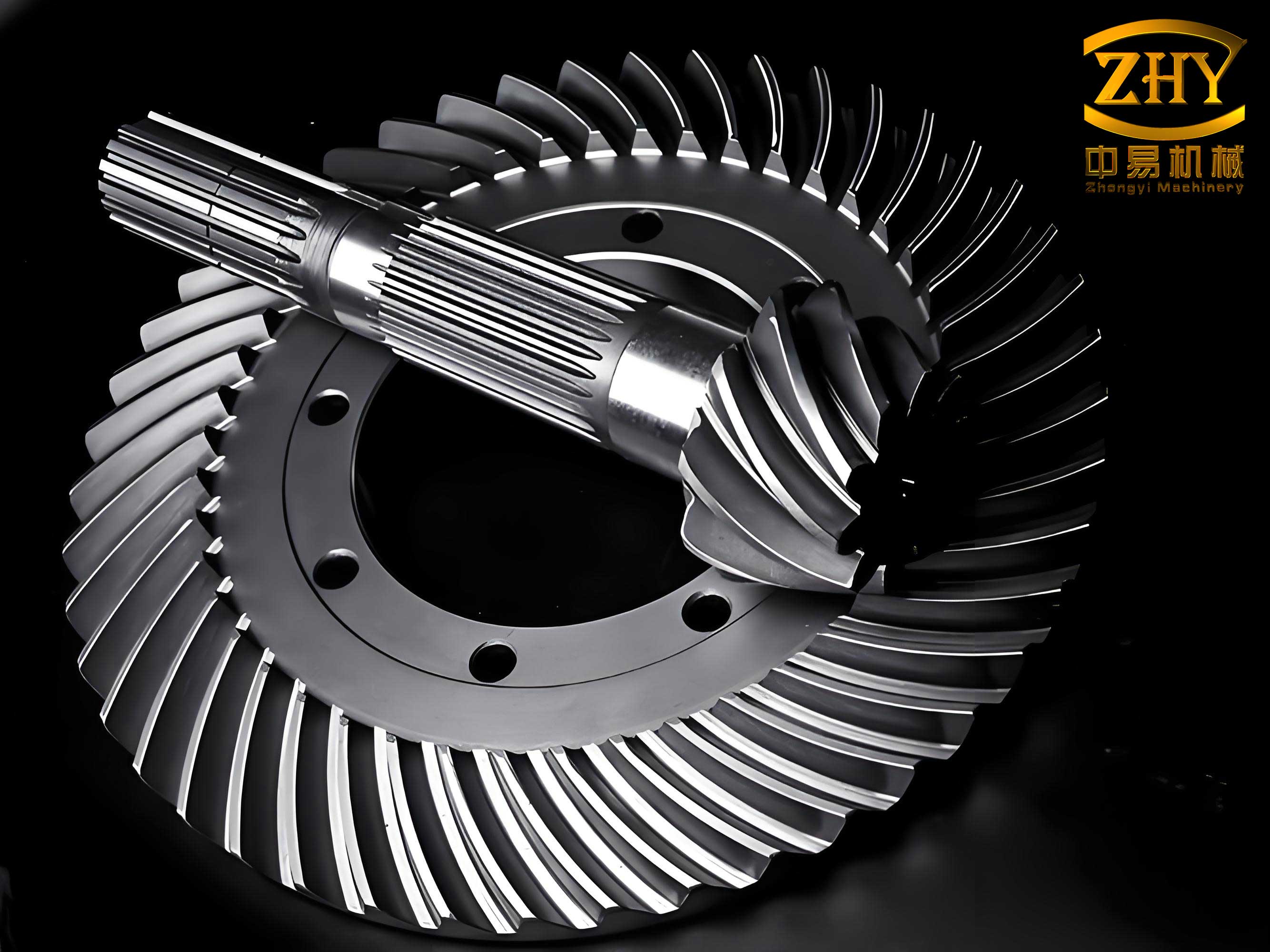
The precision manufacturing of spiral bevel gears is a cornerstone of modern mechanical power transmission systems, especially for high-speed, heavy-load applications involving intersecting axes. Their defining characteristic, the curved tooth flank, is responsible for superior smoothness of operation, reduced noise levels, and high load-bearing capacity compared to straight bevel gears. However, achieving the required high quality in spiral bevel gear teeth presents significant manufacturing challenges. The primary obstacles stem from approximations in cutting calculation algorithms, inherent machine tool setting errors, and thermal deformations during the machining process. This work focuses specifically on the systematic investigation of machine tool setting errors and their profound impact on the final tooth surface geometry.
With advancements in metrology, the integration of high-precision measuring instruments with production processes has become increasingly tight. This synergy makes it feasible to study the influence laws of machine tool errors on the tooth surface form of spiral bevel gears, enabling the identification of critical regions on the tooth flank and key machine settings that are most sensitive to deviations. In practical manufacturing, the pinion tooth surface is typically corrected to match the gear, while the gear tooth surface is usually left unmodified. Therefore, a detailed study of how machine tool errors affect the gear tooth surface geometry, leading to effective control over its form, can substantially reduce the workload required for subsequent pinion corrections.
1. Mathematical Model of the Spiral Bevel Gear Tooth Surface
The tooth surface of a spiral bevel gear (the gear member, often the larger wheel) is generated based on the principle of a plane-topped generating gear using the duplex spread-blade method. According to the theories of gearing and kinematic relationships, the mathematical formulation of the tooth surface begins with the known geometry of the cutter head blades. Through a series of coordinate transformations that relate the gear’s own coordinate system to the machine tool coordinate system and finally to the cutter head coordinate system, the complete surface model is derived. Consequently, the final shape of the spiral bevel gear tooth flank is determined not only by the cutter profile but also critically by the set of machine tool adjustment parameters.
1.1 Theoretical Tooth Surface Model
When machine settings are ideal (free of error), the theoretical tooth surface equation for the spiral bevel gear can be expressed in a functional form after the described transformations. Let us denote the set of primary machine tool settings for the gear as the vector k:
$$ \mathbf{k} = [r_{d},\ q,\ \delta_f,\ s,\ \alpha,\ E,\ x_b,\ x_g,\ i]^T $$
Where:
- $r_d$: Cutter blade point radius.
- $\alpha$: Blade profile angle (pressure angle).
- $q$: Cutter phase angle (swivel angle).
- $\delta_f$: Machine root angle (tilt setting).
- $s$: Radial distance (sliding base).
- $x_g$: Horizontal work offset.
- $x_b$: Vertical work offset (blank position).
- $i$: Machine ratio (generating roll).
- $E$: Horizontal offset (often part of the basic setting).
Using two surface parameters, $\theta$ and $\sigma$, which define a point on the generating tool surface, the theoretical gear tooth surface $\mathbf{S}_{th}$ is given by:
$$
\mathbf{S}_{th}(\theta, \sigma; \mathbf{k}) = \begin{bmatrix}
x_{th}(\theta, \sigma; \mathbf{k}) \\
y_{th}(\theta, \sigma; \mathbf{k}) \\
z_{th}(\theta, \sigma; \mathbf{k})
\end{bmatrix}
$$
1.2 Tooth Surface Model with Setting Errors
When errors are present in the machine tool setup, the functional form of the tooth surface equation remains identical. However, the actual values within the parameter vector k deviate from their nominal values. The erroneous setting vector $\mathbf{k’}$ becomes:
$$ \mathbf{k’} = [r_{d}+\Delta r_{d},\ q+\Delta q,\ \delta_f+\Delta \delta_f,\ s+\Delta s,\ \alpha+\Delta \alpha,\ E+\Delta E,\ x_b+\Delta x_b,\ x_g+\Delta x_g,\ i+\Delta i]^T $$
where each $\Delta$ term represents the error in the corresponding machine setting. The resulting actual (error-affected) tooth surface $\mathbf{S}_{err}$ is:
$$
\mathbf{S}_{err}(\theta, \sigma; \mathbf{k’}) = \begin{bmatrix}
x_{err}(\theta, \sigma; \mathbf{k’}) \\
y_{err}(\theta, \sigma; \mathbf{k’}) \\
z_{err}(\theta, \sigma; \mathbf{k’})
\end{bmatrix}
$$
1.3 Error Quantification in a Fixed Coordinate System
To quantify and analyze the surface deviations, both the theoretical and the error surfaces must be expressed within a common, fixed coordinate system $H$, typically aligned with the gear pair’s operating position. Applying the appropriate rotation and translation transformations, we obtain:
$$
\mathbf{S}_{th}^H(\theta, \sigma; \mathbf{k}) = \mathbf{T}_{H} \cdot \mathbf{S}_{th}(\theta, \sigma; \mathbf{k})
$$
$$
\mathbf{S}_{err}^H(\theta, \sigma; \mathbf{k’}) = \mathbf{T}_{H} \cdot \mathbf{S}_{err}(\theta, \sigma; \mathbf{k’})
$$
For any point $M$ on the theoretical surface with coordinates $\mathbf{P}_M^H = [X_M, Y_M, Z_M]^T$ and unit normal vector $\mathbf{n}_M^H = [n_{Mx}, n_{My}, n_{Mz}]^T$ in system $H$, we can find its corresponding point $M’$ on the error surface. The deviation $\lambda_M$ at point $M$ is defined as the normal distance from $M$ to $M’$. This leads to the following system of equations:
$$
\mathbf{P}_M^H + \lambda_M \cdot \mathbf{n}_M^H = \mathbf{P}_{M’}^H
$$
where $\mathbf{P}_{M’}^H$ is the coordinate of $M’$ in system $H$. Given $\mathbf{P}_M^H$ (obtainable from cutting simulation or by solving the theoretical surface equations), its associated parameters $(\theta_M, \sigma_M)$ and normal $\mathbf{n}_M^H$ can be calculated. Solving the nonlinear equation system above for $\lambda_M$ and $\mathbf{P}_{M’}^H$ yields the local surface error. A positive $\lambda_M$ indicates the error surface is “outside” the theoretical surface along the normal direction.
2. Analysis of Influence Laws for Spiral Bevel Gears
The fundamental influence patterns of machine tool setting errors on the tooth surface geometry are similar for any given pair of spiral bevel gears. To illustrate these laws concretely, we consider a specific example: the convex side of a spiral bevel gear member. The basic geometric parameters and the nominal machine tool settings for generating this gear are listed below.
| Parameter | Gear (Wheel) | Pinion |
|---|---|---|
| Hand of Spiral | Right Hand | Left Hand |
| Module (mm) | 8.22 | 8.22 |
| Number of Teeth | 46 | 15 |
| Pressure Angle (°) | 20 | 20 |
| Mean Spiral Angle (°) | 35 | 35 |
| Mean Cone Distance (mm) | 170.283 | 170.283 |
| Pitch Angle (°) | 71.939 | 18.061 |
| Dedendum (mm) | 11.4 | 5.67 |
| Addendum (mm) | 4.12 | 9.85 |
| Setting Parameter | Symbol | Value |
|---|---|---|
| Machine Root Angle | $\delta_f$ | 68° 40′ |
| Cutter Radius | $r_d$ | 152.4 mm |
| Blade Angle (Inner) | $\alpha$ | 22° |
| Cutter Phase Angle | $q$ | 56.4233° |
| Radial Distance | $s$ | 149.8392 mm |
| Machine Ratio (Roll) | $i$ | 0.9507298 |
| Horizontal Work Offset | $x_g$ | 0 mm |
| Vertical Work Offset | $x_b$ | 0 mm |
To simulate real-world conditions where the exact source and magnitude of errors are unknown, we introduce deliberate, isolated perturbations to individual machine settings. For each error case, the mathematical models for both the theoretical surface $\mathbf{S}_{th}^H$ and the error surface $\mathbf{S}_{err}^H$ are constructed. A grid of points is sampled from the theoretical surface model, spanning from the toe (small end) to the heel (large end) and from the root to the tip. For each sampled point $M$, the deviation $\lambda_M$ is calculated by solving the nonlinear system described in Section 1.3. Analyzing these deviation maps (contour plots of $\lambda$ across the tooth flank) reveals the characteristic influence patterns for each type of error. The key findings are summarized as follows.
2.1 Spatial Distribution of Sensitivity
The analysis of deviation maps for errors in $\Delta \delta_f$, $\Delta i$, $\Delta s$, $\Delta x_b$, $\Delta r_d$, and $\Delta \alpha$ consistently shows that the regions near the toe and heel ends of the tooth are significantly more affected than the central region along the face width. In contrast, the error $\Delta q$ (cutter phase angle) was found to produce negligible surface deviations, indicating it is a non-sensitive parameter for tooth form geometry in this context.
2.2 Location of Error-Sensitive Points
The specific location of maximum sensitivity varies depending on the type of error:
- Errors in Machine Ratio ($\Delta i$), Radial Distance ($\Delta s$), Cutter Radius ($\Delta r_d$), and Vertical Offset ($\Delta x_b$): The points most sensitive to these errors are located near the root at the toe end and near the tip at the heel end of the spiral bevel gear tooth.
- Error in Machine Root Angle ($\Delta \delta_f$): The most sensitive points are located near the tip at the toe end and near the root at the heel end.
- Error in Blade Profile Angle ($\Delta \alpha$): This error primarily affects regions near the root line and near the tip line across the entire face width.
2.3 Directional Influence of Error Perturbations
The sign of the error (positive or negative deviation from nominal) determines whether the error surface lies above or below the theoretical surface at a given point. The observed trends are systematic:
- $\Delta \delta_f > 0$: Surface tends to be “higher” (positive $\lambda$) near the heel/root and “lower” (negative $\lambda$) near the toe/tip. The influence magnitude is greater at the heel/root than at the toe/tip.
- $\Delta i > 0$: Surface tends to be higher near the root (both ends) and lower near the tip. Sensitivity is greater near the toe/root.
- $\Delta \alpha > 0$: Surface tends to be higher near the root and lower near the tip. Sensitivity is greater near the root.
- $\Delta s < 0$, $\Delta r_d < 0$, $\Delta x_b < 0$: These errors cause a similar pattern: the surface is lower near the toe and higher near the heel, with greater sensitivity at the toe.
- For perturbations of opposite sign ($\Delta \delta_f, \Delta i, \Delta \alpha < 0$ and $\Delta s, \Delta r_d, \Delta x_b > 0$), the influence pattern is symmetrical about the zero-error contour, with the direction of deviation reversed.
2.4 Ranking of Error-Sensitive Adjustment Parameters
By comparing the maximum absolute deviation magnitudes $|\lambda_{max}|$ induced by unit perturbations of different settings, the machine tool parameters can be ranked by their influence on the tooth surface geometry of spiral bevel gears. For the analyzed case, the descending order of sensitivity is:
- Machine Ratio ($i$) – Most Sensitive
- Radial Distance ($s$)
- Cutter Radius ($r_d$)
- Machine Root Angle ($\delta_f$) & Vertical Work Offset ($x_b$)
- Blade Profile Angle ($\alpha$)
- Cutter Phase Angle ($q$) – Least Sensitive
This ranking is concisely presented in the following table, which also summarizes the primary sensitive zones.
| Machine Setting Parameter | Sensitivity Rank | Primary Sensitive Zone on Tooth Flank | Typical Influence Direction (for +$\Delta$) |
|---|---|---|---|
| Machine Ratio ($i$) | 1 (Highest) | Toe/Root & Heel/Tip | Root: Higher, Tip: Lower |
| Radial Distance ($s$) | 2 | Toe/Root & Heel/Tip | Toe: Lower, Heel: Higher (for -$\Delta$) |
| Cutter Radius ($r_d$) | 3 | Toe/Root & Heel/Tip | Toe: Lower, Heel: Higher (for -$\Delta$) |
| Machine Root Angle ($\delta_f$) | 4 | Toe/Tip & Heel/Root | Heel/Root: Higher, Toe/Tip: Lower |
| Vertical Work Offset ($x_b$) | 4 | Toe/Root & Heel/Tip | Toe: Lower, Heel: Higher (for -$\Delta$) |
| Blade Profile Angle ($\alpha$) | 5 | Root Line & Tip Line | Root: Higher, Tip: Lower |
| Cutter Phase Angle ($q$) | 6 (Negligible) | – | – |
3. Framework for Compensating Machine Tool Setting Errors
The identified influence laws and sensitivity rankings form the theoretical foundation for a systematic error compensation strategy in manufacturing spiral bevel gears. The core idea is to treat the measured deviations on a machined part as the result of unknown errors in the sensitive machine settings and then calculate corrective adjustments.
3.1 Compensation Principle
Let $\mathbf{\Lambda}$ be a vector containing the measured normal deviations $\lambda_j$ at a set of $m$ predefined control points on the gear tooth surface. These deviations are a function of the unknown machine setting error vector $\Delta \mathbf{k}$:
$$ \mathbf{\Lambda} = \mathbf{F}(\Delta \mathbf{k}) $$
where $\mathbf{F}$ is a nonlinear function derived from the tooth surface model and the error quantification method. The objective is to find the correction $-\Delta \mathbf{k}$ such that when applied to the nominal settings, it minimizes the deviations. This is essentially an inverse problem: find $\Delta \mathbf{k}$ that best explains the observed $\mathbf{\Lambda}$.
3.2 Linearized Sensitivity Model
For small errors, the relationship can be linearized using a sensitivity matrix (Jacobian) $\mathbf{J}$. The element $J_{jn}$ represents the change in deviation at control point $j$ due to a unit change in machine setting $n$.
$$ J_{jn} = \frac{\partial \lambda_j}{\partial k_n} \bigg|_{\mathbf{k}_{nom}} $$
This matrix can be constructed numerically by simulating unit perturbations for each of the $n$ sensitive parameters (excluding negligible ones like $q$) at the $m$ control points (selected from the identified sensitive zones). The linearized model is:
$$ \mathbf{\Lambda} \approx \mathbf{J} \cdot \Delta \mathbf{k} $$
3.3 Calculation of Corrective Settings
Given measured deviations $\mathbf{\Lambda}_{meas}$, the estimated setting errors can be obtained by solving a least-squares problem, as the system is often overdetermined ($m > n$):
$$ \Delta \mathbf{k}_{est} = (\mathbf{J}^T \mathbf{J})^{-1} \mathbf{J}^T \mathbf{\Lambda}_{meas} $$
The compensated machine settings for the next manufacturing cycle are then:
$$ \mathbf{k}_{comp} = \mathbf{k}_{nom} – \eta \cdot \Delta \mathbf{k}_{est} $$
where $\eta$ is a relaxation factor (often $\leq 1$) to prevent over-correction. This process can be iterative. The effectiveness hinges on the accurate pre-calculation of the sensitivity matrix $\mathbf{J}$ based on the known geometry and nominal settings of the specific spiral bevel gear being produced.
4. Conclusion and Implications for Spiral Bevel Gear Manufacturing
This analysis, grounded in the mathematical model of the spiral bevel gear tooth surface, elucidates the distinct patterns of tooth surface deviation caused by various machine tool setting errors. The core outcomes are the identification of error-sensitive points on the tooth flank and the error-sensitive adjustment parameters.
Sensitive Points: For spiral bevel gears, the regions most susceptible to errors are not uniformly distributed. Critical areas include the junction of the toe and root, the junction of the heel and tip (sensitive to $i$, $s$, $r_d$, $x_b$), the junction of the toe and tip and the junction of the heel and root (sensitive to $\delta_f$), and the entire root and tip lines (sensitive to $\alpha$). Targeted measurement in these zones provides the most critical feedback for error diagnosis.
Sensitive Parameters: Among all machine adjustments, the machine ratio ($i$) exerts the most dominant influence on the global form of spiral bevel gear teeth, followed by the radial distance ($s$) and the cutter radius ($r_d$). The machine root angle ($\delta_f$) and vertical offset ($x_b$) have a moderate effect, while the blade profile angle ($\alpha$) locally modifies the profile, and the cutter phase angle ($q$) has negligible impact on form.
The practical value of this research is twofold. First, it provides a prioritized focus for machine calibration and process control in spiral bevel gear production, directing attention to the stabilization and precise setting of the most sensitive parameters. Second, it establishes a theoretical basis for active error compensation. By measuring a gear and mapping deviations to the known sensitivity patterns of spiral bevel gears, corrective adjustments can be calculated and applied in subsequent production runs or even in real-time adaptive control systems, thereby enhancing manufacturing accuracy and consistency without relying solely on post-generation pinion correction.
The derived sensitivity matrix framework bridges the gap between theoretical kinematics and practical manufacturing, offering a systematic, model-based approach to achieving higher quality in the geometrically complex task of spiral bevel gear generation.