
In my extensive experience as a mold design engineer, the development of injection molds for complex components like helical gear shafts presents unique challenges and opportunities. Gear shafts are critical in transmitting torque and motion across various mechanical systems, and their precision directly impacts performance. This article delves into the intricate design process for an injection mold tailored to helical gear shafts, emphasizing the two-step ejection mechanism that ensures efficient demolding. Through detailed analysis, tables, and formulas, I aim to share insights that can guide engineers in optimizing similar projects.
Gear shafts, particularly helical variants, are ubiquitous in modern machinery due to their superior load-bearing capacity and smooth operation. The helical design, with teeth angled relative to the axis, reduces noise and vibration but complicates mold design due to the need for rotational demolding. In this context, I will explore the entire mold design lifecycle, from initial part analysis to production validation, ensuring that the keyword ‘gear shafts’ is central to our discussion. The integration of advanced ejection techniques, such as two-step systems, is crucial for maintaining part integrity and maximizing productivity.
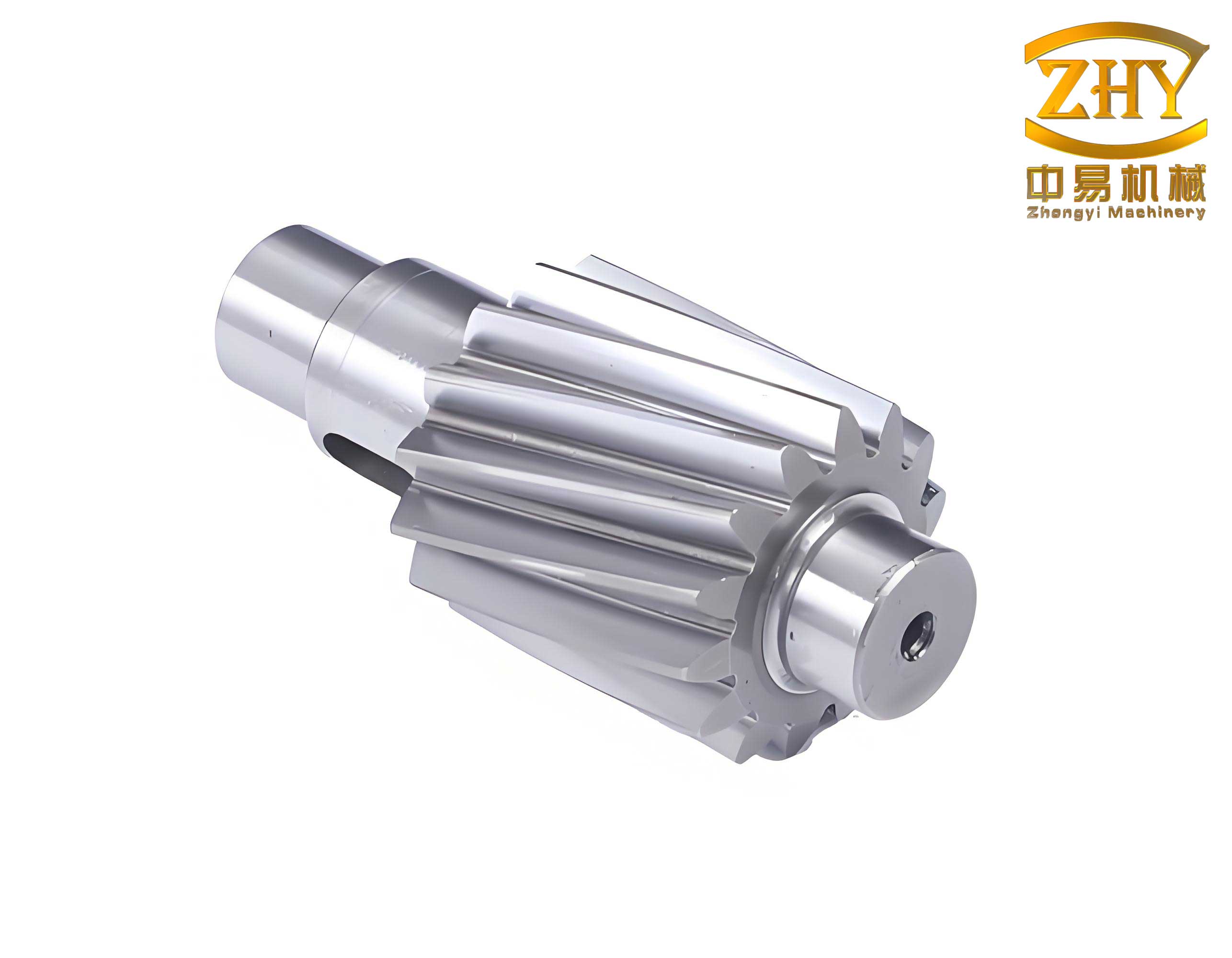
When analyzing gear shafts for injection molding, the structural and material properties must be thoroughly evaluated. Helical gear shafts often feature intricate geometries, including external threads and internal splines, which demand sophisticated mold actions. For instance, the gear shaft discussed here has a helical angle of 12°, a pitch diameter of 32 mm, and 24 teeth, with an overall dimension of 33.909 mm in length and 20.65 mm in diameter. The wall thickness averages 1.50 mm, requiring precise cooling to prevent defects. Material selection is paramount; polyoxymethylene (POM) is commonly used for gear shafts due to its high stiffness, low friction, and excellent dimensional stability. The shrinkage rate for POM is typically around 2.0%, which must be accounted for in mold design to ensure accurate gear tooth profiles. To summarize key parameters, I present Table 1 below.
| Parameter | Value | Description |
|---|---|---|
| Number of Teeth | 24 | Affects gear meshing and mold complexity |
| Helix Angle | 12° | Right-hand helix; influences demolding rotation |
| Pitch Diameter | 32 mm | Determines gear size and injection pressure |
| Material | POM | Polyoxymethylene; shrinkage rate of 2.0% |
| Wall Thickness | 1.50 mm | Average; impacts cooling time and part strength |
| Overall Dimensions | 33.909 × φ20.65 mm | Length and diameter; guides cavity layout |
The mold design process begins with determining the number of cavities. For high-volume production of gear shafts, a multi-cavity layout is essential to meet demand. In this case, I opted for a 1-out-of-12 configuration, arranging the cavities in two linear rows to facilitate side core pulls for external threads. The runner system is designed as a double-Y type to achieve flow balance, minimizing filling variations between cavities. This layout optimizes material usage and cycle time, critical for cost-effective manufacturing of gear shafts. The following formula can be used to estimate the required injection pressure based on cavity count and part volume: $$ P = \frac{F}{A} $$ where \( P \) is the injection pressure, \( F \) is the clamping force, and \( A \) is the total projected area of the gear shafts in the mold. For 12 cavities, the projected area increases, necessitating a robust mold structure to withstand forces.
Selecting the parting line is a fundamental step in mold design for gear shafts. Given the complex geometry of helical gear shafts, the parting surface must be strategically placed to simplify mold actions. I chose a flat parting plane through the top face of the gear, positioning the threaded section in the fixed mold half and the helical gear in the moving half. This arrangement leverages the two-step ejection system to handle demolding without interference. The gate design is equally important; I used submarine gates located at the shoulder of the gear shafts, which act like tunnel gates to automatically sever during ejection. This minimizes manual trimming and ensures clean part surfaces, vital for the functionality of gear shafts in传动 applications.
Side core mechanisms are indispensable for gear shafts with external features like threads. Here, I implemented a sliding split core system in the fixed mold, driven by spring force. This design, known as a “哈夫滑块” in some contexts, allows the threads to be released during mold opening without complicating ejection. To enhance interchangeability in multi-cavity molds, I incorporated replaceable core inserts and wear plates, facilitating maintenance and adjustments. The force required for side core movement can be calculated using: $$ F_s = \mu \cdot N $$ where \( F_s \) is the sliding force, \( \mu \) is the coefficient of friction, and \( N \) is the normal force from the plastic收缩. For POM gear shafts, with its low friction coefficient, this force is manageable, but proper lubrication and material selection are key.
The two-step ejection system is the cornerstone of this mold design for helical gear shafts. It addresses the challenge of demolding the helical gear without damaging the teeth. The mechanism involves two ejector plates: a lower plate housing sleeve ejectors and runner pins, and an upper plate holding the helical gear inserts. During ejection, the machine pusher first advances the lower plate, which via springs, carries the upper plate forward. After a travel of 6.35 mm, the gear shafts are stripped from the core pins, and the upper plate halts due to stops, while the lower plate continues. This action causes the helical gear inserts to rotate, unscrewing the gear shafts from the mold. The rotation is derived from the helical angle, and the principle can be expressed as: $$ \theta = \frac{L \cdot \tan(\alpha)}{r} $$ where \( \theta \) is the rotation angle, \( L \) is the ejection travel, \( \alpha \) is the helix angle, and \( r \) is the pitch radius of the gear shafts. This ensures smooth demolding, preserving the integrity of the gear teeth.
| Component | Function | Material |
|---|---|---|
| Sleeve Ejectors | Eject the gear shaft body | Tool steel (e.g., H13) |
| Helical Gear Inserts | Rotate to demold helical teeth | Hardened steel for wear resistance |
| Springs | Provide initial motion transfer between plates | Alloy steel springs |
| Stop Bolts | Limit travel of upper ejector plate | High-strength bolts |
| Return Pins | Ensure proper resetting during mold closing | Standard DME components |
Cooling system design is critical for maintaining cycle times and part quality in gear shaft production. I implemented comprehensive cooling channels in both mold halves and the side cores. In the moving core, water baffles are used to enhance heat extraction, given the thin walls of the gear shafts. The cooling efficiency can be estimated using the formula for heat transfer: $$ Q = m \cdot c_p \cdot \Delta T $$ where \( Q \) is the heat removed, \( m \) is the mass of the plastic per shot, \( c_p \) is the specific heat of POM, and \( \Delta T \) is the temperature difference between melt and mold. For 12 cavities, the total heat load is significant, necessitating optimized水路 layouts. Table 3 summarizes the cooling parameters for this mold.
| Component | Cooling Method | Channel Diameter | Flow Rate |
|---|---|---|---|
| Fixed Mold Plate | Straight drilled channels | 8 mm | 10 L/min |
| Moving Mold Plate | Baffled channels around cores | 6 mm | 8 L/min |
| Side Cores | Mini-channels for localized cooling | 4 mm | 5 L/min |
| Water Baffles in Cores | Enhanced convective cooling | Custom design | 12 L/min total |
Venting is another essential aspect to prevent defects like burns or short shots in gear shafts. I placed vents at the periphery of the cavities and at the end of runners to allow trapped air to escape. The vent depth for POM is typically around 0.02 mm to prevent flash. Proper venting ensures complete filling of the helical teeth, which is crucial for the torque transmission capability of gear shafts. The required vent area can be derived from: $$ A_v = \frac{V_a}{t \cdot v} $$ where \( A_v \) is the vent area, \( V_a \) is the air volume to be expelled, \( t \) is the injection time, and \( v \) is the air velocity. For high-precision gear shafts, meticulous venting contributes to consistent part quality.
In practice, the design of injection molds for helical gear shafts involves overcoming several难点. The rotational demolding of helical gears requires precise alignment and smooth motion to avoid shearing the teeth. I addressed this by incorporating guided ejector plates and high-precision bearings in the helical gear inserts. Additionally, the external threads necessitate synchronized side core actions, which I achieved through弹簧-loaded mechanisms with backup locks. The interaction between these systems is complex, but using CAD simulations, I verified that the two-step ejection effectively resolves interferences. The success of this approach is evident in production trials, where gear shafts were ejected without damage, meeting all dimensional tolerances.
From a material perspective, POM is ideal for gear shafts due to its low moisture absorption and high fatigue resistance. However, its high crystallinity requires controlled cooling to minimize warpage. I recommend using a melt temperature of 190-210°C and a mold temperature of 80-100°C for optimal results. The shrinkage formula for POM can be expressed as: $$ S = S_0 \cdot (1 + k \cdot T) $$ where \( S \) is the final shrinkage, \( S_0 \) is the nominal shrinkage (2.0%), \( k \) is a material constant, and \( T \) is the mold temperature. By adjusting these parameters, the accuracy of gear shafts can be enhanced, ensuring proper meshing in assemblies.
Production validation of this mold design for gear shafts has demonstrated its robustness. In batch runs, the mold achieved a cycle time of under 30 seconds, with a scrap rate of less than 1%. The two-step ejection system proved reliable, with no instances of part sticking or deformation. The helical gear shafts produced exhibited excellent surface finish and tooth profile accuracy, as measured by coordinate measuring machines. This confirms that the integration of rotational demolding with secondary ejection is a viable solution for complex gear shafts. Moreover, the use of standardized components, such as DME return systems, facilitated maintenance and reduced downtime.
Looking ahead, the design principles discussed here can be extended to other types of gear shafts, such as bevel or worm gears. Advances in additive manufacturing may allow for conformal cooling channels, further improving efficiency. Additionally, the growing demand for lightweight gear shafts in automotive and aerospace industries drives innovation in materials like carbon-fiber reinforced polymers. However, the core challenges of demolding helical features remain, and the two-step ejection approach offers a scalable framework. By continuously refining these techniques, we can push the boundaries of precision molding for gear shafts.
In conclusion, the injection mold design for helical gear shafts with two-step ejection represents a harmonious blend of mechanical ingenuity and practical engineering. Through detailed analysis of part geometry, material behavior, and mold dynamics, I have developed a system that ensures high-quality production. The tables and formulas provided here serve as a reference for optimizing similar projects. As gear shafts continue to evolve in complexity, embracing innovative ejection methods will be key to manufacturing success. I encourage fellow engineers to explore these concepts and adapt them to their specific applications, always keeping the critical role of gear shafts in mind.
To further illustrate the geometric relationships in helical gear shafts, consider the following formula for calculating the lead of the helix: $$ L_h = \pi \cdot d \cdot \cot(\alpha) $$ where \( L_h \) is the lead, \( d \) is the pitch diameter, and \( \alpha \) is the helix angle. This parameter influences the ejection travel required for complete demolding. In our design, with a helix angle of 12° and a pitch diameter of 32 mm, the lead is approximately: $$ L_h = \pi \cdot 32 \cdot \cot(12^\circ) \approx 472 \text{ mm} $$ This large lead relative to part size justifies the need for rotational ejection rather than straight pull. By integrating such calculations early in the design phase, we can preempt potential issues with gear shafts during demolding.
Another critical aspect is the stress analysis on gear shafts under load. Using the Lewis bending equation for gear teeth, we can estimate the root stress: $$ \sigma = \frac{W_t \cdot P_d}{F \cdot Y} $$ where \( \sigma \) is the bending stress, \( W_t \) is the tangential load, \( P_d \) is the diametral pitch, \( F \) is the face width, and \( Y \) is the Lewis form factor for helical gears. For POM gear shafts, with a yield strength of around 70 MPa, this calculation ensures that the molded parts can withstand operational forces. In mold design, we must replicate these tooth profiles accurately to maintain strength, highlighting the importance of precision in cavity machining.
Finally, I emphasize the iterative nature of mold design for gear shafts. Prototyping and testing are indispensable to validate ejection sequences and cooling performance. By leveraging simulation software, we can predict fill patterns and optimize gate locations. The goal is to achieve a balance between productivity and part quality, ensuring that every gear shaft meets the stringent requirements of modern machinery. As I reflect on this project, the collaboration between design, manufacturing, and quality control teams was instrumental in success, underscoring the multidisciplinary approach needed for advanced injection molds.