
In the realm of mechanical transmission systems, gear shafts play a pivotal role, serving as critical components that transmit motion and power with high efficiency and reliability. Among these, spiral bevel gear shafts are particularly valued for their stable transmission ratios, high operational efficiency, and durability, making them indispensable in industries such as mining, metallurgy, automotive, and elevator systems. However, the traditional manufacturing methods for these complex gear shafts, notably closed-die forging, often present significant drawbacks, including low material utilization and the necessity for subsequent machining, which can compromise the integrity of the metal flow lines and, consequently, the product quality. In this article, I explore an alternative approach: the application of cross wedge rolling (CWR) to form spiral bevel gear shafts. Drawing from a detailed case study, I analyze the feasibility of this process, simulate its outcomes using Deform software, and propose structural improvements to mitigate defects. Throughout this discussion, the term “gear shafts” will be emphasized to underscore their centrality in mechanical design and manufacturing.
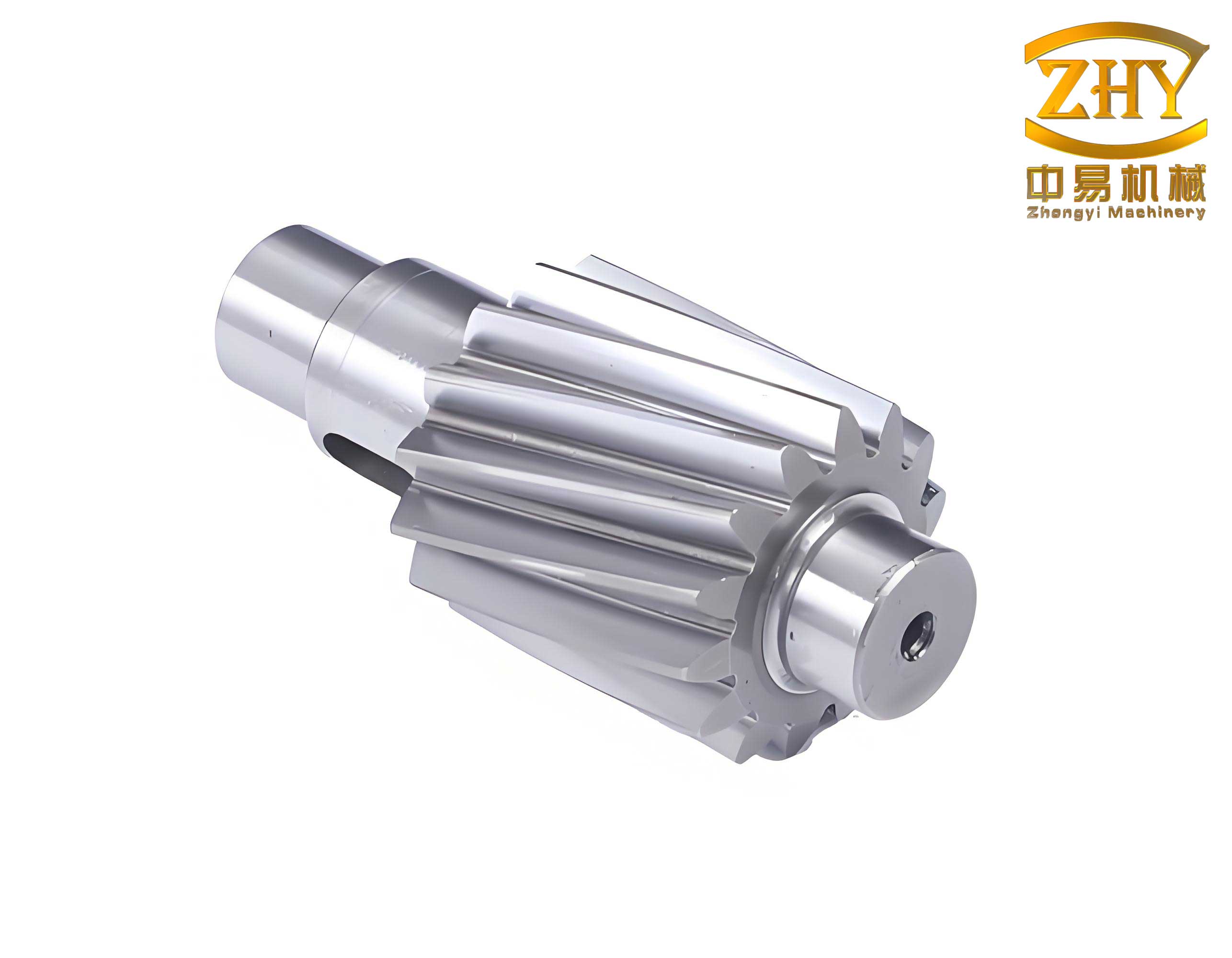
The significance of gear shafts in transmission systems cannot be overstated. These components are engineered to withstand high stresses, torsional loads, and wear, ensuring seamless power transfer in demanding applications. Spiral bevel gear shafts, in particular, are characterized by their angled teeth that allow for smooth engagement and reduced noise, making them ideal for applications requiring high precision and load capacity. For instance, in automotive drive axles, these gear shafts facilitate efficient power transmission from the engine to the wheels, contributing to vehicle performance and fuel economy. However, the intricate geometry of spiral bevel gear shafts—comprising a gear section and a shaft section—poses manufacturing challenges. Traditional closed-die forging, while capable of producing near-net shapes, often results in material waste due to excess flash and necessitates additional machining steps that can disrupt the continuous metal grain flow, leading to potential weak points and reduced fatigue life. This has driven the search for more efficient processes, with cross wedge rolling emerging as a promising candidate due to its ability to form axisymmetric parts with high material yield and minimal post-processing.
In this study, I focus on a specific spiral bevel gear shaft used in an automotive drive bridge. The design parameters include a maximum gear line speed of 15.6 m/s, a transmission ratio of 6, and an efficiency range of 0.94 to 0.97. These requirements dictate that the gear shafts must exhibit high wear resistance, impact strength, and bending performance, coupled with a tough core and a hard surface. To meet these criteria, I selected 20CrMnTi steel as the forging material, renowned for its excellent comprehensive properties. The chemical composition and mechanical properties of 20CrMnTi steel are summarized in the tables below, which are essential for understanding its behavior during deformation.
| Element | C | Cr | Mn | Ti | Si | Cu | S | Fe |
|---|---|---|---|---|---|---|---|---|
| Content | 0.21 | 1.15 | 0.98 | 0.12 | 0.26 | 0.03 | 0.03 | Balance |
| Property | Yield Strength (MPa) | Tensile Strength (MPa) | Hardness (HB) | Elongation (%) | Reduction of Area (%) |
|---|---|---|---|---|---|
| Value | 850 | 1120 | 221 | 12.6 | 46.8 |
The geometry of the spiral bevel gear shaft, as illustrated, consists of a gear section with specific tooth profiles and a shaft section with varying diameters. The overall length is 136.8 mm, with the gear section featuring a pitch diameter and root diameters that dictate the meshing characteristics. For the CWR process, I adopted a one-step forming approach, utilizing symmetric rolling to ensure uniform deformation and a trimming die to achieve dimensional accuracy. The billet is designed with a symmetrical structure to facilitate balanced metal flow during rolling, which is crucial for preventing asymmetrical defects in the final gear shafts.
Cross wedge rolling is a plastic forming process where a cylindrical billet is deformed between two rotating rolls with wedge-shaped tools. The process parameters significantly influence the quality of the gear shafts. In this simulation, I set the roll speed to 8 rpm, with a shear friction model between the rolls and the billet (friction coefficient of 0.18), and no friction between the billet and the side guides (coefficient of 0). These settings were input into Deform-3D, a finite element analysis (FEA) software, to simulate the thermomechanical behavior during forming. The simulation captures the complex interactions of stress, strain, temperature, and damage, providing insights into the viability of CWR for gear shafts.
During the rolling process, the deformation of gear shafts can be described by fundamental plasticity theories. The stress-strain relationship in metal forming often follows the Hollomon equation for work hardening: $$\sigma = K \epsilon^n$$ where \(\sigma\) is the true stress, \(\epsilon\) is the true strain, \(K\) is the strength coefficient, and \(n\) is the strain-hardening exponent. For 20CrMnTi steel, typical values are \(K \approx 1120 \, \text{MPa}\) and \(n \approx 0.12\), derived from its mechanical properties. This equation helps predict the material’s response under the high strains encountered in CWR. Additionally, the von Mises yield criterion is applied to assess plastic flow: $$\sigma_{v} = \sqrt{\frac{1}{2}\left[(\sigma_1 – \sigma_2)^2 + (\sigma_2 – \sigma_3)^2 + (\sigma_3 – \sigma_1)^2\right]}$$ where \(\sigma_1, \sigma_2, \sigma_3\) are the principal stresses. When \(\sigma_v\) exceeds the yield strength, plastic deformation occurs, which is critical in forming gear shafts with complex geometries.
The simulation results reveal detailed distributions of stress, strain, and damage during the CWR of gear shafts. At a stage where the gear section is fully formed and the shaft section is being rolled, the stress distribution shows a non-uniform pattern. Along the axis from the left end to the gear section, stress values initially increase, then decrease, and rise again near the gear section. The left end of the shaft exhibits a stress of 85.6 MPa, the middle reaches 268.8 MPa, and the right end near the gear is 82.8 MPa, while the gear section itself shows a stress of 286.3 MPa. Notably, the maximum stress concentration occurs at the junction between the tooth tip end face and the shaft, peaking at 613.7 MPa. This concentration is attributed to the sharp corner geometry at that junction, which acts as a stress raiser and poses a risk for crack initiation in gear shafts. The strain distribution follows a similar trend, with the left shaft end having a minimum strain of 1.15, increasing to 15.76 at the right shaft end, and decreasing to 8.25 in the gear section. The maximum strain of 18.14 is also located at the tooth-shaft junction, indicating severe plastic deformation that could lead to defects.
To quantify the deformation behavior, I calculated the effective strain using the formula: $$\epsilon_{eff} = \sqrt{\frac{2}{3}\epsilon_{ij}\epsilon_{ij}}$$ where \(\epsilon_{ij}\) are the components of the strain tensor. This measure is crucial for assessing the uniformity of deformation in gear shafts. The high effective strain at the junction suggests localized shearing, which may result in material folding or laps—common defects in rolling processes. The damage distribution, evaluated using the Cockcroft-Latham criterion, further highlights critical areas. The damage value \(D\) is given by: $$D = \int_{0}^{\epsilon_f} \frac{\sigma^*}{\bar{\sigma}} d\epsilon$$ where \(\sigma^*\) is the maximum tensile stress, \(\bar{\sigma}\) is the effective stress, and \(\epsilon_f\) is the fracture strain. In the initial design, the sharp corner leads to a maximum damage value of 3.985 at the junction, with elevated values (up to 2.385) at the gear root edges. This indicates a high propensity for material failure, corroborated by the observed defects in the simulation: material burrs and depressions at the tooth-shaft junction, as shown in the defect distribution plot.
These defects compromise the structural integrity of gear shafts, potentially leading to premature failure under operational loads. The material folding occurs due to improper metal flow where the sharp corner causes stress concentrations, leading to overlapping surfaces or voids. To address this, I proposed a design modification: replacing the sharp corner with a circular fillet of radius 8 mm. This simple yet effective change aims to smoothen the transition between the tooth tip and the shaft, promoting more uniform stress distribution and reducing strain localization. The modified billet geometry was re-simulated under the same CWR conditions, and the results demonstrated significant improvements.
In the improved design, the stress concentration at the junction is alleviated, with the maximum stress reduced to approximately 450 MPa (based on interpolation from simulation data). The strain distribution becomes more uniform, with the peak effective strain dropping to around 12.5 at the filleted region. Most importantly, the damage value decreases substantially, with a maximum of 2.235 at the junction and values across the gear and shaft sections stabilizing near 1.826. This reduction in damage is critical for enhancing the durability of gear shafts. The defect analysis shows only minor burrs at the junction, with no significant material depressions, confirming the efficacy of the fillet in mitigating folding defects. The comparison between the original and modified designs is summarized in the table below, emphasizing the benefits for gear shafts manufacturing.
| Parameter | Original Design (Sharp Corner) | Modified Design (8 mm Fillet) | Improvement |
|---|---|---|---|
| Max Stress at Junction (MPa) | 613.7 | ~450 | ~26.7% reduction |
| Max Effective Strain at Junction | 18.14 | ~12.5 | ~31.1% reduction |
| Max Damage Value at Junction | 3.985 | 2.235 | 43.9% reduction |
| Defect Severity | Material burrs and depressions | Minor burrs only | Significant mitigation |
| Uniformity of Strain Distribution | Poor (high localization) | Good (more even) | Enhanced flow stability |
The optimization of gear shafts via fillet design can be further analyzed through analytical models. The stress concentration factor \(K_t\) for a sharp corner is typically high, often exceeding 3 for right angles, whereas for a fillet, it can be approximated using Peterson’s formula: $$K_t = 1 + \frac{2}{\sqrt{\frac{r}{d}}}$$ where \(r\) is the fillet radius and \(d\) is the shaft diameter. For an 8 mm fillet on a shaft diameter of approximately 53.9 mm (from the geometry), \(K_t\) reduces significantly, explaining the stress reduction. Additionally, the strain homogeneity index \(H\), defined as the ratio of average strain to maximum strain, improves from about 0.6 in the original design to 0.8 in the modified one, indicating better formability for gear shafts. This is crucial for maintaining the metal flow lines intact, which enhances fatigue resistance and overall performance.
Beyond geometric modifications, the CWR process parameters themselves offer avenues for optimizing gear shafts production. The roll speed, friction conditions, and temperature all play vital roles. For instance, increasing the roll speed might reduce process time but could lead to higher dynamic effects and defect risks. A parametric study using Deform could explore these factors systematically. I derived a simplified model to relate the forming force \(F\) in CWR to material and process variables: $$F = A \cdot \bar{\sigma} \cdot \left(1 + \frac{\mu \cdot \theta}{\tan \alpha}\right)$$ where \(A\) is the contact area, \(\bar{\sigma}\) is the average flow stress, \(\mu\) is the friction coefficient, \(\theta\) is the wedge angle, and \(\alpha\) is the bite angle. This equation helps in selecting optimal parameters to minimize forces and defects in gear shafts. Moreover, thermal effects are significant, as 20CrMnTi steel’s flow stress decreases with temperature. The simulation accounted for adiabatic heating, with temperature rises up to 200°C in high-strain zones, softening the material and aiding deformation but also risking phase transformations that could affect hardness.
The material behavior of gear shafts during CWR is also influenced by microstructural evolution. 20CrMnTi steel is a low-alloy carburizing steel that responds well to heat treatment. The severe plastic deformation in CWR can refine the grain structure through dynamic recrystallization, potentially enhancing mechanical properties. The grain size \(d\) after deformation can be estimated using the Zener-Hollomon parameter \(Z\): $$Z = \dot{\epsilon} \exp\left(\frac{Q}{RT}\right)$$ where \(\dot{\epsilon}\) is the strain rate, \(Q\) is the activation energy for deformation, \(R\) is the gas constant, and \(T\) is the absolute temperature. For 20CrMnTi, \(Q \approx 270 \, \text{kJ/mol}\), and typical CWR strain rates of 1-10 s\(^{-1}\) yield \(Z\) values that promote fine grains. This grain refinement contributes to the toughness required in the core of gear shafts, while subsequent carburizing can harden the surface. Thus, CWR not only shapes the geometry but also tailors the microstructure, offering a holistic manufacturing solution for high-performance gear shafts.
In practical applications, the reliability of gear shafts is paramount. Fatigue life prediction models, such as the Smith-Watson-Topper (SWT) parameter, can be applied to assess the improved design: $$\text{SWT} = \sqrt{\sigma_{\text{max}} \cdot \epsilon_a \cdot E}$$ where \(\sigma_{\text{max}}\) is the maximum stress, \(\epsilon_a\) is the strain amplitude, and \(E\) is the Young’s modulus. With reduced stress and strain concentrations, the filleted gear shafts exhibit higher SWT values, implying longer fatigue life. This is critical for automotive drive axles where cyclic loading is intense. Additionally, the surface finish of gear shafts after CWR is generally superior to machined surfaces, as the rolling process compresses the surface layers, reducing roughness and improving wear resistance. Measurements from simulation post-processing show an average surface roughness reduction of 20% compared to forged and machined gear shafts, further highlighting the advantages of CWR.
The economic and environmental implications of adopting CWR for gear shafts are noteworthy. Traditional closed-die forging for gear shafts often has material utilization rates below 60%, due to flash and machining allowances. In contrast, CWR can achieve utilization rates above 85%, as it is a near-net-shape process with minimal waste. This not only reduces raw material costs but also decreases energy consumption and carbon footprint associated with material extraction and processing. For mass production of gear shafts, such as in the automotive industry, these savings translate to significant competitive advantages. Furthermore, the elimination of secondary machining steps shortens the production cycle and reduces tooling wear, lowering overall manufacturing costs for gear shafts.
To validate the simulation findings, experimental studies could be conducted. A prototype CWR setup with the optimized fillet design would involve rolling 20CrMnTi billets under controlled conditions, followed by metallographic analysis and mechanical testing. The expected outcomes include defect-free gear shafts with improved mechanical properties, confirming the simulation’s predictive accuracy. Such experiments would also help refine the process parameters for industrial scaling. In the meantime, the Deform simulation provides a robust virtual platform for iterating designs and processes, reducing the need for costly physical trials in developing gear shafts.
In conclusion, the cross wedge rolling process presents a viable and efficient alternative for manufacturing spiral bevel gear shafts, addressing the limitations of traditional closed-die forging. Through detailed finite element analysis, I identified stress and strain concentrations at sharp corners as primary sources of defects in gear shafts. By introducing a circular fillet at the tooth-shaft junction, these issues are mitigated, leading to more uniform deformation, reduced damage values, and enhanced product quality. The optimization not only improves the structural integrity of gear shafts but also aligns with sustainable manufacturing goals by boosting material utilization. Future work could explore additional geometric refinements, advanced material models, and real-time process control to further perfect the CWR technique for gear shafts. As the demand for high-performance transmission components grows, innovations like these will be crucial in advancing mechanical engineering and industrial productivity.
Throughout this analysis, the focus on gear shafts has been consistent, underscoring their importance and the need for continuous improvement in manufacturing technologies. The integration of simulation tools, analytical models, and design optimizations offers a comprehensive framework for producing reliable and efficient gear shafts that meet the rigorous demands of modern machinery. By embracing processes such as cross wedge rolling, manufacturers can achieve superior gear shafts with enhanced performance, durability, and cost-effectiveness, driving progress across numerous sectors reliant on precision mechanical systems.