
In my extensive experience within precision gear manufacturing, the post-heat treatment grinding of the bore stands as one of the most critical and challenging operations. This process directly determines the final geometric accuracy, particularly the radial runout of the gear teeth (often denoted as Fr), which is paramount for noise performance, load distribution, and the overall service life of the gear in its final application. While processes for straight-tooth cylindrical gears are relatively mature, the finishing of helical gears has historically presented persistent difficulties. The conventional methods, while serviceable for some applications, often fall short when dealing with thin-walled components, large helical angles, or complex assemblies like welded helical gears. This discussion details the limitations of traditional approaches and introduces a novel, purpose-designed pitch-line chuck that fundamentally rethinks the workholding and positioning strategy for these intricate components.
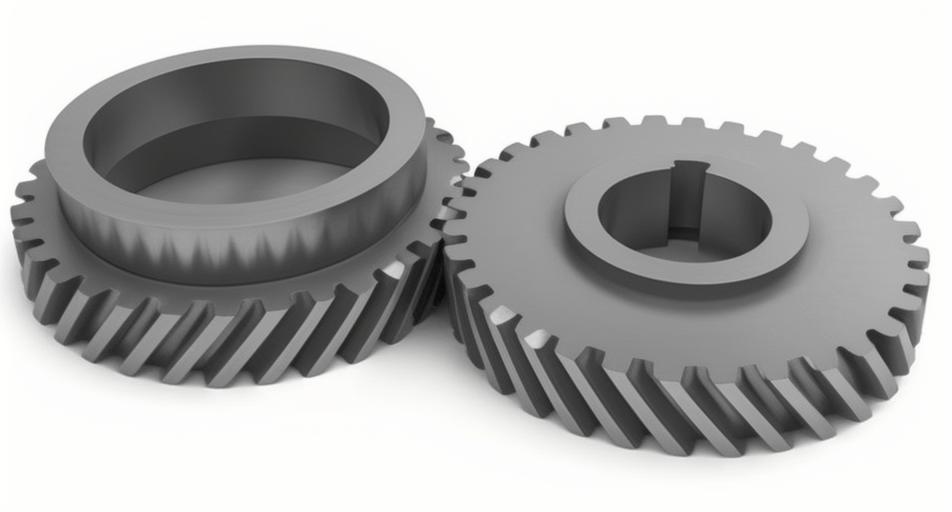
The standard post-forging process flow for an automotive gear is well-established: forging → rough turning → finish turning → hobbing → shaving → heat treatment → deburring → bore grinding → final inspection. It is after heat treatment, where distortions are inevitable, that the bore grinding operation must not only achieve a precise diameter and surface finish but, more importantly, re-establish the gear’s axis with the highest possible concentricity to the theoretical pitch circle of the teeth. For straight gears, a simple pitch-line chuck with three radial pins works effectively. However, for helical gears, the traditional adaptation has been to use three round pins (gauge pins) placed manually into selected tooth spaces, which are then clamped by a three-jaw chuck. This method, while seemingly logical, is fraught with theoretical and practical shortcomings.
Analysis of the Traditional Method’s Shortcomings
The core issue with the three-pin method for helical gears lies in a fundamental geometric mismatch. In a straight gear, the line of contact between a cylindrical pin and the involute flanks is parallel to the gear axis. In a helical gear with a helix angle $\beta$, the contact between a simple cylindrical pin and the tooth flanks is not a line but a complex, localized point contact that varies along the pin’s length. The condition for true pitch-line localization—where all contact points on the locating element are equidistant from the gear’s central axis—is only satisfied on a cross-section that is normal to the helix. This means the traditional straight pin cannot provide a stable, repeatable, and accurate radial datum. The problems manifest in several ways:
- Theoretical Flaw: As mentioned, the fundamental principle is incorrect. A cylindrical element will not contact a helical involute surface along a line that is equidistant from the center. The only way to achieve this is if the contacting element itself has a matching helical form, or if its effective contact profile is oriented at the helix angle $\beta$.
- Instability and Low Efficiency: Each pin makes only a single, unstable point contact with the tooth flank. This requires the operator to spend significant time “clocking” or indicating the gear’s face runout before final clamping, essentially negating the self-centering principle of pitch-line location. The process becomes operator-dependent, time-consuming, and inefficient.
- Poor Accuracy on Challenging Parts: The method becomes increasingly unreliable as the helix angle increases. For parts with large $\beta$ or for composite structures like welded helical gears which may have additional residual stresses and distortions, achieving the required tooth runout (often as tight as 0.02-0.03 mm) is frequently impossible with the traditional three-pin setup.
Fundamental Principle and Design Philosophy
The solution stems from a rigorous re-application of gearing geometry. The goal is to transform the problem of locating a helical gear into the equivalent of locating a straight gear. If we “unwind” the helical gear’s pitch cylinder, the tooth trace becomes a straight line on a developed plane. The key insight is that a line on this developed plane, oriented at the helix angle $\beta$, corresponds to a true line of contact that is everywhere equidistant from the axis when wrapped back into cylindrical form.
This is expressed by the relationship between the transverse and normal planes. The transverse pitch, $p_t$, is related to the normal pitch, $p_n$, by the helix angle:
$$p_t = \frac{p_n}{\cos \beta}$$
For a locating element to engage correctly, its effective contact line must align with this transverse direction. Therefore, the conceptual breakthrough was to design a chuck where the individual locating rollers are not aligned radially, but are instead canted at the precise helix angle $\beta$ of the gear being machined. In this configuration, each roller contacts the helical tooth flank along a line (in the ideal theoretical case) that lies in the transverse plane. All points along this contact line are then, by definition, at the same radial distance from the gear’s central axis, perfectly replicating the stable locating condition of a straight gear.
Detailed Design and Implementation of the Novel Chuck
The practical embodiment of this principle is a novel pitch-line chuck. Its heart is a master holder or “cage” which is not a simple disk but a precisely machined component. The critical feature of this cage is a series of slots or mounting points machined at the specific helix angle $\beta$. The number of these mounting points corresponds to the number of teeth, $Z$, on the target gear, or a divisor thereof, allowing for multi-point contact and even load distribution.
| Basic Parameter | Symbol | Value | Unit |
|---|---|---|---|
| Normal Module | $m_n$ | 2.8 | mm |
| Number of Teeth | $Z$ | 19 | – |
| Normal Pressure Angle | $\alpha_n$ | 20 | ° |
| Helix Angle | $\beta$ | 25.93 | ° |
| Gauge Pin Diameter | $d_m$ | 8 | mm |
| Base Circle Diameter | $d_b$ | Calculate | mm |
| Dimension | Symbol | Nominal / Mean Value | Tolerance | Unit |
|---|---|---|---|---|
| Over Pins Measurement | $M_m$ | 76.0846 | 76.0663 – 76.1029 | mm |
| Transverse Circular Tooth Thickness | $s_t$ | 4.7459 | 4.7353 – 4.7566 | mm |
| Normal Circular Tooth Thickness | $s_n$ | ~4.28 | – | mm |
The chuck assembly consists of the following key components, working in unison:
- The Helical Cage (Master Holder): This is the foundational element, precision-machined with mounting slots at the angle $\beta = 25.93°$. Its axial face serves as the primary mounting interface to the machine tool’s chuck or faceplate.
- The Locating Rollers: These are high-precision, hardened rollers that act as the actual contact elements with the helical gear tooth spaces.
- Retaining Pins/Wires: Flexible retaining wires or pins secure each roller within its slotted seat in the cage. This design is crucial as it allows for a degree of compliance and self-alignment, accommodating minor variations in tooth spacing or heat treatment distortion without losing positive location.
The assembly process is straightforward: The machined helical gear is placed onto the chuck, with the canted rollers naturally engaging multiple tooth spaces along their full functional length. The entire chuck assembly is then gripped by the machine’s standard three-jaw chuck. The multi-segment, compliant design ensures a large, stable contact area, effectively averaging out errors and providing exceptional rigidity for the grinding operation.
Theoretical Validation and Advantages
The effectiveness of this design can be validated through the geometry of contact. For a cylindrical roller of diameter $d_r$ cantilevered at angle $\beta$, its line of contact with a perfect helical involute can be approximated. The condition for non-interference and proper location is that the roller’s axis lies in the transverse plane of the gear. The effective locating diameter $D_{eff}$ is given by the geometry of the pitch cylinder and the roller position:
$$D_{eff} = \frac{m_n Z}{\cos \beta} = d_p$$
where $d_p$ is the pitch diameter. The chuck ensures that all rollers engage at this diameter. The primary advantage is the conversion of unstable point contacts into stable line contacts oriented in the transverse plane. This provides:
- Superior Accuracy: Dramatic reduction in gear tooth radial runout (Fr), consistently meeting tight tolerances below 0.03 mm.
- Enhanced Process Stability: The self-centering action is genuine and repeatable, eliminating the need for time-consuming manual indication. Setup time is reduced by over 70% in many cases.
- Increased Capability: Enables the successful finishing of previously problematic parts, such as helical gears with large helix angles and welded helical gear assemblies.
- Improved Rigidity: The multi-point, line-contact engagement provides a much more rigid connection between the workpiece and the machine tool, reducing vibrations during grinding and improving surface finish and dimensional consistency.
Application Spectrum and Future Potential
This novel pitch-line chuck has transitioned from a prototype solution to a standard tool for our production lines dedicated to helical gears. Its application has resolved long-standing quality and capability gaps. The principle is scalable and adaptable. Future development is focused on expanding its use into even more demanding areas, such as:
- Large-Scale Helical Gears: For wind turbine or heavy industrial gearboxes, where size and weight amplify traditional workholding challenges.
- Multi-Part Helical Assemblies: For complex welded or bolted assemblies where maintaining concentricity across all components is critical.
- Integrated Measurement: Potential integration of in-process gauging systems within the chuck design for closed-loop quality control during grinding.
In conclusion, the innovation lies not in incremental improvement but in a fundamental re-conception of the workholding principle for helical gears. By respecting the intrinsic geometry of the helix and designing a chuck that aligns with it, we have transformed a problematic, operator-sensitive process into a robust, precise, and highly efficient standard operation. This advancement underscores a core tenet of precision manufacturing: that overcoming persistent challenges often requires revisiting first principles and having the ingenuity to embody them in practical, elegant tooling solutions.