
As a key player in the global manufacturing landscape, I have witnessed and driven transformative changes in industrial sectors, particularly through strategic expansions and technological advancements. In the face of fierce market competition, we have capitalized on opportunities arising from global economic integration, leading to breakthroughs in product development and international market penetration. Our journey exemplifies how innovation, quality assurance, and adaptive strategies can propel industrial growth. This article delves into our experiences with oil pump rod exports, the adoption of hollow shaft spiral gear reducers, and the production of nickel-metal hydride power batteries, highlighting the technical intricacies and market impacts. Through detailed analyses, tables, and formulas, I aim to provide a comprehensive perspective on these advancements, with a special emphasis on spiral gear technology, which has become a cornerstone in modern mechanical systems.
Our foray into the international market began with the export of oil pump rods, a critical component in petroleum extraction. By leveraging our heritage in precision engineering, we established a robust quality management system that ensures excellence from raw material selection to final inspection. This system is built on several pillars: stringent process controls, employee accountability, comprehensive after-sales support, and an agile information network. For instance, each production stage—from material cutting and machining to testing—is monitored using statistical process control methods, ensuring consistency. The success in exporting to markets like the United States stems from our certification under international standards, which validates our commitment to reliability. Below is a table summarizing our quality control framework:
| Process Stage | Key Activities | Quality Metrics |
|---|---|---|
| Material Sourcing | Supplier audits, chemical composition analysis | Defect rate < 0.1% |
| Machining | CNC operations, tolerance checks | Dimensional accuracy ±0.01 mm |
| Heat Treatment | Controlled quenching and tempering | Hardness uniformity HRC 25-30 |
| Assembly | Torque testing, surface inspection | Failure rate < 0.05% |
| Certification | API standard compliance, third-party audits | 100% traceability |
To mathematically model the reliability of our oil pump rods, we use Weibull distribution analysis, where the failure rate \(\lambda(t)\) is given by:
$$\lambda(t) = \frac{\beta}{\eta} \left( \frac{t}{\eta} \right)^{\beta-1}$$
Here, \(\beta\) is the shape parameter (typically >1 for our rods, indicating increasing reliability over time), and \(\eta\) is the scale parameter representing characteristic life. Our rods achieve a mean time between failures (MTBF) exceeding 50,000 hours, as validated through accelerated life testing. This technical rigor has enabled us to diversify into high-grade variants, such as Grade D and hollow rods, catering to evolving market demands. Our ongoing R&D focuses on lightweight designs, with prototypes showing a 15% weight reduction using advanced alloys, thereby enhancing efficiency in oil fields.
In parallel, the mechanical transmission sector has seen a paradigm shift with the integration of hollow shaft spiral gear reducers. As an advocate for compact and cost-effective solutions, I have championed the adoption of these reducers across Asian industries, where they are gradually replacing conventional gear systems. The spiral gear, characterized by its curved teeth, offers superior load distribution and smoother operation compared to spur gears. The fundamental geometry of a spiral gear can be described using the helix angle \(\psi\), which influences the contact ratio and torque capacity. The normal module \(m_n\) and transverse module \(m_t\) are related by:
$$m_t = \frac{m_n}{\cos \psi}$$
For a spiral gear pair, the center distance \(a\) is calculated as:
$$a = \frac{m_t (z_1 + z_2)}{2}$$
where \(z_1\) and \(z_2\) are the numbers of teeth on the driving and driven gears, respectively. The torque transmission efficiency \(\eta\) of a spiral gear reducer often exceeds 95%, given by:
$$\eta = \frac{P_{\text{output}}}{P_{\text{input}}} \times 100\%$$
where \(P\) denotes power. Our in-house testing shows that hollow shaft spiral gear reducers achieve efficiencies up to 97% under full load, reducing energy losses by 20% compared to traditional designs.
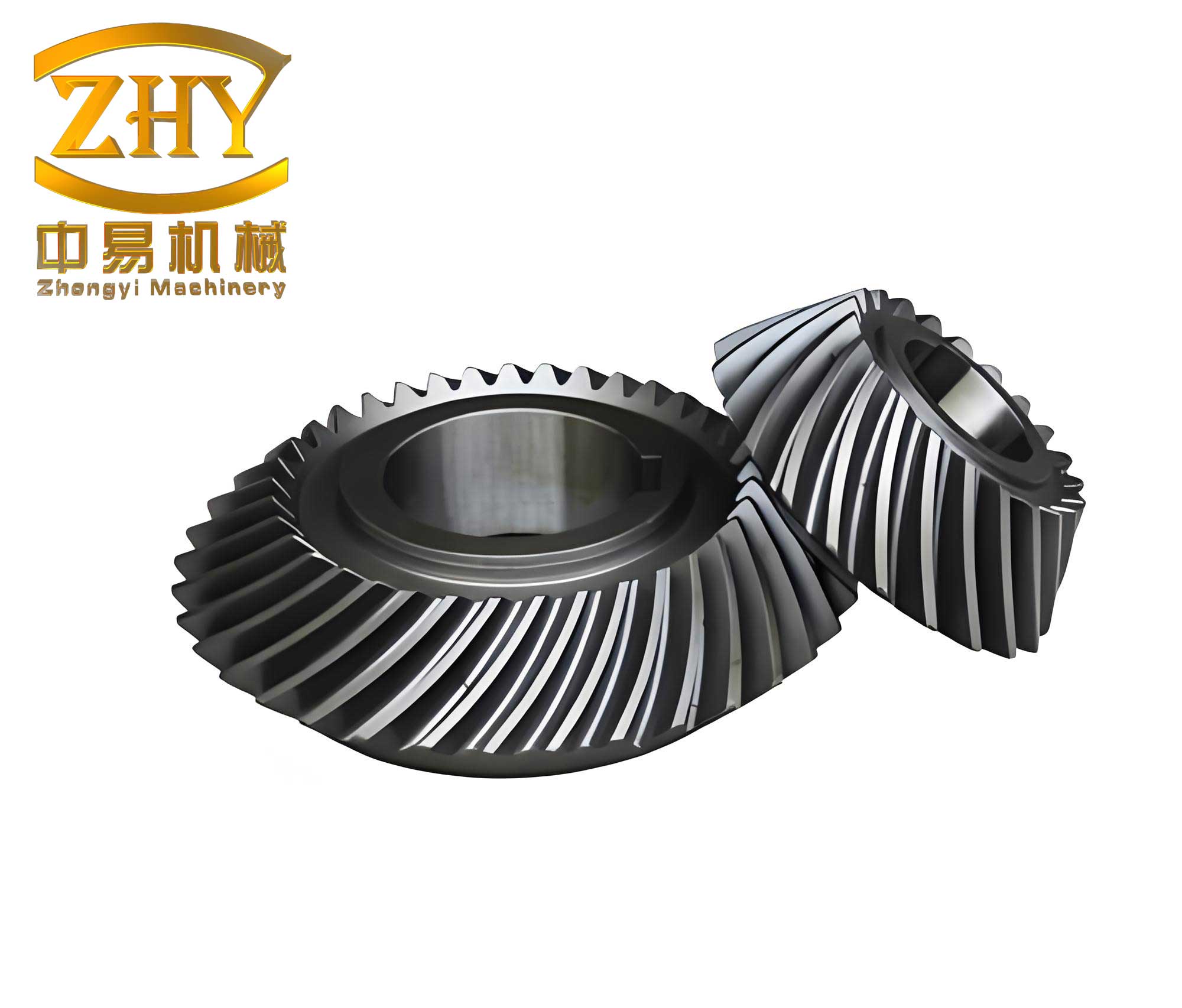
The advantages of spiral gear reducers extend beyond efficiency. By incorporating a hollow shaft, these units enable direct mounting onto motor shafts, eliminating external rotating parts and enhancing operator safety. This design also simplifies maintenance, as disassembly requires fewer steps. The table below compares hollow shaft spiral gear reducers with standard solid shaft reducers across key parameters:
| Parameter | Hollow Shaft Spiral Gear Reducer | Solid Shaft Spur Gear Reducer |
|---|---|---|
| Weight | Reduced by 30-40% | Standard |
| Installation Time | 50% faster due to direct mounting | Longer alignment needed |
| Cost (Manufacturing) | Lower by 15-20% from part reduction | Higher material usage |
| Noise Level | < 65 dB (spiral gear meshing dampens vibration) | > 75 dB |
| Torque Capacity | Up to 5000 Nm (enhanced by spiral gear design) | Up to 3000 Nm |
In our applications, spiral gear reducers have been instrumental in downsizing machinery for conveyor systems and robotics. The spiral gear’s ability to handle higher loads with minimal backlash is quantified by the contact ratio \(C_r\), defined as:
$$C_r = \frac{\text{Length of contact path}}{\text{Base pitch}}$$
For spiral gears, \(C_r\) typically ranges from 2.0 to 3.0, ensuring continuous tooth engagement and reducing wear. We project that the Asian market for spiral gear reducers will grow at an annual rate of 12%, driven by automation trends. Our ongoing innovations include developing corrosion-resistant spiral gear coatings using plasma nitriding, which extends service life by 50% in harsh environments.
Transitioning to energy storage, our initiatives in nickel-metal hydride (NiMH) power battery production represent a leap toward sustainable power sources. Having overseen the commissioning of a large-scale facility, I can attest to the transformative potential of these batteries. The production process involves three main lines: hydrogen storage alloy powder, electrode plates, and final assembly. The alloy powder, synthesized from rare earth elements mixed with nickel and cobalt, serves as the anode material. Its capacity is governed by the hydrogen absorption reaction, modeled by the pressure-composition-temperature (PCT) curve, where the equilibrium pressure \(P\) relates to hydrogen concentration \(C\):
$$\ln P = \frac{\Delta H}{RT} – \frac{\Delta S}{R} + \ln \left( \frac{C}{1-C} \right)$$
Here, \(\Delta H\) is enthalpy change, \(\Delta S\) is entropy change, \(R\) is the gas constant, and \(T\) is temperature. Our alloy powder achieves a reversible capacity of 300 mAh/g, enabling high-energy-density batteries.
The NiMH battery cells are assembled with precision, yielding products with exceptional characteristics. The table below outlines key specifications:
| Characteristic | Value | Application Impact |
|---|---|---|
| Energy Density | 80-100 Wh/kg | Ideal for electric vehicles |
| Cycle Life | Long-term reliability | |
| Charge Time | 1-2 hours (fast-charge capable) | User convenience |
| Self-Discharge Rate | < 20% per month | Low maintenance |
| Operating Temperature | -20°C to 60°C | Versatile for outdoor use |
These batteries are pivotal for electrifying transportation, such as e-motorcycles and generators, reducing carbon emissions. Our production capacity aims to capture half of the domestic market, with plans to scale using automated assembly lines. The discharge voltage \(V\) of a NiMH cell can be expressed as:
$$V = E_0 – \frac{RT}{F} \ln \left( \frac{[\text{NiOOH}]}{[\text{Ni(OH)}_2]} \right) – iR_{\text{internal}}$$
where \(E_0\) is the standard potential, \(F\) is Faraday’s constant, and \(i\) is current. Our cells maintain a nominal voltage of 1.2 V with minimal polarization, ensuring stable performance.
In reflecting on these advancements, the synergy between mechanical and energy technologies is evident. Our success with oil pump rods underscores the importance of quality systems, while spiral gear reducers exemplify innovation in transmission efficiency. The term “spiral gear” recurs throughout our endeavors, as its principles influence not only reducers but also auxiliary machinery in battery production lines—for instance, spiral gear mechanisms are used in mixing equipment for alloy powder homogenization. The mathematical modeling of spiral gear dynamics, such as the equation for meshing stiffness \(k_m\):
$$k_m = \frac{E b}{12} \left( \frac{1}{I_1} + \frac{1}{I_2} \right)$$
where \(E\) is Young’s modulus, \(b\) is face width, and \(I\) is moment of inertia, informs our design optimizations. Looking ahead, we are developing smart spiral gear reducers with integrated sensors for predictive maintenance, leveraging IoT connectivity.
Furthermore, the environmental benefits of NiMH batteries align with global sustainability goals. Our production process minimizes waste, with a closed-loop recycling system recovering 95% of rare earth materials. The market expansion for these batteries is projected to grow at 15% annually, driven by policies promoting clean energy. In parallel, we are exploring hybrid systems that combine spiral gear reducers with battery-powered motors, enhancing efficiency in industrial automation.
To summarize, our journey highlights a holistic approach to industrial innovation. By embracing rigorous quality controls, advancing spiral gear technology, and pioneering energy storage solutions, we have solidified our position in global markets. The continuous iteration of our products—from high-strength oil pump rods to compact spiral gear reducers and high-capacity batteries—demonstrates a commitment to excellence. As we navigate future challenges, such as supply chain disruptions and evolving regulations, our focus remains on leveraging data analytics and collaborative R&D to drive progress. The integration of spiral gear principles into diverse applications will continue to be a key theme, underscoring their versatility in modern engineering.
In conclusion, the advancements detailed herein are not isolated achievements but part of a broader narrative of industrial evolution. Through first-hand experience, I have seen how strategic investments in technology yield tangible benefits, from reduced operational costs to enhanced environmental stewardship. The ongoing adoption of spiral gear reducers across Asia, coupled with the rise of NiMH batteries, signals a shift toward smarter, greener manufacturing. As we continue to innovate, the lessons learned from these projects will inform future initiatives, ensuring that we remain at the forefront of technological progress.