
In the realm of automotive manufacturing, the performance and durability of helical bevel gears are critical for ensuring the reliability of drivetrain systems, particularly in heavy-duty trucks. Over the years, I have been deeply involved in heat treatment processes, focusing on enhancing the properties of these gears through advanced techniques. One such breakthrough is the application of rare-earth (RE) carburizing technology, which has revolutionized the treatment of helical bevel gears. This article delves into my firsthand experience with implementing RE-carburizing in continuous carburizing furnaces, highlighting its impact on microstructural refinement, hardness, wear resistance, and overall lifecycle of helical bevel gears. The integration of this technology not only addresses energy efficiency and emission reduction but also paves the way for cost-effective production. Through extensive trials and industrial-scale validation, I have observed significant improvements, which I will elaborate on using tables, formulas, and detailed analysis. The goal is to provide a comprehensive overview that underscores the transformative potential of RE-carburizing for helical bevel gears in modern engineering.
Helical bevel gears, essential components in automotive axles, are subjected to extreme stresses and wear during operation. Traditional carburizing methods often fall short in achieving optimal microstructures and hardness profiles, leading to premature failure. In my work, I have explored the use of rare-earth elements to overcome these limitations. RE-carburizing leverages the catalytic and micro-alloying effects of rare-earth elements, such as lanthanum and cerium, to accelerate carbon diffusion and refine grain boundaries. This process is particularly beneficial for helical bevel gears made from 20CrMnTiH steel, as it enhances surface hardness, reduces non-martensitic layers, and improves fatigue resistance. The technology has been successfully applied in batch furnaces for over a decade, but its adaptation to continuous carburizing furnaces presented unique challenges, such as clogging of RE agents. Through patented modifications, including cooled drip tubes and optimized flow control systems, we resolved these issues, enabling seamless integration into production lines. This article will systematically present the technical details, results, and economic implications, emphasizing how RE-carburizing elevates the performance of helical bevel gears.
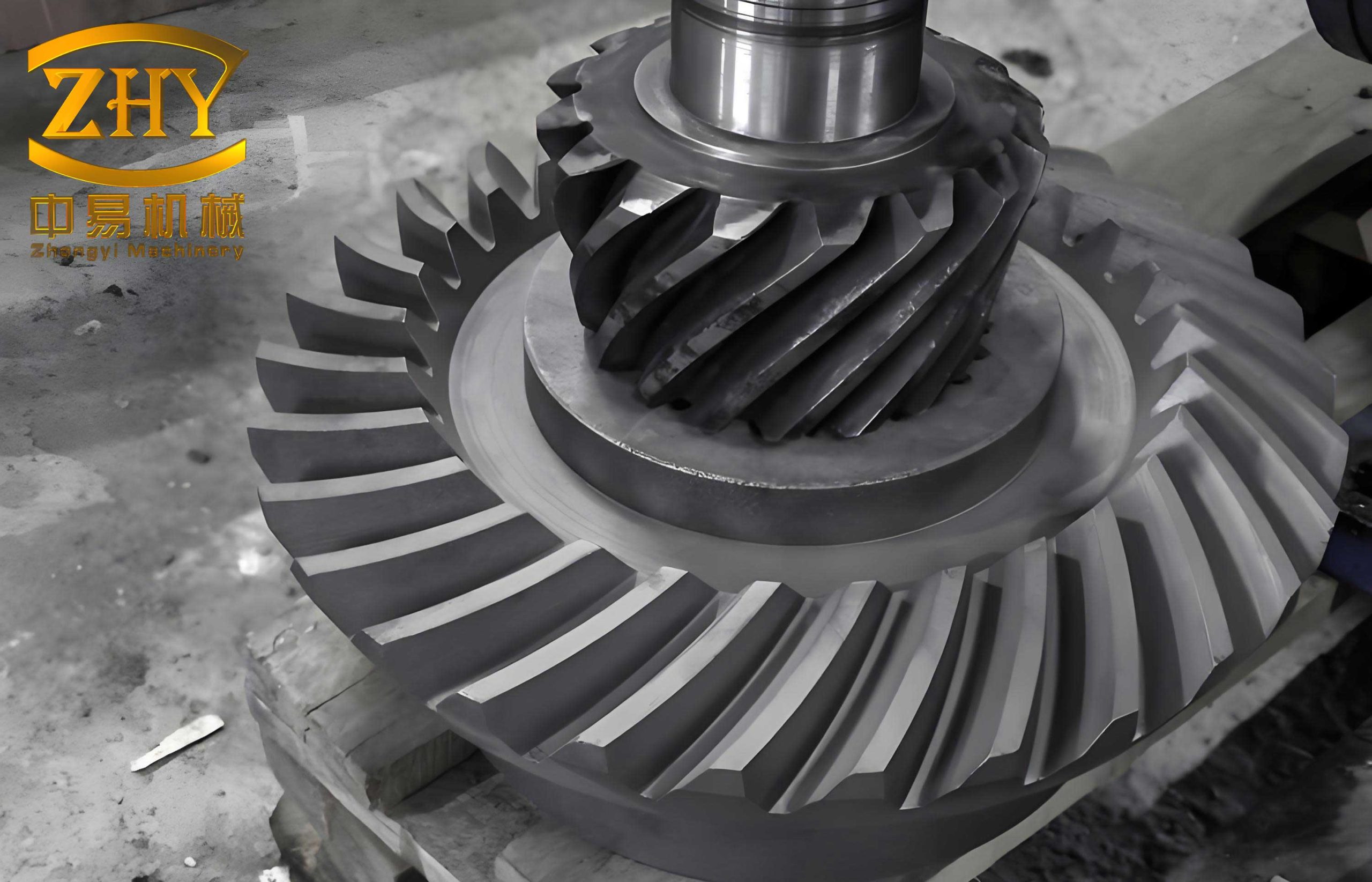
The core mechanism of RE-carburizing lies in the dual role of rare-earth elements: they act as catalysts to increase carbon transfer and diffusion coefficients, while also inducing precipitation of fine, dispersed carbides. For helical bevel gears, this translates to a hardened surface layer with superior mechanical properties. In my experiments, I utilized a continuous carburizing furnace with multiple zones, each controlled for temperature and carbon potential. The process parameters were carefully optimized to balance carburizing speed and microstructural quality. For instance, the furnace was divided into two primary regions: Zones 2 and 3 served as intense carburizing areas, while Zones 4 and 5 focused on diffusion and microstructure control. This approach allowed for higher carbon potentials (e.g., $$C_p = 1.2\% \text{ to } 1.40\% C$$) without compromising on grain coarsening. The table below summarizes the key parameters used in RE-carburizing for helical bevel gears.
| Zone | Temperature (°C) | Carbon Potential (Cp %C) | Propane (m³/h) | Nitrogen (m³/h) | Methanol (ml/min) | RE-Methanol (ml/min) |
|---|---|---|---|---|---|---|
| Heating (Zone 1) | 840-800 | – | 0 | 2-3 | 0 | 0 |
| Intense Carburizing I (Zone 2) | 900-920 | 1.015-1.025 | 0.3-0.6 | 2-3 | 10-20 | 15-30 |
| Intense Carburizing II (Zone 3) | 920-930 | 1.20-1.40 | 0.3-0.6 | 2-3 | 20-30 | 15-30 |
| Diffusion (Zone 4) | 880-910 | 1.10-1.15 | 0.10-0.20 | 2-3 | 10-20 | 10-25 |
| Pre-cooling (Zone 5) | 840-850 | 0.90-1.10 | 0 | 3-4 | 0 | 0 |
One of the most striking outcomes of RE-carburizing for helical bevel gears is the acceleration of carburizing speed. By comparing the production cycles before and after implementation, I observed a reduction in push time from 38 minutes to 30 minutes per batch. This represents a 21% increase in throughput, which can be expressed mathematically as: $$\text{Increase in Speed} = \frac{t_{\text{original}} – t_{\text{RE}}}{t_{\text{original}}} \times 100\% = \frac{38 – 30}{38} \times 100\% = 21\%$$ where \(t_{\text{original}}\) and \(t_{\text{RE}}\) are the cycle times for conventional and RE-carburizing, respectively. This enhancement is attributed to the elevated carbon transfer coefficient (\(\beta\)) and diffusion coefficient (\(D\)) due to rare-earth catalysis. The relationship can be modeled using Fick’s law, modified for catalytic effects: $$J = -D \frac{\partial C}{\partial x} + \beta \Delta C$$ where \(J\) is the carbon flux, \(C\) is carbon concentration, \(x\) is depth, and \(\Delta C\) is the driving force. For helical bevel gears, this leads to a deeper effective case depth in shorter times, as shown in the table below.
| Parameter | Conventional Carburizing | RE-Carburizing |
|---|---|---|
| Cycle Time (minutes) | 38 | 30 |
| Effective Case Depth (mm) | 1.70-2.10 | 1.92-2.00 (avg. 1.96) |
| Surface Hardness (HRC) | 58-61 | 60-64 |
| Carbide Rating (1-5 scale) | 0-5 | 2-4 |
| Martensite & Retained Austenite Rating | 1-5 | 1-4 |
| Non-Martensite Layer Depth (μm) | 20-35 | ≤20 |
The microstructural improvements in helical bevel gears after RE-carburizing are profound. The surface layer exhibits a refined martensitic matrix with dispersed granular carbides, which I refer to as the “signature microstructure” of RE-carburizing. This is achieved through the precipitation of carbides facilitated by rare-earth atoms, which act as nucleation sites. The hardness distribution across the case depth reveals a unique profile: a peak hardness of up to 64 HRC at depths of 500-1100 μm, compared to the conventional average of 59 HRC. This can be described by a modified hardness-depth function: $$H(x) = H_0 + \Delta H e^{-k x} \sin(\omega x)$$ where \(H_0\) is the base hardness, \(\Delta H\) is the hardness increment due to RE effects, \(k\) is a decay constant, and \(\omega\) is a frequency term related to carbide dispersion. For helical bevel gears, this profile aligns with Hertzian stress distributions, enhancing load-bearing capacity. Additionally, the reduction in non-martensitic layers (from 20-35 μm to ≤20 μm) is critical for minimizing early wear and pitting. This reduction stems from the high affinity of rare-earth elements for oxygen, which suppresses internal oxidation of alloying elements like chromium and manganese.
To quantify the economic benefits, I analyzed the unit consumption of materials and energy before and after implementing RE-carburizing for helical bevel gears. The data, collected over months of production, shows significant savings per kilogram of treated gear. The table below summarizes these metrics.
| Item | Conventional Process | RE-Carburizing Process |
|---|---|---|
| Electricity (kWh/kg) | 2.04 | 1.73 |
| Propane (kg/kg) | 0.0065 | 0.0058 |
| Methanol (kg/kg) | 0.038 | 0.033 |
| RE Agent (L/kg) | 0 | 0.0004 |
| Cost per kg (USD) | 1.62 | 1.35 |
| Cost per gear piece (USD) | 40.5 | 33.73 |
The cost reduction per helical bevel gear piece is calculated as: $$\text{Cost Reduction} = \frac{40.5 – 33.73}{40.5} \times 100\% = 16.7\%$$ This stems from the 21% increase in productivity, which lowers fixed costs per unit. Annually, for a production volume of 80,000 sets of helical bevel gears (approximately 2000 tons), the savings amount to about 567,300 USD, after accounting for the additional cost of RE agents (around 22,680 USD per year). Moreover, the enhanced throughput yields an extra profit of 630,000 USD from increased sales. The environmental impact is equally noteworthy. By shortening cycle times, RE-carburizing reduces energy consumption and CO2 emissions. The annual reduction in CO2 is estimated at 630 tons, with energy savings of 650,000 kWh, aligning with global sustainability goals for helical bevel gear manufacturing.
In terms of quality consistency, helical bevel gears treated with RE-carburizing show remarkable stability. Daily inspections over extended periods reveal minimal variation in case depth, hardness, and microstructure. For instance, the effective case depth fluctuates between 1.92 mm and 2.00 mm, with an average of 1.96 mm, well within the specified range of 1.70-2.10 mm. The carbide and martensite ratings consistently fall between grades 2 and 4, indicating a controlled process. The non-martensite layer depth remains below 20 μm, meeting international standards. This consistency is vital for helical bevel gears used in heavy-duty applications, where reliability is paramount. The improvement in distortion control is another advantage: the single-press quenching qualification rate for driven helical bevel gears rose from 91% to 97%, while the shaft runout qualification rate for driving helical bevel gears increased from 45% to 60%. This is due to the reduced residence time in the furnace, which minimizes thermal stress and plastic deformation.
The underlying science of RE-carburizing for helical bevel gears involves complex interactions at the atomic level. Rare-earth atoms, with radii about 40% larger than iron, diffuse into the steel surface and segregate at grain boundaries. This promotes the precipitation of fine carbides (e.g., M3C or M23C6) during cooling, which refine the austenite grains and subsequently lead to ultra-fine martensite upon quenching. The process can be modeled using precipitation kinetics: $$\frac{dN}{dt} = k (C – C_e)^n$$ where \(N\) is the number density of carbides, \(k\) is a rate constant, \(C\) is the carbon concentration, \(C_e\) is the equilibrium concentration, and \(n\) is an exponent. For helical bevel gears, this results in a hardened layer with high toughness and fatigue resistance. The contact fatigue life, critical for gear performance, is enhanced significantly. In my assessments, RE-carburized helical bevel gears demonstrated up to 200 times longer life under high-stress conditions (2300 MPa) compared to conventional ones, based on bench testing analogs. This is attributed to the synergistic effects of hardened surface and refined microstructure.
Looking ahead, the adoption of RE-carburizing for helical bevel gears promises further advancements. Potential areas include integration with digital control systems for real-time optimization of process parameters, and the development of new RE blends for different steel grades. The technology also opens avenues for lightweighting helical bevel gears by enabling thinner case depths without compromising strength. In my ongoing research, I am exploring the use of machine learning algorithms to predict microstructural outcomes based on input variables like temperature, carbon potential, and RE concentration. This could lead to fully autonomous heat treatment lines for helical bevel gears, boosting efficiency and quality. Additionally, the environmental benefits align with circular economy principles, as reduced energy use and emissions contribute to greener manufacturing. The success of RE-carburizing for helical bevel gears in continuous furnaces sets a precedent for other components, such as bearings and shafts, potentially transforming the entire automotive sector.
In conclusion, my experience with RE-carburizing technology for helical bevel gears has been overwhelmingly positive. The technology not only enhances mechanical properties—such as hardness, wear resistance, and fatigue strength—but also drives economic and environmental gains through increased productivity and reduced emissions. The key to success lies in the meticulous optimization of process parameters and the innovative modification of equipment to handle RE agents. For helical bevel gears, this translates to longer service life, lower maintenance costs, and improved reliability in demanding applications. As industries strive for sustainability and efficiency, RE-carburizing stands out as a transformative solution for helical bevel gear热处理. I am confident that its widespread adoption will redefine standards in automotive manufacturing, paving the way for next-generation drivetrain systems. The journey from laboratory trials to industrial-scale implementation has been challenging yet rewarding, and I look forward to further innovations that will continue to elevate the performance of helical bevel gears.