
The pursuit of high-performance linear actuation remains a central challenge in advanced robotics and precision machinery. Among various solutions, the planetary roller screw assembly (PRSA) has distinguished itself due to its superior load capacity, longevity, and precision compared to traditional ball screws. Its unique architecture distributes mechanical loads across multiple threaded rollers, offering remarkable durability and stiffness. A specific variant, the inverted planetary roller screw assembly (IPRSA), is particularly favored in compact applications like humanoid robot joints, as it allows for the motor to be integrated directly with the nut, reducing the overall system footprint. However, the manufacturing complexity of its helically threaded rollers presents economic and technical hurdles.
This article presents a novel synthesis: the Inverted Recirculating Planetary Roller Screw Assembly (IRPRSA). This design merges the structural compactness and motor-integration potential of the inverted configuration with the simplified manufacturability inherent to the recirculating type. In the recirculating variant, the rollers feature simple annular grooves rather than complex helices, significantly easing production. This work details the innovative design, derives its fundamental kinematic and geometric relationships, and employs dynamic simulation to analyze its operational characteristics and contact forces, providing a foundation for its optimization and application.
Structural Architecture and Operating Principle
The proposed IRPRSA comprises five primary components: the nut, the screw, multiple rollers, a cam ring, and a carrier (or retainer). The assembly is designed so the nut acts as the rotational input, while the screw provides the linear output, remaining rotationally fixed.
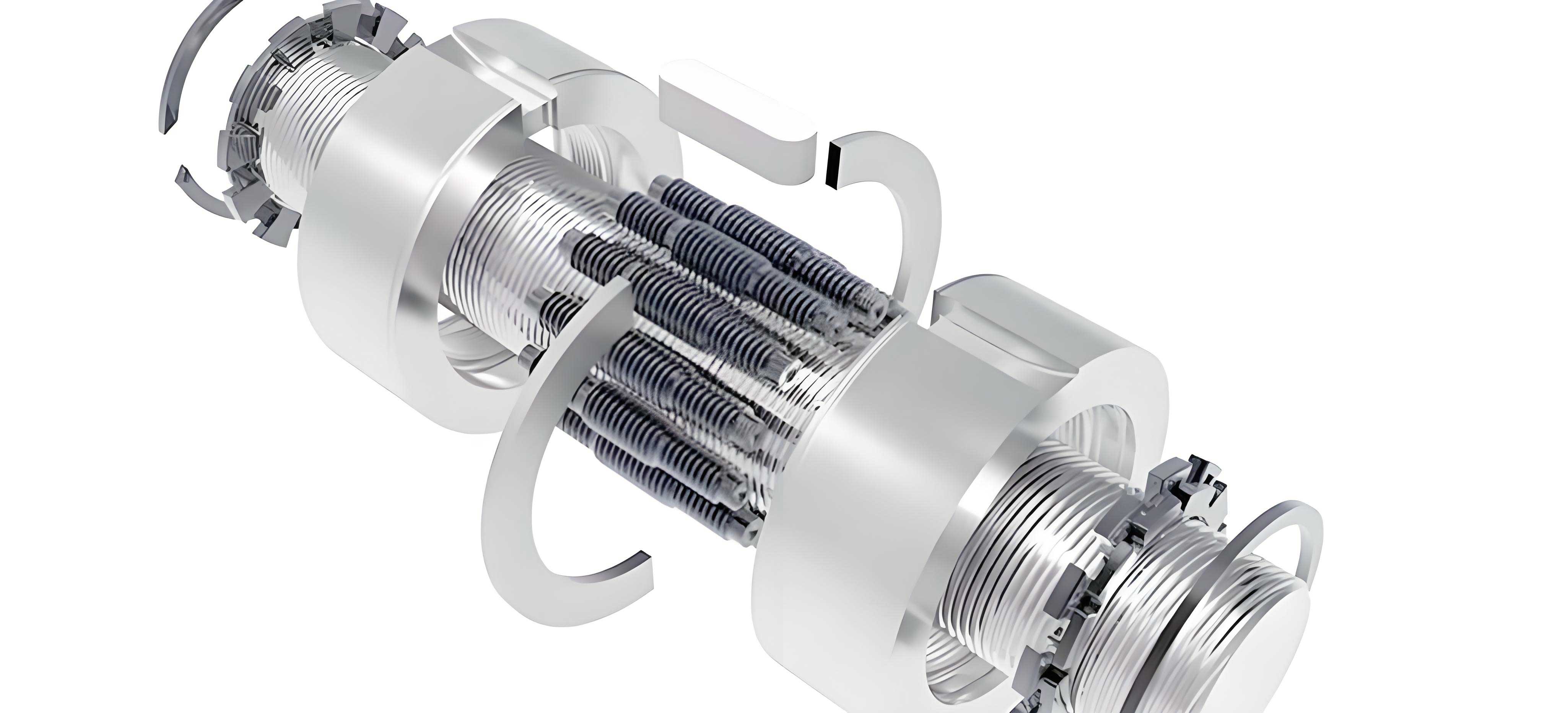
The nut is engineered with an internal 90° triangular thread. Externally, it can be customized; for instance, it can house permanent magnets for seamless integration with a stator, creating a direct-drive actuator. The screw possesses a matching 90° triangular external thread. The rollers, which are the defining feature of this planetary roller screw assembly, are designed with a 90° arc-shaped annular groove and have zero helix angle. This “ring-groove” design is fundamentally simpler to machine than a full helical thread. The cam ring, fixed relative to the screw, contains a special profile with ramps. Finally, the carrier rotates with the rollers’ orbital motion and guides them axially during the recirculation phase.
The transmission principle is as follows: The rotating nut drives the rollers through contact at their annular grooves. These rollers, in turn, engage with the threaded screw, converting their planetary motion into linear motion of the screw. During operation, each roller undergoes both rotation about its own axis (spin) and revolution around the screw’s axis (orbit). Crucially, to enable continuous travel, the screw features an unthreaded section. When a roller orbits into this zone, it disengages from both the nut and screw threads. Guided by the carrier and the ramped profile of the cam ring, the roller is shifted axially by exactly one lead before re-entering the threaded zone to re-engage, thus completing the recirculation cycle. This process allows for a theoretically unlimited stroke within a compact nut envelope.
Geometric Design and Parameter Matching
The successful operation of the planetary roller screw assembly hinges on precise geometric relationships between its components. The design must satisfy concentricity, thread matching, and recirculation path constraints.
1. Fundamental Thread Matching and Concentricity:
For proper meshing, the screw, rollers, and nut must share a common axis with defined radial relationships. The concentricity condition is:
$$d_s + 2d_r = d_n$$
where \(d_s\), \(d_r\), and \(d_n\) are the pitch diameters of the screw, roller, and nut, respectively. Furthermore, the screw and nut must have identical thread hand, number of starts \(n\), pitch \(p\), and lead \(S\):
$$n_s = n_n, \quad p_s = p_n, \quad S_s = S_n$$
2. Design of the Unthreaded Recirculation Zone:
The unthreaded section on the screw is critical for roller recirculation. Its profile is constructed from three circular arcs that guide the roller’s center. The primary design challenge is ensuring the roller completes its necessary axial shift \(S\) (one lead) within this zone. The second arc, with radius \(R_{su2}\), is associated with the cam ring’s ramp and facilitates the axial motion. The tangential displacement \(B_1D’_1\) required on this arc for an axial shift \(S\) is \(S / \tan(\alpha/2)\), where \(\alpha\) is the thread profile angle (90°). The corresponding central angle \(\beta_2\) for this displacement, given the roller’s orbital radius \(R_{c1} = R_{su2} + d_{r1}/2\), is:
$$\beta_2 = 2 \arcsin\left( \frac{S}{2 \tan(\alpha/2) R_{c1}} \right)$$
The central angle of the second arc, \(\beta_1\), must be greater than \(\beta_2\) to accommodate the motion. The total central angle \(\gamma\) of the unthreaded zone must be less than the angular spacing between adjacent rollers \(\phi = 2\pi / N\) (where \(N\) is the number of rollers) to prevent more than one roller from being in the recirculation zone simultaneously, yet large enough for the roller to complete its path:
$$\beta_2 + 2\beta_3 < \gamma < \phi$$
Here, \(\beta_3\) is the angle subtended by the entry/exit arcs.
3. Carrier and Cam Ring Design:
The carrier rotates synchronously with the rollers’ orbital motion. Its slots have an arcuate profile to cradle the rollers, and its length must allow for the roller’s full axial travel plus clearance:
$$l_b \geq l_r + S + 2e_b$$
where \(l_r\) is the roller’s grooved length and \(e_b\) is a machining allowance.
The cam ring is fixed to the housing and its internal thread must match the screw’s thread to prevent loosening. Its most critical feature is the ramped boss. The spiral angle \(\lambda\) of this ramp is derived from the lead and the cam ring’s pitch diameter \(d_t\):
$$\lambda = \arctan\left( \frac{S}{\pi d_t} \right)$$
The slope angle \(\varphi\) of the ramp’s inclined surface is a key parameter influencing the dynamics of the roller’s axial reset, as will be analyzed later.
The following table summarizes the key design parameters for a prototype IRPRSA model used in subsequent analysis.
| Component | Major Diameter (mm) | Pitch Diameter (mm) | Minor Diameter (mm) | Starts | Pitch (mm) | Profile Angle (°) |
|---|---|---|---|---|---|---|
| Screw | 9.92 | 9.60 | 9.08 | 1 | 1.0 | 90 |
| Roller | 4.95 | 4.50 | 4.13 | – | 1.0 (Groove Spacing) | 90 (Arc) |
| Nut | 19.12 | 18.60 | 18.28 | 1 | 1.0 | 90 |
| Cam Ring | 10.00 | 9.50 | 9.00 | 1 | 1.0 | 90 |
Kinematic Analysis of the Assembly
The kinematic relationships within this planetary roller screw assembly can be analyzed using the principles of planetary gearing. With the nut rotating (input, angular velocity \(\omega_n\)), the screw translating (output, linear velocity \(v_s\)), and the carrier orbiting with the rollers (angular velocity \(\omega_c\)), the system is a planetary mechanism.
Considering the velocity diagram at the meshing points, the orbital (carrier) speed is found to be:
$$\omega_c = \pm \frac{d_n}{d_n – d_r} \omega_n$$
The sign depends on the direction of rotation. The roller’s spin velocity \(\omega_r\) is derived from the transmission ratio of the converted mechanism (fixing the carrier):
$$i_{nr}^c = \frac{\omega_n – \omega_c}{\omega_r – \omega_c} = \frac{d_r}{d_n}$$
Solving for the roller spin velocity yields:
$$\omega_r = \pm \left[ \omega_c + (\omega_n – \omega_c) \frac{d_n}{d_r} \right]$$
Finally, the linear output velocity of the screw is determined by the nut’s rotation and the lead of the assembly:
$$v_s = \pm \frac{n p \omega_n}{2\pi} = \pm \frac{S \omega_n}{2\pi}$$
These equations fully describe the ideal kinematic motion of the inverted recirculating planetary roller screw assembly.
Dynamic Simulation and Contact Force Analysis
To validate the design and investigate its dynamic behavior, a multi-body dynamics model of the IRPRSA was developed using Adams software. The model included all components with appropriate materials (GCr15 bearing steel) and contacts. Contact forces between rollers/screw and rollers/nut were modeled using a Hertzian contact model with a stiffness coefficient \(K = 1 \times 10^5\) N/mm and a force exponent \(e = 1.5\). Friction was incorporated using the Coulomb model with static and dynamic coefficients of 0.3 and 0.25, respectively. The simulation applied a two-stage motion: a 1-second ramp-up phase where the nut speed and screw load increased to their target values, followed by a steady-state phase.
1. Kinematic Validation:
The simulation results confirmed the basic kinematic functionality. The roller’s spin velocity showed periodic drops corresponding to its passage through the unthreaded recirculation zone, where driving contact is lost. Averaging the spin velocity in the engaged periods yielded a value close to the theoretical prediction. The table below compares the steady-state simulation averages with theoretical values, confirming the model’s accuracy with errors below 1.2%.
| Parameter | Theoretical Value | Simulation Average | Relative Error |
|---|---|---|---|
| Roller Spin \(\omega_r\) (rad/s) | 25.97 | 25.68 | 1.12% |
| Carrier Orbit \(\omega_c\) (rad/s) | 8.29 | 8.35 | 0.72% |
| Screw Velocity \(v_s\) (mm/s) | 2.00 | 1.995 | 0.25% |
2. Analysis of Thread Contact Forces:
The axial component of the contact force between the rollers and the screw/nut threads is a critical performance indicator, related to load capacity and fatigue life. Dynamic simulations were conducted under varying operating conditions (nut speed and external load) and design parameters (cam ramp angle \(\varphi\)).
- Effect of Operating Conditions: The axial contact force in the threaded zone was found to be highly sensitive to the external load \(F_{ext}\) but virtually insensitive to the input nut speed \(\omega_n\). Doubling the load from 4000 N to 8000 N nearly doubled the average axial contact force per roller. This linear relationship is expected in a planetary roller screw assembly where the load is shared among the engaged rollers. The insensitivity to speed indicates minimal inertial effects in the studied range, which is desirable for predictable force transmission.
- Effect of Cam Ramp Angle \(\varphi\): Varying the cam ring’s boss slope angle \(\varphi\) from 45° to 60° had a negligible effect (< 3% change) on the average thread contact force. This confirms that the primary function of the cam ring is to manage recirculation dynamics without significantly altering the fundamental load-sharing mechanics of the threaded zone.
3. Analysis of Recirculation Impact Forces:
A distinctive dynamic event in this planetary roller screw assembly is the collision between the roller end and the inclined surface of the cam ring’s boss during the axial reset phase. The magnitude of this impact force \(F_{impact}\) is crucial for noise, vibration, and component wear.
- Effect of Operating Conditions: In contrast to thread forces, the recirculation impact force showed significant sensitivity to both speed and load. Higher nut speeds increase the relative velocity at which the roller contacts the ramp, leading to larger impact forces. Similarly, a higher external load increases the normal force between the roller and its guiding surfaces (carrier, screw body) during recirculation, which can translate into a larger force component during the ramp collision.
- Effect of Cam Ramp Angle \(\varphi\): The cam ramp angle \(\varphi\) proved to be the most influential parameter on impact dynamics. Increasing \(\varphi\) from 45° to 60° dramatically reduced the collision force range. A shallower slope (smaller \(\varphi\)) results in a more gradual axial reset but with a higher transverse force component as the roller is “squeezed” along the ramp. A steeper slope (larger \(\varphi\)) provides a more direct axial push, significantly mitigating the lateral collision forces. The simulation showed the impact force range dropped from approximately 1040-1180 N at \(\varphi=45^\circ\) to just 1.7-5.2 N at \(\varphi=60^\circ\). However, \(\varphi\) cannot be increased arbitrarily; it must be designed in conjunction with the unthreaded zone’s angular width \(\gamma\) to ensure the roller completes its full axial travel \(S\) within the available path.
The following table synthesizes the effects of key parameters on the dynamic forces within the IRPRSA, summarizing the insights gained from the simulation study.
| Parameter Variation | Effect on Thread Axial Contact Force | Effect on Recirculation Impact Force |
|---|---|---|
| Increase Nut Speed (\(\omega_n\)) | Negligible change | Significant increase |
| Increase External Load (\(F_{ext}\)) | Proportional increase | Moderate increase |
| Increase Cam Ramp Angle (\(\varphi\)) | Negligible change | Dramatic decrease |
Conclusion
This work has presented a comprehensive design and analysis of an Inverted Recirculating Planetary Roller Screw Assembly. The innovative design successfully combines the compact, motor-integratable architecture of an inverted planetary roller screw assembly with the manufacturing simplicity offered by recirculating rollers featuring annular grooves. Detailed geometric relationships and parameter matching formulas were derived, ensuring proper meshing and functional recirculation. Kinematic equations were established and validated through dynamic simulation, with errors less than 1.2%, confirming the feasibility of the proposed structure.
The dynamic analysis yielded critical insights for optimizing this planetary roller screw assembly. The axial contact forces in the main threaded engagement zone are predominantly determined by the external load, showing minimal sensitivity to operational speed or cam ring geometry. This characteristic is advantageous for predictable load-sharing and life estimation. Conversely, the forces associated with the recirculation process, specifically the roller-cam ramp impact, are highly sensitive to speed, load, and most importantly, the cam ramp inclination angle. The results demonstrate that increasing the cam boss slope angle \(\varphi\) is an extremely effective strategy for minimizing these potentially detrimental impact forces, thereby reducing vibration, noise, and wear during the reset phase. The optimal design must balance a sufficiently large \(\varphi\) to mitigate impacts with the geometric constraints of the unthreaded zone to ensure reliable roller recirculation.
This study establishes a foundational framework for the development of the IRPRSA. The findings, particularly regarding the decoupled nature of thread forces and recirculation dynamics, provide clear guidance for designers. Future work will focus on experimental validation, detailed elastohydrodynamic lubrication analysis of the groove contacts, and multi-objective optimization of geometric parameters to maximize load capacity and efficiency while minimizing recirculation-induced losses in this promising class of planetary roller screw assembly.