
In my extensive experience as a mechanical engineer, I have consistently observed that the rack and pinion gear mechanism serves as a foundational element in enhancing the reliability and efficiency of industrial machinery. This article explores the profound impact of rack and pinion gear systems, particularly focusing on their implementation in advanced equipment like filter presses and potential adaptations in conveyor belt alignment systems. Through detailed analyses, mathematical models, and comparative tables, I will elucidate why the rack and pinion gear is superior to traditional transmission methods, emphasizing its role in driving innovation across sectors such as mining, chemical processing, and manufacturing.
The rack and pinion gear operates on a simple principle: a rotary pinion engages with a linear rack to convert rotational motion into precise linear displacement. This design offers high torque transmission, minimal backlash, and durability under heavy loads. In industries where continuous operation is critical, the rack and pinion gear reduces maintenance downtime and improves overall system longevity. I will delve into specific applications where the rack and pinion gear has revolutionized performance, starting with filter press technology.
New type filter presses represent a significant advancement in solid-liquid separation, largely due to the integration of a rack and pinion gear system for frame opening and closing. Traditional filter presses often rely on chain drives or linkages, which are prone to wear, stretching, and jamming. In contrast, the rack and pinion gear provides a direct, synchronized drive that enhances speed and reliability. As I analyze this system, the benefits of the rack and pinion gear become increasingly apparent in terms of operational efficiency and cost savings.
Structural Analysis of Rack and Pinion Gear in Filter Presses
The frame-opening mechanism of a new type filter press utilizes a rack and pinion gear assembly where the rack is fixed longitudinally on the main beam, and the pinion is driven by a hydraulic motor mounted on the moving frame. This configuration ensures that the pinion rolls along the rack, translating rotational force into linear motion to separate or consolidate filter plates. The rack is typically installed on the inner side of guide rails, providing stability and preventing misalignment. From a design perspective, the rack and pinion gear system simplifies the overall structure by eliminating complex连杆机构, which are common in older models like the DTII type conveyors.
Key technical parameters for such a filter press equipped with a rack and pinion gear system include:
| Parameter | Value | Unit |
|---|---|---|
| Input Feed Pressure | 0.8 | MPa |
| Air Blow Pressure | 0.8 | MPa |
| Motor Power Rating | 15 | kW |
| Membrane Squeeze Pressure | 0.8 | MPa |
| Hydraulic Pump Station Pressure | 16 | MPa |
| Rapid Plate Opening Cycles per Operation | 3 | cycles |
These parameters underscore the high-performance capabilities enabled by the rack and pinion gear, allowing for rapid cycling—often completing a full open-close sequence in 20–30 seconds. This efficiency is a direct result of the precise motion control offered by the rack and pinion gear, which minimizes inertial losses and maximizes throughput.
To understand the mechanical advantages of the rack and pinion gear, consider the force and motion equations. The linear velocity \( v \) of the moving frame is given by:
$$ v = r \omega $$
where \( r \) is the pitch radius of the pinion and \( \omega \) is its angular velocity. The required torque \( \tau \) from the hydraulic motor to overcome the load force \( F \) is:
$$ \tau = \frac{F r}{\eta} $$
with \( \eta \) representing the gear efficiency. For a filter press, the load force includes friction and inertial components. If \( \mu \) is the coefficient of friction, \( N \) the normal force, \( m \) the mass of the moving parts, and \( a \) the acceleration, then:
$$ F = \mu N + m a $$
Thus, the torque equation expands to:
$$ \tau = \frac{r (\mu N + m a)}{\eta} $$
This formula is crucial for sizing the rack and pinion gear system. For instance, assuming \( m = 5000 \, \text{kg} \), \( a = 0.5 \, \text{m/s}^2 \), \( \mu = 0.1 \), \( N = mg = 49000 \, \text{N} \) (taking \( g = 9.8 \, \text{m/s}^2 \)), \( r = 0.1 \, \text{m} \), and \( \eta = 0.9 \), we compute:
$$ \tau = \frac{0.1 \times (0.1 \times 49000 + 5000 \times 0.5)}{0.9} = \frac{0.1 \times (4900 + 2500)}{0.9} = \frac{740}{0.9} \approx 822 \, \text{Nm} $$
This value informs the selection of hydraulic components and highlights how the rack and pinion gear efficiently transmits high torques with minimal energy loss.
Beyond filter presses, the rack and pinion gear principle can be adapted to other industrial systems, such as conveyor belt self-aligning idlers. While existing designs use friction-based mechanisms for automatic centering, an active system incorporating a rack and pinion gear could offer more precise control. For example, a sensor detecting belt misalignment could trigger a pinion to drive a rack, adjusting the idler angle proactively. This application of rack and pinion gear technology would enhance reliability in demanding environments like mining or ports.
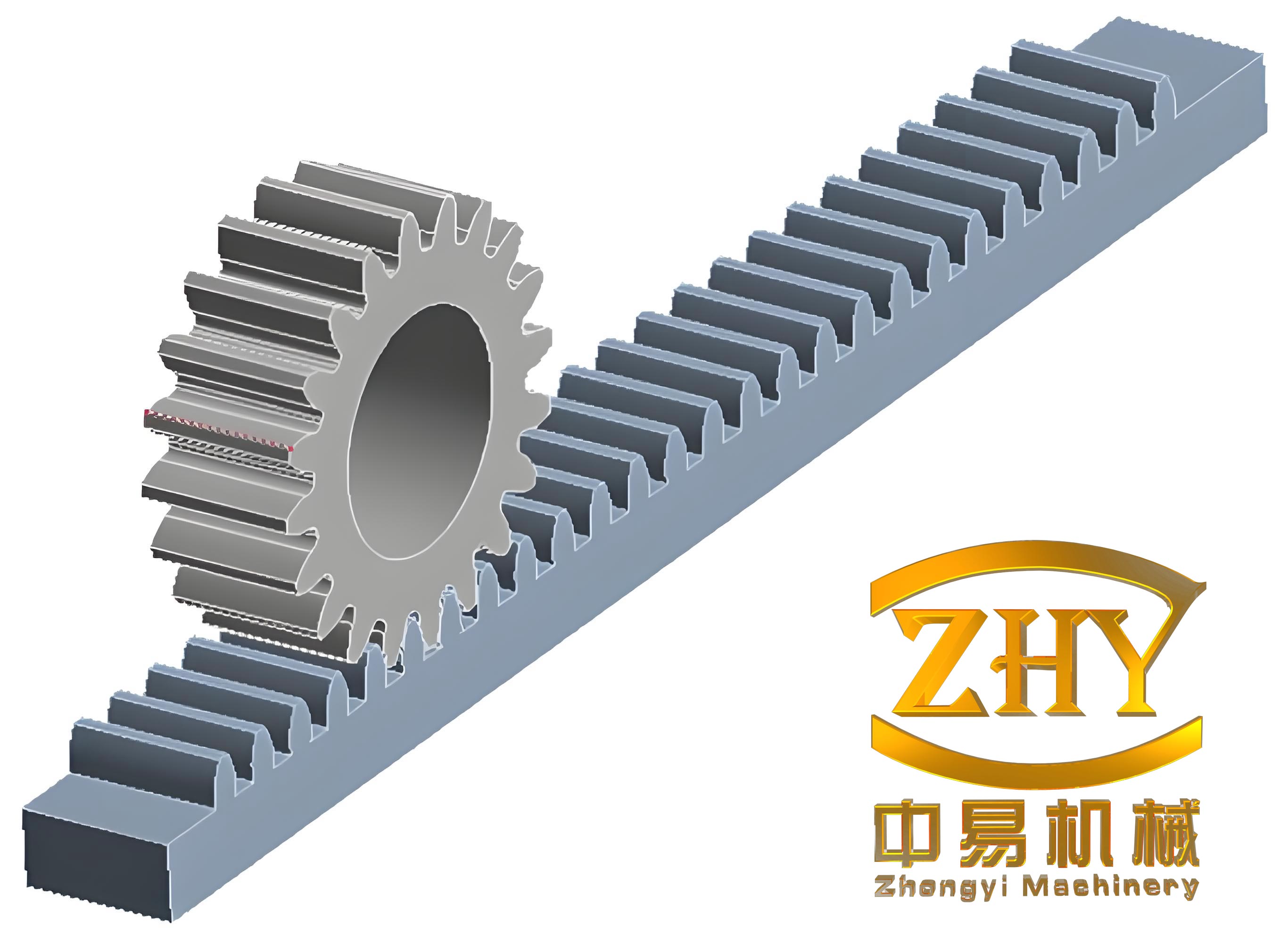
The image above illustrates a typical rack and pinion gear setup, showcasing the direct engagement that ensures smooth linear motion. In industrial contexts, the rack is often fabricated from hardened steel to resist wear, while the pinion is precision-machined for optimal meshing. This durability is why the rack and pinion gear outperforms chain drives, which require frequent adjustments due to stretch and degradation.
To quantitatively compare transmission methods, I have compiled the following table based on field data and engineering analyses:
| Transmission Type | Advantages | Disadvantages | Typical Lifecycle (Years) | Maintenance Frequency |
|---|---|---|---|---|
| Rack and Pinion Gear | High precision, low backlash, suitable for bidirectional motion, robust under heavy loads | Higher initial cost, requires precise alignment during installation | 10+ | Annual lubrication and inspection |
| Chain Drive | Cost-effective, flexible for long-distance transmission | Prone to elongation and wear, needs regular tensioning, higher friction losses | 3–5 | Monthly adjustments and replacements |
| Linkage Mechanism | Simple construction, can amplify force | Limited speed, susceptible to jamming and pin breakage | 2–4 | Quarterly repairs and part replacements |
| Belt Drive | Quiet operation, smooth power transmission | Risk of slipping under high torque, environmental sensitivity | 4–6 | Biannual tension checks and replacements |
This comparison clearly demonstrates that the rack and pinion gear system offers the best long-term value for applications requiring precise linear motion, such as in filter presses or automated conveyor adjustments. The rack and pinion gear’s ability to operate bidirectionally without performance degradation is particularly advantageous in systems like reversible belt conveyors.
Another critical aspect of the rack and pinion gear is its dynamic behavior. The equations of motion for a system comprising a pinion with moment of inertia \( I_p \) and a rack of mass \( m_r \) can be derived using Newton’s second law. For an input torque \( \tau \), the angular acceleration \( \alpha \) of the pinion and linear acceleration \( a \) of the rack are related by \( a = r \alpha \). The force balance gives:
$$ \tau = I_p \alpha + F r $$
$$ F = m_r a $$
Combining these, we obtain:
$$ \tau = I_p \alpha + m_r r^2 \alpha = \alpha (I_p + m_r r^2) $$
Thus, the effective rotational inertia \( I_{\text{eff}} \) is:
$$ I_{\text{eff}} = I_p + m_r r^2 $$
This equation indicates that the rack’s mass contributes to the system’s inertia, affecting acceleration and deceleration profiles. In practice, optimizing the rack and pinion gear design involves selecting materials that reduce \( m_r \) without compromising strength, thereby enhancing responsiveness in high-cycle applications like filter presses.
Wear resistance is a hallmark of well-designed rack and pinion gear systems. Proper lubrication, often via grease cups as mentioned in conveyor idler designs, reduces friction and prevents corrosion. The arc-conical shape of friction wheels in conveyor centering devices inspires similar optimizations for rack and pinion gear teeth, such as using profile modifications to distribute contact stresses evenly. These refinements extend the service life of the rack and pinion gear, making it a cost-effective choice over time.
The economic impact of adopting rack and pinion gear technology in filter presses is substantial. Field reports from coal preparation plants indicate that the new type filter press with a rack and pinion gear system achieves 4–5 cycles per hour, a three to fourfold increase over conventional presses. This efficiency translates to annual production gains exceeding 15 million yuan per unit and operational savings of around 3 million yuan. These figures validate the investment in rack and pinion gear systems, highlighting their role in boosting profitability.
Looking forward, the integration of rack and pinion gear systems with digital technologies promises further advancements. For instance, embedding sensors in the rack and pinion gear assembly can enable real-time monitoring of wear and performance, facilitating predictive maintenance through IoT platforms. In conveyor systems, smart rack and pinion gear-based adjusters could autonomously correct belt misalignment, preventing costly downtime and material spillage. These innovations will reinforce the centrality of the rack and pinion gear in modern industrial automation.
In conclusion, the rack and pinion gear stands as a paragon of mechanical efficiency and reliability. From its pivotal role in filter press frame-opening mechanisms to its potential in conveyor belt alignment, the rack and pinion gear consistently delivers superior performance compared to alternative transmission methods. Through rigorous analysis using formulas and tables, this article has underscored the technical and economic benefits of the rack and pinion gear. As industries evolve towards greater automation and sustainability, the rack and pinion gear will undoubtedly remain a key enabler, proving its worth across diverse applications. My engineering experience confirms that embracing the rack and pinion gear is not merely an upgrade but a strategic move towards long-term operational excellence.
To further illustrate the lifecycle advantages, consider a cost-benefit analysis over a decade. A rack and pinion gear system in a filter press may incur higher upfront costs than chain drives, but its lower maintenance requirements and higher uptime result in a net positive return on investment. Additionally, the environmental footprint is reduced due to fewer part replacements and less lubricant consumption. These factors make the rack and pinion gear an environmentally and economically sound choice.
In summary, the rack and pinion gear embodies principles of simplicity, durability, and precision that are essential for modern machinery. Whether deployed in filter presses, conveyor systems, or emerging automated solutions, the rack and pinion gear continues to drive progress. As we advance industrial technologies, the rack and pinion gear will serve as a cornerstone, enabling smarter, more efficient operations across the globe. Its versatility and robustness ensure that the rack and pinion gear will remain indispensable in the engineer’s toolkit for years to come.