
In the field of gear engineering, hyperboloid gears represent a critical component for transmitting motion between non-intersecting and non-parallel axes, commonly used in automotive differentials and industrial machinery. Traditional design and machining methods for hyperboloid gears rely heavily on spatial geometric analyses, which involve numerous variables and complex equation systems, making computations cumbersome and error-prone. This article introduces a novel analytical method that simplifies the entire process, from blank design to machining adjustments, using a pure mathematical framework. By focusing on the tangency contact conditions between two skew conical surfaces, we derive a unified set of equations that are easier to understand and compute, thereby revolutionizing the approach to hyperboloid gears.
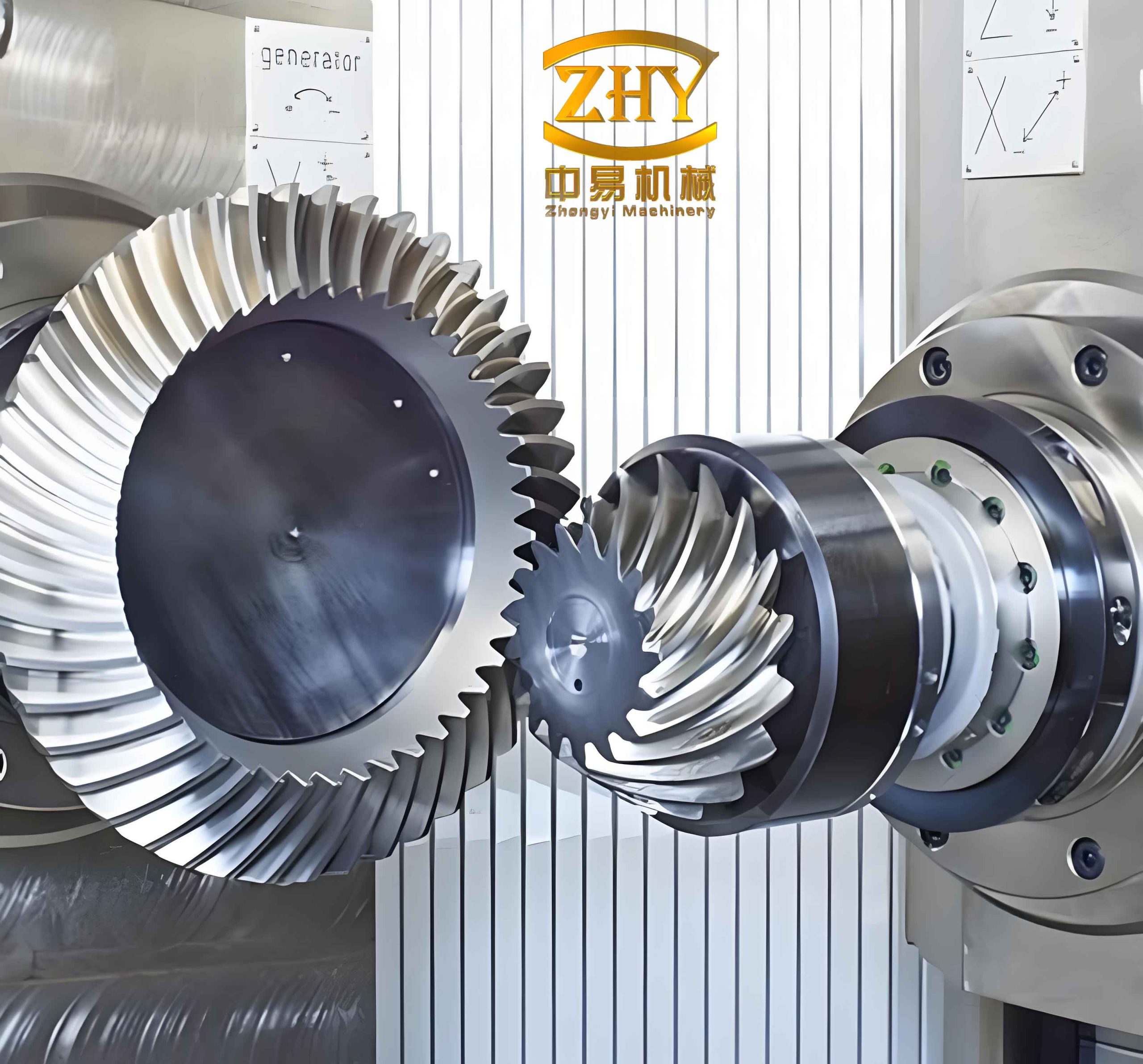
The design of hyperboloid gears hinges on accurately modeling the pitch cones, which are conical surfaces that define the gear teeth’s theoretical contact points. Existing literature often employs graphical analyses from solid geometry, leading to intricate systems with multiple unknowns. In contrast, our method formulates the problem using coordinate transformations and vector calculus, reducing it to a manageable set of nonlinear equations. This not only enhances computational efficiency but also provides deeper insights into the behavior of hyperboloid gears under various configurations, including orthogonal and non-orthogonal arrangements.
To begin, we consider two hyperboloid gears with skew axes, represented as edges of a parallelepiped. The conical surfaces of the gears, denoted as surface 1 and surface 2, are described in their local coordinate systems. The equations and normal vectors for these surfaces are fundamental to our analysis. For surface 1, in coordinates $(x^{(1)}, y^{(1)}, z^{(1)})$, we have:
$$
x^{(1)}_1 = r_1 \cos\theta_1, \quad y^{(1)}_1 = r_1 \cot\gamma_1, \quad z^{(1)}_1 = r_1 \sin\theta_1
$$
and for surface 2, in coordinates $(x^{(2)}, y^{(2)}, z^{(2)})$:
$$
x^{(2)}_2 = r_2 \cos\theta_2, \quad y^{(2)}_2 = r_2 \sin\theta_2, \quad z^{(2)}_2 = -r_2 \cot\gamma_2
$$
The corresponding normal vectors are:
$$
\mathbf{n}^{(1)}_1 = (\cos\gamma_1 \cos\theta_1, -\sin\gamma_1, \cos\gamma_1 \sin\theta_1)
$$
$$
\mathbf{n}^{(2)}_2 = (\cos\gamma_2 \cos\theta_2, \cos\gamma_2 \sin\theta_2, \sin\gamma_2)
$$
Here, $r_1$ and $r_2$ are the radial distances from the cone vertices, $\gamma_1$ and $\gamma_2$ are the cone angles, and $\theta_1$ and $\theta_2$ are the angular positions. These parameters are essential in defining the geometry of hyperboloid gears. To analyze the contact between the gears, we transform these local coordinates into a unified global coordinate system $(x^{(0)}, y^{(0)}, z^{(0)})$. The transformations incorporate the axial offset $E$ (distance between axes) and the distances $e_1$ and $e_2$ from the cone vertices to the skew point:
$$
x^{(0)}_1 = x^{(1)}_1 + E, \quad y^{(0)}_1 = y^{(1)}_1 – e_1, \quad z^{(0)}_1 = z^{(1)}_1
$$
$$
x^{(0)}_2 = x^{(2)}_2, \quad y^{(0)}_2 = y^{(2)}_2, \quad z^{(0)}_2 = z^{(2)}_2 – e_2
$$
This transformation is crucial for ensuring that the contact conditions are applied consistently across both hyperboloid gears. The tangency condition requires that at the contact point, the normal vectors of the two surfaces are parallel, i.e., $\mathbf{n}^{(0)}_1 \parallel \mathbf{n}^{(0)}_2$. From this, we derive two key equations:
$$
-\sin\gamma_1 \sin\gamma_2 = \cos\gamma_2 \cos\gamma_1 \sin\theta_1 \sin\theta_2 \quad \text{(1)}
$$
$$
\cos\gamma_1 \cos\gamma_2 \cos\theta_1 \sin\theta_2 = -\sin\gamma_1 \cos\gamma_2 \cos\theta_2 \quad \text{(2)}
$$
Additionally, the contact point must have identical coordinates in the global system, leading to three more equations:
$$
r_1 \cos\theta_1 + E = r_2 \cos\theta_2 \quad \text{(3)}
$$
$$
r_1 \cot\gamma_1 – e_1 = r_2 \sin\theta_2 \quad \text{(4)}
$$
$$
r_1 \sin\theta_1 = -r_2 \cot\gamma_2 – e_2 \quad \text{(5)}
$$
This system involves eight unknowns: $r_1$, $r_2$, $\gamma_1$, $\gamma_2$, $e_2$, $e_1$, $\theta_1$, and $\theta_2$. To solve it, we introduce three additional conditions based on gear design requirements. First, the limiting normal curvature at the pitch point must equal the cutter curvature, expressed as:
$$
r_c = \frac{\tan\psi_1 – \tan\psi_2}{\left[ \pm \tan\phi_0 \left( \frac{\tan\psi_1}{L_1 \tan\gamma_1} + \frac{\tan\psi_2}{L_2 \tan\gamma_2} \right) + \left( \frac{1}{L_1 \cos\psi_1} – \frac{1}{L_2 \cos\psi_2} \right) \right]} \quad \text{(6)}
$$
where $\tan\phi_0 = \frac{\tan\gamma_1 \tan\gamma_2 (L_1 \sin\psi_1 – L_2 \sin\psi_2)}{L_1 \tan\gamma_1 + L_2 \tan\gamma_2}$, with $\psi_1$ and $\psi_2$ being the spiral angles, $L_1$ and $L_2$ the cone distances at the pitch point, and $\phi_0$ the limiting pressure angle. Second, the pitch radius for the larger gear is typically set at the mid-point of the tooth width, given by:
$$
r_2 = \frac{D – F \sin\gamma_2}{2} \quad \text{(7)}
$$
where $D$ is the outer diameter and $F$ the face width. Third, the spiral angle for the pinion satisfies:
$$
\tan\psi_1 = \frac{k – \cos\varepsilon’}{\sin\varepsilon’} \quad \text{(8)}
$$
with $k = \frac{N_2 r_1}{n_1 r_2}$, where $N_2$ and $n_1$ are tooth numbers, and $\varepsilon’$ is the angle between the generating lines at the contact point, derived from the dot product of tangent vectors:
$$
\mathbf{t}^{(0)}_1 \cdot \mathbf{t}^{(0)}_2 = \sin\gamma_1 \cos\theta_1 \sin\gamma_2 \cos\theta_2 + \cos\gamma_1 \sin\gamma_2 \sin\theta_2 – \cos\gamma_2 \sin\gamma_1 \sin\theta_1 = \cos\varepsilon’ \quad \text{(9)}
$$
and $\psi_1 = \psi_2 + \varepsilon’$. By combining these equations, we reduce the problem to solving a two-variable nonlinear system. Specifically, for given $\gamma_1$ and $\gamma_2$, we compute $r_1$ and $r_2$ from (3) and (7), then $e_2$ and $e_1$ from (4) and (5), followed by $\theta_1$ and $\theta_2$ from (1) and (2). Finally, we check if $r_c = r_{c0}$ and $\psi_1 = \psi_{1o}$ from (6) and (8), iterating until convergence. This approach simplifies the design of hyperboloid gears significantly.
To illustrate the parameters and equations involved, Table 1 summarizes the key variables used in our analytical method for hyperboloid gears:
| Symbol | Description | Typical Units |
|---|---|---|
| $r_1, r_2$ | Radial distances on pitch cones | mm |
| $\gamma_1, \gamma_2$ | Cone angles | degrees |
| $\theta_1, \theta_2$ | Angular positions | radians |
| $E$ | Axial offset distance | mm |
| $e_1, e_2$ | Vertex to skew point distances | mm |
| $\psi_1, \psi_2$ | Spiral angles | degrees |
| $L_1, L_2$ | Cone distances at pitch point | mm |
| $\phi_0$ | Limiting pressure angle | degrees |
| $\varepsilon’$ | Angle between generating lines | degrees |
Our method extends seamlessly to non-orthogonal hyperboloid gears, where the axes are not perpendicular. In such cases, the coordinate transformations involve additional rotation matrices. For a shaft angle $\Sigma$, the transformation from the local system of the pinion to the global system is given by:
$$
\mathbf{M}_{o1} = \mathbf{M}_{ot} \mathbf{M}_{tu} \mathbf{M}_{u1} =
\begin{bmatrix}
1 & 0 & 0 & E \\
0 & \cos\Sigma & \sin\Sigma & -e_1 \cos\Sigma \\
0 & -\sin\Sigma & \cos\Sigma & e_1 \sin\Sigma \\
0 & 0 & 0 & 1
\end{bmatrix}
$$
This modifies equations (1) to (5) and (9) as follows:
$$
\cos\gamma_1 \cos\gamma_2 \cos\theta_1 \sin\theta_2 = (-\sin\gamma_1 \cos\Sigma + \cos\gamma_1 \sin\theta_1 \sin\Sigma) \cos\gamma_2 \cos\theta_2 \quad \text{(1′)}
$$
$$
\cos\gamma_1 \sin\gamma_2 \cos\theta_1 = (\sin\gamma_1 \sin\Sigma + \cos\gamma_1 \sin\theta_1 \cos\Sigma) \cos\gamma_2 \cos\theta_2 \quad \text{(2′)}
$$
$$
r_1 \cos\theta_1 + E = r_2 \cos\theta_2 \quad \text{(3′)}
$$
$$
r_1 \cot\gamma_1 \cos\Sigma + r_1 \sin\theta_1 \sin\Sigma – e_1 \cos\Sigma = r_2 \sin\theta_2 \quad \text{(4′)}
$$
$$
-r_1 \cot\gamma_1 \sin\Sigma + r_1 \sin\theta_1 \cos\Sigma = -r_2 \cot\gamma_2 – e_2 \quad \text{(5′)}
$$
$$
\cos\varepsilon’ = \sin\gamma_1 \sin\gamma_2 \cos\theta_1 \cos\theta_2 + (\cos\gamma_1 \cos\Sigma + \sin\gamma_1 \sin\theta_1 \sin\Sigma) \sin\gamma_2 \sin\theta_2 – \cos\gamma_2 (\sin\gamma_1 \sin\theta_1 \cos\Sigma – \cos\gamma_1 \sin\Sigma) \quad \text{(9′)}
$$
These equations allow for the design of hyperboloid gears with arbitrary shaft angles, broadening the applicability of our method. The analytical framework remains consistent, emphasizing the versatility of this approach for various hyperboloid gears configurations.
Beyond pitch cone design, our method facilitates other critical calculations for hyperboloid gears, such as determining the tip and root cones. The tip cone angle for the pinion is derived from the addendum, while the root cone of the gear must be tangent to the pinion’s tip cone. Given $\gamma_1$, $e_2$, and $e_1$, we solve equations (1′) to (5′) for $r_1$, $r_2$, $\gamma_2$, $\theta_1$, and $\theta_2$. Similarly, the machining cone (or process cone) for the gear is an equidistant surface from the root cone at the pitch point, and a new pitch cone for the pinion is defined relative to its tip cone. These calculations ensure proper tooth clearance and strength in hyperboloid gears.
For machining adjustments, the relationship between the gear blank and the generating gear (or crown gear) is vital. The generating gear is essentially a flat-top gear with a cone angle of $90^\circ$ minus the addendum angle $\delta_h$, i.e., $\delta = 90 – \delta_h$. The tangency condition between the gear’s process cone and the flat-top surface allows us to solve for unknowns when $r_2$, $\gamma_1$, $\gamma_2$, and $E$ are known. Using equations (1′) to (5′) and (6), we determine $e_2$, $e_1$, $\theta_1$, $\theta_2$, $r_1$, and then compute $\varepsilon’$ from (9′), $\psi_{1G}$ from a modified spiral angle relation, and $k$ from (8). This yields the gear ratio $N/n$ for the cutting process, streamlining the setup for manufacturing hyperboloid gears.
To further elucidate the computational steps, Table 2 outlines the sequence for solving the hyperboloid gears design problem using our analytical method:
| Step | Action | Equations Used | Outputs |
|---|---|---|---|
| 1 | Initialize cone angles | Assumed $\gamma_1, \gamma_2$ | Starting values |
| 2 | Compute pitch radii | (3) and (7) | $r_1, r_2$ |
| 3 | Determine vertex distances | (4) and (5) or (4′) and (5′) | $e_2, e_1$ |
| 4 | Solve for angular positions | (1) and (2) or (1′) and (2′) | $\theta_1, \theta_2$ |
| 5 | Calculate line angle | (9) or (9′) | $\varepsilon’$ |
| 6 | Check curvature and spiral angle | (6) and (8) | $r_c, \psi_1$ convergence |
| 7 | Iterate if needed | Adjust $\gamma_1, \gamma_2$ | Final design parameters |
This tabular representation highlights the logical flow, making it easier to implement in software for hyperboloid gears design. The method’s robustness is evident in its ability to handle both standard and non-standard geometries, reducing reliance on empirical charts and iterative graphical methods.
The advantages of our analytical approach are manifold. Firstly, it unifies the calculations for pitch cones, tip and root cones, and machining cones under a single mathematical framework, eliminating inconsistencies that often arise in traditional methods. Secondly, it reduces the computational burden by transforming an eight-variable nonlinear system into a simpler two-variable problem, accelerating the design process for hyperboloid gears. Thirdly, it enhances accuracy by leveraging exact algebraic equations rather than approximate graphical techniques, which is crucial for high-performance applications like automotive transmissions where hyperboloid gears are prevalent.
Moreover, our method aligns with modern computational tools, allowing for seamless integration into CAD/CAM systems. Engineers can easily program these equations to automate the design and machining of hyperboloid gears, fostering innovation and customization. For instance, in the development of advanced hyperboloid gears for electric vehicle differentials, precise control over tooth contact patterns is essential for efficiency and noise reduction—our method provides the necessary analytical foundation.
In practice, the application of this method to hyperboloid gears involves several considerations. Material properties, load conditions, and manufacturing tolerances must be incorporated into the parameters. For example, the limiting curvature in equation (6) depends on the cutter geometry, which can be optimized for specific gear materials. Additionally, the spiral angles $\psi_1$ and $\psi_2$ influence the tooth contact and load distribution, requiring careful selection based on dynamic analysis. Our analytical framework accommodates these factors by allowing parametric studies, where variables like $E$ or $\Sigma$ are varied to optimize performance.
To demonstrate the method’s efficacy, consider a case study involving orthogonal hyperboloid gears with an axial offset $E = 30$ mm, outer diameter $D = 200$ mm, and face width $F = 40$ mm. Using the equations, we can derive the cone angles, spiral angles, and other dimensions. The iterative solution converges quickly, yielding design parameters that meet strength and contact requirements. This process exemplifies how our approach simplifies the complex task of hyperboloid gears design, making it accessible to a wider range of engineers.
Looking ahead, the implications of this method extend beyond traditional hyperboloid gears. It can be adapted for novel gear types, such as those with modified tooth profiles or hybrid geometries. Furthermore, the analytical principles can inform real-time monitoring and adjustment in smart manufacturing systems, where hyperboloid gears are produced with minimal human intervention. As industry moves towards Industry 4.0, such mathematical rigor becomes increasingly valuable.
In conclusion, the proposed analytical method represents a significant advancement in the design and machining of hyperboloid gears. By focusing on tangency conditions and employing coordinate transformations, we have developed a unified, computationally efficient framework that surpasses traditional geometric approaches. This method not only simplifies calculations but also enhances understanding of the underlying mechanics, paving the way for innovation in gear technology. As hyperboloid gears continue to be integral in mechanical systems, tools like this will drive progress in efficiency, reliability, and performance.
To further support this discussion, we present key formulas in a consolidated manner for hyperboloid gears design. The core equations from our derivation are summarized below, emphasizing their interrelationships:
Contact condition for parallel normals in orthogonal hyperboloid gears:
$$
-\sin\gamma_1 \sin\gamma_2 = \cos\gamma_2 \cos\gamma_1 \sin\theta_1 \sin\theta_2
$$
Coordinate matching at the contact point:
$$
r_1 \cos\theta_1 + E = r_2 \cos\theta_2
$$
Limiting curvature for cutter matching:
$$
r_c = \frac{\tan\psi_1 – \tan\psi_2}{\left[ \pm \tan\phi_0 \left( \frac{\tan\psi_1}{L_1 \tan\gamma_1} + \frac{\tan\psi_2}{L_2 \tan\gamma_2} \right) + \left( \frac{1}{L_1 \cos\psi_1} – \frac{1}{L_2 \cos\psi_2} \right) \right]}
$$
These equations, along with others detailed earlier, form the backbone of our method. By iteratively solving them, designers can achieve optimal configurations for hyperboloid gears, ensuring smooth operation and longevity. The integration of such analytical techniques into standard practice will undoubtedly elevate the field of gear engineering, making hyperboloid gears more reliable and efficient in diverse applications.
Finally, it is worth noting that the success of this method hinges on accurate parameter initialization and convergence criteria. For hyperboloid gears with extreme offsets or angles, numerical stability may require tailored algorithms, but the fundamental equations remain valid. As computational power grows, real-time optimization of hyperboloid gears designs will become feasible, further underscoring the value of this analytical approach. In essence, we have provided a roadmap for transforming the art of gear design into a precise science, with hyperboloid gears at the forefront of this evolution.