
In this study, we explore a novel type of cylindrical gear, specifically designed with cycloidal tooth profiles along the axial direction, which enables efficient machining through continuous index milling. Unlike conventional spur gears, which are widely used but suffer from limitations such as low contact ratios and vibration issues, our proposed gear offers enhanced performance characteristics, including high load capacity, smooth transmission, and absence of axial forces. The ability to manufacture these gears using a continuous milling process significantly improves production efficiency, making them a promising alternative to traditional spur gears in various industrial applications. This research delves into the mathematical modeling, design, and machining principles of these cycloidal spur gears, highlighting their advantages over standard spur gears while addressing their limitations.
Spur gears are among the most common types of cylindrical gears, valued for their simplicity in design, ease of manufacturing, and straightforward assembly. However, spur gears exhibit a low contact ratio, leading to increased noise and vibration under high-load conditions. In contrast, helical gears provide smoother operation due to gradual engagement of teeth, but they introduce axial forces that can compromise structural integrity. Double-helical or herringbone gears mitigate axial forces but require complex machining processes, including wide recess grooves that reduce effective tooth surface utilization. Our investigation focuses on overcoming these drawbacks by developing a cycloidal spur gear that combines the benefits of spur gears with improved performance and manufacturability.
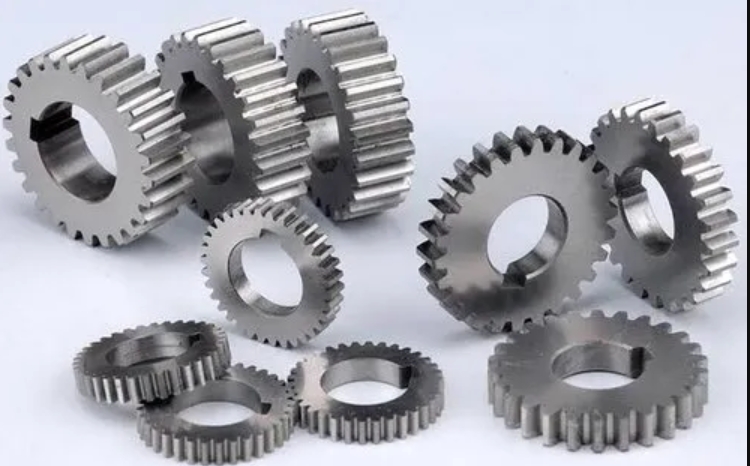
The core of our approach lies in the geometric design of the gear teeth, which follow a cycloidal path in the axial direction. This configuration allows for continuous index milling, where a disc milling cutter with replaceable blades rotates in sync with the workpiece, eliminating the need for intermittent indexing and retraction motions common in traditional spur gear machining. The mathematical foundation for this gear is derived from gear meshing theory, ensuring proper conjugation between mating gears. We begin by establishing the relationship between the disc cutter and the generating rack, which is essential for defining the tooth surface. The generating rack’s tooth profile is represented by a cycloid generated by a point on a circle rolling along a straight line, as described by the parametric equations below.
Let us define the cycloid equation in the coordinate system fixed to the rack. Consider a circle of radius $R_b$ rolling along the rack’s pitch line, with a point located at a distance $R_t$ from the circle’s center. The cycloid trajectory in the rack coordinate system $S_1$ is given by:
$$ \begin{cases}
X_1 = R_b \theta – R_t \sin \theta + L_2 \\
Y_1 = R_b – R_t \cos \theta
\end{cases} $$
where $L_2 = R_b / \tan [ \arcsin ( R_b / R_t ) ] – R_b \arccos ( R_b / R_t )$, and $\theta$ is the rolling angle parameter. This equation forms the basis for the rack tooth surface, which is extended linearly along the Z-axis to create a three-dimensional surface. By introducing a parameter $u$ to represent the linear variation, the rack tooth surface equation becomes:
$$ \mathbf{r}_1(u, \theta) = \begin{pmatrix}
R_b \theta – (R_t + u \tan \alpha) \sin \theta + L_2 \\
R_b – (R_t + u \tan \alpha) \cos \theta \\
u
\end{pmatrix} $$
Here, $\alpha$ denotes the pressure angle, typically set between 18° and 25° for compatibility with standard spur gears. This surface serves as the generating tool for the cycloidal spur gears, analogous to the rack in spur gear generation.
To ensure proper meshing between the rack and the gear, we apply the fundamental equation of gear meshing, which requires that the relative velocity at the contact point is perpendicular to the common normal vector. In the fixed coordinate system $S_f$, the rack surface is transformed, and the meshing condition is expressed as:
$$ \mathbf{v}_{12} \cdot \mathbf{n} = 0 $$
where $\mathbf{v}_{12}$ is the relative velocity vector, and $\mathbf{n}$ is the normal vector to the rack surface. Solving this equation yields the relationship between parameters $u$ and $\theta$ for the contact line at any given time $t$. For our cycloidal spur gear, the meshing equation simplifies to a quadratic form:
$$ A u^2 + B u + C = 0 $$
with coefficients defined as:
$$ A = -\sin \theta (\tan^3 \alpha + \tan \alpha) $$
$$ B = \tan^2 \alpha (L_2 + r_p t + R_b \theta – R_t \sin \theta) – R_t \sin \theta – \tan^2 \alpha \sin \theta (R_t – R_b \cos \theta) $$
$$ C = \tan \alpha (R_t – R_b \cos \theta) (L_2 + r_p t + R_b \theta – R_t \sin \theta) $$
Here, $r_p$ is the pitch radius of the gear, and $t$ is time. The solution for $u$ in terms of $\theta$ and $t$ determines the contact points, which are then transformed into the gear coordinate system to define the gear tooth surface $\Sigma_2$:
$$ \mathbf{r}_2 = \mathbf{M}_{2f} \cdot \mathbf{r}_f [u(\theta, t), \theta, t] $$
where $\mathbf{M}_{2f}$ is the transformation matrix from the fixed system to the gear system. This mathematical model ensures that multiple gears generated by the same rack are conjugate, adhering to Camus’ theorem, which is crucial for efficient power transmission in spur gear systems.
For practical implementation, we developed a software tool to compute discrete points on the gear tooth surface based on the derived equations. The parameters for a sample gear pair and their generating rack are summarized in Table 1. These parameters were selected to balance gear performance with machining feasibility, considering factors such as tooth width, diameter, and nominal helix angle. The cycloid parameters $R_b$ and $R_t$ were chosen to provide sufficient curvature for smooth engagement while avoiding excessive disc cutter sizes that could lead to interference issues.
| Parameter | Gear 1 | Gear 2 | Rack |
|---|---|---|---|
| Number of Teeth | 30 | 20 | — |
| Module (mm) | 5 | 5 | 5 |
| Pressure Angle (°) | 20 | 20 | 20 |
| Helix Angle (°) | 16.2 | 16.2 | 16.2 |
| Center Distance (mm) | 125 | 125 | — |
| Addendum Coefficient | 1 | 1 | 1.25 |
| Dedendum Coefficient | 1.25 | 1.25 | 1.35 |
| Pitch Diameter (mm) | 150 | 100 | — |
| Face Width (mm) | 50 | 52 | 60 |
| Backlash (mm) | 0.18 | 0.18 | — |
| Contact Ratio | 2.34 | 2.34 | — |
Using these parameters, we generated point clouds for the rack and gear surfaces by discretizing $u$ and $\theta$ over their respective ranges, as shown in Table 2. The point data was imported into SolidWorks 2022 to construct three-dimensional models through surface fitting and extrusion operations. The rack model was created by cutting the generated surface into a solid body, while the gear models were built by mapping the contact points onto the gear blank and performing Boolean operations. Figure 1 illustrates the resulting gear pair and their imaginary generating rack, demonstrating the conjugate nature of the teeth.
| Parameter | Range |
|---|---|
| $u$ (mm) | -7 to 7 |
| $\theta$ (°) | 52 to 92 |
| $t$ (s) | -25 to 25 |
| $\alpha$ (°) | 20 |
The machining process for these cycloidal spur gears employs a disc milling cutter equipped with interchangeable blades, allowing for high flexibility and standardization. The cutter consists of a disc holder with multiple blades arranged uniformly around the periphery, as depicted in Figure 2. The blades include inner and outer types to machine both flanks of the gear teeth, and their positions can be adjusted radially and circumferentially to accommodate different gear modules and tooth thicknesses. Key parameters of the disc cutter are listed in Table 3, which ensure optimal performance and avoid interference during machining.
| Parameter | Description | Typical Value |
|---|---|---|
| $D_d$ | Disc diameter | Designed based on gear size |
| $D_e$ | Disc holder diameter | Proportional to $D_d$ |
| $H_d$ | Disc thickness | Determined by tooth width |
| $D_m$ | Mounting diameter | Standardized |
| $Z_b$ | Number of blades | Varies with module |
| $\alpha$ | Blade pressure angle | 18°–25° |
| $d_r$ | Radial adjustment | Adjustable |
| $d_c$ | Circumferential adjustment | Adjustable |
Continuous index milling is achieved by synchronizing the rotations of the disc cutter and the workpiece. The angular velocity ratio is given by:
$$ \frac{\omega_1}{\omega_2} = \frac{R_{p2}}{R_b} $$
where $\omega_1$ is the cutter angular velocity, $\omega_2$ is the workpiece angular velocity, and $R_{p2}$ is the pitch radius of the gear. This simulates the rolling motion between the generating rack and the gear, ensuring that the cutter blades envelope the cycloidal tooth profile without interruption. The process involves simultaneous rotation and linear feed motions, as illustrated in Figure 3, which shows the relative positions and movements of the cutter and gear. This method eliminates the need for dedendum cycles and individual tooth indexing, resulting in a significant reduction in machining time compared to traditional spur gear manufacturing.
The advantages of cycloidal spur gears over conventional spur gears are multifaceted. In terms of performance, they offer a higher contact ratio, leading to smoother operation and reduced noise levels. The absence of axial forces enhances structural reliability, making them suitable for high-load applications where spur gears might fail. From a manufacturing perspective, the continuous milling process boosts efficiency by up to 50% compared to逐齿分度 methods used for standard spur gears. Moreover, the disc cutter’s modular design allows for standardization across different gear modules, reducing tooling costs and simplifying inventory management. For instance, a single disc cutter can handle multiple gear sizes by merely replacing the blades, whereas traditional spur gear cutters often require dedicated tools for each module.
However, cycloidal spur gears have limitations. They are not ideal for very large diameters (e.g., above 1 meter) due to potential disc cutter size constraints and interference risks. In such cases, alternative machining methods like hobbing or shaping for spur gears may be more practical. Additionally, the mathematical complexity involved in design and simulation requires advanced software tools, which could pose a barrier for small-scale manufacturers accustomed to simpler spur gear production.
In conclusion, our research presents a comprehensive framework for designing and manufacturing cycloidal spur gears using continuous index milling. By leveraging gear meshing theory and advanced modeling techniques, we have demonstrated that these gears outperform traditional spur gears in key areas while enabling efficient production. Future work will focus on optimizing cycloid parameters for specific applications and exploring hybrid designs that combine the benefits of spur gears with cycloidal profiles. This study lays the groundwork for broader adoption of high-performance cylindrical gears in industries ranging from automotive to robotics, where reliability and efficiency are paramount.