
In my extensive experience in forging technology, the production of helical bevel gear blanks has always presented significant challenges, particularly concerning material efficiency and post-forging machining. The traditional forging dies for components like the Beijing 130 automotive rear axle driven helical bevel gear often resulted in problematic defects that hindered subsequent operations. This article details my first-hand involvement in developing and implementing a novel precision forging die system that fundamentally addresses these issues, leading to substantial cost savings and quality improvements for helical bevel gear manufacturing.
The core problem with the conventional die, as I encountered it, was the inherent design flaw that produced a longitudinal flash on the inner bore of the forged helical bevel gear blank. This flash, arising from the necessary draft angle on the punch, was not merely an aesthetic issue. It directly increased material waste, added unnecessary cutting volume during machining, and most critically, posed a severe risk of tool breakage (“tool smashing”) in the turning工序. The manual process of hammering this flash flat was not only labor-intensive and inefficient but also introduced inconsistencies. The material for the helical bevel gear was 20CrMnTi, and the initial blank weight was 9.3 kg. The need for a closed-die forging process after ring rolling to achieve final dimensions exacerbated this flaw, making a redesign imperative.
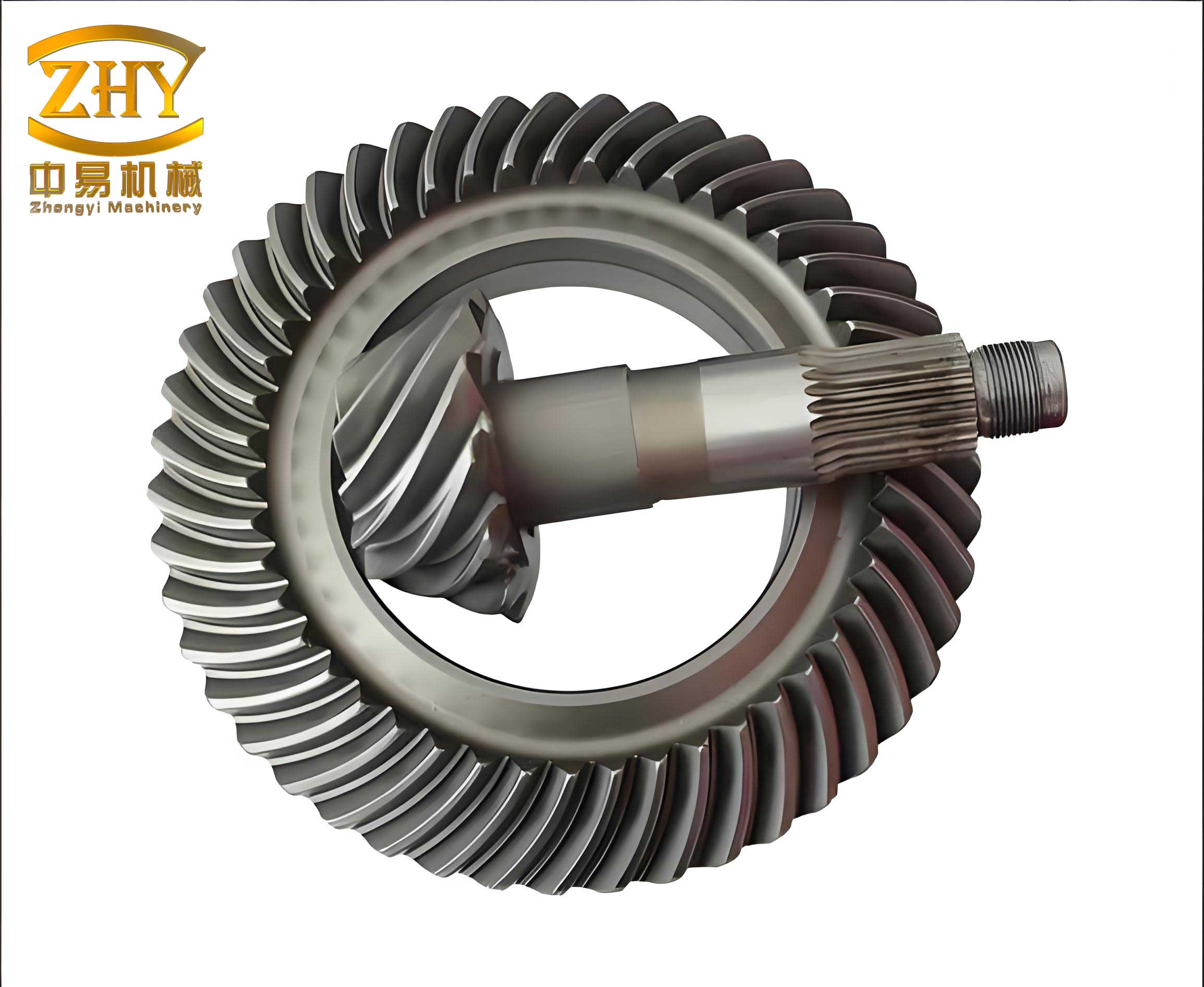
My approach was to re-engineer the entire forging process for the helical bevel gear blank. The new precision forging process flow I established is: Blanking → Induction Heating → Upsetting → Piercing → Punching the web → Ring Rolling (preform) → Precision Forging. The critical innovation lies in the preform design and the final forging stage. The preform is no longer a simple ring but is shaped to more closely match the final volume distribution of the helical bevel gear blank, ensuring smoother material flow and complete die filling without excess. The final forging is now performed in a truly closed环形 cavity, eliminating the possibility of longitudinal flash formation altogether.
The heart of this advancement is the novel die structure I designed for use on a 10,000 kN screw press. This structure fundamentally departs from the traditional fixed-punch and fixed-die approach. The key features are a floating mold core and a floating cavity die assembly. The die assembly forms a sealed环形模腔 during operation, where the helical bevel gear preform is deformed. The upper die consists of a prestressed组合凹模 with a taper for strength and cost-effective replacement. The lower die assembly is particularly ingenious: it incorporates a spring-supported floating mechanism that allows the lower cavity to move vertically.
The working principle, as I designed and observed it, is sequential and precise. Initially, the springs hold the floating core and the lower die assembly in their lower and upper极限 positions, respectively. The preform for the helical bevel gear is placed on the lower镶块. As the press ram descends, the upper and lower dies engage via guide locks, forming the封闭 cavity. Continued descent compresses the springs. The floating core moves upward relative to the upper die, and the lower die assembly moves downward, reducing the cavity height and forging the blank. The deformation occurs under three-dimensional pressure within a confined space, ensuring high dimensional accuracy and no flash. Upon ram ascent, the components separate in a controlled sequence due to their tapers and the spring actions, leaving the finished helical bevel gear blank on the lower cavity, ready for ejection.
The theoretical underpinnings of this design are crucial. The forging force required in a closed-die operation for a helical bevel gear can be estimated using upper-bound methods. The average forging pressure \( p \) can be related to the material’s flow stress \( \sigma_f \), the geometry, and friction. For a ring-shaped forging like our helical bevel gear blank, a simplified expression for the forging force \( F \) is:
$$ F = p \cdot A $$
where \( A \) is the projected area of the forging in the forging direction. In flashless forging, \( A \) is precisely the horizontal cross-sectional area of the helical bevel gear blank. For a conventional forging with flash, \( A \) is significantly larger due to the flash land area \( A_{flash} \):
$$ A_{total} = A_{gear} + A_{flash} $$
$$ F_{conventional} = p \cdot (A_{gear} + A_{flash}) $$
$$ F_{new} = p \cdot A_{gear} $$
Thus, the new die reduces the required forging force approximately by the ratio \( A_{flash} / A_{total} \), allowing the use of existing press capacity more efficiently or enabling the use of a smaller press for the same helical bevel gear. The flow stress \( \sigma_f \) for 20CrMnTi at forging temperature can be modeled using a constitutive equation like:
$$ \sigma_f = K \cdot \epsilon^n \cdot \dot{\epsilon}^m $$
where \( K \) is the strength coefficient, \( \epsilon \) is the strain, \( n \) is the strain-hardening exponent, \( \dot{\epsilon} \) is the strain rate, and \( m \) is the strain-rate sensitivity exponent. For hot forging, \( n \) is typically small, and \( m \) has a positive value. The precise calibration of these parameters for 20CrMnTi is essential for simulating the helical bevel gear forging process.
The material savings are directly calculable. The original blank mass \( m_o \) was 9.3 kg. The new process uses a blank mass \( m_n \) of 8.79 kg. The percentage reduction \( \Delta m \% \) in steel consumption for each helical bevel gear is:
$$ \Delta m \% = \left( \frac{m_o – m_n}{m_o} \right) \times 100\% = \left( \frac{9.3 – 8.79}{9.3} \right) \times 100\% \approx 5.48\% $$
This aligns perfectly with the reported 5.5% reduction. Over a large production run of helical bevel gears, this translates to enormous cost savings.
To summarize the quantitative benefits and design parameters, the following tables provide a clear comparison and specification overview.
| Parameter | Original Process & Die | New Precision Forging Process & Die | Improvement / Note |
|---|---|---|---|
| Blank Mass (kg) | 9.30 | 8.79 | Reduction of 0.51 kg per gear |
| Steel Consumption Reduction | Baseline | 5.5% | Direct material cost saving |
| Forging Feature | Longitudinal flash on inner bore | Flashless (closed-die forging) | Eliminates machining interference and manual work |
| Die Assembly Complexity | Simpler, fixed components | Higher, with floating core and cavity | Enables flashless forming |
| Projected Forging Area | \( A_{gear} + A_{flash} \) | \( A_{gear} \) | Reduces required forging force |
| Post-forging Operation | Manual flash removal required | No flash removal needed | Saves labor and time |
The design of the floating components involves careful calculation of spring forces and displacements. The spring for the floating core must provide sufficient force to return it to its start position but must not significantly resist the forging force. If the spring constant is \( k_c \) and the required compression for full forging is \( x_c \), the maximum force exerted by this spring during forging is \( F_{spring, core} = k_c \cdot x_c \). This force should be negligible compared to the forging force \( F \), say less than 1%:
$$ k_c \cdot x_c < 0.01 \cdot F $$
Similarly, for the lower floating cavity assembly with multiple springs (8 in the design), if each has a constant \( k_d \), the total spring constant \( K_{total} = 8 \cdot k_d \). The compression distance \( x_d \) must accommodate the total height reduction of the preform to form the helical bevel gear. The preform height \( H_p \) and final forging height \( H_f \) give \( x_d \approx H_p – H_f \). The energy stored in these springs is \( E_{spring} = \frac{1}{2} K_{total} x_d^2 \), which is a small fraction of the total forging energy. The precise dimensions of the helical bevel gear blank, such as the outer diameter, inner diameter, and height, are critical inputs for these calculations. For instance, the volume \( V \) of the forged helical bevel gear blank must equal the volume of the preform (ignoring minimal scale loss):
$$ V = \frac{\pi}{4} \left( D_o^2 – D_i^2 \right) \cdot H_f $$
where \( D_o \) and \( D_i \) are the final outer and inner diameters. This volume dictates the required preform dimensions from the ring rolling stage.
| Component | Key Feature / Dimension | Design Specification / Tolerance | Functional Rationale |
|---|---|---|---|
| Upper Cavity Die | Prestressed组合结构, Taper | 1° – 1°30′ taper on配合面 | Enhances radial strength, allows easier replacement |
| Floating Mold Core | Fit with Upper Cavity | Clearance fit H9/f8 | Allows smooth vertical movement |
| Lower Cavity Insert | Fit with Ring Anvil | Clearance fit H9/f8 | Allows assembly and replacement |
| Ejector Assembly | Connection between parts | Clearance H9/e9 & Interference H6/u5 | Ensures solid ejection mechanism |
| Floating Core Spring | Pre-load and travel | Selected to satisfy \( F_{spring} << F_{forging} \) | Ensures proper core positioning without hindering forging |
| Lower Cavity Spring System | 8 springs, constant \( k_d \) | Distributed circumferentially, pre-loaded | Provides counter-force for cavity closure and return |
The implementation of this die for the helical bevel gear required meticulous attention to detail in manufacturing and assembly. For instance, the use of暗螺母 in the die base to prevent thread wear from frequent bolt disassembly is a practical solution I employed. The stepped cylindrical housing for this nut, with a radial step width of 5–7 mm, facilitates both machining and future replacement. A single spot weld secures it against rotation but allows for removal. Furthermore, the guide lock design ensures perfect alignment between the upper and lower dies before the forging surfaces接触, preventing横向力 and premature wear or misalignment, which is critical for the precision of the helical bevel gear blank.
The material flow during the forging of the helical bevel gear blank in this closed cavity is complex. Finite element analysis (FEA) simulations would be valuable to visualize it. The effective strain \( \bar{\epsilon} \) distribution can be estimated. For a simple upsetting of a ring, the strain in the radial direction \( \epsilon_r \) and height direction \( \epsilon_h \) are related by volume constancy. For our more complex shape, the strain is non-uniform. However, ensuring complete filling of the tooth profile region of the helical bevel gear blank is paramount. The preform design is optimized to have more material volume in the regions that will form the thicker sections of the gear blank.
The economic impact extends beyond material savings. By eliminating the longitudinal flash, the machining time for the helical bevel gear is reduced. The turning operation no longer risks tool damage from unexpected hard flash, increasing tool life and process reliability. The manual labor for flash removal is completely saved. While the new die has higher initial manufacturing costs due to its complexity and use of prestressed assemblies, the per-part cost reduction and increased production efficiency quickly offset this. For a high-volume component like the automotive helical bevel gear, the return on investment is swift.
In conclusion, the development and application of this floating-core, floating-cavity precision forging die represent a significant advancement in the production of helical bevel gear blanks. The design successfully eliminates the persistent problem of longitudinal flash, leading to a direct 5.5% reduction in material consumption for each helical bevel gear. The principle of using floating elements to create a sealed forging cavity can be adapted for other类似环形 forgings. The theoretical analysis supports the reduction in required forging force and the importance of spring design. The implementation details, such as the组合 structure, guide locks, and fastener solutions, ensure robustness and maintainability in an industrial setting. This innovation underscores the continuous potential for process optimization in forging technology, particularly for critical components like the helical bevel gear, where precision and efficiency are paramount.