
In the realm of mechanical manufacturing, the process of gear shaping is pivotal for producing high-quality gears, especially internal gears. As a practitioner deeply involved in machinery equipment research and development, I have observed that traditional methods for internal gear shaping often involve cumbersome setup processes, such as using pressure plates for clamping and manually aligning the workpiece’s inner bore and end face. This not only increases labor intensity but also prolongs the machining cycle, leading to inconsistencies in precision. To address these challenges, I embarked on designing a novel fixture tailored for internal gear shaping, focusing on rapid clamping, self-centering定位, and enhanced accuracy. This article delves into the design philosophy, structural intricacies, and practical applications of this fixture, aiming to provide a comprehensive solution for improving efficiency in gear shaping operations.
The primary objective of this fixture design is to significantly reduce the non-productive time associated with workpiece setup during internal gear shaping. In traditional setups, operators spend considerable time on alignment and clamping, which can account for up to 30% of the total machining time. By streamlining these processes, the fixture aims to cut down auxiliary time to under 15 minutes per workpiece, thereby boosting overall productivity. Moreover, it seeks to minimize human error, ensuring consistent precision across batches. The design emphasizes quick changeover capabilities, allowing for seamless transitions between different workpiece sizes without the need for extensive recalibration. This is crucial in today’s manufacturing landscape, where flexibility and speed are paramount. The fixture’s ability to maintain high stability during the dynamic forces of gear shaping further underscores its reliability, making it suitable for both small-batch and high-volume production environments.
My design approach draws inspiration from the self-centering mechanism of three-jaw chucks, commonly used in lathes. However, adapting this for gear shaping required innovative modifications to prevent interference with the cutting tool and to accommodate various gear geometries. The fixture comprises key components such as a base body, conical gears for synchronized jaw movement, quick-change pressure plates, and adjustable clamping elements. To ensure versatility, the fixture is engineered to handle workpiece outer diameters ranging from φ50 mm to φ500 mm, covering a broad spectrum of internal gears. The use of a modular structure allows for easy adaptation to different插齿机models, enhancing its通用性. Below is a table summarizing the design parameters and their intended benefits:
| Design Parameter | Specification | Benefit in Gear Shaping |
|---|---|---|
| Clamping Diameter Range | φ50 – φ500 mm | Accommodates diverse internal gear sizes without fixture redesign |
| Setup Time Reduction | ≤ 15 minutes | Increases machine utilization and throughput |
| Positioning Accuracy | ≤ 0.005 mm runout | Enhances radial and concentricity精度 of shaped gears |
| Tool Clearance | 2-3 mm from定位面 | Prevents collision during tool retraction in gear shaping |
| Compatibility | Multiple插齿机models | Reduces capital investment in专用夹具 |
The structural challenges in developing this fixture were threefold: achieving rapid changeover, ensuring precise定位, and maintaining通用性. For fast changeover, I implemented rotating pressure plates mounted on swing arms, which can be quickly pivoted to release or clamp the workpiece. This eliminates the need for adjusting support bolts, as seen in conventional U-slot pressure plates. The定位 system leverages a pair of conical gears—a small pinion and a large gear—that engage with the jaws to provide synchronized radial movement. This mechanism ensures that all three jaws move in unison, centering the workpiece accurately based on its outer diameter. Mathematically, the self-centering accuracy can be modeled using the following formula for radial error reduction:
$$ \Delta_r = \frac{\sum_{i=1}^{3} (d_i – \bar{d})^2}{3 \cdot k} $$
where \( \Delta_r \) is the radial positioning error, \( d_i \) represents the distance from each jaw to the workpiece center, \( \bar{d} \) is the mean distance, and \( k \) is a stiffness constant of the fixture. By minimizing \( \Delta_r \), the fixture enhances the concentricity of the gear shaping process. Additionally, the通用性 was addressed by designing reversible jaws and adjustable components, allowing the fixture to handle both internal and external gears, as well as double-gear configurations. The integration of spring-loaded elements ensures consistent clamping force, reducing vibration during high-speed gear shaping operations.
The working principle of this internal gear shaping fixture revolves around its assembly of 12 key parts, including the base body, screws, end covers, conical gears,定位卡爪, springs, double-ended bolts, and quick-change pressure plates. During operation, the base body is first mounted onto the rotary table of the插齿机using T-bolts. The initial alignment involves adjusting the three定位卡爪 to achieve a runout value of less than 0.005 mm, as verified with a dial indicator. Once secured, the workpiece is placed on the jaws, and the small conical gear is rotated. This drives the large conical gear, which in turn moves the jaws synchronously to grip the workpiece’s outer diameter. Since the workpiece is typically machined in a prior turning operation where the inner bore, end face, and outer diameter are finished in one setup, the基准转化 from inner to outer diameter is valid, ensuring high同心度. The clamping force is applied axially via the quick-change pressure plates, which are fastened with double-ended bolts and secured with anti-loosening screws. After gear shaping is complete, loosening the nuts allows the pressure plates to swing away, and rotating the small conical gear releases the jaws, enabling rapid workpiece removal. This entire cycle is designed to be intuitive and efficient, reducing operator fatigue.
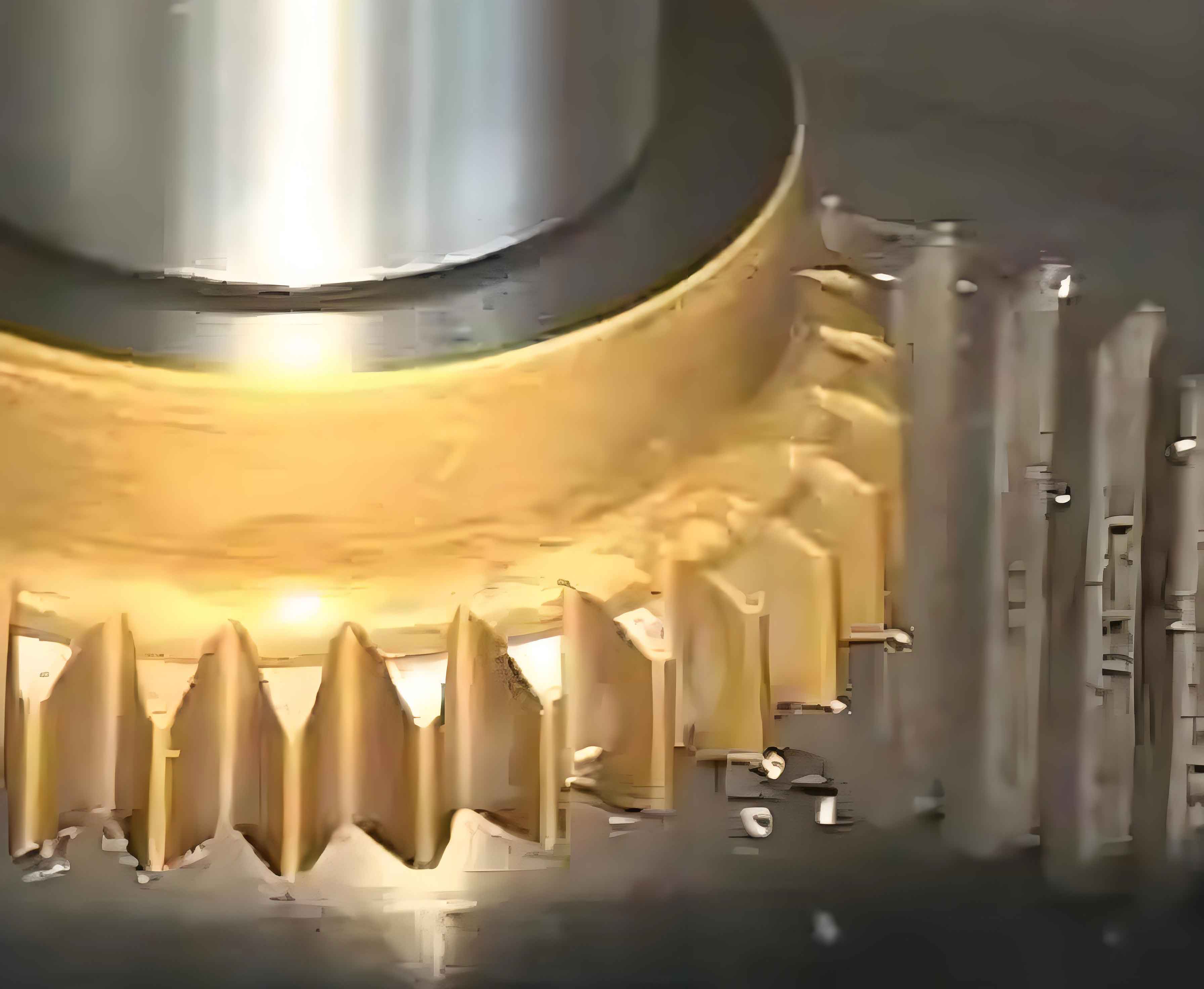
One of the standout innovations of this fixture is its wide clamping diameter range. Unlike traditional专用夹具 that are limited to specific sizes, this fixture can accommodate workpieces from φ50 mm to φ500 mm simply by adjusting the jaw positions. This flexibility is achieved through the scalable design of the conical gear system and the reversible jaw configuration. For instance, by flipping the jaws, the fixture can switch between clamping external surfaces for internal gear shaping and internal surfaces for other operations. Another key innovation is the drastic reduction in preparation time. The self-centering mechanism eliminates the need for time-consuming manual alignment with dial indicators, as the jaws automatically center the workpiece. This is quantified by the following relationship for setup time savings:
$$ T_{savings} = T_{traditional} – T_{new} = \frac{N \cdot (t_a + t_l)}{60} $$
where \( T_{savings} \) is the total time saved in hours, \( N \) is the number of workpieces, \( t_a \) is the alignment time per workpiece (typically 10-20 minutes in traditional methods), and \( t_l \) is the clamping time. With the new fixture, \( t_a \) approaches zero, leading to significant productivity gains. Furthermore, the quick-change feature of the pressure plates allows for tool-less adjustments, enabling operators to swap workpieces in under a minute. This is particularly beneficial in high-mix, low-volume production scenarios common in today’s定制化 manufacturing for gear shaping.
To validate the fixture’s effectiveness, I conducted application case studies on two common齿轮 types: internal gears and double-gears. For internal gear shaping, the fixture uses the outer diameter for定位 and the top face for clamping. This setup ensures that the插齿 tool can access the齿部 without interference, as the pressure plates are positioned to provide adequate clearance from the齿根. In tests, the fixture maintained a positional accuracy of ±0.003 mm, resulting in gears with improved radial runout and齿形精度. For double-gears, the fixture enables single-setup machining of both gear rows by clamping via the inner bore and top face. This eliminates the need for re-alignment between operations, preserving the同心度 between the two gear sets. The table below summarizes the performance outcomes from these case studies:
| Application | Workpiece Size | Accuracy Improvement | Time Reduction |
|---|---|---|---|
| Internal Gear Shaping | φ200 mm inner diameter | Radial runout reduced by 40% | Setup time cut by 70% |
| Double-Gear Shaping | Two rows, φ150 mm each | Concentricity error ≤ 0.01 mm | Overall cycle time down by 50% |
The mathematical modeling of errors in gear shaping further supports the fixture’s design. For instance, the cumulative pitch error in gears can be expressed as:
$$ E_p = \sqrt{E_c^2 + E_m^2 + E_f^2} $$
where \( E_p \) is the total pitch error, \( E_c \) is the error from clamping misalignment, \( E_m \) is the machine tool error, and \( E_f \) is the fixture-induced error. By minimizing \( E_c \) and \( E_f \) through precise self-centering and stable clamping, the fixture contributes to lower \( E_p \), enhancing the overall quality of the shaped gears. Additionally, the dynamic stability during gear shaping can be analyzed using vibration damping coefficients, which are improved by the fixture’s rigid construction and even force distribution.
In conclusion, this innovative fixture for internal gear shaping represents a significant advancement in machining technology. By integrating self-centering定位, rapid clamping mechanisms, and broad通用性, it addresses the longstanding challenges of efficiency and precision in gear manufacturing. The fixture’s ability to reduce setup times, minimize human error, and adapt to various workpiece sizes makes it a valuable asset for both small-scale and mass production environments. As the demand for high-precision gears grows in industries such as automotive, aerospace, and robotics, such夹具 designs will play a crucial role in optimizing gear shaping processes. Future developments could involve incorporating smart sensors for real-time monitoring and adaptive control, further pushing the boundaries of what’s possible in机械装备研发. Through continuous innovation, we can ensure that gear shaping remains at the forefront of manufacturing excellence, driving productivity and quality to new heights.
The design principles discussed here are grounded in practical engineering considerations, such as material selection for wear resistance and thermal stability. For example, the夹具 base is typically made from hardened steel to withstand the cyclic loads of gear shaping, while the jaws incorporate carbide inserts for longevity. The conical gears are precision-ground to ensure smooth transmission and minimal backlash, critical for maintaining accuracy during repeated clamping cycles. Moreover, the fixture’s modularity allows for easy maintenance and升级, with components like springs and bolts designed for quick replacement. This aligns with modern trends in sustainable manufacturing, where equipment longevity and reparability are key. By embracing such holistic design approaches, we can create夹具 solutions that not only enhance gear shaping but also contribute to broader industry goals of efficiency and sustainability.
To further illustrate the technical details, consider the force analysis during clamping. The axial clamping force \( F_a \) required to secure the workpiece during gear shaping can be calculated as:
$$ F_a = \frac{T \cdot \mu}{r} $$
where \( T \) is the torque applied by the nut on the double-ended bolt, \( \mu \) is the friction coefficient between the pressure plate and workpiece, and \( r \) is the effective radius. Ensuring \( F_a \) exceeds the cutting forces prevents workpiece slippage, which is vital for achieving consistent齿形 in gear shaping. The fixture’s design incorporates safety factors to account for dynamic loads, typically using a factor of 1.5 to 2.0 based on empirical data from machining trials. This rigorous engineering approach ensures reliability under diverse operating conditions, from light finishing cuts to heavy roughing in gear shaping applications.
In summary, the journey of designing this internal gear shaping fixture has highlighted the importance of interdisciplinary knowledge—combining mechanical design, kinematics, and material science. By leveraging insights from traditional tooling and modern manufacturing needs, we can develop solutions that are both innovative and practical. As I continue to refine this fixture, feedback from industry applications will be invaluable for迭代 improvements, ultimately contributing to the evolution of gear shaping technology. The potential for integration with digital twin simulations and AI-driven optimization further expands the horizons, promising even greater efficiencies in the years to come. Through such endeavors, we can uphold the spirit of research and development in machinery equipment, fostering progress that benefits the entire manufacturing ecosystem.