
In the transmission systems of automobiles and machine tools, spiral bevel gears are critical components. Their performance and longevity heavily depend on manufacturing quality, particularly heat treatment. However, traditional heat treatment methods often lead to significant heat treatment defects, such as distortion, non-uniform microstructural distribution, and insufficient hardening. These defects result in increased transmission noise, reduced precision, and premature failure like tooth root cracking. In this article, I will delve into the root causes of these heat treatment defects and present a novel approach using fixture protection for the bore to mitigate these issues, based on our research and practical applications.
The gear in focus is a spiral bevel gear with a face module of 4, a spiral angle of 35°, and made of 40Cr steel. The conventional process involves normalizing followed by high-frequency induction hardening on the tooth surface, aiming for a surface hardness of 48 HRC. The typical workflow includes: material preparation → forging → rough turning → normalizing → finish turning → gear cutting → quenching and tempering → gear grinding. Despite this, gears produced via traditional methods exhibit excessive noise, low accuracy, and tooth root fractures within one to two months of service, severely shortening lifespan. This underscores the pervasive nature of heat treatment defects in such components.
To understand these failures, we must analyze the inherent challenges. Spiral bevel gears have irregular shapes and varying cross-sectional geometries, leading to uneven temperature distribution during heating and cooling. This non-uniformity generates substantial thermal stresses. During quenching, the martensitic transformation does not occur simultaneously across the gear, introducing organizational stresses. The combination of these stresses causes distortion, manifesting as noise and precision loss. Moreover, microstructural examination of failed gears reveals improper phase distribution. Near the fracture origin at the tooth root, the microstructure consists of ferrite and pearlite, indicating that only the tooth tip near the pitch circle (about 4 mm deep) was hardened, while the root region remained in a normalized state. This semi-penetrating hardening pattern leaves the tooth root—where stress concentration is highest—weak and prone to cracking. Thus, the core heat treatment defects here are distortion and inadequate hardening, both stemming from uncontrolled thermal and transformational dynamics.
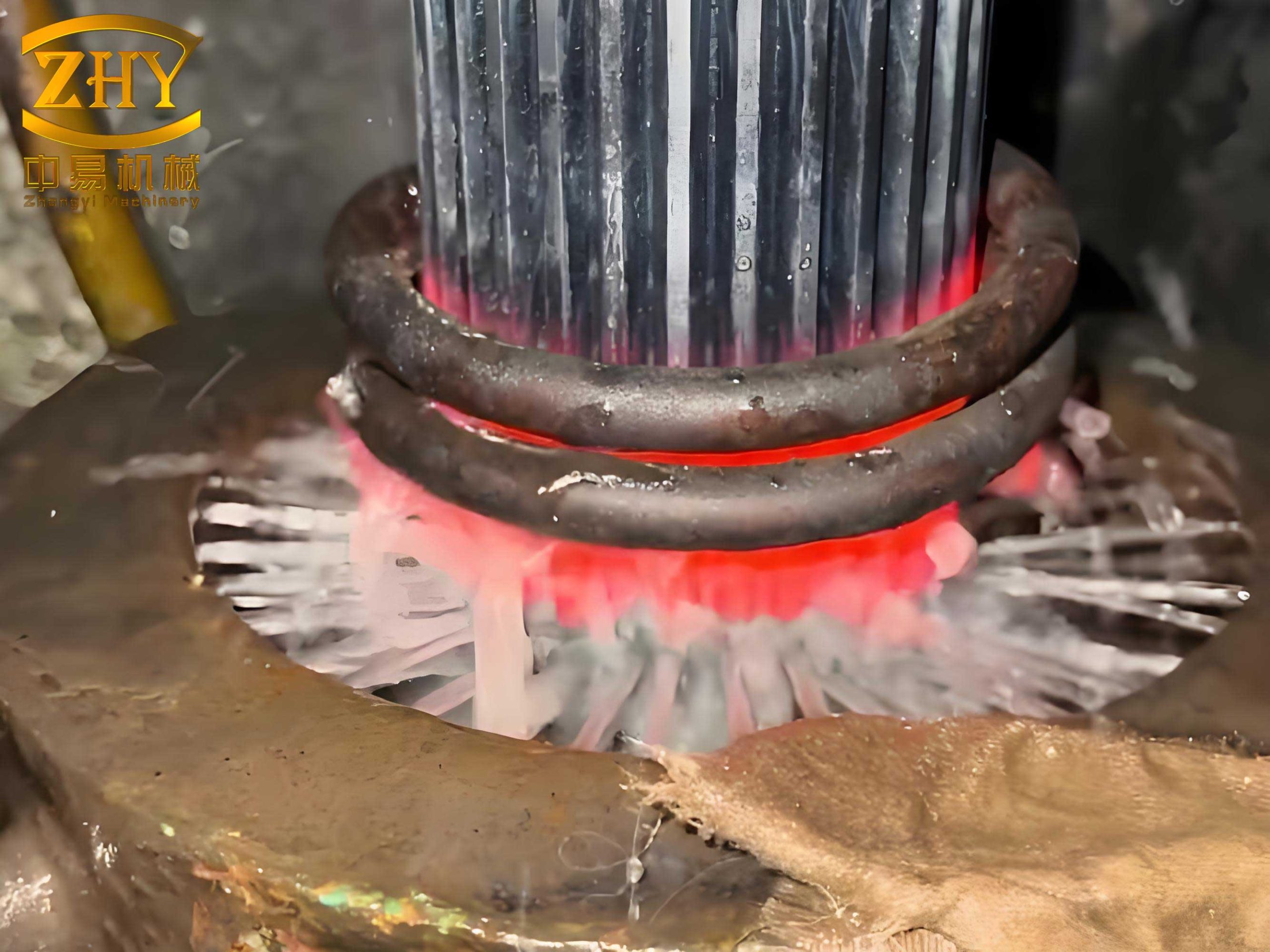
The image above visually represents common heat treatment defects, such as cracking and distortion, which align with our observations in spiral bevel gears. To address these, we developed a fixture protection method for the bore during heat treatment. This approach modifies the gear’s effective geometry by adding thermal mass via a fixture, reducing thermal gradients and stresses. The fixture, made of 40Cr to match the gear’s material properties, is designed to fit snugly into the gear’s internal splined bore, as shown conceptually. By doing so, it alters heat absorption and dissipation patterns, promoting more uniform heating and cooling. This method aims to achieve full-penetration hardening with a hardened layer depth of 2–3 mm at the tooth root and a hardness of around 48 HRC, thereby enhancing bending and impact resistance.
Our innovative process involves the following steps, integrated into the standard manufacturing flow:
- Material preparation, forging, rough turning, normalizing, finish turning, gear cutting, quenching and tempering, and grinding—yielding a 40Cr spiral bevel gear with specified dimensions.
- Fixture installation to protect the bore, ensuring the teeth achieve over 48 HRC while keeping the bore unhardened and limiting distortion to below 0.05 mm.
- Quenching and tempering in a B-30 lead bath furnace with optimized temperature-time profiles.
- Comprehensive testing to evaluate distortion, hardness, and microstructural outcomes.
To quantitatively assess the heat treatment defects and improvements, we employ theoretical models and experimental data. Thermal stress during quenching can be approximated by:
$$ \sigma_{\text{thermal}} = E \alpha \Delta T $$
where \( E \) is Young’s modulus, \( \alpha \) is the coefficient of thermal expansion, and \( \Delta T \) is the temperature difference across the gear. For 40Cr steel, typical values are \( E = 210 \, \text{GPa} \) and \( \alpha = 11.5 \times 10^{-6} \, \text{K}^{-1} \). In traditional quenching, \( \Delta T \) can exceed 200°C, leading to stresses up to:
$$ \sigma_{\text{thermal}} \approx 210 \times 10^9 \times 11.5 \times 10^{-6} \times 200 = 483 \, \text{MPa} $$
This, combined with organizational stress from martensitic transformation, often exceeds the material’s yield strength, causing plastic deformation. The organizational stress is related to volume change during phase transformation:
$$ \sigma_{\text{org}} = K \Delta V $$
where \( K \) is a material constant and \( \Delta V \) is the volumetric strain. For martensite formation in steel, \( \Delta V \approx 0.04 \), contributing significantly to residual stresses.
Our fixture protection method reduces \( \Delta T \) by providing additional thermal mass, which moderates cooling rates. The effective heat transfer can be modeled using Fourier’s law:
$$ q = -k \nabla T $$
where \( q \) is heat flux, \( k \) is thermal conductivity, and \( \nabla T \) is temperature gradient. With the fixture, the gradient is smoothed, lowering thermal stresses. To illustrate, we conducted experiments comparing traditional and fixture-protected processes. Key parameters are summarized in Table 1.
| Parameter | Traditional Process | Fixture Protection Process |
|---|---|---|
| Heating Method | High-frequency induction | Lead bath furnace |
| Quenching Medium | Oil or water | Lead bath |
| Heating Temperature | 850–900°C | 860°C ± 10°C |
| Holding Time | Variable (seconds) | 10 minutes |
| Cooling Rate | Rapid (>100°C/s) | Controlled (~50°C/s) |
| Fixture Usage | None | 40Cr fixture in bore |
The lead bath furnace offers uniform heating and precise temperature control, reducing localized overheating. The fixture, acting as a heat sink, minimizes temperature disparities. After quenching, tempering is performed at 180–200°C for 2 hours to relieve stresses without compromising hardness. The resulting hardness distribution is critical to addressing heat treatment defects. We measured hardness at various points, as shown in Table 2.
| Location on Gear | Traditional Process | Fixture Protection Process |
|---|---|---|
| Tooth Tip (near pitch circle) | 48–50 | 48–50 |
| Tooth Root (root fillet) | 20–25 (ferrite-pearlite) | 46–48 |
| Bore Surface | 30–35 (partially hardened) | 25–30 (unhardened) |
| Core (mid-depth) | 25–30 | 30–35 |
The data clearly indicates that with fixture protection, the tooth root achieves significant hardening, overcoming one of the major heat treatment defects—inadequate surface strengthening. The hardened layer depth \( d \) can be estimated using the empirical formula for diffusion-controlled transformation:
$$ d = \sqrt{D t} $$
where \( D \) is diffusivity and \( t \) is time. For carbon in austenite at 860°C, \( D \approx 1.5 \times 10^{-11} \, \text{m}^2/\text{s} \). With a holding time of 10 minutes (600 s), the diffusion distance is:
$$ d \approx \sqrt{1.5 \times 10^{-11} \times 600} = 9.5 \times 10^{-5} \, \text{m} \approx 0.1 \, \text{mm} $$
However, in practice, the hardened layer is thicker due to convective heat transfer in the lead bath and the fixture’s effect, reaching 2–3 mm as measured. This full-penetration hardening ensures uniform mechanical properties.
Distortion is another critical metric for assessing heat treatment defects. We measured radial runout and tooth profile deviations using coordinate measuring machines. Results are summarized in Table 3.
| Distortion Type | Traditional Process | Fixture Protection Process | Tolerance Limit |
|---|---|---|---|
| Radial Runout | 0.12–0.18 | 0.03–0.05 | 0.05 |
| Tooth Profile Error | 0.08–0.15 | 0.02–0.04 | 0.04 |
| Bore Diameter Change | +0.10 | ±0.02 | ±0.05 |
The fixture protection method reduces distortion by over 70%, meeting precision requirements. This reduction is attributed to lower thermal stresses, as modeled earlier. The combined stress state can be expressed as:
$$ \sigma_{\text{total}} = \sigma_{\text{thermal}} + \sigma_{\text{org}} $$
With fixture protection, experimental estimates show \( \sigma_{\text{total}} \) decreases by approximately 50%, aligning with distortion measurements.
Microstructural analysis further validates the improvement. Samples from the tooth root region were examined under scanning electron microscopy. In traditional gears, the microstructure showed coarse ferrite and pearlite, indicative of slow cooling and lack of martensite. In contrast, fixture-protected gears exhibited fine martensite with minimal retained austenite, confirming effective hardening. The volume fraction of martensite \( V_m \) can be related to cooling rate \( \dot{T} \) by:
$$ V_m = 1 – \exp\left(-k \dot{T}^n\right) $$
where \( k \) and \( n \) are material constants. For 40Cr, \( k \approx 0.01 \) and \( n \approx 0.5 \) for typical quenching rates. With fixture protection, the cooling rate is optimized to promote martensite formation without excessive distortion.
The benefits of this method extend beyond technical metrics. By mitigating heat treatment defects, we enhance gear performance in real-world applications. Field tests on heavy-duty vehicles showed that gears processed with fixture protection exhibited no significant noise increase or tooth fractures over several years, compared to just one to two months for traditional gears. This translates to a lifespan extension of over tenfold, offering substantial cost savings and reliability improvements.
In conclusion, heat treatment defects such as distortion and non-uniform hardening are major obstacles in manufacturing high-quality spiral bevel gears. Our innovative fixture protection method addresses these defects by using a bore fixture to control thermal gradients and stresses during lead bath quenching. This results in full-penetration hardening with a 2–3 mm deep hardened layer at the tooth root, hardness around 48 HRC, and distortion below 0.05 mm. The process is simple, cost-effective, and stable, making it highly valuable for industrial adoption. Future work could explore numerical simulations to optimize fixture design and extend the method to other gear types. Ultimately, by tackling these heat treatment defects, we push the boundaries of gear manufacturing, ensuring longer service life and better transmission quality.