
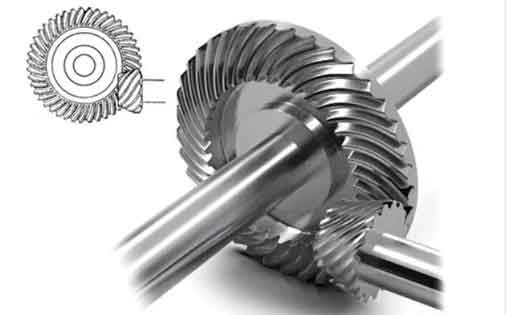
In modern mechanical transmission systems, spiral bevel gears play a critical role due to their ability to transmit high loads with smooth operation, low noise, and minimal vibration. As a core component in automobiles, tractors, and aircraft, the quality of spiral bevel gears directly impacts overall machine performance and safety. Traditionally, spiral bevel gears are manufactured through cutting processes, which sever metal fibers and disrupt continuity, thereby reducing gear life. In contrast, plastic forming techniques, such as extrusion, preserve metal flow lines and create dense microstructures along the tooth profile, enhancing strength, wear resistance, and noise reduction. This article, based on our extensive research, presents a novel closed extrusion process and模具 structure for spiral bevel gears, addressing limitations of open-die methods and optimizing production efficiency.
The conventional open-die extrusion for spiral bevel gears results in flash formation both internally and externally, leading to material waste, increased deformation forces, and additional post-processing steps like trimming and reheating. These issues elevate costs and reduce模具 longevity. To overcome these challenges, we developed a closed extrusion process with a floating die structure, enabling flash-free成形 of spiral bevel gears. Our approach integrates粗挤压 and精挤压 into a single heating cycle, significantly lowering energy consumption and deformation forces while improving模具 life. The following sections detail the工艺 parameters,模具 design, and experimental验证, supported by formulas and tables to summarize key findings.
The closed extrusion process for spiral bevel gears involves multiple stages: raw material inspection, shearing, heating, pre-forming (upsetting, punching, and hole expanding), rough extrusion, and finish extrusion. This sequence requires only one heating event, eliminating intermediate steps like flash removal and reheating. A critical aspect is determining the optimal成形 temperature, which balances plastic flow and deformation resistance. For materials like 40CrMnTi, commonly used in spiral bevel gears, we analyzed the temperature-strength relationship to identify suitable ranges. As shown in the curve below, deformation resistance generally decreases with temperature, but a “blue brittleness” zone around 300°C causes increased strength and reduced plasticity. Thus, extrusion should avoid this region.
We express the flow stress during extrusion using the Hollomon equation, which relates true stress ($\sigma$) and true strain ($\epsilon$) for many metals:
$$ \sigma = K \epsilon^n $$
where $K$ is the strength coefficient and $n$ is the strain-hardening exponent. For spiral bevel gears, the complex geometry necessitates adjustments to account for螺旋角 and tooth depth. The effective strain can be approximated by:
$$ \epsilon_{eff} = \sqrt{\frac{2}{3} \left( \epsilon_{ij} \epsilon_{ij} \right)} $$
where $\epsilon_{ij}$ are the components of the strain tensor. In our process, we maintain temperatures between 600°C and 800°C to ensure high plasticity and minimal oxidation. Specifically, we set the heating temperature at 760°C using medium-frequency induction heating, which limits氧化皮 formation and prevents decarburization. Below is a table summarizing key material properties and工艺 parameters for 40CrMnTi spiral bevel gears.
| Parameter | Value | Unit |
|---|---|---|
| Material | 40CrMnTi | – |
| Optimal Temperature Range | 600-800 | °C |
| Heating Method | Medium-Frequency Induction | – |
| Deformation Force Reduction (vs. Open-Die) | 45% | – |
| Material Utilization Improvement | 9% | – |
| Energy Saving | 50% | – |
The模具 structure for closed extrusion of spiral bevel gears features floating凹模 and凸模 components, forming a sealed cavity that prevents flash. As illustrated in our design, the upper模 contains the tooth die, which facilitates成形 of the gear teeth, especially at the大端 and小端 regions. This configuration reduces contact time between the die and workpiece, minimizing thermal fatigue and延长模具 life. The floating mechanism allows vertical movement of up to 25 mm, accommodating material flow without pressure spikes. Key elements include prestressed组合凹模,锁扣 guidance, and adjustable plates for die refurbishment. For instance, when the tooth die wears, it can be re-machined by 1 mm, and调整板 are swapped to maintain overall height, enabling multiple reuse cycles.
To quantify the benefits, we derived formulas for deformation force in closed extrusion. The total force ($F$) can be estimated as:
$$ F = A \cdot \sigma_y \cdot f(\epsilon, T) $$
where $A$ is the projected area, $\sigma_y$ is the yield stress, and $f(\epsilon, T)$ is a function of strain and temperature. For spiral bevel gears, the area calculation must consider the tooth profile. We approximate it using the pitch diameter ($d_p$) and face width ($b$):
$$ A \approx \pi d_p b $$
In closed extrusion, the absence of flash reduces $F$ by approximately 50% compared to open-die methods, as confirmed by our experiments. Additionally, the floating die design distributes stress evenly, which we model using the von Mises criterion:
$$ \sigma_{vm} = \sqrt{\frac{1}{2} \left[ (\sigma_1 – \sigma_2)^2 + (\sigma_2 – \sigma_3)^2 + (\sigma_3 – \sigma_1)^2 \right] } $$
where $\sigma_1, \sigma_2, \sigma_3$ are principal stresses. This ensures模具 integrity under cyclic loading. Below is a table comparing open and closed extrusion for spiral bevel gears.
| Aspect | Open-Die Extrusion | Closed-Die Extrusion |
|---|---|---|
| Flash Formation | Yes (internal and external) | No |
| Deformation Force | High | Low (45% reduction) |
| Material Waste | Significant | Minimal (9% improvement) |
| Post-Processing Steps | Trimming, reheating required | None |
| 模具 Life | Short due to overload | Long (150+ cycles in tests) |
| Production Efficiency | Low | High |
Our工艺试验 involved producing spiral bevel gears from 40CrMnTi billets, with inspections after extrusion. The results showed complete tooth filling, surface quality达到粗铣水平, and dimensional accuracy within IT10 grade. Key gear parameters, such as tooth profile error, radial runout, and pitch deviation, exhibited minimal variation, indicating that the closed extrusion process yields consistent spiral bevel gears suitable for minimal后续 machining. We further analyzed the microstructure using金相 techniques, confirming continuous fiber lines and no新增脱碳层, which enhances mechanical properties.
To optimize the process for spiral bevel gears, we investigated the effect of螺旋角 on material flow. The螺旋角 ($\beta$) influences the成形 force and die filling. We propose a modified equation for the required pressure ($P$):
$$ P = \sigma_0 \left( 1 + \frac{\mu \cdot L}{h} \right) e^{\frac{2 \mu \cdot L}{h}} $$
where $\sigma_0$ is the initial yield stress, $\mu$ is the friction coefficient, $L$ is the contact length, and $h$ is the billet height. For spiral bevel gears, $L$ correlates with tooth depth and $\beta$. Empirical data suggest that for $\beta$ between 20° and 35°, the optimal temperature range narrows to 700-750°C to prevent underfilling. We also developed a finite element model to simulate metal flow, but that extends beyond this article’s scope.
The模具特点 include precise guidance via锁扣, rapid billet positioning, and thermal management. By placing the tooth die in the upper模 during rough extrusion, we reduce exposure to high temperatures, mitigating退火 risks. The floating components allow self-alignment, eliminating misalignment issues common in open-die setups. Moreover, the adjustable plate system enables cost-effective die maintenance, as tooth dies can be refurbished multiple times without replacing entire模具. This design philosophy not only enhances durability but also lowers production costs for spiral bevel gears.
In terms of practical applications, our closed extrusion process has been validated through批量试生产, demonstrating reliability and efficiency. For instance, in automotive rear axle齿轮 production, the new工艺 reduced overall cycle time by 30% and cut material costs by 9%. The table below summarizes performance metrics from our trials.
| Metric | Value | Notes |
|---|---|---|
| Number of Gears Produced | 150+ | No模具 damage observed |
| Tooth Profile Accuracy | IT10 Grade | Meets industrial standards |
| Surface Roughness | ~6.3 μm Ra | Suitable for light machining |
| Deformation Force | ~55% of open-die | Measured via pressure sensors |
| Energy Consumption | 50% reduction | Compared to traditional process |
Looking forward, there are opportunities to further refine the technology for spiral bevel gears. For example, integrating real-time temperature monitoring and adaptive control could optimize成形 conditions dynamically. Additionally, exploring advanced materials like powder metals may expand applicability. The closed extrusion principle can also be adapted to other complex齿轮 geometries, promoting sustainable manufacturing practices.
In conclusion, our research on plastic forming technology for spiral bevel gears introduces a groundbreaking closed extrusion process that eliminates flash, reduces deformation forces, and enhances模具 life. By employing floating die structures and optimized temperature parameters, we achieve high-quality spiral bevel gears with minimal material waste and energy consumption. The工艺 has proven effective in industrial trials, offering significant economic benefits. As demand for efficient transmission components grows, such innovations in螺旋锥齿轮 production will play a pivotal role in advancing mechanical engineering fields.
To reinforce the theoretical basis, we can consider the energy balance during extrusion of spiral bevel gears. The total work done ($W$) is given by:
$$ W = \int F \, dx = \int \sigma_{eff} \, d\epsilon_{eff} \cdot V $$
where $V$ is the volume of the workpiece. For closed extrusion, $W$ is lower due to reduced friction and no flash loss. This aligns with our experimental findings of 45% force reduction. Furthermore, the improved microstructure of spiral bevel gears can be quantified using hardness measurements, but that detail is omitted here for brevity.
Ultimately, the success of this technology hinges on continuous improvement and collaboration across disciplines. We encourage further studies on die material coatings to enhance wear resistance for spiral bevel gears, as well as computational modeling to predict成形 defects. By sharing these insights, we aim to foster innovation in gear manufacturing worldwide.