
In modern automotive manufacturing, the precision forging of straight bevel gears stands as a cornerstone of efficient, high-volume production. This near-net-shape forming technology dramatically reduces material waste and machining time compared to traditional cutting processes, leading to superior mechanical properties in the final component, particularly for critical driveline applications like differential assemblies. My experience in developing the manufacturing process for a heavy-duty axle’s straight bevel gears—specifically the side gear and pinion gear—underscores the indispensability of an integrated CAD/CAM approach. When the required precision exceeds the capability of conventional gear-generating machines, the solution lies in creating precise mold electrodes through digital design and computer-aided manufacturing, subsequently used in Electrical Discharge Machining (EDM) to fabricate the forging dies. This article details the comprehensive workflow, from parametric solid modeling and kinematic simulation to multi-axis CNC programming, which ensures the stringent quality demands for forged straight bevel gears are met.
Digital Foundation: Parametric Modeling of Gears and Tooling
The entire process begins with a deep understanding of the product geometry and the design intent. A straight bevel gear’s tooth profile is complex, defined on a back cone which is then unfolded into an equivalent spur gear. This requires the calculation of several key parameters beyond the basic gear data.
The fundamental parameters for the straight bevel gear design are typically derived from the product drawing and include:
| Parameter | Symbol | Description / Formula |
|---|---|---|
| Number of Teeth | Z | Actual number of teeth on the bevel gear. |
| Module (at large end) | m | Standard module defining tooth size. |
| Pressure Angle | α | Angle defining the inclination of the tooth face (e.g., 20°). |
| Shaft Angle | Σ | Angle between the two gear shafts (commonly 90°). |
| Pitch Cone Distance | R | Distance from the apex to the pitch circle. |
| Face Width | b | Length of the tooth along the cone element. |
To model the tooth form accurately, we must compute the parameters of the equivalent spur gear on the back cone. The most critical derived parameters are:
Virtual (Formative) Number of Teeth (Zv): This is the number of teeth the equivalent spur gear would have.
$$ Z_v = \frac{Z}{\cos \delta} $$
Where \( \delta \) is the pitch cone angle of the straight bevel gear.
Base Circle Radius (rb): For the equivalent spur gear.
$$ r_b = \frac{m Z_v \cos \alpha}{2} $$
Addendum Modification Coefficient (x): Also known as the profile shift coefficient, it adjusts the tooth thickness and root strength, often necessary to avoid undercut and balance specific sliding velocities in the gear pair.
Tangential Modification Coefficient (xS): Used to adjust the tooth thickness independently of the addendum modification, crucial for setting the correct backlash in the forged gear pair.
With these parameters calculated, the 3D modeling in Pro/ENGINEER (Pro/E) commences. The core of the modeling is the generation of the involute tooth profile at both the large and small ends of the gear tooth. This is achieved using the software’s equation-driven curve feature. By defining a coordinate system and inputting the parametric equations for an involute, we create the precise curve. The generalized involute equations in a Cartesian system are:
$$ x_0 = r_b (\cos(t) + t \cdot \sin(t)) $$
$$ y_0 = r_b (\sin(t) – t \cdot \cos(t)) $$
Where \( t \) is the involute roll angle in radians. For implementation within Pro/E’s relation, it is often written in a sequential, parametric form suitable for its curve-from-equation function:
/* Pro/E Relation Syntax Example */
r0 = rb
t0 = t * 60 /* Scaling the parameter */
x0 = (cos(t0) + t0 * pi/180 * sin(t0)) * r0
y0 = (sin(t0) - t0 * pi/180 * cos(t0)) * r0
/* Apply rotation for correct positioning */
theta = -(tan(alpha) - alpha * pi/180) * 180/pi - 90/zv
x = x0 * cos(theta) - y0 * sin(theta)
y = x0 * sin(theta) + y0 * cos(theta)
z = 0
This generates a single involute curve. Mirroring this curve about the tooth centerline provides the opposite flank. By sketching the tooth tip, root, and fillet profiles at the large and small ends and using them as boundaries, a single tooth surface is created via the Boundary Blend feature. This surface body is then patterned around the axis using the number of teeth (Z) to complete the full gear tooth form, which is merged with the gear blank body (shaft, web, etc.). This process results in a fully parametric solid model of the forged straight bevel gear component.
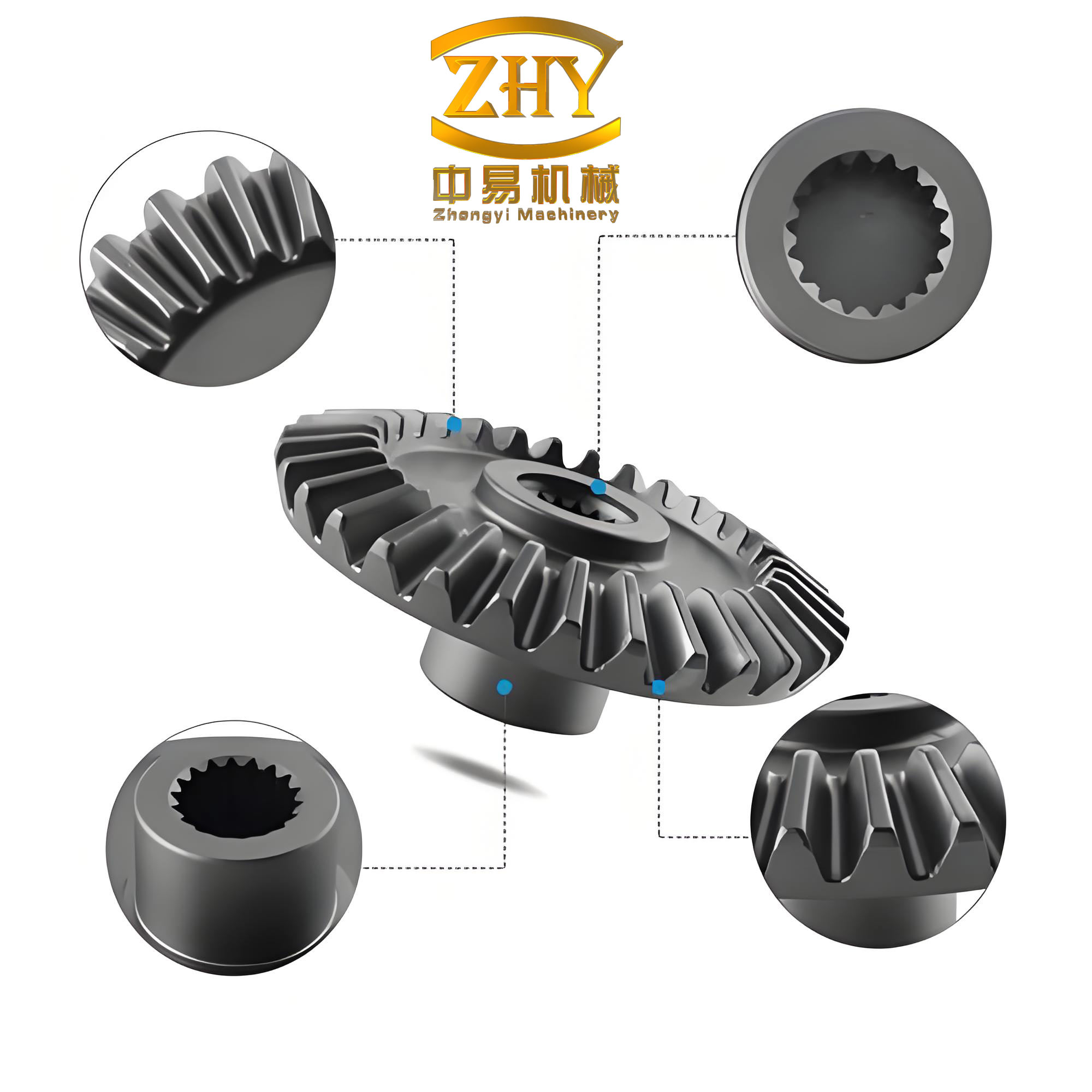
The same rigorous modeling principle is applied to create the essential tooling:
- Die Electrode: This is a positive (male) model of the gear cavity. Its dimensions incorporate the forging draft angles, shrinkage allowance for the forging material (typically 1.2% to 1.5%), and extra stock for the EDM finishing pass. It is the master used to sink the female impression into the forging die block via EDM.
- Fixture Electrode: For post-forging machining operations like turning the back face or drilling bolt holes, the gear must be located precisely from its forged tooth surfaces. The fixture electrode is used to machine a locating fixture that clamps onto the gear teeth, ensuring concentricity and correct axial position relative to the forged tooth geometry.
- Master Gear (Standard Wheel): This is a precise, hardened gear model used for checking the tooth contact pattern and backlash of the forged gear pair during quality inspection. Its geometry matches the theoretical ideal of the gear design.
To validate the design of the side gear and pinion gear pair before any physical tooling is made, we leverage Pro/ENGINEER’s Mechanism module. The fully assembled differential model (two side gears, four pinion gears, and the differential case) is subjected to kinematic analysis. By defining gear pair connections and applying a driver, we can simulate rotation, analyze the motion trajectories, and most importantly, perform global interference checks and measure the theoretical tooth flank clearance. This virtual prototyping step is crucial for identifying and correcting potential design clashes or incorrect backlash before committing to costly manufacturing.
From Model to Machine: CNC Programming for Complex Tooling
The high-quality 3D models of the die electrode, fixture electrode, and master gear are of no value unless they can be machined with extreme precision. This is where dedicated CAM software is essential. Our choice was PowerMill, renowned for its robust strategies for complex 3-axis to 5-axis machining, efficient toolpath calculation, and comprehensive collision checking.
The CAM workflow follows a structured sequence:
1. Data Import and Setup: The Pro/E models are exported in a neutral format (e.g., IGES, STEP) and imported into PowerMill. The first step is defining the stock material block from which the component will be machined.
2. Process Planning and Toolpath Strategy: This is the core of CAM programming. For electrodes and master gears made from high-grade copper or steel, a multi-stage approach is mandatory.
| Machining Stage | Primary Strategy | Key Objectives | Typical Tool | Considerations |
|---|---|---|---|---|
| Roughing | Model Area Clearance | Remove bulk material rapidly and safely. | Large diameter flat-end mill or bull-nose mill. | Maximize Material Removal Rate (MRR), ensure toolholder clearance, use trochoidal moves for hard materials. |
| Semi-Finishing | Raster, Offset, or 3D Offset | Leave a uniform, small stock allowance for finishing. | Ball-nose end mill. | Stepover is larger than finishing. Aims to stabilize cutting conditions before the final pass. |
| Finishing (Tooth Flanks) | Z-Level (Slice) Finishing or Optimized Constant Z | Generate the final, high-quality surface on steep and shallow areas. | Ball-nose end mill (size depends on tooth groove width). | Very small stepdown (cusp height control). Toolpath must follow the tooth surface geometry accurately. Scallop height is a critical parameter. |
| Finishing (Fillets & Roots) | Pencil Machining or Steep and Shallow | Clean out material in concave corners. | Small ball-nose or taper ball-nose mill. | Uses the tool’s radius to trace along the corner. Essential for achieving true gear tooth root geometry. |
3. Toolpath Calculation and Verification: PowerMill’s strength lies in its ability to calculate efficient, collision-free paths. The Residual Model visualization is invaluable; it shows exactly where material remains after a toolpath is applied, guiding the programmer to add additional passes only where needed. Before finalizing, the entire toolpath set is run through a solid-based simulation within PowerMill. This simulation checks for collisions between the tool, holder, shank, and the part/stock, which is absolutely critical for complex multi-axis moves in tight spaces like gear tooth grooves.
4. Post-Processing: The verified toolpaths are just a series of coordinate movements. A post-processor—a translator specific to the target CNC machine tool (e.g., a 5-axis DMG Mori or Hermle)—converts these movements into machine-readable G-code. This code includes all machine-specific commands for spindle control, tool changes, coolant, and precise interpolation for simultaneous 5-axis motion when required for optimal tool orientation on the complex curved surfaces of the straight bevel gear electrode.
Validation and Implementation
The final step is the physical validation of the machined tooling. The master gear and electrodes are mounted on a precision taper mandrel and measured on specialized gear inspection equipment, such as a gear rolling tester or a coordinate measuring machine (CMM) equipped with gear analysis software. Key inspection items include:
- Profile Deviation: The difference between the actual and theoretical involute profile.
- Lead (Helix) Deviation: For straight bevel gears, this checks the straightness and alignment of the tooth trace.
- Pitch Error: The accuracy of the angular spacing between teeth.
- Runout: The eccentricity of the gear.
The success criterion for the die electrode and master gear is typically achieving a quality grade equivalent to AGMA or ISO 4-5 level. This high precision directly translates into the capability to produce forging dies that yield precision forged straight bevel gears requiring minimal finishing grind, if any.
Conclusion and Broader Impact
The integration of CAD and CAM technologies provides a deterministic and high-precision pathway for manufacturing the complex tooling required for straight bevel gear forging. This methodology transforms an otherwise intractable problem—machining a precise, conjugate electrode for a straight bevel gear die—into a controlled, repeatable digital workflow. The parametric modeling ensures design integrity and allows for easy future modifications. The advanced CAM strategies guarantee efficient and safe machining of the delicate tooth forms. The result is a significant elevation in the quality and consistency of the final forged straight bevel gears, leading to improved performance, durability, and noise characteristics in the automotive differential assembly. This integrated CAD/CAM approach has proven so effective that it has become the standard for developing new straight bevel gear forging processes for various axle platforms, delivering substantial economic benefits through reduced scrap, fewer physical trials, and faster time-to-market for robust driveline components.