
In modern precision engineering, the demand for complex components like spiral gears has surged, particularly in applications such as flow meters, where their meshing characteristics ensure minimal vibration, low noise, and efficient handling of viscous fluids. My exploration into advanced manufacturing techniques focuses on leveraging the synergistic potential of UG NX for computer-aided design (CAD) and PowerMILL for computer-aided manufacturing (CAM). This integrated approach streamlines the transition from digital model to physical part, especially for intricate geometries like spiral gears, which traditionally involved time-consuming processes like gear hobbing and milling-grinding combinations, often yielding subpar accuracy. The advent of multi-axis CNC machining, coupled with sophisticated programming software, now enables the efficient production of these complex surfaces. In this comprehensive discussion, I will detail the entire workflow, from the foundational mathematical modeling of spiral gears in UG to the generation of optimized toolpaths in PowerMILL, emphasizing parameter selection, strategy optimization, and real-world implementation for four-axis machining.
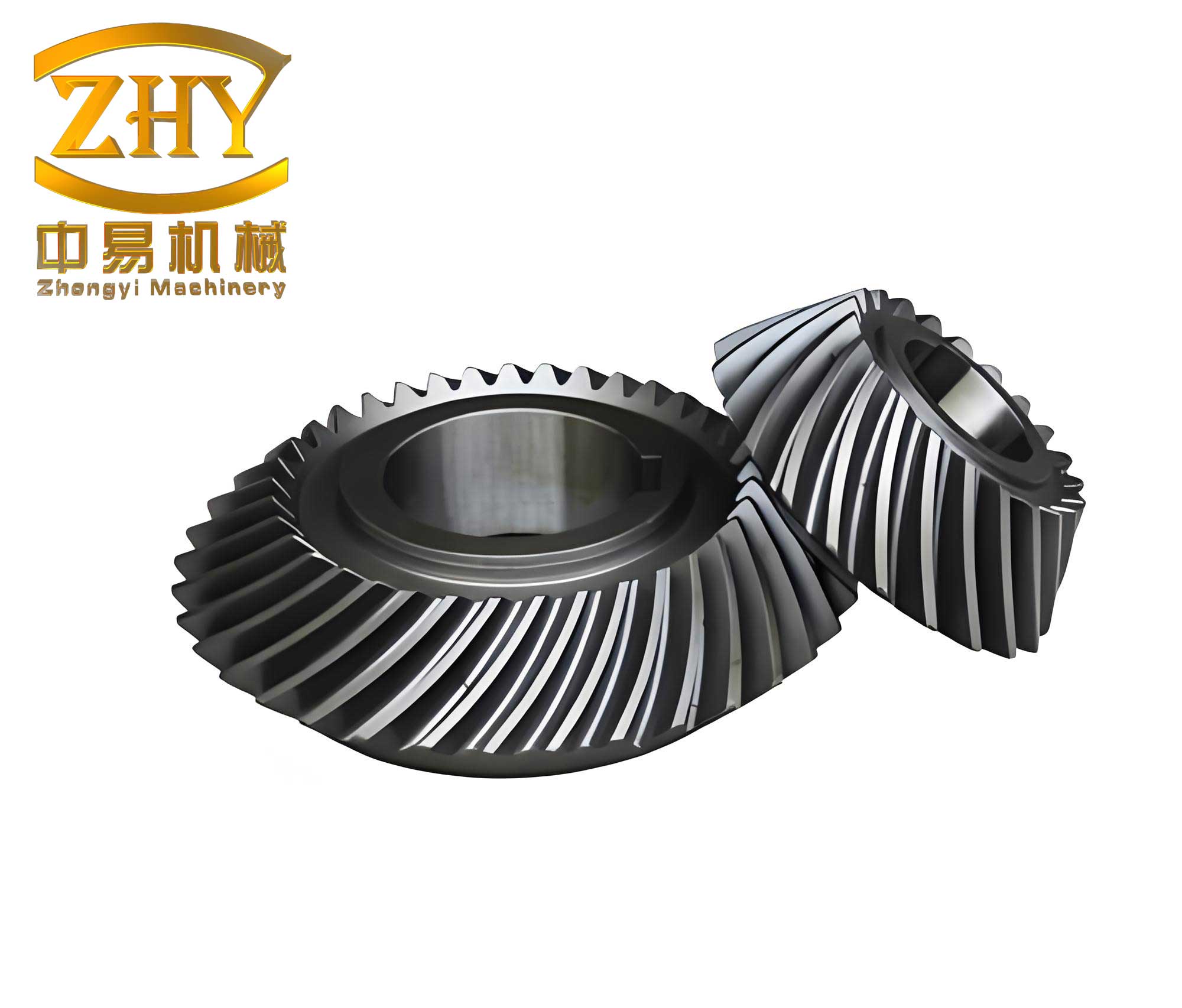
The design phase for spiral gears is paramount, as the accuracy of the CAD model directly influences the final machined part. Spiral gears, characterized by their helical teeth, require precise definition of the tooth profile, typically based on an involute curve. For gears with a low tooth count (non-standard), standard gear equations do not suffice, necessitating a derivation from first principles. The fundamental equation of an involute curve in polar coordinates is given by:
$$r_k = \frac{r_b}{\cos \alpha_k}$$
$$\theta_k = \tan \alpha_k – \alpha_k$$
Here, \( r_k \) is the radius vector to any point on the involute, \( r_b \) is the base circle radius, \( \alpha_k \) is the pressure angle, and \( \theta_k \) is the roll angle. To implement this in UG NX, which primarily uses Cartesian coordinates, a conversion is essential. By defining the angle \( u \) as the central angle corresponding to the arc of the base circle rolled by the generating line, where \( u = \alpha_k + \theta_k \), and knowing that \( \alpha_k = \arccos(r_b / r_k) \), we can express the parametric equations in a UG-compatible form. Using the system parameter \( t \) (varying from 0 to 1) to control the curve from the root circle to the tip circle, the Cartesian equations become:
$$x_t = r_b \cdot \cos u + r_b \cdot u \cdot \sin u$$
$$y_t = r_b \cdot \sin u – r_b \cdot u \cdot \cos u$$
In these equations, \( u \) is expressed in radians, and \( t \) maps to \( u \) linearly between a start angle \( a \) and an end angle \( b \): \( u = (1 – t) \cdot a + t \cdot b \). This parametric approach allows for the precise sketching of a single involute tooth profile. For a spiral gear, this 2D profile is then extruded along a helical path, defined by the helix angle, to create the three-dimensional tooth geometry. The entire process underscores the mathematical rigor required in designing accurate spiral gears, ensuring proper meshing and function in final assemblies.
Once the 3D solid model of the spiral gear is constructed in UG NX, the next critical step is preparing for manufacturing. This involves meticulous planning of the CNC machining process. The material selected for the spiral gear in this case is 40Cr alloy steel, with a blank dimension of Ø103 mm × 175 mm. The key geometric features include an outer diameter of Ø127.4 mm and an inner bore of Ø25 mm. A systematic工艺安排 is devised, encompassing coordinate system definition, sequence of operations, tool selection, and workholding.
| Process Stage | Key Actions | Parameters & Tools | Objective |
|---|---|---|---|
| Workpiece Setup & Coordinate System | Establish right face as datum; align model axis with machine X-axis using World and User Coordinate Systems in PowerMILL. | Fixture: Step mandrel with one end clamped and one end centered using the Ø25mm bore. | Ensure correct spatial orientation for 4-axis (X, Y, Z, A) machining. |
| Roughing Operation | Maximize material removal from gear slots using reference line machining strategy. | Tool: Ø16 mm ball nose end mill. Focus on one tooth gap, then rotate-copy toolpath. | Efficiently clear bulk material while preserving spiral tooth trajectory. |
| Semi-Finishing Operation | Remove remaining uneven stock, improving geometry accuracy. | Strategy: Rotary machining. Tool: Ø16 mm ball nose end mill. Stepover: 1.0 mm, Tolerance: 0.1 mm, Allowance: 0.5 mm. | Prepare surfaces for final finish by achieving near-net shape. |
| Finishing Operation | Generate high-quality surface finish on all spiral gear tooth flanks. | Strategy: Rotary machining. Tool: Ø16 mm ball nose finish mill. Stepover: 0.25 mm, Tolerance: 0.1 mm, Allowance: 0.0 mm. Spindle: 3000 RPM, Feed: 150 mm/min. | Achieve final dimensions and surface roughness (Ra ≤ 3.2 μm) with smooth toolpaths. |
The selection of machining strategies within PowerMILL is pivotal for the successful fabrication of spiral gears. For roughing, the “Reference Line” machining strategy is employed. This involves defining a driving curve (reference line) along the desired toolpath trajectory for one tooth gap. The parameters are set to prioritize material removal rate while avoiding tool overload. The key settings include a toolpath tolerance of 0.2 mm, a stepover of 40% of the tool diameter (6.4 mm), and a depth of cut configured according to the axial depth of the gear slot. The generated toolpath for the single gap is then transformed using a rotary pattern around the gear axis to machine all tooth gaps, significantly reducing programming time for these repetitive features on the spiral gears.
Semi-finishing serves as an intermediate stage to ensure uniform stock left for the finishing pass. Here, the “Rotary Machining” strategy is ideal as it aligns with the cylindrical nature of the spiral gears. This strategy projects toolpaths onto the model while rotating it around a defined axis (the gear axis). The parameters are tuned for a balance between efficiency and surface quality, as summarized in Table 1. The stepover is reduced compared to roughing to create a more uniform residual layer.
Finishing is the most critical operation for spiral gears, determining the final functional quality of the tooth flanks. The same “Rotary Machining” strategy is used but with significantly finer parameters. A very small stepover (0.25 mm) ensures a high-density toolpath, which is essential for achieving the required surface finish on the complex helical surfaces of the spiral gears. The toolpath tolerance is tightened to 0.1 mm to accurately follow the designed involute-helical geometry. The choice of a dedicated finish ball nose mill, combined with high spindle speed and low feed rate, minimizes vibrations and promotes a superior surface texture. The visibility of these precise toolpaths is crucial for verification before actual cutting.
| Parameter | Roughing (Reference Line) | Semi-Finishing (Rotary) | Finishing (Rotary) |
|---|---|---|---|
| Primary Objective | Aggressive volume removal | Stock equalization | Dimensional & surface accuracy |
| Tool Diameter | 16 mm (Ball Nose) | 16 mm (Ball Nose) | 16 mm (Ball Nose Finish) |
| Stepover | 6.4 mm (40% of tool dia.) | 1.0 mm | 0.25 mm |
| Machining Tolerance | 0.2 mm | 0.1 mm | 0.1 mm |
| Remaining Stock | 1.0 mm (on walls) | 0.5 mm | 0.0 mm |
| Spindle Speed (RPM) | ~1800 | ~2200 | 3000 |
| Feed Rate (mm/min) | ~800 | ~400 | 150 |
PowerMILL’s robust simulation module is an indispensable tool for validating the generated toolpaths for spiral gears. Before committing to machine time, a dynamic material removal simulation is performed. This visualization allows for the inspection of potential issues such as gouging, collisions between the tool/holder and the workpiece or fixture, and the completeness of material removal. The simulation runs at controllable speeds, providing a clear view of how the tool engages with the complex helical surfaces of the spiral gears. Any anomalies detected can be corrected by adjusting the toolpath parameters or the geometry reference, ensuring a safe and efficient machining process. This step dramatically reduces the risk of costly errors on the shop floor.
Following successful simulation and verification, the final stage is post-processing. PowerMILL’s post-processor converts the calculated toolpaths into machine-specific G-code (NC program). The post-processor is configured for the target 4-axis CNC milling machine (with rotary A-axis). The generated code includes all necessary commands for tool changes, spindle control, feed rates, and the coordinated linear (X, Y, Z) and rotary (A) movements required to trace the helical toolpaths around the spiral gears. A snippet of a typical finishing code block for a Fanuc-controlled system might look like the example below, demonstrating the interpolation of linear and rotary axes to machine the spiral gear profile:
G01 X92.750 Y-0.009 Z87.524 A0.0 F86
...
Z18.512 A-2.158
Z18.907 A-3.203
...
M30
The continuous transformation of the A-axis angle synchronized with Z-axis movement is evident, which is characteristic of machining the helical flute of spiral gears. The entire programming cycle, from model import to G-code generation, highlights the efficiency gained by using a dedicated CAM system like PowerMILL for such complex tasks.
The integration of UG NX and PowerMILL presents a powerful solution for the challenges posed by spiral gear manufacturing. UG excels in parametric and feature-based design, allowing for the creation of accurate and editable 3D models of spiral gears, even those with non-standard profiles. Its robust data export capabilities (via STEP or IGES formats) ensure a seamless transfer of geometry to the CAM environment. PowerMILL, on the other hand, specializes in high-speed and multi-axis machining calculations. Its strength lies in generating efficient, collision-free toolpaths with a vast array of strategies tailored for complex surfaces, which are ubiquitous in spiral gears. The software’s focus on ease of use, combined with powerful editing tools, allows manufacturing engineers to quickly develop and optimize machining programs.
Beyond the specific case, this methodology is applicable to a wide range of complex sculptured surfaces found in molds, dies, aerospace components, and other precision gears. The key to success lies not only in software proficiency but also in a deep understanding of machining principles, material behavior, and cutting mechanics. For instance, optimizing cutting parameters for spiral gears involves balancing factors like tool deflection, heat generation, and chip evacuation, especially in the deep, narrow slots of the gear teeth. Empirical formulas and tool manufacturer recommendations often supplement software defaults. The relationship between feed per tooth (\( f_z \)), spindle speed (\( N \)), feed rate (\( V_f \)), and number of flutes (\( Z \)) is fundamental:
$$V_f = f_z \cdot Z \cdot N$$
Selecting an appropriate \( f_z \) for the ball nose mill when machining the hardened 40Cr steel is critical to prevent tool wear and achieve the desired surface finish on the spiral gears. Furthermore, the effective cutting diameter of a ball nose tool varies with the depth of cut, affecting the actual surface speed, a factor that advanced CAM software can account for in constant surface speed modes.
In conclusion, the fusion of CAD expertise in UG NX and CAM prowess in Delcam’s PowerMILL provides a streamlined, accurate, and efficient pathway for manufacturing high-precision spiral gears. This approach replaces traditional, less accurate methods with a digital thread that enhances quality, reduces lead time, and increases manufacturing agility. The ability to simulate, verify, and post-process within a unified digital environment significantly mitigates risks associated with machining complex parts like spiral gears. As industries continue to demand higher performance and customization, mastering such integrated software platforms becomes essential for engineers and machinists aiming to push the boundaries of what is possible in precision component fabrication, particularly for critical elements like spiral gears that form the heart of advanced mechanical systems.