
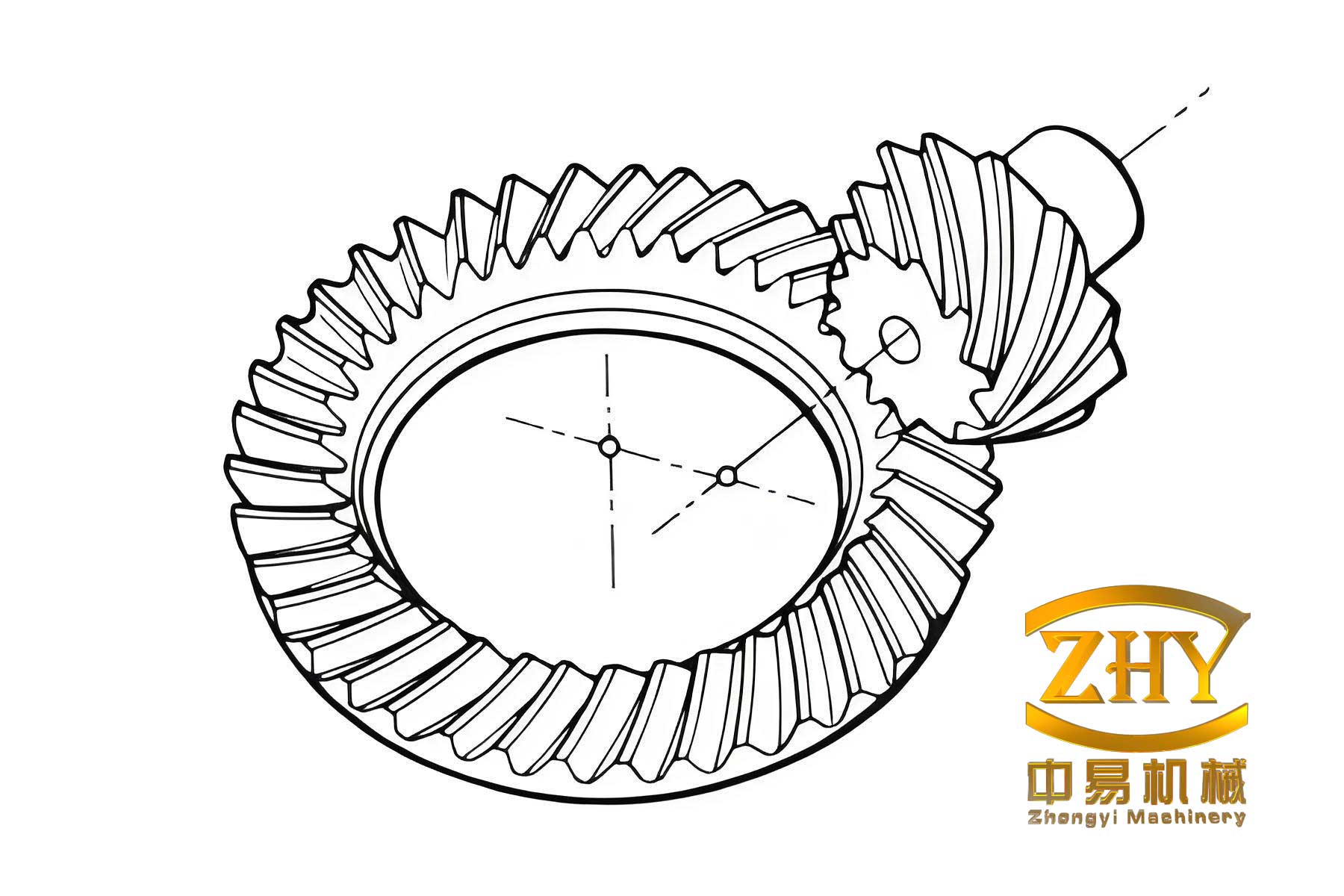
The design and manufacturing of hypoid gears represent one of the most complex challenges in gear engineering. Their superior characteristics—smooth power transmission, high load capacity, and the crucial ability to provide a spatial offset between intersecting axes—make them indispensable for critical applications like automotive rear axle drives. However, the intricate geometry of their tooth flanks, coupled with a multitude of interdependent design and machining parameters, leads to a notoriously cumbersome and error-prone process. This complexity necessitates sophisticated computational support. While standalone CAD drawing tools or basic calculation programs exist, a truly integrated system that seamlessly combines geometric design, strength verification, tooth contact analysis, machine adjustment calculation, and automated drafting has been notably absent. This article details the development and architecture of such a comprehensive, in-house integrated CAD/CAM system specifically engineered for hypoid gears, leveraging the synergistic power of multiple software platforms.
The core system was architected to manage the entire workflow from initial specifications to final production data. It is built upon a foundation of Visual C++ for the primary user interface and application logic, strategically incorporating MATLAB for its advanced computational and graphical analysis capabilities, and utilizing ObjectARX for deep integration with AutoCAD to enable robust parameterized drafting. The system is modular, comprising five interconnected yet functionally distinct modules: Blank Geometry Calculation, Strength Verification, Tooth Contact Analysis (TCA) & Correction, Machine Adjustment Card Generation, and Parameterized CAD Drafting. Data flows sequentially through these modules, with outputs from one serving as inputs for the next, ensuring consistency and automation.
System Architecture and Module Functions
The integrated system follows a structured workflow, as illustrated in the functional diagram below. The process begins with user-defined initial parameters and proceeds through validation, calculation, analysis, and finally, the generation of manufacturing instructions and drawings.
1. Gear Blank Geometry Calculation Module
This foundational module performs the initial sizing and geometric definition of the hypoid gear pair, primarily based on established Gleason standards. It automates the selection of critical design factors based on the chosen tooth root form (standard taper, dual taper, or tilted root). The module initiates with a validation check on the user-input initial parameters (e.g., number of teeth, axis offset, pitch angles, face width). If the proposed design is geometrically infeasible, the user is prompted to revise the inputs. Upon successful validation, the module executes comprehensive calculations to determine all major gear blank dimensions for both the pinion and the gear, as well as essential cutter parameters.
Key calculated geometric parameters include spiral angle, pitch diameters, whole depth, addendum, dedendum, and cutter radius. The governing equations for some fundamental dimensions are summarized below. The pitch diameter of the gear ($$D_{2}$$) is derived from the mean cone distance ($$R_{m}$$) and the pitch angle of the gear ($$\delta_{2}$$):
$$D_{2} = 2 R_{m} \sin \delta_{2}$$
The addendum ($$h_{a}$$) and dedendum ($$h_{f}$$) for the gear are calculated using chosen addendum and clearance coefficients ($$k_{a}$$, $$c$$) and the outer transverse module ($$m_{et}$$):
$$h_{a2} = k_{a2} \cdot m_{et}$$
$$h_{f2} = (k_{a2} + c) \cdot m_{et}$$
The system automatically populates a detailed output table with all results, which can be reviewed, saved, or printed before proceeding to strength analysis.
| Parameter | Symbol | Pinion Value | Gear Value | Unit |
|---|---|---|---|---|
| Number of Teeth | Z | 11 | 41 | – |
| Axis Offset | E | 35.0 | mm | |
| Mean Spiral Angle | βm | 50.0° | 30.0° | degree |
| Pitch Diameter at Mean Point | dm | 68.42 | 254.92 | mm |
| Outer Addendum | hae | 8.12 | 3.25 | mm |
| Outer Dedendum | hfe | 4.78 | 9.65 | mm |
| Face Width | F | 50.0 | 45.0 | mm |
| Design Cutter Radius | rc0 | 114.30 | mm | |
2. Strength Verification Module
Following geometric definition, the hypoid gears must be evaluated for their ability to withstand operational loads. This module implements strength rating procedures based on the American Gear Manufacturers Association (AGMA) standards for bevel and hypoid gears. It accounts for a comprehensive set of application conditions including input power, rotational speed, desired service life, and overload factors. The user specifies material properties, heat treatment, and desired reliability level through intuitive drop-down menus.
The core calculations involve determining the bending stress and contact stress for both the pinion and gear, and comparing them against allowable stress limits for the chosen material. The bending stress formula is central to this analysis:
$$\sigma_{F} = \frac{F_{t}}{b m_{et}} \cdot \frac{K_{A} K_{V} K_{H\beta}}{K_{X}} \cdot Y_{J} Y_{\zeta}$$
Where:
$$F_{t}$$ is the tangential load at the mean point,
$$b$$ is the net face width,
$$m_{et}$$ is the outer transverse module,
$$K_{A}$$, $$K_{V}$$, $$K_{H\beta}$$, $$K_{X}$$ are application, dynamic, load distribution, and size factors respectively,
$$Y_{J}$$ is the geometry factor for bending strength,
$$Y_{\zeta}$$ is the lengthwise curvature factor.
The geometry factor $$Y_{J}$$ is particularly critical and is obtained from AGMA charts based on number of teeth, tool edge radius, and pressure angle. The module provides an integrated interface for selecting these coefficients. If the calculated stresses exceed the allowable limits, the system flags the design as inadequate and guides the user to return to the initial parameter stage. Only designs passing both bending and pitting resistance checks proceed to the contact analysis phase.
| Item | Pinion | Gear | Unit/Note |
|---|---|---|---|
| Applied Torque | 800 | – | Nm |
| Tangential Load at Mean Pt. | 23,400 | 23,400 | N |
| Bending Geometry Factor (YJ) | 0.245 | 0.285 | From AGMA Chart |
| Calculated Bending Stress | 385 | 331 | MPa |
| Allowable Bending Stress | 450 | 450 | MPa |
| Safety Factor (Bending) | 1.17 | 1.36 | – |
| Calculated Contact Stress | 1550 | MPa | |
| Allowable Contact Stress | 1650 | MPa | |
| Safety Factor (Pitting) | 1.06 | – | |
3. Tooth Contact Analysis (TCA) and Correction Module
This is the most advanced module, responsible for simulating the meshing behavior of the designed hypoid gear pair. The quality of meshing—manifested as the contact pattern under load and the transmission error—is paramount for noise, vibration, and durability performance. This module was developed using a mixed programming approach, embedding MATLAB’s powerful computational engine within the VC++ framework. It performs a simulation by numerically solving the mathematical conditions of continuous tangency between the pinion and gear tooth surfaces as they rotate.
The TCA outputs are graphical plots of the contact pattern on the gear tooth flank (both convex and concave sides) and the curve of transmission error (TE). The initial machine settings from the blank calculation often do not yield an optimal contact pattern. Therefore, the system incorporates algorithms for first-order and second-order corrections. First-order corrections (e.g., altering the machine root angle or offset) primarily adjust the location and orientation of the contact pattern. Second-order corrections (e.g., modifying the lengthwise or profile curvature of the tooth surfaces) control the pattern’s size, shape, and the amplitude/symmetry of the TE curve.
The core TCA algorithm solves the system of equations:
$$
\begin{cases}
\mathbf{r}_{f}^{(1)}(u_{1}, \theta_{1}, \phi_{1}) = \mathbf{r}_{f}^{(2)}(u_{2}, \theta_{2}, \phi_{2}) \\
\mathbf{n}_{f}^{(1)}(u_{1}, \theta_{1}, \phi_{1}) = \mathbf{n}_{f}^{(2)}(u_{2}, \theta_{2}, \phi_{2})
\end{cases}
$$
Where $$\mathbf{r}_{f}^{(i)}$$ and $$\mathbf{n}_{f}^{(i)}$$ are the position vector and unit normal vector of the tooth surface in the fixed coordinate system for member $$i$$ (1=pinion, 2=gear), $$u_i$$, $$\theta_i$$ are surface parameters, and $$\phi_i$$ are rotation angles. The transmission error is computed as:
$$\Delta \phi_{2} = \phi_{2} – \frac{Z_{1}}{Z_{2}} \phi_{1}$$
The user interacts with the module to iteratively apply corrections until a desired contact pattern (centered, of appropriate size and orientation) and a low-amplitude, symmetric TE curve are achieved. The final correction values (∆E, ∆∆, etc.) are then passed to the next module to compute the actual machine settings.
| Correction Parameter | Type | Primary Effect on Contact Pattern | Primary Effect on Transmission Error |
|---|---|---|---|
| Machine Offset (E) | First-Order | Moves pattern along length (Toe/Heel) | Shifts baseline |
| Machine Root Angle (∆) | First-Order | Moves pattern along profile (Top/Root) | Changes slope |
| Sliding Base (∆XB) | First-Order | Changes pattern lead (inclination) | Affects symmetry |
| Lengthwise Curvature (∆rc) | Second-Order | Controls pattern length and width | Influences amplitude |
| Profile Curvature (∆α) | Second-Order | Controls pattern profile shape | Influences shape/amplitude |
4. Machine Adjustment Card Calculation Module
This module translates the final, corrected geometric design into specific instructions for the gear cutting machine. It supports multiple machine models (e.g., analogues of Y2250, Y2280, Gleason No. 26, GH35) and cutting methods (Single-Side, Formate, or Duplex). Based on the finalized gear data and the selected machine model, it calculates all necessary setup parameters.
These parameters include:
• Cutter head data: diameter, blade group settings, point width.
• Machine kinematic settings: ratio of roll, cradle angle, swivel angle, tilt angle.
• Workpiece positioning: machine center to back, sliding base, vertical offset.
• Feed and speed rates.
The module outputs a comprehensive set of six adjustment cards: Rough and Finish Cutting cards for both the Gear and the Pinion, a Dimension Card for gear inspection (specifying chordal dimensions, span measurement), and a Correction Card summarizing the applied TCA corrections. These cards are the direct link between the digital design and the physical manufacturing of the hypoid gears, used by the machinist to set up the machine and by the inspector to verify the cut teeth.
| Setting Item | Symbol | Value | Unit |
|---|---|---|---|
| Cutter Diameter | Dc | 228.6 | mm (9.0″) |
| Blade Angle (Inner/Outer) | αi/αo | 18° / 22° | degree |
| Machine Center to Back | XB | 125.35 | mm |
| Sliding Base | SB | -2.15 | mm |
| Vertical Offset | ∆V | 0.85 | mm |
| Cradle Angle (Setup) | qs | 78°15′ | degree |
| Ratio of Roll | RR | 4.2158 | – |
| Swivel Angle | i | 45°00′ | degree |
5. Parameterized CAD Drafting Module
The final module automates the generation of production drawings for the hypoid gear components. It leverages the ObjectARX development environment to create a dynamic link between the system’s database and AutoCAD. Upon command from the main application, this module launches AutoCAD and automatically loads a custom ARX application.
The ARX application reads the finalized geometric data (stored in a structured file or database from previous modules) and executes a sequence of parameterized drawing commands. It handles the creation of multiple views (front, sectional), detailed tooth geometry callouts, tolerance tables, and title blocks. The system supports different gear blank configurations (e.g., with web, with shaft, flange-mounted). The user only needs to select the configuration and input any additional structural dimensions (shaft diameters, keyway sizes, bolt circle), and the drawing is generated automatically, ensuring perfect alignment between the calculated dimensions and the production blueprint.
Key Technical Implementations
Hybrid Programming with VC++ and MATLAB
Integrating MATLAB’s computational prowess into the Windows-based VC++ application was crucial for the TCA module. The process involved several steps. First, the core TCA and correction algorithms were developed, debugged, and encapsulated into a function within the MATLAB environment. This function was then compiled into C++ code using the MATLAB Compiler (command: mcc -t -L Cpp function_name), producing .hpp and .cpp files. In the VC++ project, the include and library paths were set to point to MATLAB’s extern directories. Necessary preprocessor definitions (e.g., MSVC, IBMPC, MSWIND) and MATLAB library files (libmmfile.lib, libmatlb.lib, libmx.lib, libmwsglm.lib, etc.) were linked. Finally, within the VC++ code, specific initialization functions were called before invoking the compiled MATLAB function, enabling seamless data exchange and graphical output from within the native system interface.
Database-Driven Parameter Management and CAD Automation
Managing the vast number of parameters, standards, and machine-specific data required a robust backend. A Microsoft Access database (accessed via ODBC/DAO classes in MFC) was implemented to store look-up tables for AGMA coefficients, machine constants, tooling specifications, and default drawing configurations. This allows for easy maintenance and updating of standards without modifying the core application code.
The AutoCAD automation uses the ObjectARX API, which operates at the core level of AutoCAD, offering high performance. The interface is established through the acrxEntryPoint() function. The main VC++ application initiates AutoCAD dynamically using the CreateProcess() Windows API function. To load the ARX module, the system writes the path to the custom .arx file into AutoCAD’s acad.rx file, ensuring automatic loading upon startup. Critical data (like the path to the current parameter file) is passed from the main system to the AutoCAD session using inter-process communication techniques, such as the SendMessage() function. The ARX program then reads this data, initializes drawing layers, text styles, and dimension scales, and proceeds to generate the geometry based entirely on the parameters, creating a fully associative and accurate drawing.
System Application and Case Study
The practical application of this integrated system dramatically streamlines the development process for hypoid gears. A typical workflow for designing a new automotive rear axle gearset is condensed from weeks of manual calculations and trial-and-error on the machine to a matter of days. The engineer inputs the basic requirements (ratio, offset, torque, package size). The system performs the geometric synthesis and immediately flags any infeasible combinations. After strength approval, the engineer can interactively develop the contact pattern in the TCA module. By adjusting virtual correction parameters and instantly seeing the simulated contact pattern and transmission error graph, an optimal set of machine settings is derived computationally before any metal is cut.
For instance, in developing a pinion for a heavy-duty truck axle, the initial TCA might show a contact pattern biased towards the toe with a high transmission error amplitude. Applying a negative sliding base (∆XB) correction rotates the pattern towards a more favorable centered position. Subsequently, a slight increase in lengthwise curvature (∆rc) shortens and deepens the pattern, reducing the TE amplitude to an acceptable level. These final ∆ values are fed directly into the adjustment card module to generate the precise setup for a specific grinding machine. The associated dimension card provides the quality inspector with the exact span measurement and chordal tooth thickness to verify the finished part. Finally, the drafting module produces the manufacturing drawing, complete with all tolerances derived from the calculated geometry.
The integration ensures consistency; a change propagated from the TCA module automatically updates the adjustment cards and the critical dimensions on the drawing. This closed-loop digital process minimizes errors, reduces reliance on physical tryouts, and accelerates the time-to-market for new hypoid gear designs.
| Input/Module | Key Action | Primary Output | Next Module |
|---|---|---|---|
| Initial Parameters (Ratio, Offset, Power) |
User Definition | Design Specifications | Blank Calculation |
| Blank Calculation | Geometric Synthesis | Gear Dimensions, Cutter Data | Strength Verification |
| Strength Verification | AGMA Rating | Safety Factors, Approved Geometry | TCA & Correction |
| TCA & Correction | Mesh Simulation & Optimization | Contact Pattern, TE Curve, Correction Values (∆) | Adjustment Card Calc. |
| Adjustment Card Calc. | Machine Kinematics Calculation | Set of 6 Cutting/Inspection Cards | CAD Drafting / Machining |
| CAD Drafting | Parameterized Drawing | Detailed Manufacturing Drawing (.dwg) | Production |
Conclusion
The development of this integrated CAD/CAM system marks a significant step forward in the digital design and manufacturing of hypoid gears. By unifying the disparate stages of design, analysis, and production engineering into a single, cohesive software environment, it addresses the fundamental complexity and interdependence inherent in hypoid gear technology. The strategic use of mixed programming—combining VC++ for the interface, MATLAB for advanced numerical analysis, and ObjectARX for deep CAD integration—has resulted in a powerful tool that is both user-friendly and technically profound.
The system’s modular architecture ensures flexibility and maintainability. Its database-driven core allows for easy adaptation to new standards or machine tools. Most importantly, it transforms the design process from a sequential, trial-based approach into an interactive, simulation-driven optimization loop. Engineers can now proactively develop high-performance, low-noise hypoid gears with predictable contact behavior before committing to costly physical prototyping. The automatic generation of accurate machine adjustment cards and production drawings directly from the optimized digital model eliminates transcription errors and ensures manufacturing intent is perfectly captured. In summary, this integrated system not only enhances engineering efficiency and product quality but also encapsulates a mature, digital thread for the entire lifecycle of complex hypoid gears.