
I propose an integrated prediction framework for the remaining useful life of a pinion gear by fusing a physically grounded crack propagation model with data-driven health indicators. A pinion gear operates under severe contact and bending loads, and fatigue cracks often initiate at the tooth root. Once a crack appears in a pinion gear, it may propagate stably and then become unstable, finally resulting in tooth fracture. Such a failure can cause unexpected shutdown, secondary damage, and safety hazards. Therefore, accurate life prediction for a pinion gear is essential for condition-based maintenance and reliable power transmission.
Conventional life prediction methods for a pinion gear can be broadly grouped into three categories: physical model methods, data-driven methods, and hybrid fusion methods. A physical model method uses failure mechanisms to establish a degradation model. A data-driven method analyzes measured degradation data and constructs health indicators or state models. A hybrid fusion method combines physical knowledge with observed data to improve prediction reliability. In my work, I adopt the hybrid fusion philosophy because a pure physical model may not fully exploit measured vibration data, while a pure data-driven model may lack explicit physical meaning and may fail when the health indicator does not clearly represent the degradation state of the pinion gear.
The main difficulty addressed in my method is that health indicators obtained directly from raw vibration signals cannot always accurately reflect the degradation state of a pinion gear. To overcome this problem, I process the vibration data of the pinion gear by empirical wavelet transform, reconstruct the signal using kurtosis as a selection criterion, and then build a health indicator that reflects the relationship between vibration data and pinion gear life. I further establish a crack propagation degradation model for the pinion gear based on the Paris law and finite element analysis. Finally, I link the degradation model with the health indicator through an unscented Kalman filter and update the degradation model parameters to predict the remaining useful life of the pinion gear. Experimental results show that my method achieves more accurate life prediction than traditional data-driven methods.
The proposed framework contains four tightly coupled parts: health indicator construction, crack propagation modeling, finite element analysis of the pinion gear, and unscented Kalman filter-based parameter updating. I summarize the overall procedure in Table 1. The procedure is designed for a pinion gear operating under steady conditions, because the crack propagation process of a pinion gear is closely related to its working state.
| Stage | Input | Operation | Output |
|---|---|---|---|
| Health indicator construction | Raw vibration signal of the pinion gear | Empirical wavelet transform, kurtosis-based mode selection, signal reconstruction | Health indicator of the pinion gear |
| Crack propagation modeling | Material parameters and pinion gear geometry | Paris law and finite element analysis | Degradation model for the pinion gear |
| Model linking | Health indicator and degradation model | Unscented Kalman filter | Updated model parameters |
| Life prediction | Updated degradation model and failure threshold | Remaining useful life estimation | Predicted life of the pinion gear |
I first consider the construction of a health indicator for the pinion gear. The raw vibration signal measured from a pinion gear contains not only degradation-related impact components but also harmonic components, noise, and other interference. If I directly use a time-domain or frequency-domain feature of the raw signal as a health indicator, the degradation information of the pinion gear may be masked. Therefore, I use empirical wavelet transform to decompose the original vibration signal of the pinion gear and then reconstruct the signal by selecting the empirical modes that contain more degradation information.
Empirical wavelet transform was originally developed by combining the adaptivity of empirical mode decomposition with wavelet analysis. It adaptively divides the Fourier spectrum of a signal and constructs an appropriate orthogonal wavelet filter bank. Compared with empirical mode decomposition, empirical wavelet transform has a more rigorous theoretical foundation. In my method, empirical wavelet transform is used to extract amplitude-modulated and frequency-modulated components from the vibration signal of the pinion gear. The detailed procedure of health indicator construction is given in Table 2.
| Step | Operation | Mathematical expression or criterion |
|---|---|---|
| 1 | Input raw vibration signal of the pinion gear | $$f(t)$$ |
| 2 | Compute Fourier transform | $$F(\omega)=\mathcal{F}\{f(t)\}$$ |
| 3 | Find local maxima of amplitude in the spectrum | $$(\omega_i,A_i)$$ |
| 4 | Select significant maxima by a relative amplitude ratio | $$A_i \ge A_{\min}+\varepsilon(A_{\max}-A_{\min})$$ |
| 5 | Determine spectrum segmentation boundaries | $$\omega_n=\frac{m_j+m_{j+1}}{2},\quad n\in[1,N]$$ |
| 6 | Construct empirical wavelet functions and empirical scaling functions | $$\psi_n(\omega),\ \phi_n(\omega)$$ |
| 7 | Compute detail coefficients and approximation coefficients | $$W_f^e(n,t)=\langle f(t),\psi_n(t)\rangle,\quad W_f^e(0,t)=\langle f(t),\phi_1(t)\rangle$$ |
| 8 | Obtain empirical modes | $$g_k(t),\quad k\in[1,N]$$ |
| 9 | Compute kurtosis of each empirical mode | $$K_k=\mathrm{kurtosis}(g_k(t))$$ |
| 10 | Sort modes and select the reconstruction interval | $$K_{\max}\ge K_k\ge K_{\min}$$ |
| 11 | Reconstruct the signal of the pinion gear | $$f_c(t)=\sum_{k=1}^{N/2} g_k(t)$$ |
| 12 | Compute the health indicator | $$\mathrm{HI}=\mathrm{kurtosis}(f_c(t))$$ |
For a discrete signal \(x\), kurtosis is defined as the fourth standardized moment. I use the following expression for the health indicator of the pinion gear:
$$
K=\frac{E[(x-\mu)^4]}{\sigma^4}
$$
where \(\mu\) is the mean and \(\sigma\) is the standard deviation. A larger kurtosis value indicates a more impulsive signal. Because a fatigue crack in a pinion gear generates periodic impacts during meshing, the kurtosis of the reconstructed signal is expected to increase as the crack grows. However, kurtosis computed from the raw signal may be contaminated by other vibration sources. By selecting empirical modes with high kurtosis, I emphasize the impact components that carry degradation information of the pinion gear.
To verify the proposed health indicator, I first perform a simulation study. The simulated vibration signal of a pinion gear is constructed by combining periodic impacts, harmonic components, and Gaussian noise. The impulse response is written as
$$
x_{\mathrm{imp}}(\xi,f_d,t)=\sum_{i=1}^{8}\sum_{j=1}^{2} A_{ij}\exp\left[-\frac{2\pi\xi_j}{\sqrt{1-\xi_j^2}}f_{dj}(t-\tau_i-iT_n)\right]\sin\left[2\pi f_{dj}(t-\tau_i-iT_n)\right]
$$
where \(A_{ij}\) is the amplitude of the impact, \(\xi_j\) is the damping ratio, \(f_{dj}\) is the natural frequency, \(\tau_i\) is a random time delay, and \(T_n\) is the rotation period. The harmonic component of the pinion gear is expressed as
$$
x_s(t)=\sum_{m=1}^{9} A_m\left[1+\sin(2\pi f_n t)\right]\sin(2\pi m f_z t)
$$
where \(f_z\) is the meshing frequency and \(f_n\) is the rotational frequency. The full-life simulation signal of the pinion gear is then generated by
$$
x_i(t)=\left[1+0.2\beta(\lambda_i)\right]x_s(t)+\beta(\lambda_i)x_{\mathrm{imp}}(t)+\eta(t),\quad i\in[1,200]
$$
$$
x=[x_1,x_2,x_3,\ldots,x_{200}]
$$
In my simulation, I set the meshing frequency of the pinion gear to \(f_z=258.3\ \mathrm{Hz}\) and the rotational frequency to \(f_n=8.3\ \mathrm{Hz}\). The sampling frequency is \(12800\ \mathrm{Hz}\), each segment lasts \(1\ \mathrm{s}\), and one sample is taken every minute. The total signal length is \(200\ \mathrm{min}\). Two natural frequencies are set as \(f_{d1}=1400\ \mathrm{Hz}\) and \(f_{d2}=1930\ \mathrm{Hz}\), with damping ratios \(\xi_1=0.03\) and \(\xi_2=0.01\). The amplitude fluctuation is \(A_{ij}=\mathrm{rand}(0.9,1.1)\), and the speed fluctuation is \(\tau_i=\mathrm{rand}(0,0.05)T_n\). The amplitude of the pinion gear vibration is assumed to grow exponentially as \(\lambda_i=[0.01:0.01:2]\) and \(\beta(\lambda_i)=\exp(\lambda_i)\). Gaussian white noise \(\eta(t)\) with a signal-to-noise ratio of \(-2\ \mathrm{dB}\) is added to each segment.
I compare the proposed health indicator with the kurtosis obtained from the raw vibration signal of the pinion gear. I fit both indicators with an exponential function to evaluate whether they can accurately reflect the degradation state of the pinion gear. The correlation results are summarized in Table 3. The health indicator obtained from the reconstructed signal has a higher correlation with the exponential fitting curve. This indicates that the proposed health indicator can more accurately reflect the degradation state of the pinion gear than the raw-signal kurtosis.
| Indicator type | Full-life correlation | Correlation after 150 min |
|---|---|---|
| Health indicator from empirical wavelet transform reconstruction | 0.95 | 0.80 |
| Health indicator from raw vibration signal | 0.80 | 0.52 |
After 150 minutes, the correlation between raw-signal kurtosis and the fitting curve is only 0.52, while the proposed health indicator reaches 0.80. This means that when raw-signal kurtosis is used as a health indicator, it cannot accurately reflect the degradation state of the pinion gear in the later stage of the life cycle. Although the correlation of the proposed health indicator also decreases slightly, it still reflects the degradation state of the pinion gear with acceptable accuracy.
In the time domain, the reconstructed signal contains more obvious impact components than the original signal. These impact components carry more degradation information of the pinion gear. In the frequency domain, the reconstructed signal mainly retains the resonance band and the high-frequency components related to the pinion gear vibration. At the beginning of the life cycle, the resonance band in the raw signal is almost invisible, whereas the reconstructed signal clearly shows the resonance band. At a later stage, this phenomenon becomes even more obvious. I also define the signal-to-noise ratio as the energy of the impact components divided by the total signal energy. A larger signal-to-noise ratio indicates that the degradation information in the signal is more evident. At the initial fault stage of the pinion gear, the signal-to-noise ratio of the raw signal is only 0.019, which means that the degradation information is masked by other components. As the pinion gear fault grows, the signal-to-noise ratio increases, but the difference between the raw signal and the reconstructed signal becomes larger. This confirms that the reconstructed signal contains more evident degradation information of the pinion gear.
To further validate the proposed health indicator, I use a public gear fatigue degradation dataset. The health indicator obtained by my method has lower variance than the raw-signal kurtosis indicator and can better reflect the degradation state of the pinion gear. The reason is that empirical wavelet transform separates the signal into several modes, and the modes containing more degradation information are selected by kurtosis for reconstruction. As a result, the reconstructed signal reduces the interference of other components on the degradation information of the pinion gear.
After constructing the health indicator, I establish the crack propagation degradation model of the pinion gear. A purely data-driven method often uses an exponential model to describe the degradation state of the pinion gear. Although such a model is convenient, its parameters lack clear physical meaning and cannot accurately describe the crack propagation trend. Therefore, I combine the Paris law with finite element analysis to build the degradation model of the pinion gear. The Paris law is widely used to describe fatigue crack growth and is written as
$$
\frac{da}{dt}=C(\Delta K)^n
$$
where \(a\) is the crack length, \(C\) and \(n\) are material constants, and \(\Delta K\) is the stress intensity factor range. For a pinion gear, the crack propagation mode depends on the tooth root stress state. Because a spur pinion gear is almost free from external shear force, the crack in the pinion gear can be treated as a mixed-mode I and mode II crack. I use finite element analysis to determine the crack propagation path of the pinion gear.
I build the finite element model of the pinion gear according to the parameters listed in Table 4. The static load analysis is performed first. The gear shaft hole is fixed, and the force is applied perpendicular to the tooth surface. The maximum principal stress appears at the tooth root, which indicates that the initial crack is most likely to form at this location. Therefore, I introduce an initial crack at the maximum stress position. Then I apply a dynamic load to simulate the operating condition of the pinion gear. The force is applied perpendicular to the tooth surface with the initial crack, and the extended finite element method is used to simulate crack propagation. In each step, the crack is allowed to propagate at most \(0.16\ \mathrm{mm}\), and a total of 50 steps are performed.
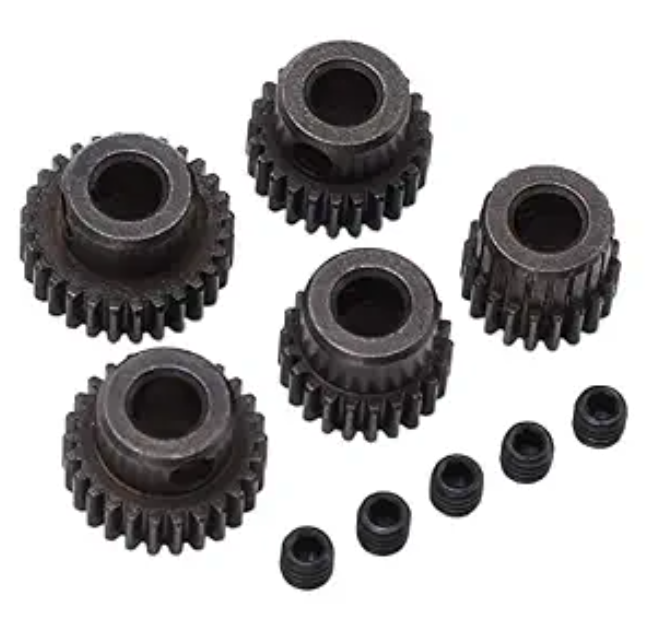
| Parameter | Value or description |
|---|---|
| Number of teeth | 31 |
| Module | \(5\ \mathrm{mm}\) |
| Pressure angle | \(20^\circ\) |
| Material | 40Cr |
| Tooth width | \(10\ \mathrm{mm}\) |
The variation of stress intensity factors with crack length is important for the degradation model. As the crack grows, both \(K_I\) and \(K_{II}\) increase with crack length. During the whole crack propagation period of the pinion gear, the magnitude of \(K_{II}\) is relatively small compared with \(K_I\). Its average magnitude is only \(11.3\%\) of the average magnitude of \(K_I\). Therefore, the crack propagation of the pinion gear is mainly dominated by \(K_I\). I neglect the influence of \(K_{II}\) to simplify the degradation model. The mode I stress intensity factor is expressed as
$$
K_I=Y\sigma\sqrt{\pi a}
$$
where \(Y\) is the shape factor, \(\sigma\) is the stress at the crack front, and \(a\) is the crack length. The stress intensity factor range is
$$
\Delta K=K_{\max}-K_{\min}
$$
Substituting the expression of \(K_I\) into the above equation gives
$$
\Delta K=K_{I,\max}-K_{I,\min}=Y\Delta\sigma\sqrt{\pi a}
$$
This equation shows that the crack growth rate of the pinion gear also depends on the crack length. Substituting \(\Delta K\) into the Paris law and integrating, I obtain the relationship between remaining life and crack length:
$$
\int_{a}^{a_c}\frac{da}{C(Y\Delta\sigma\sqrt{\pi a})^n}=\int_{T}^{t_c}dt
$$
where \(a_c\) is the critical crack length at failure, \(t_c\) is the total operating time at failure, and \(T\) is the remaining useful life of the pinion gear. The solution can be written in a compact form as
$$
T=p_0+p_1 a^{p_2}
$$
where \(p_0\), \(p_1\), and \(p_2\) are parameters to be fitted. These parameters represent the combined influence of material properties, pinion gear geometry, and operating conditions on the life of the pinion gear. This equation is the degradation model for crack propagation in the pinion gear.
When estimating the remaining useful life of the pinion gear, the crack length cannot be measured in real time. Therefore, I use the health indicator instead of the crack length to represent the degradation state of the pinion gear. The crack length obtained from finite element simulation and the proposed health indicator have high consistency. Their Pearson correlation coefficient is 0.913. This means that the proposed health indicator can replace the crack length in the crack propagation degradation model for predicting the life of the pinion gear. I fit the health indicator data with the degradation model to verify whether the model can accurately describe the degradation trend. The correlation between the proposed crack propagation degradation model and the health indicator is 0.77, while the correlation of the exponential model is 0.47. Compared with the exponential model, the crack propagation degradation model can more accurately describe the degradation trend of the pinion gear when a crack fault occurs.
To update the degradation model parameters online, I use an unscented Kalman filter. The degradation process of the pinion gear is nonlinear, and the unscented Kalman filter can avoid the error caused by system linearization. The state-space equations are defined as follows:
$$
\begin{cases}
p_0(k+1)=p_0(k)+\upsilon_0(k)\\
p_1(k+1)=p_1(k)+\upsilon_1(k)\\
p_2(k+1)=p_2(k)+\upsilon_2(k)
\end{cases}
$$
$$
T(k)=p_0(k)+p_1(k)a^{p_2(k)}+\mu(k)
$$
where \(\upsilon_0\), \(\upsilon_1\), \(\upsilon_2\), and \(\mu\) are normally distributed errors. The unscented Kalman filter propagates a set of sigma points through the nonlinear model, computes the predicted mean and covariance, and then updates the state estimate using the latest health indicator observation of the pinion gear. In this way, the degradation model parameters are continuously adapted to the measured data.
I use the gear tooth breakage degradation dataset to validate the remaining life prediction. The initial parameters of the degradation model have a strong influence on the prediction accuracy. Because the finite element crack analysis data and the health indicator are strongly correlated, I estimate the initial parameters of the degradation model from the finite element analysis data. According to the degradation model \(T=p_0+p_1 a^{p_2}\), I treat the health indicator as the independent variable and the remaining useful life \(T\) of the pinion gear as the dependent variable. The parameters \(p_0\), \(p_1\), and \(p_2\) are updated as the health indicator data are updated. The initial parameters obtained by least-squares fitting of the finite element analysis data are listed in Table 5.
| Parameter | Value |
|---|---|
| \(p_0\) | \(-16.25\) |
| \(p_1\) | \(6794\) |
| \(p_2\) | \(-2.612\) |
With the unscented Kalman filter, the degradation model curve of the pinion gear becomes increasingly accurate as the health indicator data are updated. When the input data amount increases from the first \(50\%\) to the first \(70\%\), the root mean square error between the unscented Kalman filter prediction and the health indicator decreases from 73.79 to 17.92. I also replace the unscented Kalman filter with an extended Kalman filter for comparison. The degradation model obtained by the extended Kalman filter has lower fitting accuracy near the end of the life of the pinion gear. With the same first \(70\%\) of data, its root mean square error is 27.87. The root mean square error is defined as
$$
\mathrm{RMSE}=\sqrt{\frac{1}{N}\sum_{i=1}^{N}(y_i-\hat{y}_i)^2}
$$
I use the root mean square error as the criterion for evaluating the fitting accuracy of the degradation curve. As the amount of input data increases, the root mean square error of the proposed method begins to decrease rapidly after the 220th minute of the life cycle of the pinion gear. This shows that the fitting accuracy of the degradation curve increases rapidly as more data are available. To further demonstrate the effectiveness of the proposed method, I compare different combinations of degradation model, health indicator, and parameter updating method. These combinations are summarized in Table 6.
| Method | Degradation model | Health indicator | Parameter updating |
|---|---|---|---|
| Proposed method | Crack propagation model | Health indicator from empirical wavelet transform reconstruction | Unscented Kalman filter |
| Method 1 | Exponential model | Health indicator from empirical wavelet transform reconstruction | Unscented Kalman filter |
| Method 2 | Crack propagation model | Raw-signal kurtosis | Unscented Kalman filter |
| Method 3 | Crack propagation model | Health indicator from empirical wavelet transform reconstruction | Extended Kalman filter |
I take a certain value as the failure threshold of the pinion gear and estimate the final remaining life on this basis. To make the proposed health indicator and the raw-signal kurtosis indicator comparable, I normalize both indicators. When the kurtosis value is greater than 0.4, the growth rate increases rapidly, which indicates that the pinion gear enters the unstable crack propagation stage. Because the unstable propagation stage occupies a very small proportion of the whole life cycle and leads to rapid fracture, I use this value as the failure threshold of the pinion gear.
As the health indicator data are continuously updated, the life prediction result of the proposed method becomes closer to the true value. Under the same conditions, when the degradation model is an exponential model, the life prediction accuracy is lower than that of the proposed method. The reason is that the exponential model is only an empirical model built from degradation data and cannot accurately describe the degradation trend of the pinion gear. When the health indicator is raw-signal kurtosis, the life prediction result deviates greatly from the true value because the kurtosis obtained from the raw vibration data cannot accurately reflect the degradation state of the pinion gear. When the parameter updating method is the extended Kalman filter, the prediction accuracy may even decrease as the data are updated.
The root mean square errors of the life prediction results of different methods are given in Table 7. The proposed method gives the most accurate life prediction. Method 3 has a larger error than the other two methods, which indicates that the parameter updating method has a relatively small influence on the life prediction accuracy of the pinion gear. In contrast, the degradation model and the health indicator have a strong influence on the prediction accuracy.
| Method | RMSE |
|---|---|
| Proposed method | 24.7 |
| Method 1 | 135.1 |
| Method 2 | 172.7 |
| Method 3 | 44.7 |
I further analyze the influence of the health indicator on the prediction of the pinion gear. The health indicator built from the reconstructed signal has a clearer physical relationship with the crack growth of the pinion gear. The impact components generated by the crack in the pinion gear are enhanced by empirical wavelet transform, while the harmonic components and noise are suppressed. Therefore, the health indicator responds more consistently to the degradation state of the pinion gear. This is especially important near the end of the life cycle, where the raw-signal kurtosis becomes less correlated with the degradation trend.
I also investigate the influence of the degradation model on the prediction of the pinion gear. The crack propagation model is derived from the Paris law and finite element analysis. It contains parameters that represent material properties, pinion gear geometry, and operating conditions. Compared with a purely empirical exponential model, the crack propagation model has clearer physical meaning and can better describe the nonlinear crack growth behavior of the pinion gear. This leads to more reliable long-term prediction of the remaining useful life of the pinion gear.
The unscented Kalman filter is used to link the degradation model with the health indicator. The state vector consists of the model parameters \(p_0\), \(p_1\), and \(p_2\). At each update step, the unscented Kalman filter generates sigma points around the current state estimate and propagates them through the nonlinear degradation model. The predicted measurement is the remaining useful life of the pinion gear. The difference between the predicted life and the life indicated by the health indicator is used to update the state estimate. Because the unscented Kalman filter does not require linearization of the nonlinear model, it is more suitable for the pinion gear degradation process than the extended Kalman filter.
I summarize the advantages of the proposed method for the pinion gear in Table 8. The method combines the physical interpretability of the crack propagation model with the adaptability of data-driven health indicators. The health indicator is constructed from the reconstructed vibration signal, the degradation model is derived from the Paris law and finite element analysis, and the model parameters are updated by the unscented Kalman filter. These components work together to improve the accuracy of remaining useful life prediction for the pinion gear.
| Aspect | Conventional data-driven method | Proposed method |
|---|---|---|
| Health indicator | Raw-signal feature, sensitive to interference | Reconstructed signal feature, enhanced degradation information |
| Degradation model | Empirical exponential model, unclear physical meaning | Crack propagation model based on Paris law and finite element analysis |
| Parameter updating | Offline fitting or linearized filtering | Unscented Kalman filter for nonlinear state estimation |
| Prediction accuracy | Lower, especially near the end of life | Higher, with stronger physical consistency |
In my experimental validation, the proposed method is applied to a pinion gear with a crack fault. The health indicator is computed from the reconstructed vibration signal. The degradation model is initialized using finite element analysis results. The unscented Kalman filter updates the model parameters as new health indicator data arrive. The predicted remaining useful life of the pinion gear is compared with the true life. The results show that the proposed method can track the degradation trend of the pinion gear and provide accurate life prediction. The comparison with other methods confirms that both the health indicator and the degradation model are critical for accurate prediction.
I also consider the effect of the failure threshold on the prediction of the pinion gear. The failure threshold is set according to the transition from stable crack growth to unstable crack growth. In the normalized health indicator, this transition occurs when the value exceeds 0.4. Because the unstable stage is very short, the exact choice of the threshold within a small range does not significantly change the predicted life. However, if the threshold is set too low, the predicted life may be underestimated. If the threshold is set too high, the predicted life may be overestimated. Therefore, I select the threshold based on the physical degradation behavior of the pinion gear.
I further discuss the computational cost of the proposed method. The empirical wavelet transform requires a Fourier transform and a filter bank construction. The finite element analysis is performed offline and does not need to be repeated for each prediction. The unscented Kalman filter has a computational cost that depends on the number of sigma points and the dimension of the state vector. In my implementation, the state dimension is three, so the computational burden is acceptable for online prediction of the pinion gear. The health indicator computation is also efficient because it only involves the selected empirical modes and the kurtosis calculation.
I also examine the robustness of the proposed method to noise. Because the vibration signal of the pinion gear is often contaminated by noise, the health indicator must be robust. The empirical wavelet transform decomposes the signal into several modes, and the kurtosis criterion selects the modes with high impulsiveness. This process suppresses the noise-dominated modes and enhances the impact components related to the crack in the pinion gear. As a result, the health indicator is less sensitive to noise than the raw-signal kurtosis. In the simulation, Gaussian white noise with \(-2\ \mathrm{dB}\) is added, and the proposed health indicator still maintains a high correlation with the degradation trend of the pinion gear.
I also compare the proposed health indicator with other common indicators. The raw-signal kurtosis is easy to compute but is not robust. The root mean square is sensitive to load variations. The crest factor is also sensitive to noise. The proposed health indicator takes advantage of empirical wavelet transform and kurtosis-based mode selection, which makes it more suitable for the pinion gear degradation process. In the experimental dataset, the proposed health indicator has lower variance and a clearer increasing trend than the raw-signal kurtosis.
For the crack propagation model, I use finite element analysis to determine the crack path and the stress intensity factors of the pinion gear. The maximum principal stress occurs at the tooth root, which is consistent with the common failure location of a pinion gear. The extended finite element method allows the crack to propagate without remeshing, which makes the simulation efficient. The stress intensity factor results show that mode I dominates the crack propagation of the pinion gear. Therefore, the degradation model can be simplified by neglecting mode II. This simplification reduces the number of parameters and makes the model more suitable for online updating.
The Paris law parameters \(C\) and \(n\) are material constants, but in the degradation model I use the integrated form with parameters \(p_0\), \(p_1\), and \(p_2\). These parameters absorb the effects of material, geometry, and operating conditions. The unscented Kalman filter updates these parameters using the health indicator observations. Because the health indicator is correlated with the crack length of the pinion gear, the updated parameters reflect the actual degradation state. This is the key to achieving accurate remaining useful life prediction.
I also note that the proposed method is intended for a pinion gear operating under steady conditions. If the operating conditions vary significantly, the crack propagation behavior and the vibration response may change. In such cases, the degradation model and the health indicator may need to be adjusted. Nevertheless, the framework of combining a physical crack propagation model with data-driven health indicators is general and can be extended to variable conditions by introducing operating-condition-dependent parameters.
In summary, I have proposed an integrated crack propagation and data-driven method for predicting the remaining useful life of a pinion gear. The method includes the following contributions. First, I use empirical wavelet transform to process the raw vibration signal of the pinion gear and reconstruct the signal using kurtosis as a selection criterion. The reconstructed signal provides a health indicator that more accurately reflects the degradation state of the pinion gear. Second, I establish a crack propagation degradation model for the pinion gear based on the Paris law and finite element analysis. This model has clearer physical meaning than an exponential model and better fits the degradation trend of the pinion gear. Third, I use an unscented Kalman filter to update the degradation model parameters online. The updated model is used to predict the remaining useful life of the pinion gear. Experimental results show that the proposed method achieves higher prediction accuracy than traditional data-driven methods.
The results of my study indicate that the health indicator and the degradation model are the two most important factors for accurate life prediction of a pinion gear. The parameter updating method also affects the prediction accuracy, but its influence is smaller. The proposed method combines the strengths of physical modeling and data-driven learning, and it provides a practical way to predict the remaining useful life of a pinion gear under steady operating conditions. In future work, I will consider variable operating conditions, multiple damage modes, and more complex gear systems. I will also investigate the integration of additional sensors and advanced filtering techniques to further improve the reliability of pinion gear life prediction.
To make the method reproducible, I summarize the main equations used in the proposed framework in Table 9. These equations cover the health indicator, the crack propagation model, the remaining life relationship, and the unscented Kalman filter state-space representation. The combination of these equations forms the mathematical foundation of my pinion gear life prediction method.
| Purpose | Equation |
|---|---|
| Kurtosis health indicator | $$K=\frac{E[(x-\mu)^4]}{\sigma^4}$$ |
| Paris law | $$\frac{da}{dt}=C(\Delta K)^n$$ |
| Mode I stress intensity factor | $$K_I=Y\sigma\sqrt{\pi a}$$ |
| Stress intensity factor range | $$\Delta K=Y\Delta\sigma\sqrt{\pi a}$$ |
| Remaining life integral | $$\int_{a}^{a_c}\frac{da}{C(Y\Delta\sigma\sqrt{\pi a})^n}=\int_{T}^{t_c}dt$$ |
| Compact degradation model | $$T=p_0+p_1 a^{p_2}$$ |
| State evolution | $$\begin{cases}p_0(k+1)=p_0(k)+\upsilon_0(k)\\p_1(k+1)=p_1(k)+\upsilon_1(k)\\p_2(k+1)=p_2(k)+\upsilon_2(k)\end{cases}$$ |
| Measurement model | $$T(k)=p_0(k)+p_1(k)a^{p_2(k)}+\mu(k)$$ |
| Root mean square error | $$\mathrm{RMSE}=\sqrt{\frac{1}{N}\sum_{i=1}^{N}(y_i-\hat{y}_i)^2}$$ |
I conclude that the proposed method provides a physically meaningful and data-adaptive solution for pinion gear life prediction. The crack propagation model captures the underlying fatigue mechanism of the pinion gear, while the empirical wavelet transform-based health indicator captures the degradation information from vibration measurements. The unscented Kalman filter connects the two parts and enables online parameter updating. The experimental results demonstrate that the proposed method outperforms traditional data-driven methods in terms of prediction accuracy. Therefore, the method is suitable for remaining useful life prediction of a pinion gear under steady operating conditions and can serve as a foundation for more advanced prognostic systems for gear transmissions.