
In my extensive experience with power transmission systems, the design and validation of worm gears present a unique set of challenges. These components are ubiquitous in applications requiring high reduction ratios and compact design, from automotive steering systems to heavy industrial machinery. However, the physical prototyping and testing of worm gears are notoriously costly and time-consuming. A significant portion of my research, therefore, focuses on developing robust digital workflows that allow for accurate performance prediction during the design phase itself. This article details a comprehensive methodology I employ, integrating precise three-dimensional modeling, finite element analysis for stress evaluation, and advanced multi-body dynamics with flexible body effects to create a virtual prototype of a worm gear set. The core objective is to establish a reliable digital thread that can shorten development cycles, reduce reliance on physical tests, and ultimately lower the cost of bringing new worm gear designs to market.
The foundation of any accurate simulation is a geometrically correct digital model. For worm gears, this is particularly critical due to their complex, enveloping tooth contact. I have found that parametric CAD software, specifically CATIA in this workflow, offers the necessary control and editability for creating these precise geometries. The modeling process begins with the exact kinematic and geometric parameters of the worm and worm wheel. For the purpose of this study, I will use a representative set of parameters derived from an industrial application, as summarized in the table below. This parametric approach ensures that the model can be easily modified for subsequent design iterations, a flexibility that is invaluable during the development process.
| Parameter | Symbol | Value |
|---|---|---|
| Module | \(m\) | 1.25 mm |
| Number of Worm Threads | \(Z_1\) | 1 |
| Number of Worm Wheel Teeth | \(Z_2\) | 42 |
| Centre Distance | \(a\) | 36.50 mm |
| Lead Angle of Worm | \(\gamma\) | 3.49° |
| Reference Diameter of Worm | \(d_1\) | 20.50 mm |
| Reference Diameter of Worm Wheel | \(d_2\) | 52.50 mm |
| Normal Pressure Angle | \(\alpha_n\) | 20.0° |
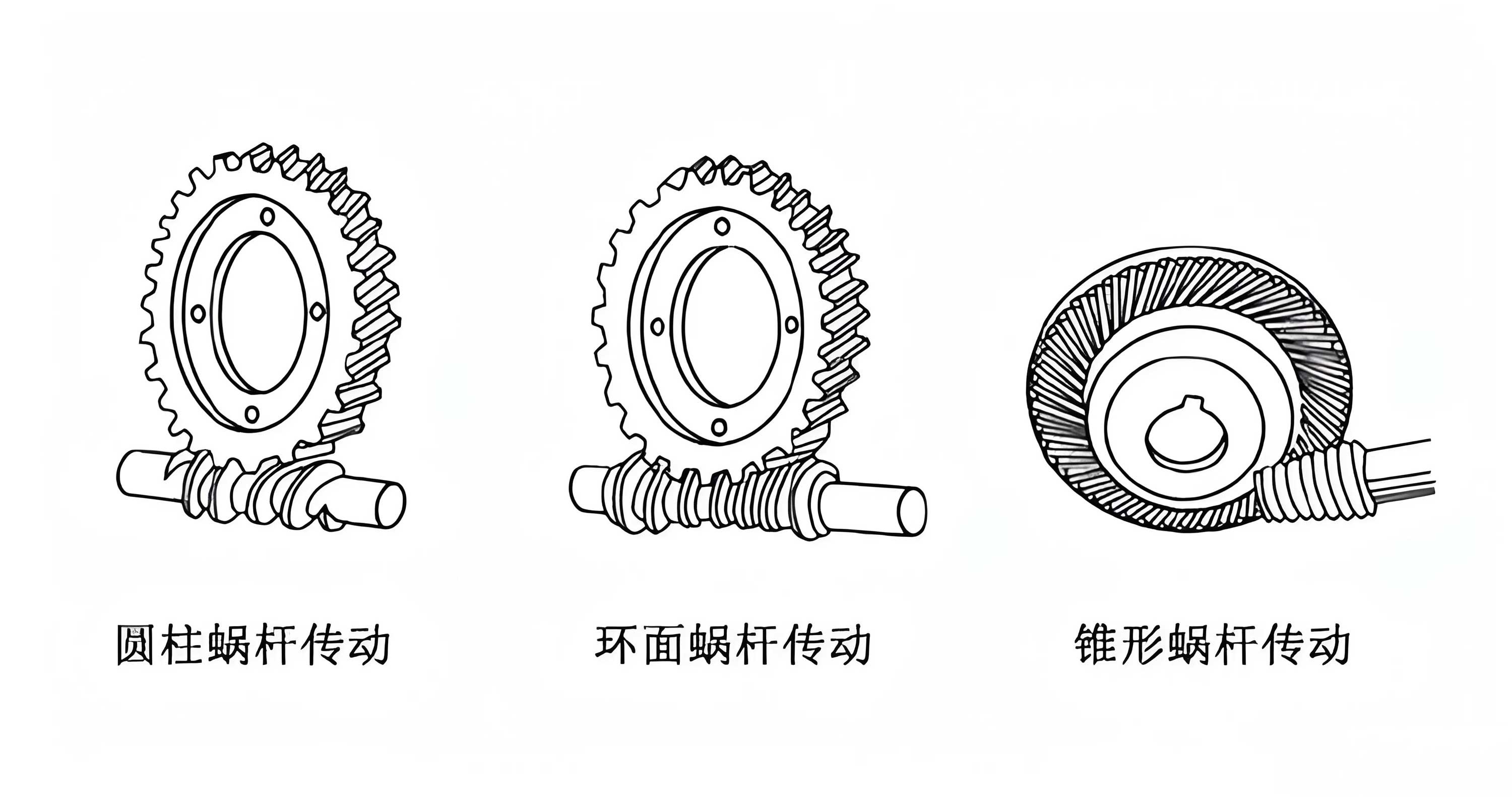
Once the solid model of the worm gear pair is created, it serves as the single source of truth for all subsequent analyses. This eliminates errors associated with geometry translation and ensures consistency. Before proceeding to complex simulations, it is prudent to perform preliminary hand calculations for allowable stresses based on standard mechanical design practices. These calculations provide a benchmark for evaluating the more detailed simulation results. For worm gears, the primary failure modes are surface contact fatigue (pitting) and root bending fatigue. The contact stress at the tooth interface under rated load can be estimated using a standardized formula:
$$ \sigma_H = Z_E \sqrt{\frac{9400 T_2 K_A K_V K_\beta}{d_1 d_2^2}} $$
Where \(Z_E\) is the elasticity factor (for steel-bronze pair, typically ~157 \(\sqrt{\text{MPa}}\)), \(T_2\) is the output torque on the worm wheel (13.923 Nm), \(K_A\) is the application factor (taken as 1.5 for moderate shock), \(K_V\) is the dynamic factor (assumed as 1 for low speeds), and \(K_\beta\) is the load distribution factor (taken as 1.2). Substituting the values for our worm gears yields a calculated contact stress of approximately 286 MPa.
Similarly, the root bending stress for the worm wheel teeth can be calculated using:
$$ \sigma_F = \frac{666 T_2 K_A K_V K_\beta}{d_1 d_2 m} Y_{FS} Y_\beta $$
The spiral angle factor \(Y_\beta\) is given by \(Y_\beta = 1 – \frac{\gamma}{120} = 0.97\). The composite tooth form factor \(Y_{FS}\) for the specific tooth geometry is taken as 3.8. This results in a bending stress estimate of about 49 MPa. These stress values, while approximate, indicate that the design is within reasonable limits for common materials, setting the stage for a more localized and transient analysis via simulation.
The next phase in my virtual prototyping workflow involves a static structural finite element analysis (FEA) to visualize and quantify the contact pressure distribution and stress concentrations that the simplified formulas cannot capture. I export the cleaned geometry from CATIA directly into ANSYS Workbench. Defining accurate material properties is crucial for realistic results. The worm is typically made from a hardened steel, while the worm wheel is often a bronze alloy to reduce friction and wear. The properties used in this analysis are listed below.
| Component | Material | Density (kg/m³) | Young’s Modulus (GPa) | Poisson’s Ratio |
|---|---|---|---|---|
| Worm | 42CrMo Steel | 7850 | 212 | 0.28 |
| Worm Wheel | QA19-4 Bronze | 7500 | 116 | 0.33 |
I apply boundary conditions that simulate a locked output scenario, a common check for static strength. The worm is fixed in all degrees of freedom except for a small enforced rotation (e.g., 5 degrees) around its axis to initiate contact. The worm wheel is constrained to rotate only about its axis, and a resistive torque of 13.923 Nm is applied to simulate the load. A frictional contact definition is established between the tooth flanks. The mesh is refined in the contact region, often resulting in a model with over 200,000 tetrahedral elements to balance accuracy and computational cost. Solving this nonlinear contact problem reveals the stress state. The contact pressure on the worm wheel teeth typically shows a distinct band-shaped pattern, with the maximum pressure, often around 250-270 MPa, located near the root of the teeth where the mesh begins. This FEA result for contact stress shows good correlation with the hand calculation (286 MPa), validating the model setup. The FEA provides a detailed, static snapshot of the stress, but worm gears operate dynamically.
To understand the dynamic forces, vibrations, and transient stresses during operation, I transition to a multi-body dynamics (MBD) environment, specifically using ADAMS. The initial step is a rigid-body dynamics analysis. I import the CAD geometry, define appropriate joints (revolute joints for the worm and wheel axes), and most importantly, define a force-based contact between the teeth. Modeling contact in dynamics requires a different approach. I use the Hertzian-based impact model available in ADAMS, which approximates the contact force \(F\) as a function of penetration \(\delta\):
$$ F = K \delta^n + C(\delta) \dot{\delta} $$
Here, \(K\) is the contact stiffness, \(n\) is the force exponent (typically 1.5 for metals), \(C\) is a damping coefficient, and \(\dot{\delta}\) is the penetration velocity. The stiffness \(K\) is derived from the material properties and local curvature at the contact point. For two cylinders in contact, the formula is:
$$ K = \frac{4}{3} R^{1/2} E^* $$
with the equivalent radius \(R\) and equivalent modulus \(E^*\) given by:
$$ \frac{1}{R} = \frac{1}{R_1} + \frac{1}{R_2} $$
$$ \frac{1}{E^*} = \frac{1-\mu_1^2}{E_1} + \frac{1-\mu_2^2}{E_2} $$
Where \(R_1, R_2\) are the effective radii of the worm and wheel teeth at the meshing point (approximated by their pitch radii), and \(E_1, \mu_1, E_2, \mu_2\) are the Young’s moduli and Poisson’s ratios of the worm and wheel materials, respectively. For the given worm gears, this yields a stiffness \(K \approx 3.0 \times 10^{5} \, \text{N/mm}^{1.5}\). I apply a smooth step function to ramp up the input torque on the worm to avoid numerical instabilities from a sudden load. The output from this rigid-body simulation is the time-history of the meshing force. It shows an initial peak due to impact upon engagement, followed by periodic fluctuations around a mean value (e.g., ~570 N) due to the changing contact conditions and transmission error inherent in worm gear pairs. However, this model assumes both worm gears are perfectly rigid, which overlooks the elastic deformations that influence load distribution and dynamic response.
To capture these effects, I perform a co-simulation or a full flexible multibody dynamics analysis—a *rigid-flexible coupling* analysis. In this advanced step, I replace the rigid worm (as the driving, stressed component) with a flexible body. This is achieved by first performing a modal analysis on the worm geometry. I use a preprocessor like HyperMesh to mesh the worm with solid elements, assign the steel material properties, and define the interface points where it connects to the joints. This model is then solved using a solver like OptiStruct to extract its natural frequencies and mode shapes, which are exported in a Modal Neutral File (MNF) format. This MNF file contains a reduced-order representation of the worm’s flexibility based on its component modes. I import this flexible worm model into the ADAMS environment, replacing the rigid worm. The constraints (revolute joint) and the contact force definition are now applied to this flexible body. Running the dynamic simulation again, but now with the worm able to elastically deform, provides a much more realistic outcome. The meshing force curve exhibits higher-frequency oscillations superimposed on the rigid-body trend, reflecting the excitation of the worm’s natural modes. Furthermore, I can extract stress time histories at any point on the flexible worm. The maximum transient contact stress from this flexible-body dynamics analysis, particularly in the tooth root fillet, can be directly compared to the static FEA result. In my analyses, the discrepancy between the peak stress from the flexible dynamics simulation and the static FEA is typically within 5-10%, which is an excellent agreement given the vastly different methodologies. This convergence validates both the original CAD geometry of the worm gears and the overall digital simulation workflow.
The implications of this integrated approach for the design of worm gears are substantial. By combining parametric CAD, FEA, and flexible MBD, I can conduct virtual experiments that were previously only possible with physical hardware. I can investigate the effects of design changes—such as modifying the pressure angle, lead angle, or using different materials—on performance metrics like transmission error, efficiency, contact pattern, root stress, and system vibrations. The table below summarizes a comparative view of the key outputs from the different analysis stages for this specific worm gear set, highlighting the consistency achieved.
| Analysis Type | Primary Output | Key Result (Example) | Purpose/Insight |
|---|---|---|---|
| Hand Calculation | Nominal Contact & Bending Stress | \(\sigma_H \approx 286 \, \text{MPa}, \sigma_F \approx 49 \, \text{MPa}\) | Preliminary design sizing and material selection. |
| Static FEA (ANSYS) | Localized Stress & Contact Pressure Distribution | Max Contact Pressure ~266 MPa | Identify stress concentrations and verify static strength under peak load. |
| Rigid-Body Dynamics (ADAMS) | Time-varying Meshing Force | Mean Force ~570 N, Impact Peaks | Understand load sharing, and dynamic forces for bearing selection. |
| Flexible-Body Dynamics (ADAMS) | Dynamic Stress & Force with Vibration | Max Dynamic Stress ~251 MPa, Oscillatory Forces | Predict fatigue life, noise, and vibration, and validate against FEA. |
In conclusion, the journey from a parametric model to a validated dynamic simulation represents a powerful paradigm for modern mechanical design, especially for complex components like worm gears. The methodology I have detailed demonstrates that by leveraging a suite of digital engineering tools—CATIA for parametric modeling, ANSYS for detailed stress analysis, and ADAMS with flexible body integration for system dynamics—it is possible to gain a deep, predictive understanding of worm gear performance long before a single metal chip is cut. This not only accelerates the design cycle and reduces costs but also enables the optimization of worm gears for specific performance criteria, leading to more reliable, efficient, and quieter transmission systems. The close agreement between the finite element analysis and the rigid-flexible coupling dynamics analysis serves as a strong verification of the entire process, giving confidence that the virtual prototype can effectively guide physical prototype development and testing, focusing resources on final validation rather than iterative guesswork.