
In the design and application of electronic cylinders for belt conveyors, the integration of the motor and transmission within the drum body presents unique thermal and mechanical challenges. When a harmonic drive gear system is adopted as the transmission core, its distinct operational principles necessitate a specialized approach to lubrication analysis. Unlike conventional rigid gear transmissions typically analyzed with elastohydrodynamic lubrication (EHL) theory, the near-surface-contact nature of the harmonic drive gear meshing process aligns more closely with hydrodynamic lubrication theory. This paper, from an engineering application perspective, details a comprehensive lubrication calculation methodology that synergizes the thermal dissipation requirements of the electronic cylinder with the hydrodynamic lubrication analysis of the harmonic gear teeth. The goal is to ensure both effective heat rejection and the formation of a protective fluid film, thereby resolving the critical lubrication challenges in this compact, integrated drive system.
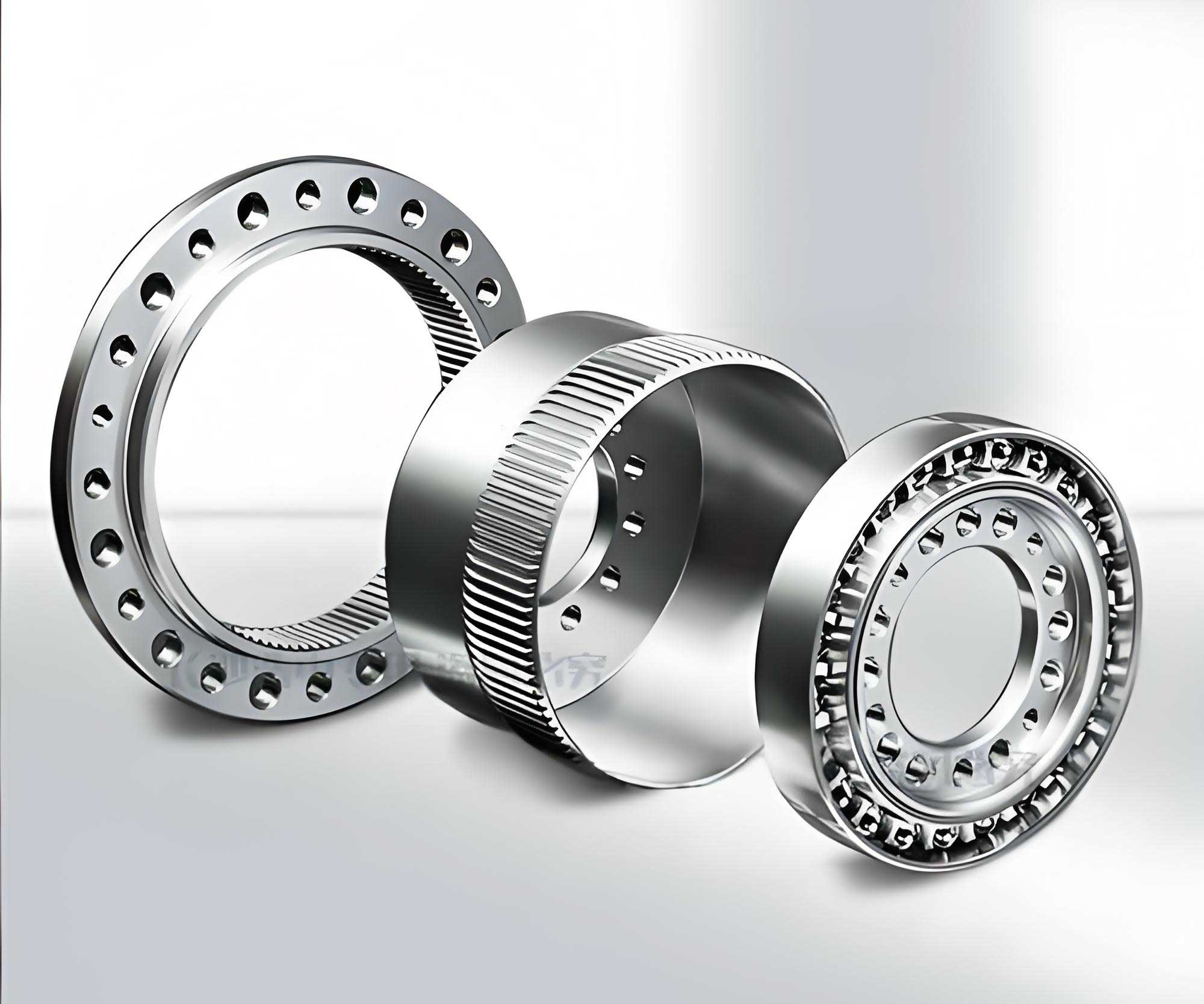
The fundamental working principle of a harmonic drive gear involves a wave generator, a flexible spline (flexspline), and a circular spline. The wave generator deforms the flexspline, causing its external teeth to engage progressively with the internal teeth of the circular spline. This results in high reduction ratios, compactness, and high torque capacity. However, this same mechanism leads to a multi-tooth, nearly area-contact meshing condition. The lubrication regime for the harmonic drive gear teeth is therefore critical and is dominated by the formation of both shear and squeeze films between the contacting surfaces. The primary heat sources within the electronic cylinder are the motor losses (electrical and magnetic) and the mechanical losses from the harmonic drive gear transmission and bearings. Efficient lubrication must address the dual role of the oil: acting as a coolant for the motor and as a lubricant for the gears and bearings. An elevated oil temperature, often resulting from insufficient heat dissipation, directly reduces oil viscosity, which can collapse the hydrodynamic film on the harmonic drive gear teeth, leading to increased wear, scoring, and potential failure. Consequently, the lubrication calculation is inseparable from the thermal analysis of the entire cylinder.
1. Thermal Dissipation and Temperature Rise Calculation
The steady-state temperature rise of the electronic cylinder is the cornerstone for subsequent lubrication decisions. The balance between internally generated heat and external heat dissipation determines the operating oil temperature. The general formula for temperature rise $\Delta t$ (°C) is given by:
$$ \Delta t = \frac{1000P(1 – \eta_N \eta_g)}{K\{S_1 + S_2 + [S_3 – S_4(1 – \psi_1)]\psi_2\}} $$
Where:
- $P$ is the motor’s rated power (kW).
- $\eta_N$ is the motor efficiency at rated output.
- $\eta_g$ is the overall mechanical transmission efficiency of the cylinder’s drive train.
- $K$ is the heat transfer coefficient (W/(m²·°C)), often calculated empirically: $K = 21 – \frac{2P}{D} + 36\sqrt{1+v}$. Here, $D$ is the drum diameter (mm) and $v$ is the belt speed (m/s).
- $S_1$, $S_2$, $S_3$, $S_4$ are various surface areas of the drum (m²) for heat dissipation.
- $\psi_1$, $\psi_2$ are correction factors for belt wrap angle and rubber lagging, respectively.
For a system employing a harmonic drive gear, the mechanical transmission efficiency $\eta_g$ requires careful calculation as it directly impacts the heat load. It is a product of several component efficiencies:
$$ \eta_g = \eta_1 \cdot \eta_2 \cdot \eta_3 \cdot \eta_4 $$
The components are detailed below:
| Efficiency Component | Symbol | Description & Calculation for Harmonic Drive |
|---|---|---|
| Gear Meshing Efficiency | $\eta_1$ | For a harmonic drive gear, this is $\eta_1 = \eta_{wg} \cdot \eta_e$, where $\eta_{wg}$ accounts for losses due to flexspline deformation and wave generator bearing friction, and $\eta_e$ is the pure kinematic meshing efficiency, dependent on tooth profile and friction coefficients. |
| Bearing Friction Efficiency | $\eta_2$ | Efficiency of support bearings (input/output). Can be obtained from bearing manufacturer catalogs or empirical estimates (e.g., 0.995 per bearing pair). |
| Oil Churning & Splashing Efficiency | $\eta_3$ | Losses due to the gears agitating the oil bath. For a harmonic drive gear in an oil bath, a modified formula is used: $$ \eta_3 = 1 – \frac{0.75 \cdot b \cdot \sqrt[3]{\nu_t} \cdot z_v \cdot v^{1.5}}{200 \cdot P} $$ where $b$ is gear width immersed (mm), $\nu_t$ is kinematic viscosity at operating temp (mm²/s), $v$ is pitch line velocity (m/s), $P$ is power (kW), and $z_v$ is the effective number of teeth in simultaneous contact for the harmonic drive gear, typically $z_v = \frac{1}{4} E z_1$ ($E \approx 0.3-0.5$, $z_1$ = flexspline teeth). |
| Drum Rotation Loss Efficiency | $\eta_4$ | Accounts for drum bearing friction and windage. Often estimated from experience or set to a high value like 0.99. |
An accurate estimation of $\eta_g$ is vital. A poorly designed or inefficient harmonic drive gear system will generate more heat, leading to a higher $\Delta t$, which complicates lubrication. The final operating oil temperature $t_{oil}$ is then:
$$ t_{oil} = t_{ambient} + \Delta t $$
A target maximum $t_{oil}$ is usually set below 70°C to prevent excessive viscosity drop and the breakdown of the hydrodynamic film in the harmonic drive gear.
2. Lubricant Selection Based on Thermal Conditions
Once the expected operating temperature $t_{oil}$ is known, an appropriate lubricant must be selected. For oil-cooled or oil-immersed electronic cylinders, the same oil cools the motor and lubricates the harmonic drive gear. Common choices are ISO VG 32 or VG 46 turbine oils or equivalent high-quality gear oils with good oxidation stability and anti-wear additives. The key property is the kinematic viscosity $\nu_t$ at the operating temperature. The viscosity-temperature relationship can be approximated by the following equation for temperatures between 30°C and 150°C:
$$ \nu_t = \nu_{50} \left( \frac{50}{t_{oil}} \right)^n $$
Where $\nu_{50}$ is the kinematic viscosity at 50°C (mm²/s) and $n$ is a temperature-viscosity exponent dependent on the oil’s viscosity index. The dynamic viscosity $\eta$ (Pa·s), required for hydrodynamic calculations, is then:
$$ \eta = \rho \cdot \nu_t \times 10^{-6} $$
with $\rho$ being the oil density (kg/m³).
| Target Operating Temperature $t_{oil}$ | Recommended ISO Viscosity Grade (VG) | Typical $\nu_{40}$ (mm²/s) | Key Consideration for Harmonic Drive |
|---|---|---|---|
| Below 50°C | VG 32 | 32 | Lower churning losses, must ensure sufficient film thickness at max load. |
| 50°C – 65°C | VG 46 | 46 | Balanced choice for film strength and cooling flow. |
| Above 65°C (to be avoided) | VG 68 or higher VI oils | 68 | Only if design forces high temps; high VI oils mitigate viscosity drop. Risk of increased churning losses and possible film breakdown in the harmonic drive gear contact. |
3. Minimum Oil Film Thickness Calculation for the Harmonic Gear Mesh
The heart of the lubrication analysis for the harmonic drive gear system is the calculation of the minimum oil film thickness (MOFT) between the flexspline and circular spline teeth. The meshing action combines tangential sliding and radial squeezing motions, generating both a shear (wedge) film and a squeeze film. The total film thickness is the sum of these two components at the most critical point, typically near the pitch line or the point of highest load.
3.1 Shear (Wedge) Film Component ($h_{qmin}$):
For an individual tooth pair $i$ in the load zone, the minimum shear film thickness at the trailing edge of the contact is given by:
$$ h_{qmin}^{(i)} = \frac{\eta \cdot v_{rt}^{(i)} \cdot L \cdot C_w^{(i)} \cdot \Lambda^{(i)}}{F_n^{(i)}} \cdot B^{(i)} $$
Where:
- $\eta$: Dynamic viscosity of lubricant (Pa·s).
- $v_{rt}^{(i)}$: Tangential relative sliding velocity for tooth pair $i$ (m/s).
- $L$: Face width of the gear teeth (m).
- $C_w^{(i)}$: Load coefficient for a tapered wedge: $C_w^{(i)} = \frac{6}{(a^{(i)} – 1)^2} \left[ \ln(a^{(i)}) – \frac{2(a^{(i)} – 1)}{a^{(i)} + 1} \right]$, where $a^{(i)}$ is the gap ratio (outlet/inlet film thickness) of the converging wedge.
- $\Lambda^{(i)}$: Side leakage factor: $\Lambda^{(i)} = \frac{5}{4(1 + \xi_i^2)}$, where $\xi_i$ is a function of the width-to-length ratio of the contact pad.
- $F_n^{(i)}$: Normal load on tooth pair $i$ (N).
- $B^{(i)}$: Depth of engagement (or contact length) for tooth pair $i$ (m).
3.2 Squeeze Film Component ($h_{ymin}$):
The minimum squeeze film thickness, often most critical at the tooth tip engagement, is:
$$ h_{ymin}^{(i)} = \sqrt[3]{\frac{3 \beta \eta (B^{(i)})^3}{F_n^{(i)}} \left( v_{rs}^{(i)} – \frac{B^{(i)} \tan(\alpha^{(i)})}{2} \right) } $$
Where:
- $\beta$: A side leakage factor for squeeze film (dimensionless).
- $v_{rs}^{(i)}$: Relative radial (squeeze) velocity for tooth pair $i$ (m/s).
- $\alpha^{(i)}$: Wedge angle of the contact (rad).
3.3 Total Minimum Film Thickness and Lubrication Regime Assessment:
The total minimum film thickness for the worst-case tooth pair is:
$$ h_{min} = h_{qmin}^{(critical)} + h_{ymin}^{(critical)} $$
The crucial parameter to judge the lubrication success is the film thickness ratio $\lambda$:
$$ \lambda = \frac{h_{min}}{\sqrt{R_{q1}^2 + R_{q2}^2}} \approx \frac{1.6 h_{min}}{R_{a1} + R_{a2}} $$
Where $R_{a1}$ and $R_{a2}$ are the arithmetic average surface roughness of the flexspline and circular spline teeth (µm). The lubrication regime is assessed as follows:
| Film Ratio $\lambda$ | Lubrication Regime | Implication for Harmonic Drive Gear |
|---|---|---|
| $\lambda > 3$ | Full Fluid Film (Hydrodynamic) | Optimal condition. Surfaces are completely separated by lubricant. Minimal wear, low risk of scuffing or pitting. |
| $1 \leq \lambda \leq 3$ | Mixed Lubrication | Partial metal-to-metal contact occurs. Acceptable but may lead to moderate wear over time. Common in heavily loaded harmonic drive gear applications. |
| $\lambda < 1$ | Boundary Lubrication | Insufficient film. High risk of adhesive wear (scuffing), abrasive wear, and premature failure of the harmonic drive gear. |
The calculation goal is to ensure $\lambda$ is sufficiently greater than 1, ideally approaching or exceeding 3, by carefully selecting oil viscosity (via temperature control and oil grade), optimizing gear geometry, and controlling surface finish.
4. Oil Fill Volume Calculation
The final step is determining the correct volume of oil to add to the electronic cylinder. It must satisfy two, sometimes conflicting, requirements: 1) Provide sufficient oil for effective splash lubrication and heat transfer from the harmonic drive gear and bearings, and 2) Not be so excessive as to cause high churning losses, which increase heat load and reduce efficiency $\eta_3$. The calculation is based on the effective wetted surface area for heat dissipation.
The total dissipative surface area $S$ from the temperature rise equation assumes the entire outer surface is effective. However, when the cylinder is stationary, only a portion $S_c$ is in contact with the oil. When rotating, the oil coats more surface. This is accounted for by a factor $\beta’$ (typically 0.55 to 0.65):
$$ S = S_c + S_d $$
$$ \frac{S_c}{S_d} = \beta’ $$
Thus, the stationary wetted area $S_c$ can be found from the total required dissipative area $S$. Knowing the internal radius of the drum $r$ (dm) and its length $L_{drum}$ (dm), $S_c$ corresponds to a specific wetted arc. The oil fill volume $V_{oil}$ (liters) is then the area of the corresponding circular segment multiplied by the drum length:
$$ V_{oil} = \left[ \frac{r^2}{2} (s_{rad} – \sin(s_{rad})) + \left( r \cos\left(\frac{s_{rad}}{2}\right) \cdot r \sin\left(\frac{s_{rad}}{2}\right) \right) \right] \cdot L_{drum} $$
Where $s_{rad}$ is the wetted arc length in radians, derived from $S_c = r \cdot s_{rad} \cdot L_{drum}$. A simplified formula using chord length $b$ (dm) and segment height $h$ (dm) is often used:
$$ V_{oil} = \left[ \frac{r^2 (s – b) + b h}{2} \right] \cdot L_{drum} $$
This calculated volume ensures that under operating conditions, the oil level is sufficient to lubricate the harmonic drive gear and bearings adequately while promoting effective heat transfer to the drum shell, without being wasteful or causing excessive parasitic drag.
5. Summary and Design Workflow
The lubrication design for an electronic cylinder with a harmonic drive gear transmission is an iterative process that links thermal management with tribological performance. The following table summarizes the key equations and their interdependencies:
| Calculation Phase | Key Inputs | Core Equations | Outputs & Criteria |
|---|---|---|---|
| 1. Thermal Analysis | Power $P$, Speeds, Dimensions, Motor Efficiency $\eta_N$ | $\Delta t = \frac{1000P(1 – \eta_N \eta_g)}{K\{S\}}$ $\eta_g = \eta_1 \cdot \eta_2 \cdot \eta_3 \cdot \eta_4$ |
Operating Oil Temp $t_{oil}$ Must be < 70°C (target). |
| 2. Lubricant Selection | $t_{oil}$, Desired viscosity | $\nu_t = \nu_{50} \left( \frac{50}{t_{oil}} \right)^n$ $\eta = \rho \cdot \nu_t$ |
Oil Grade (ISO VG) Dynamic Viscosity $\eta$ for film calculation. |
| 3. Film Thickness Analysis | $\eta$, Gear Geometry, Loads $F_n$, Speeds, Surface Finish $R_a$ | $h_{min} = h_{qmin} + h_{ymin}$ $\lambda = \frac{1.6 h_{min}}{R_{a1} + R_{a2}}$ |
Minimum Film Thickness $h_{min}$, Film Ratio $\lambda$ Target $\lambda > 1$, ideally $\lambda > 3$. |
| 4. Oil Fill Determination | Drum internal geometry, Required dissipative area $S$ | $S_c = \frac{\beta’}{1+\beta’} S$ $V_{oil} = f(S_c, r, L_{drum})$ |
Optimal Oil Volume $V_{oil}$ (L). |
In conclusion, successfully integrating a harmonic drive gear into an electronic cylinder demands a holistic lubrication strategy. By rigorously coupling the cylinder’s散热计算 with the hydrodynamic analysis specific to the harmonic gear mesh, engineers can accurately predict operating temperatures, select appropriate lubricants, verify the formation of protective oil films, and determine the correct oil fill quantity. This integrated methodology ensures that the unique advantages of the harmonic drive gear—compactness and high torque—are not compromised by thermal or tribological failures, leading to a reliable and efficient integrated drive solution for belt conveyor systems.