
In the field of mechanical transmission, cylindrical gears play a pivotal role due to their efficiency and reliability in power transfer. Among various types, double circular arc cylindrical gears have garnered significant attention for their superior load-bearing capacity, reduced flow pulsation, and lower noise levels compared to traditional involute gears. These characteristics make them ideal for applications such as gear pumps in hydraulic systems. However, the complex geometry of double circular arc cylindrical gears, characterized by their unique tooth profile consisting of upper and lower circular arcs connected by a transition curve, poses challenges in precise modeling and efficient manufacturing. This study aims to address these challenges by developing an integrated approach that combines parametric modeling, computer-aided manufacturing (CAM) programming, and numerical control (NC) machining simulation for double circular arc cylindrical gears. The methodology leverages software tools like MATLAB, UG NX, and Vericut to ensure accuracy and feasibility from design to production.
The tooth profile of double circular arc cylindrical gears is defined by basic parameters such as module, number of teeth, pressure angle, and helix angle. For this research, we focus on a helical gear variant with an involute transition curve, which enhances smooth meshing and performance. The fundamental parameters for the driving and driven gears are summarized in Table 1. These parameters serve as the foundation for all subsequent modeling and analysis steps.
| Parameter | Driving Gear | Driven Gear |
|---|---|---|
| Normal Module (mn) / mm | 2 | 2 |
| Transverse Module (mt) / mm | 2.57 | 2.57 |
| Number of Teeth (z) | 7 | 7 |
| Pressure Angle (αn) / degrees | 28 | 28 |
| Face Width (B) / mm | 10 | 10 |
| Helix Angle (β) / degrees | 39 | 39 |
The transverse tooth profile is derived from these parameters, where the upper and lower circular arcs are centered on the pitch circle. The radius of these arcs, denoted as r, and the pitch circle radius, R, are calculated using geometric relationships. The involute transition curve connects these arcs smoothly, ensuring continuous tooth engagement. To generate this curve accurately, we utilized MATLAB due to its robust computational capabilities for complex curves. The involute equation in parametric form is expressed as:
$$ x = r_b (\cos(\theta – \theta_0) + \theta \sin(\theta – \theta_0)) $$
$$ y = r_b (\sin(\theta – \theta_0) – \theta \cos(\theta – \theta_0)) $$
where \( r_b \) is the base circle radius, \( \theta \) is the involute angle parameter, and \( \theta_0 \) is the initial angle offset. The base circle radius is computed as \( r_b = \frac{d \cos(\alpha_t)}{2} \), with \( d \) being the pitch diameter and \( \alpha_t \) the transverse pressure angle. In MATLAB, we programmed this with specific values: \( \alpha_n = 28^\circ \), \( \beta = 39^\circ \), and \( z = 7 \). The transverse pressure angle is derived as \( \alpha_t = \arctan\left(\frac{\tan(\alpha_n)}{\cos(\beta)}\right) \), yielding approximately 32.5°. The pitch diameter \( d = m_t \times z = 2.57 \times 7 = 17.99 \, \text{mm} \), so \( r_b \approx 7.58 \, \text{mm} \). The involute points were generated over a range of \( \theta \) from 0 to \( \pi/2 \) with a step of 0.01, resulting in high precision. A subset of these coordinate points is listed in Table 2 for reference.
| Point No. | X-coordinate | Y-coordinate | Z-coordinate |
|---|---|---|---|
| 1 | 2.254304 | 7.078319 | 0 |
| 2 | 2.280141 | 7.224460 | 0 |
| 3 | 2.278897 | 7.669461 | 0 |
| 4 | 2.132757 | 8.396562 | 0 |
| 5 | 1.731835 | 9.354320 | 0 |
| 6 | 0.983170 | 10.459558 | 0 |
| 7 | 0.087159 | 11.376868 | 0 |
| 8 | -1.437721 | 12.457394 | 0 |
| 9 | -3.528415 | 13.370079 | 0 |
These points were exported as a .dat file and imported into UG NX 12.0 using the “Points from File” function. In UG, we established a parametric model by defining expressions for key gear parameters. This allowed for automatic updates to the geometry when parameters changed, enhancing flexibility. The transverse tooth profile was constructed by sketching the upper and lower circular arcs based on their radii and centers, then connecting them with the imported involute curve via trimming and mirroring operations. The complete tooth profile was replicated around the pitch circle using circular array, resulting in a full gear face. For three-dimensional modeling, a helix was generated along the pitch circle with a helix angle of 39°. The lead of the helix, L, is calculated as:
$$ L = \frac{\pi d}{\tan(\beta)} $$
Substituting values, \( L \approx \frac{\pi \times 17.99}{\tan(39^\circ)} \approx 70 \, \text{mm} \). This helix served as a guide for sweeping the transverse tooth profile, creating the solid model of the double circular arc cylindrical gear. Similarly, the driven gear was modeled with a negative helix angle to ensure proper meshing. The final three-dimensional models exhibit precise tooth geometry, essential for subsequent machining simulations. The design of these cylindrical gears emphasizes their helical nature, which contributes to smoother operation and higher load capacity in gear pumps.
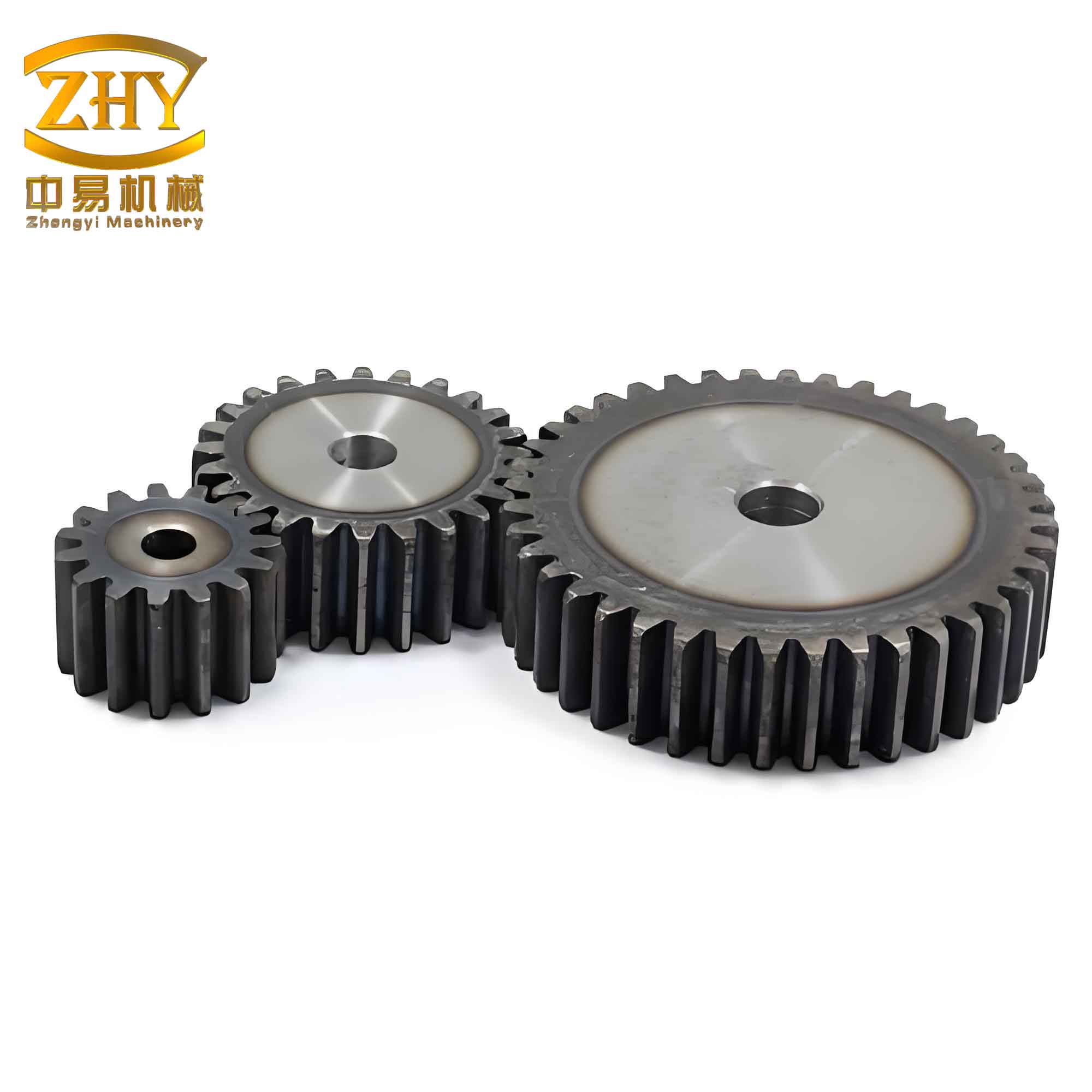
To validate the design, we performed a kinematic simulation in UG NX. The driving and driven cylindrical gears were assembled with constraints such as face alignment, contact, and parallel axes. A motion simulation was created with a polynomial driver applied to the driving gear’s rotational joint. The gears were coupled using a gear pair constraint, and the solution was computed over a specified time span. The simulation demonstrated smooth meshing without interference, confirming the correctness of the tooth profile and alignment. This step is crucial for ensuring that the double circular arc cylindrical gears will operate reliably in real-world applications, such as in hydraulic pumps where minimal noise and vibration are desired.
Moving to manufacturing, we employed the CAM module in UG NX for NC programming. The goal was to generate toolpaths for machining the double circular arc cylindrical gears using a ball-end mill, which is suitable for complex curved surfaces. The tool selection was critical: a ball-end mill with a diameter of 1 mm was chosen to avoid overcutting, given the small radius of the tooth arcs. The tool had a cone angle of 0°, length of 50 mm, and cutting edge length of 6 mm. In the CAM environment, we specified the gear model as the part and created a cylindrical stock with a 0.2 mm radial offset to represent raw material. The driving method selected was “Surface Area,” with tool axis orientation set to “Away from Line” to accommodate the helical geometry. For roughing, a machining allowance of 0.03 mm was set, while finishing was done with zero allowance. The spindle speed was fixed at 1200 rpm, and appropriate feed rates were assigned based on material properties. The generated toolpaths for finishing are illustrated in Figure 4, showcasing efficient material removal along the tooth flanks.
The CAM simulation in UG provided visual verification of the toolpaths, ensuring no collisions or gouging. Post-processing was then performed to generate NC code compatible with standard CNC controllers. The post-processor output G-code sequences for multi-axis milling, which included commands for coordinated movements along X, Y, Z, and rotational axes. A snippet of the NC program is shown below, highlighting typical commands for contouring the cylindrical gears:
N10 G90 G54 G17
N20 S1200 M03
N30 G43 H01 Z50.
N40 G00 X10. Y5.
N50 G01 Z-5. F200.
N60 G02 X15. Y10. I5. J0. F500.
... (additional toolpath commands)
To further validate the NC program, we used Vericut 9.2, a powerful simulation software that emulates real CNC machine behavior. A virtual milling machine was constructed based on a typical 5-axis CNC mill topology, incorporating components like the spindle, table, and tool changer. The control system was configured using a Fanuc-type file (fan31im.ctl). The stock was defined as a cylinder matching the gear blank dimensions, and the ball-end mill tool was loaded with the same specifications as in UG. The NC program from UG was imported into Vericut, and the coordinate system was aligned to the machine workspace. During simulation, Vericut’s status window monitored for errors such as collisions, overcuts, or excess material. The simulation ran without warnings, confirming the correctness of the toolpaths and NC code. This step is essential for reducing risks in actual machining, as it allows for optimization of cutting parameters and detection of potential issues before physical production.
The effectiveness of our integrated approach was further demonstrated through additive manufacturing. A 3D printer (Aurora A8 industrial grade) was used to produce a physical prototype of the double circular arc cylindrical gear in nylon material. The UG model was exported as an STL file and printed at a 1:1 scale. The printed gear exhibited accurate tooth profiles and helical structure, validating the geometric modeling and design feasibility. This prototype serves as a tangible reference for assessing fit and function in assembly contexts, such as in gear pump rotors. The use of 3D printing also highlights the versatility of our methodology, enabling rapid prototyping alongside traditional subtractive manufacturing.
Throughout this study, the term “cylindrical gears” has been emphasized to underscore the broader category encompassing double circular arc designs. Cylindrical gears are fundamental in transmission systems, and their optimization through advanced CAM techniques can lead to significant performance improvements. Our methodology integrates multiple software platforms to streamline the process from design to manufacturing, reducing errors associated with model conversions. The parametric modeling in UG ensures that gear dimensions can be easily modified for different applications, while the CAM and simulation steps guarantee machining accuracy. This holistic approach is particularly beneficial for complex cylindrical gears like double circular arc variants, where precision is paramount.
In conclusion, we have developed a comprehensive framework for modeling and machining double circular arc cylindrical gears using CAM-based integration. The process involves: (1) parametric definition of gear parameters, (2) accurate tooth profile generation via MATLAB and UG, (3) kinematic simulation to verify meshing, (4) CAM programming for NC toolpaths, (5) simulation in Vericut for code validation, and (6) physical prototyping via 3D printing. All steps were performed seamlessly, avoiding discrepancies that often arise from software interoperability issues. The results confirm that double circular arc cylindrical gears can be efficiently produced with high precision, making them suitable for demanding applications like hydraulic pumps. Future work could explore other transition curves or advanced materials to further enhance gear performance. This research contributes to the ongoing advancement of cylindrical gear technology, leveraging digital tools to bridge design and manufacturing gaps.