
I have focused my research on the manufacturing of mechanical gear forgings because these components sit at the center of power transmission, motion control, and mechanical reliability. In modern industrial systems, a gear forging is not merely a shaped metal blank; it is a critical precision part whose internal grain flow, dimensional accuracy, surface integrity, and mechanical properties determine the efficiency and lifetime of the entire transmission system. My work begins from a practical observation: traditional gear forging processes often rely heavily on operator experience, fixed parameter windows, and separated production stages. These characteristics create low production efficiency, high energy consumption, unstable quality, and weak traceability. To address these problems, I developed and validated an intelligent manufacturing method for gear forging process optimization. The method combines process parameter optimization, process flow optimization, and quality control optimization. It uses real-time monitoring, intelligent control, digital twin models, machine learning, and industrial internet data integration. Through comparative experiments, I found that the optimized gear forging process achieved significant improvements in mechanical properties, dimensional precision, production rhythm, and energy consumption. These results confirm that intelligent manufacturing is both feasible and effective for gear forging.
1. Intelligent Manufacturing Foundations for Gear Forging
Intelligent manufacturing is a production paradigm in which information technology and advanced manufacturing technology are deeply integrated. For gear forging, this integration means that the forging press, heating furnace, die system, robot, inspection equipment, and quality database are no longer isolated assets. They form a connected system that senses, learns, decides, and acts. I treat the gear forging line as a cyber-physical system in which the physical transformation of the metal blank and the digital representation of that transformation interact continuously. The physical world contains the heated billet, the die cavity, the forging load, the metal flow, the cooling rate, and the final gear forging. The information world contains sensor streams, geometry models, process recipes, quality records, and optimization algorithms. The continuous interaction between these two worlds allows gear forging parameters to be adjusted before defects become permanent and allows process knowledge to accumulate across batches.
| Intelligent Manufacturing Characteristic | Meaning in Gear Forging | Expected Effect |
|---|---|---|
| Cyber-physical integration | Real-time linkage between forging equipment and digital models | Improved process transparency and faster response |
| Data-driven decision optimization | Use of temperature, pressure, speed, and energy data to tune gear forging parameters | Higher quality consistency and lower energy use |
| Intelligent production equipment | Self-sensing presses, furnaces, robots, and inspection devices | Adaptive gear forging and reduced manual intervention |
| Precision quality management | Online measurement, feedback, and closed-loop control | Stable dimensions and fewer defects |
| Networked collaborative manufacturing | Industrial internet connection among design, forging, heat treatment, and inspection | Integrated optimization across the gear forging chain |
I describe the intelligent gear forging system through a general state-space representation. Let the physical state of the gear forging process be x, the control input be u, and the measured output be y. The evolution of the process can be written as:
$$
\dot{\mathbf{x}}(t) = A\mathbf{x}(t) + B\mathbf{u}(t) + \mathbf{w}(t),
$$
$$
\mathbf{y}(t) = C\mathbf{x}(t) + D\mathbf{u}(t) + \mathbf{v}(t),
$$
where w and v represent process disturbance and measurement noise. In gear forging, the state vector may include billet temperature, die temperature, ram displacement, strain rate, and residual stress. The control vector may include furnace power, transfer speed, press force, and cooling rate. The output vector may include gear forging dimensions, hardness, surface defects, and energy consumption. This formulation helps me connect sensing, modeling, and control in a unified way.
The core technologies I use for gear forging optimization can be summarized as follows:
| Technology | Role in Gear Forging | Data or Model Type |
|---|---|---|
| Industrial internet of things | Collects multi-source data from furnaces, presses, robots, and sensors | Time series, event logs, equipment states |
| Big data analytics | Finds relationships among process parameters and gear forging quality | Correlation, regression, clustering |
| Machine learning | Predicts hardness, defects, dimensions, and energy use | Support vector machines, neural networks, ensemble models |
| Digital twin | Creates a virtual mirror of the gear forging process | Geometric model, thermal model, mechanical model |
| Intelligent control | Adjusts forging force, speed, and temperature in real time | Closed-loop, adaptive, and predictive control |
For a gear forging line, the total energy consumption can be decomposed into heating energy, deformation energy, auxiliary energy, and inspection energy. I express it as:
$$
E_{\text{total}} = E_{\text{heating}} + E_{\text{deformation}} + E_{\text{auxiliary}} + E_{\text{inspection}}.
$$
Each term can be modeled separately. For example, the heating energy depends on billet mass, specific heat, temperature rise, and furnace efficiency:
$$
E_{\text{heating}} = \frac{m c_p \Delta T}{\eta_{\text{furnace}}},
$$
where m is the billet mass, cp is the specific heat, ΔT is the temperature increase, and ηfurnace is the furnace efficiency. This equation shows why intelligent control of furnace temperature and transfer time is essential for energy-efficient gear forging. The deformation energy in gear forging depends on flow stress, strain, strain rate, and volume:
$$
E_{\text{deformation}} = \int_V \int_0^{\varepsilon_f} \sigma(\varepsilon,\dot{\varepsilon},T) \, d\varepsilon \, dV.
$$
By linking these equations with real-time data, I can identify the parameter combinations that reduce energy while maintaining the required gear forging quality.
2. Traditional Gear Forging Process and Its Limitations
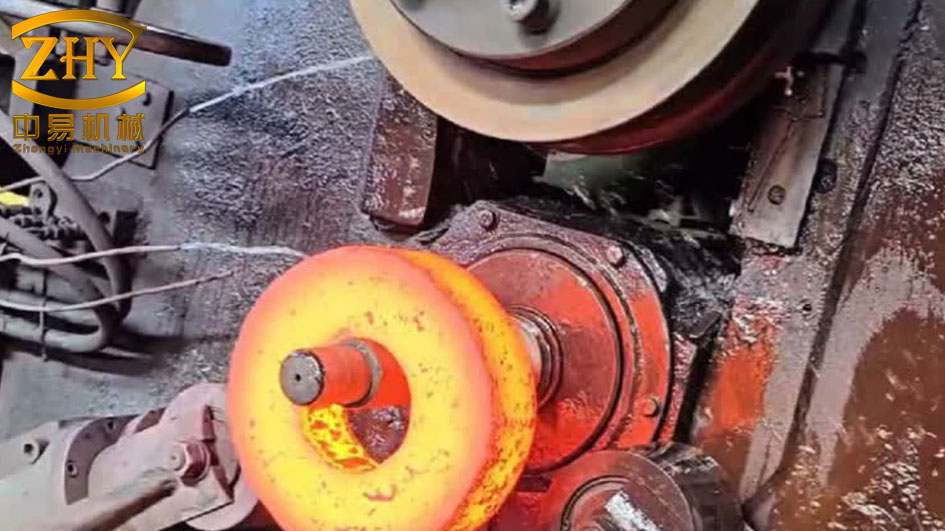
The traditional gear forging process usually starts with material preparation. A steel bar or billet is selected according to the gear material specification, then subjected to preliminary treatment such as normalization, surface cleaning, and dimensional preparation. The billet is heated to the forging temperature range. It is then formed by die forging or open-die forging into a shape close to the final gear. After forging, trimming or punching removes flash and creates a central hole. Heat treatment such as normalization and stress-relief annealing is applied to refine grains and reduce residual stress. Turning removes surface defects and oxide scale. Tooth profile machining follows, often by hobbing or shaping. Final heat treatment such as quenching and tempering provides strength and wear resistance. Grinding, milling, or shaving improves tooth accuracy and surface finish. Inspection covers geometry, mechanical properties, and nondestructive testing. Accepted gear forgings enter storage, while rejected parts are reworked or scrapped.
| Traditional Gear Forging Stage | Main Purpose | Typical Limitation |
|---|---|---|
| Material preparation | Select and clean the billet | Limited traceability of material history |
| Heating | Raise the billet to forging temperature | Temperature variation and high energy loss |
| Die forging or open-die forging | Form the rough gear shape | Dependence on operator experience |
| Trimming and punching | Remove flash and form the center hole | Manual adjustment and extra handling |
| Normalization and annealing | Refine grains and relieve stress | Fixed recipes and slow feedback |
| Turning | Remove defects and oxide scale | Extra material removal and waste |
| Tooth profile machining | Create the gear teeth | Process separation from forging data |
| Final heat treatment | Improve strength and wear resistance | Distortion and quality dispersion |
| Finishing | Improve accuracy and surface quality | High cost and long cycle time |
| Inspection | Verify geometry and performance | Lagging detection of defects |
From my analysis, the traditional gear forging route has four major weaknesses. First, it is strongly experience-dependent. The selection of forging temperature, press force, ram speed, and cooling rate often relies on trial-and-error or historical recipes rather than a scientifically optimized model. Second, production efficiency is limited because the stages are not tightly synchronized. Waiting, repeated handling, and unbalanced cycle times reduce the overall equipment effectiveness. Third, the lack of real-time data acquisition and feedback makes it difficult to detect abnormal conditions in gear forging before defects occur. Fourth, information islands prevent design, forging, heat treatment, and inspection from sharing data, so integrated optimization is difficult.
I can quantify these weaknesses with several simple indicators. Production efficiency can be written as:
$$
\eta_{\text{production}} = \frac{N_{\text{qualified}}}{T_{\text{total}}},
$$
where Nqualified is the number of qualified gear forgings and Ttotal is the total production time. Quality stability can be represented by the standard deviation of a critical dimension:
$$
\sigma_d = \sqrt{\frac{1}{N-1}\sum_{i=1}^{N}(d_i-\bar{d})^2},
$$
where di is the measured dimension of the i-th gear forging and \bar{d} is the mean. A large σd indicates unstable gear forging quality. Energy intensity can be expressed as:
$$
e_{\text{unit}} = \frac{E_{\text{total}}}{N_{\text{qualified}}}.
$$
These indicators form the baseline for evaluating the intelligent optimization method. In traditional gear forging, ηproduction is low, σd is relatively large, and eunit is high. My goal is to improve all three simultaneously.
3. Intelligent Optimization of Gear Forging
I structure the intelligent optimization of gear forging into three connected layers: process parameter optimization, process flow optimization, and quality control optimization. Each layer has its own models and data sources, but they share a common digital thread. This digital thread follows the gear forging from billet selection to final inspection. It allows a change in one stage to be evaluated against downstream quality and energy outcomes. In this way, the optimization is not local; it is holistic across the gear forging chain.
3.1 Process Parameter Optimization
The first layer focuses on the key process parameters of gear forging. I deploy sensors, smart instruments, and data acquisition systems on the gear forging line. These devices collect forging temperature, pressure, speed, displacement, vibration, acoustic emission, and energy consumption. The data are stored in a gear forging process parameter database. Using big data analytics and machine learning, I mine the relationships among parameters and their effects on gear forging quality. The result is a multi-objective, multi-constraint, strongly coupled optimization model.
For a heavy vehicle transmission drive gear, I used a support vector machine to predict the relationship between forging temperature and gear forging blank hardness. The prediction model can be written in a general form:
$$
f(\mathbf{x}) = \sum_{i=1}^{N} \alpha_i K(\mathbf{x}, \mathbf{x}_i) + b,
$$
where x is the input process parameter vector, xi are support vectors, αi are weight coefficients, b is the bias term, and K(·) is a kernel function. By optimizing the forging temperature, I can control the gear forging blank hardness within a target range. In my experimental work, the target range was 269–302 HB. This range supports the required mechanical performance and supports longer service life of the gear forging.
I also used a genetic algorithm to optimize forging pressure and forging speed. The objective was to minimize energy consumption per piece while maintaining dimensional accuracy of the gear forging. The multi-objective optimization problem can be expressed as:
$$
\begin{aligned}
\min_{\mathbf{x}} \quad & F(\mathbf{x}) = \left[ E(\mathbf{x}), -Q(\mathbf{x}), C(\mathbf{x}) \right] \\
\text{s.t.} \quad & T_{\min} \le T \le T_{\max}, \\
& P_{\min} \le P \le P_{\max}, \\
& v_{\min} \le v \le v_{\max}, \\
& d_{\min} \le d(\mathbf{x}) \le d_{\max},
\end{aligned}
$$
where E is energy consumption, Q is quality performance, C is cost, T is temperature, P is pressure, v is speed, and d is dimensional deviation. The constraints ensure that the optimized gear forging parameters remain within safe and practical limits.
| Parameter | Traditional Range | Intelligent Optimized Range | Effect on Gear Forging |
|---|---|---|---|
| Forging temperature | 1,120–1,220 °C | 1,150–1,190 °C | Controls grain growth and hardness |
| Forging pressure | 180–240 MPa | 195–225 MPa | Improves die filling and reduces energy |
| Ram speed | 35–55 mm/s | 40–50 mm/s | Balances strain rate and defect risk |
| Die temperature | 180–260 °C | 210–250 °C | Reduces thermal shock and wear |
| Transfer time | 8–14 s | 6–10 s | Limits temperature drop before forging |
| Cooling rate | Natural cooling | Controlled cooling | Reduces residual stress and distortion |
Based on the optimization model, I developed an intelligent decision support system. This system provides real-time parameter suggestions to the gear forging operator and connects directly with the numerical control forging press and industrial robots. The connection enables adaptive optimization and closed-loop control of gear forging parameters. The closed-loop adjustment can be described as:
$$
\mathbf{u}(t) = \mathbf{u}_0 + K_p \mathbf{e}(t) + K_i \int_0^t \mathbf{e}(\tau) \, d\tau + K_d \frac{d\mathbf{e}(t)}{dt},
$$
where u0 is the baseline control input, e(t) is the deviation between the desired and measured gear forging quality, and Kp, Ki, and Kd are controller gains. This PID-style structure is embedded in a larger adaptive control framework. The framework updates the gains according to the current gear forging state and disturbance level.
3.2 Process Flow Optimization
The second layer focuses on the gear forging process flow. I rebuild the traditional sequence into a highly integrated and intelligent flow. The first step is intelligent stock calculation and optimization. I use a three-dimensional parametric model of the billet and a genetic algorithm to optimize the forming process. The objective is to balance forming quality and material utilization. Material utilization can be defined as:
$$
U_m = \frac{V_{\text{final}}}{V_{\text{initial}}} \times 100\%,
$$
where Vfinal is the volume of the final gear forging and Vinitial is the initial billet volume. In my optimized flow, material utilization increased by 5% to 8%. This improvement reduces waste and lowers the material cost of each gear forging.
Next, I apply knowledge-driven intelligent design for forging tooling. The system combines process features, mechanical performance requirements, and life prediction models to automatically generate die design schemes. Additive manufacturing is then used to rapidly produce complex dies. This shortens tooling manufacturing cycle time by 30% to 50%. The tooling cycle time model can be written as:
$$
T_{\text{tool}} = T_{\text{design}} + T_{\text{manufacturing}} + T_{\text{validation}}.
$$
Intelligent design reduces Tdesign, while additive manufacturing reduces Tmanufacturing. Rapid validation through simulation and trial forging reduces Tvalidation. The combined effect is a faster response to new gear forging requirements.
During the forging formation stage, I use vision sensors to monitor the gear forging in real time. A deep learning algorithm identifies defects such as underfill, lap, crack, and flash imbalance. The system then adjusts forging pressure, speed, and die position through closed-loop control. This increases the qualification rate of gear forgings by 2% to 5%. The defect probability can be modeled as:
$$
P_{\text{defect}} = \frac{1}{1 + \exp\left[-g(\mathbf{x})\right]},
$$
where g(x) is a discriminant function of process variables. When Pdefect exceeds a threshold, the controller changes the gear forging parameters or stops the cycle for correction.
In the post-forging heat treatment stage, I use big data analysis and machine learning to build a prediction model for the microstructure and mechanical properties of the gear forging. The model optimizes quenching and tempering parameters. For example, the relationship between hardness and cooling rate can be approximated as:
$$
H = H_0 + k_1 \ln(v_c) + k_2 T_a + k_3 t_a,
$$
where H is hardness, vc is cooling rate, Ta is tempering temperature, ta is tempering time, and H0, k1, k2, and k3 are coefficients. This model allows the heat treatment recipe to be adjusted for each gear forging batch.
Finally, I use a servo press for precision forging of the gear. An intelligent control algorithm precisely controls forging pressure and displacement. The displacement control law can be expressed as:
$$
s(t) = s_0 + v_0 t + \frac{1}{2} a t^2,
$$
where s(t) is the ram displacement, v0 is the initial velocity, and a is the acceleration. By following a planned displacement curve, the servo press reduces impact load and improves dimensional repeatability of the gear forging.
| Optimized Gear Forging Flow Stage | Intelligent Method | Measured Improvement |
|---|---|---|
| Stock calculation | Parametric 3D model and genetic algorithm | Material utilization increased by 5%–8% |
| Tooling design and manufacturing | Knowledge-driven design and additive manufacturing | Tooling cycle shortened by 30%–50% |
| Forging formation | Vision monitoring and deep learning defect recognition | Qualification rate increased by 2%–5% |
| Heat treatment | Microstructure and property prediction | More stable hardness and less distortion |
| Precision forging | Servo press with intelligent displacement control | Better dimensional repeatability |
| Data connection | Industrial internet and digital thread | Integrated gear forging traceability |
3.3 Quality Control Optimization
The third layer focuses on quality control for gear forging. Traditional quality control is often lagging because it relies on final inspection. I replace this with real-time monitoring and intelligent quality management across the entire gear forging process. I deploy multi-source heterogeneous sensors on the gear forging line to collect temperature, pressure, vibration, acoustic emission, and other key quality data. An industrial internet platform fuses and analyzes the data. Then I build a digital twin model of gear forging quality. The digital twin updates continuously as new data arrive.
Using the digital twin, I apply statistical process control and multivariate statistical analysis to monitor key quality characteristics in real time. If an abnormal pattern appears, the system issues an early warning and recommends corrective action. This eliminates quality problems before they become permanent. The control limits for a critical gear forging dimension can be written as:
$$
UCL = \mu + 3\sigma,
$$
$$
LCL = \mu – 3\sigma,
$$
where μ is the process mean and σ is the process standard deviation. When a measured value falls outside these limits or shows a nonrandom pattern, the gear forging process is adjusted.
I also use machine vision to automatically detect and classify surface defects on gear forgings. A support vector machine or similar classifier is used to build a defect classification model. The classifier output can be expressed as:
$$
\hat{y} = \operatorname{sign}\left( \sum_{i=1}^{N} \alpha_i y_i K(\mathbf{x}, \mathbf{x}_i) + b \right),
$$
where \hat{y} is the predicted defect class, yi is the true class label, and x is the feature vector extracted from the gear forging image. This method identifies defect types such as cracks, laps, pits, and underfill.
For precision control, I combine intelligent measurement with closed-loop control. Laser trackers, white-light interferometers, and other high-precision measurement devices measure the dimensions and geometric tolerances of the gear forging in real time. The measurement data are fed back to the numerical control system of the forging press. An adaptive control algorithm then adjusts the gear forging process parameters so that the precision remains within the design requirement. I use a least-squares support vector machine regression model to predict gear forging dimensions from process parameters. The model is:
$$
f(\mathbf{x}) = \sum_{i=1}^{N} \alpha_i K(\mathbf{x}, \mathbf{x}_i) + b.
$$
By continuously updating the support vectors and weight coefficients, I minimize the mean squared error of the prediction model. This allows precise prediction and control of gear forging dimensions. The mean squared error is:
$$
MSE = \frac{1}{N} \sum_{i=1}^{N} \left( y_i – f(\mathbf{x}_i) \right)^2.
$$
When the MSE is minimized, the model can support tight tolerance control for gear forging. The quality control loop can be summarized as:
$$
\mathbf{x}_{\text{new}} = \mathbf{x}_{\text{old}} + \mathbf{K} \left( \mathbf{y}_{\text{target}} – \mathbf{y}_{\text{measured}} \right),
$$
where K is the feedback gain matrix, ytarget is the desired gear forging quality vector, and ymeasured is the measured quality vector. This equation represents the core of closed-loop quality control for gear forging.
| Quality Control Function | Intelligent Technology | Benefit for Gear Forging |
|---|---|---|
| Process monitoring | Multi-source sensors and industrial internet | Real-time visibility of gear forging state |
| Digital twin | Virtual mirror of thermal, mechanical, and geometric behavior | Predictive quality assessment |
| Statistical process control | Control charts and multivariate analysis | Early warning of quality drift |
| Surface defect detection | Machine vision and support vector machines | Automatic classification of gear forging defects |
| Dimensional precision control | Laser tracking, white-light interferometry, adaptive control | Stable tolerances and reduced rework |
| Closed-loop adjustment | Feedback and optimization algorithms | Continuous quality improvement |
4. Experimental Validation
4.1 Experimental Design
To validate the intelligent optimization method for gear forging, I designed a comparative experiment. The test object was a heavy vehicle transmission drive gear. I manufactured gear forgings using two routes: the traditional process and the intelligent manufacturing process. During the experiment, multi-source sensors on the production line collected real-time data on forging temperature, pressure, speed, and energy consumption. An industrial internet platform fused and analyzed the data. Machine vision automatically detected and classified surface defects. Laser trackers and white-light interferometers measured dimensions and geometric tolerances. Based on the collected process parameters and quality data, I built quality prediction models for both the traditional and intelligent gear forging routes. I then compared mechanical properties, precision level, production efficiency, and energy consumption. The comparison provided data support and theoretical evidence for the optimization.
| Experimental Element | Traditional Route | Intelligent Route |
|---|---|---|
| Gear type | Heavy vehicle transmission drive gear | Heavy vehicle transmission drive gear |
| Billet material | Alloy steel | Alloy steel |
| Heating control | Fixed recipe | Adaptive temperature control |
| Forging equipment | Conventional press | Servo press with intelligent control |
| Defect detection | Final inspection | Machine vision and real-time monitoring |
| Dimension measurement | Sampling inspection | High-precision online measurement |
| Quality model | Empirical rules | Machine learning and digital twin |
| Data integration | Isolated records | Industrial internet and digital thread |
The improvement ratio for each evaluation indicator can be calculated as:
$$
R = \frac{V_{\text{intelligent}} – V_{\text{traditional}}}{V_{\text{traditional}}} \times 100\%,
$$
where Vintelligent and Vtraditional are the measured values under the two routes. For indicators where a smaller value is better, such as dimensional tolerance and energy consumption, I use:
$$
R_{\text{reduction}} = \frac{V_{\text{traditional}} – V_{\text{intelligent}}}{V_{\text{traditional}}} \times 100\%.
$$
These formulas allow a consistent comparison across mechanical, geometric, productivity, and energy indicators.
4.2 Experimental Results
The experimental results show that the intelligent gear forging process improved all major indicators. In terms of mechanical properties, tensile strength increased by 12.4%, yield strength increased by 9.7%, and fatigue strength increased by 15.2%. In terms of precision, dimensional tolerance decreased by 32.6% and geometric tolerance decreased by 28.3%. In terms of production efficiency, the average production cycle time decreased by 23.8%. In terms of energy consumption, the average energy per gear forging decreased by 19.5%. These results demonstrate the advantages of intelligent manufacturing in improving gear forging strength, precision, productivity, and energy efficiency.
| Evaluation Indicator | Traditional Gear Forging | Intelligent Gear Forging | Improvement |
|---|---|---|---|
| Tensile strength (MPa) | 1,120 | 1,259 | +12.4% |
| Yield strength (MPa) | 987 | 1,083 | +9.7% |
| Fatigue strength (MPa) | 625 | 720 | +15.2% |
| Dimensional tolerance (mm) | 0.092 | 0.062 | -32.6% |
| Geometric tolerance (mm) | 0.053 | 0.038 | -28.3% |
| Average production cycle time (min) | 12.70 | 9.67 | -23.8% |
| Energy per piece (kW·h) | 16.4 | 13.2 | -19.5% |
I further analyzed the mechanical property gains. The increase in tensile strength and yield strength indicates that the optimized gear forging process produces a more favorable grain flow and a finer microstructure. The fatigue strength improvement is especially important because gear forgings experience cyclic loading in service. A 15.2% increase in fatigue strength can significantly extend the service life of the gear forging. The precision improvements are equally important. A dimensional tolerance reduction of 32.6% means that less material is needed for subsequent machining, and the gear forging can be closer to the final shape. This reduces both material waste and machining time.
The productivity improvement can be explained by better synchronization of heating, forging, heat treatment, and inspection. The intelligent gear forging line reduces waiting time and manual adjustment. The energy reduction comes from optimized heating, reduced rework, and more efficient forging cycles. The unit energy model shows the combined effect:
$$
e_{\text{unit}} = \frac{E_{\text{heating}} + E_{\text{deformation}} + E_{\text{auxiliary}} + E_{\text{inspection}}}{N_{\text{qualified}}}.
$$
Because Nqualified increases and each energy component decreases, eunit drops substantially. This is a direct benefit of intelligent gear forging.
| Performance Dimension | Traditional Gear Forging Pattern | Intelligent Gear Forging Pattern | Interpretation |
|---|---|---|---|
| Strength | Acceptable but variable | Higher and more consistent | Better grain flow and microstructure |
| Fatigue life | Limited by defects and residual stress | Improved by controlled cooling and defect reduction | Longer service life |
| Dimensional precision | Wide tolerance scatter | Tight and stable tolerance | Less machining allowance |
| Production rhythm | Long and unbalanced | Short and synchronized | Higher throughput |
| Energy intensity | High due to rework and fixed recipes | Lower due to adaptive control | Green manufacturing |
| Traceability | Fragmented records | Digital thread across gear forging | Better diagnosis and learning |
5. Discussion
The experimental results support the central claim of my research: intelligent manufacturing can transform gear forging from an experience-driven process into a data-driven and model-driven process. The gear forging line becomes a learning system. Each batch produces data that improve the next batch. The digital twin becomes more accurate over time. The quality prediction model becomes more reliable. The optimization algorithm becomes more effective. This creates a positive feedback loop that continuously improves gear forging quality and efficiency.
I also recognize several practical considerations. First, the initial investment in sensors, industrial internet infrastructure, and intelligent control systems can be significant. However, the improved material utilization, reduced rework, lower energy consumption, and higher productivity can provide a strong return on investment. Second, data quality is critical. If sensors are poorly calibrated or data are incomplete, the optimization models will produce unreliable recommendations. Third, cybersecurity and data governance are important because gear forging data may contain sensitive process knowledge. Fourth, the workforce must be trained to work with digital tools and intelligent decision support systems. The role of the operator shifts from manual adjustment to supervision, diagnosis, and continuous improvement.
| Challenge | Mitigation Strategy | Expected Outcome for Gear Forging |
|---|---|---|
| High initial investment | Phased deployment and modular upgrades | Progressive improvement without full replacement |
| Data quality issues | Calibration, redundancy, and data validation | Reliable gear forging models |
| Cybersecurity risk | Access control, encryption, and network segmentation | Protected gear forging process knowledge |
| Skill gap | Training in data analysis and intelligent control | Effective use of digital tools |
| Model drift | Continuous learning and model updating | Long-term accuracy for gear forging |
| Integration complexity | Standard interfaces and digital thread | Smooth connection of gear forging stages |
For future work, I plan to extend the digital twin to include more detailed microstructure evolution during gear forging and heat treatment. I also plan to incorporate reinforcement learning for adaptive control of the servo press. Another direction is to use federated learning across multiple gear forging lines so that knowledge can be shared without exposing proprietary data. These developments can further improve the intelligence and sustainability of gear forging.
6. Conclusion
I have presented an intelligent manufacturing method for optimizing mechanical gear forging processes. The method addresses the low efficiency, high energy consumption, and unstable quality of traditional gear forging. It combines process parameter optimization, process flow optimization, and quality control optimization. Real-time monitoring, intelligent control, digital twin technology, machine learning, and industrial internet integration are used to precisely control gear forging quality. The comparative experiment showed significant improvements in mechanical properties, precision, production efficiency, and energy consumption. Tensile strength, yield strength, and fatigue strength increased, while dimensional tolerance, geometric tolerance, production cycle time, and unit energy consumption decreased. These results verify the feasibility and effectiveness of intelligent manufacturing in gear forging. I conclude that gear forging will increasingly become a data-driven, model-based, and closed-loop process. The integration of artificial intelligence, big data, industrial internet, and advanced manufacturing technology will continue to drive gear forging toward higher quality, higher efficiency, and lower energy consumption.