
In my research and practical experience within the gear manufacturing industry, I have long been fascinated by the complexities and challenges associated with spiral bevel gears. These components are pivotal in numerous high-performance applications due to their superior characteristics, such as high load capacity, smooth operation, and increased overlap ratio. However, a persistent issue that hampers their widespread adoption in mass production, particularly in automotive sectors, is the lack of interchangeability. Unlike cylindrical gears, which benefit from standardized parameters and geometries, spiral bevel gears suffer from non-standardized design and manufacturing processes, leading to paired usage and high scrap rates in batch production. This article delves into my comprehensive study on achieving interchangeability for spiral bevel gears through advanced design, simulation, measurement, and corrective techniques. I will explore the theoretical underpinnings, methodological approaches, and experimental validations that form the cornerstone of this endeavor, aiming to provide a viable pathway for the batch processing of interchangeable spiral bevel gears.
The fundamental problem with spiral bevel gears lies in their intricate tooth geometry, which is inherently non-standardized. Cylindrical gears, accounting for over 90% of gear transmissions, achieve interchangeability through standardized modules, pressure angles, and helix angles, resulting in well-defined base circles and tooth profiles. In contrast, spiral bevel gears lack such standards; their design is based on approximate topological geometries, leading to variations in local conjugate tooth forms depending on calculation methods and machining parameters. This absence of a uniform tooth profile means that even gears with identical nominal parameters can exhibit significant topological disparities if designed or manufactured differently. From a manufacturing standpoint, the high cost of specialized inspection equipment often forces reliance on manual visual inspection of contact patterns, introducing subjectivity and inconsistency. Different operators, subtle heat treatment deformations, and machine adjustments create divergent standards, necessitating one-to-one pairing and precluding interchangeability. Therefore, the core challenge for achieving interchangeability in spiral bevel gears revolves around establishing unified design, machining, and tooling standards. My approach focuses on leveraging modern computational tools and precision metrology to bridge this gap, ensuring that each gear in a batch conforms to a theoretical reference, thereby enabling random pairing.
To address these issues, I first concentrate on the geometric design and parameter calculation phase, which forms the baseline for all subsequent steps. The design of spiral bevel gears begins with fundamental parameters: shaft angle, number of teeth, module, spiral angle and direction, pressure angle, and modification coefficients. From these, critical dimensions such as addendum, dedendum, face angle, root angle, pitch diameter, and outer diameter are derived. A key aspect is checking for undercutting and interference while ensuring adequate overlap ratios for smooth operation. I utilize specialized gear design software to perform these calculations meticulously, ensuring that the initial design is robust and optimized for performance. Below is a table summarizing the geometric design parameters for a typical spiral bevel gear pair used in my study, which serves as the foundation for interchangeability.
| Parameter | Pinion (Driver) | Gear (Driven) |
|---|---|---|
| Module (mm) | 4.5 | 4.5 |
| Pressure Angle (°) | 20 | 20 |
| Spiral Angle (°) | 35 | 35 |
| Shaft Angle (°) | 90 | 90 |
| Hand of Spiral | Left | Right |
| Face Width (mm) | 28 | 28 |
| Whole Depth (mm) | 9.5 | 9.5 |
| Number of Teeth | 11 | 25 |
| Addendum Modification Coefficient | 0.25 | -0.25 |
| Tangential Modification Coefficient | 0.08 | -0.08 |
| Pitch Angle (°) | 23.75 | 66.25 |
| Outer Cone Angle (°) | 27.5 | 69.5 |
| Root Angle (°) | 20.0 | 62.0 |
| Pitch Diameter (mm) | 49.5 | 112.5 |
| Outer Diameter (mm) | 58.2 | 116.8 |
| Crown To Back (mm) | 45.2 | 20.1 |
| Transverse Contact Ratio | 1.15 | 1.15 |
| Total Contact Ratio | 2.05 | 2.05 |
Following geometric design, I proceed to machining parameter calculation and tooth contact analysis (TCA). The “local synthesis method” is employed, which allows controlled modification of tooth geometry and meshing performance by adjusting contact path direction and transmission error curve shape. Using gear design and simulation software, I generate a set of machining adjustment parameters that yield an ideal tooth form, deemed the interchangeable tooth profile. This profile serves as the reference for all gears in the batch. The TCA simulation provides theoretical contact patterns and transmission errors, which are crucial for benchmarking. The contact pattern should be centrally located on the tooth flank, with minimal bias to avoid edge loading, while the transmission error should be low and smooth to ensure quiet operation. The machining parameters for generating this tooth form are detailed in the table below.
| Machining Parameter | Gear (Driven) Roughing | Gear (Driven) Finishing | Pinion (Driver) Roughing | Pinion (Driver) Finishing (Concave) | Pinion (Driver) Finishing (Convex) |
|---|---|---|---|---|---|
| Cutter Diameter (mm) | 152.4 | 152.4 | 152.4 | 152.4 | 152.4 |
| Radial Setting (mm) | 75.8 | 75.5 | 74.2 | 74.0 | 74.0 |
| Angular Setting (°) | -2.5 | -2.5 | 3.0 | 3.2 | 2.8 |
| Vertical Alignment (mm) | 0.0 | 0.0 | 0.0 | -0.05 | 0.05 |
| Horizontal Alignment (mm) | 0.0 | 0.0 | 0.0 | -0.03 | 0.03 |
| Machine Center to Back (mm) | 0.0 | 0.0 | 0.0 | -0.02 | 0.02 |
| Eccentric Angle (°) | 0.0 | 0.0 | 15.0 | 15.2 | 14.8 |
| Cradle Angle (°) | 120.5 | 120.5 | 95.0 | 95.5 | 94.5 |
| Ratio of Generating Gear | 2.5 | 2.5 | 1.8 | 1.82 | 1.78 |
The theoretical contact pattern and transmission error obtained from TCA are visualized through simulation. For instance, the contact ellipse should be oriented along the tooth flank with a length covering 40-60% of the face width and height covering 40-60% of the tooth depth. The transmission error curve can be expressed mathematically to ensure minimal fluctuations. A simplified representation of transmission error (TE) as a function of pinion rotation angle $\theta_p$ is given by:
$$ TE(\theta_p) = A \sin(2\pi f \theta_p + \phi) + B $$
where $A$ is the amplitude, $f$ is the meshing frequency, $\phi$ is the phase shift, and $B$ is the offset. In ideal spiral bevel gears, $A$ should be minimized to reduce noise and vibration. The TCA software computes these parameters, ensuring that the designed gear pair meets performance criteria for interchangeability.
With the theoretical design and parameters established, the next critical phase is actual machining and error correction. Traditional manufacturing of spiral bevel gears, such as the Gleason method, involves multi-step cutting with manual adjustments based on rolling tests, which is time-consuming and operator-dependent. To achieve interchangeability, I implement a closed-loop process integrating CNC machining, precision measurement, and feedback correction. The gears are machined on a CNC hypoid gear generator using the adjustment parameters from the design phase. After machining, the tooth flanks are measured on a gear measurement center (e.g., a coordinate measuring machine dedicated to gears). The measurement involves digitizing the tooth surface by sampling points along the lengthwise and profile directions. Typically, a grid of $10 \times 10$ points is used, resulting in 100 points per flank. The measured coordinates are compared with the theoretical surface model to compute deviations.
The deviation analysis reveals errors such as pressure angle deviations, profile errors, or lead deviations. These errors are quantified and fed back into the machining software to adjust the machine settings. This feedback loop, known as reverse adjustment or compensation, is iterative until the measured tooth surface aligns with the theoretical reference. The mathematical basis for this correction can be described using surface error vectors. Let the theoretical tooth surface be represented by a vector function $\mathbf{S}_t(u,v)$ and the measured surface by $\mathbf{S}_m(u,v)$, where $u$ and $v$ are parameters. The error vector $\mathbf{E}(u,v)$ is:
$$ \mathbf{E}(u,v) = \mathbf{S}_m(u,v) – \mathbf{S}_t(u,v) $$
By analyzing $\mathbf{E}(u,v)$, corrective adjustments to machining parameters like radial setting, angular setting, and machine center distance are computed. For example, a pressure angle error might correlate with changes in the cutter tilt or swivel angle. The adjustment formulas often involve linear approximations or sensitivity matrices derived from gear geometry. Suppose $\Delta \mathbf{P}$ is the vector of machining parameter changes and $\Delta \mathbf{E}$ is the vector of measured errors; then, a sensitivity matrix $\mathbf{J}$ relates them:
$$ \Delta \mathbf{E} = \mathbf{J} \cdot \Delta \mathbf{P} $$
Inverting this relationship allows calculation of $\Delta \mathbf{P}$ to minimize $\Delta \mathbf{E}$. This process ensures that each spiral bevel gear in the batch converges to the same theoretical tooth form, enabling interchangeability.
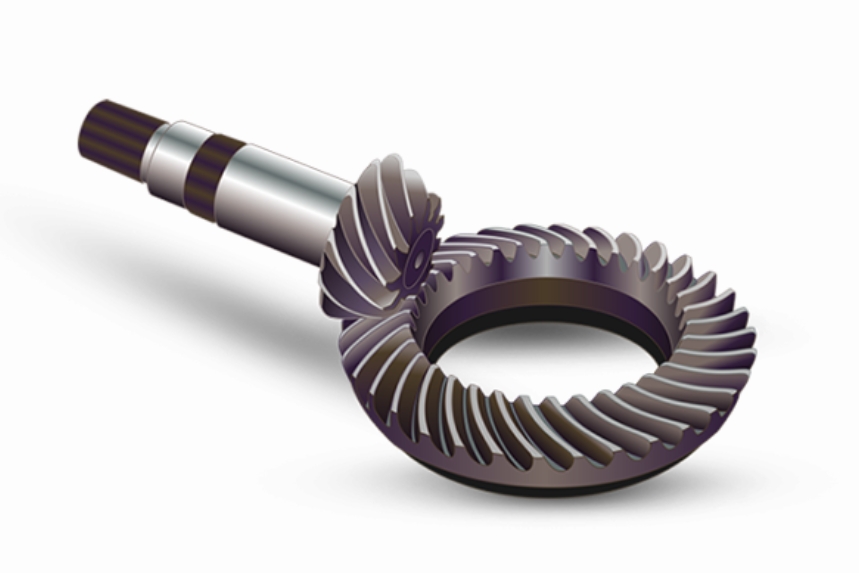
In my experimental validation, I conducted cutting tests on a spiral bevel gear pair with the parameters listed earlier. The driven gear (gear) was machined first using the initial adjustment card. After machining, it was measured on the gear measurement center. The initial measurement showed significant pressure angle errors on the convex flank, with deviations up to 0.05 mm. Through reverse adjustment, the machining parameters were modified: the angular setting was adjusted by $-0.2^\circ$, the radial setting by +0.1 mm, and the machine center distance by -0.02 mm. After two iterations, the measured tooth surface errors were reduced to within $\pm 0.01$ mm of the theoretical model. The pinion was then machined using the single-sided method, starting with the concave flank (working surface). Similar measurement and adjustment cycles were performed, with three iterations needed to achieve conformity. The convex flank of the pinion followed suit. The final machined spiral bevel gears exhibited tooth surfaces that closely matched the theoretical design.
To verify interchangeability, I randomly selected one pinion and one gear from a batch of 50 pairs and conducted a rolling test on a gear testing machine. The contact pattern observed was centralized, with a length of approximately 55% of the face width and height of 50% of the tooth depth, closely matching the TCA simulation. The transmission error measured during rolling showed a peak-to-peak value of less than 0.5 arc-minutes, indicating smooth meshing. This result confirms that the gears are interchangeable, as any randomly selected pair from the batch performs similarly. The success of this method hinges on maintaining consistent tooling standards; once the theoretical tooth form is fixed, cutter parameters such as diameter, pressure angle, and blade geometry are kept constant throughout the batch production. Any wear or regrinding of cutters is monitored and compensated via the measurement feedback loop.
The implications of achieving interchangeability for spiral bevel gears are profound for industries like automotive, aerospace, and heavy machinery. It reduces inventory costs, simplifies assembly lines, and minimizes waste due to mismatched pairs. My approach integrates several advanced technologies: computer-aided design and TCA for theoretical optimization, CNC machining for precision, and coordinate metrology for quality control. The synergy of these elements ensures that each spiral bevel gear adheres to a digital twin, enabling mass production with high reliability. Furthermore, this methodology can be extended to other types of bevel gears, such as hypoid or zerol gears, with appropriate modifications to the design algorithms.
In conclusion, my research demonstrates a comprehensive framework for achieving interchangeability in the batch processing of spiral bevel gears. By establishing unified design standards through TCA, implementing precision machining with CNC controls, and employing rigorous measurement-based feedback correction, I have shown that spiral bevel gears can be produced interchangeably. The experimental results validate that the contact patterns and transmission errors of randomly paired gears align with theoretical simulations, meeting performance requirements. This work not only addresses a long-standing challenge in gear manufacturing but also paves the way for more efficient and cost-effective production of spiral bevel gears. Future directions include incorporating real-time adaptive control using in-process sensors and exploring additive manufacturing for customized spiral bevel gears. As the demand for high-performance transmissions grows, the ability to produce interchangeable spiral bevel gears will remain a critical advancement, driving innovation across mechanical systems.