
In modern mechanical transmission systems, spiral bevel gears play a critical role due to their ability to transmit power between intersecting shafts with high efficiency and smooth operation. These gears are widely used in aerospace, marine propulsion, wind turbines, and heavy machinery. However, manufacturing spiral bevel gears presents significant challenges, especially when using advanced CNC machining techniques. One of the key issues is avoiding interference between the cutter back and the opposite tooth surface during face milling operations. This interference can lead to tool damage, workpiece scrap, and compromised gear performance. In this article, I explore a comprehensive methodology to prevent such interference, focusing on structural optimization of the cutter and gear geometry. The approach leverages mathematical modeling, curvature analysis, and virtual simulation to ensure accurate and efficient machining of spiral bevel gears.
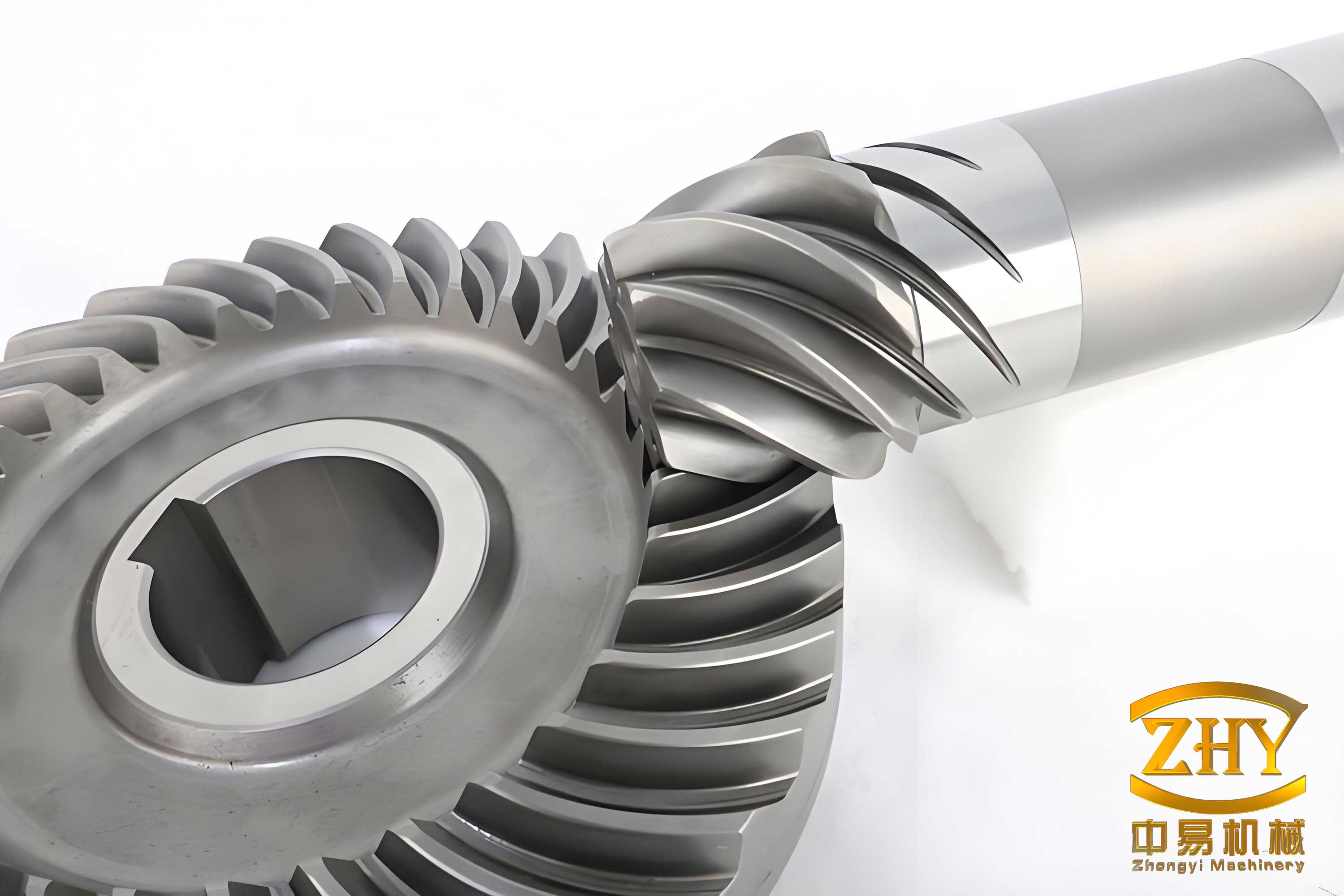
The machining of spiral bevel gears traditionally relies on generating methods or surface machining techniques. Generating methods use dedicated disc cutters that match the gear blank diameter, but for large-diameter spiral bevel gears, this approach becomes impractical due to tool manufacturing difficulties and poor machine dynamics. Surface machining methods, such as using end mills or disc cutters, offer flexibility but introduce risks like chatter and limited cutting width. Recently, five-axis CNC face milling with a disc cutter featuring a concave end has emerged as a promising solution for machining spiral bevel gears. This method enhances cutting efficiency and stability, but it introduces a unique interference problem: the back cone of the cutter may collide with the opposite tooth surface within the narrow gear slot. This interference is particularly problematic because the tooth surfaces of spiral bevel gears have complex topological structures with varying curvatures and close spacing. If not addressed, it can cause overcutting, residual material, or catastrophic tool failure. Therefore, developing robust interference avoidance strategies is essential for successful CNC machining of spiral bevel gears.
To understand the interference phenomenon, consider a virtual machining model where a disc cutter with a concave end mills the tooth surface of a spiral bevel gear. The cutter must penetrate the gear slot and move along the tooth direction to envelope the surface. If the cutter’s edge thickness is too large or the back cone angle is excessive, the cutter back can intrude into the opposite tooth surface. This results in unwanted material removal on the opposite side, leaving defects that affect gear meshing and durability. The interference can occur at the tooth root, tip, or across the entire surface, depending on the relative positions and curvatures. For instance, when milling the concave side of a spiral bevel gear tooth, the cutter back and the opposite convex surface have opposing curvatures, which may lead to localized interference. Conversely, when milling the convex side, both surfaces have similar curvature directions, increasing the risk of broader interference. Identifying and mitigating these issues requires a detailed analysis of the cutter geometry, tool path, and gear tooth morphology.
The core of the interference avoidance method lies in optimizing the cutter’s structural parameters, such as edge thickness and back cone angle, based on the gear’s geometry. The approach is divided into two parts: avoiding interference along the cutter’s most prominent generatrix and ensuring no interference elsewhere on the cutter back. For the most prominent generatrix, which is the line on the cutter back cone that extends furthest into the gear slot, a position relationship analysis is conducted. The goal is to guarantee that this generatrix does not intersect the opposite tooth surface. This involves calculating distances and adjusting parameters iteratively. For other parts of the cutter back, especially when milling convex tooth surfaces, a curvature comparison is necessary. The normal curvature of the cutter back cone along the feed direction must be greater than that of the opposite tooth surface to prevent enveloping interference. These principles are derived from differential geometry and kinematics, providing a theoretical foundation for practical applications.
To formalize the method, let’s define key mathematical models. In CNC face milling of spiral bevel gears, the cutter position at a given cutting point is characterized by the tool center and orientation. Let \( \mathbf{r}_M \) be the position vector of the cutting point on the tooth surface, and \( \mathbf{u} \) be the unit vector along the cutter axis. The cutter’s edge thickness is denoted as \( d_b \), and the back cone angle is \( \mu \). The position vector of the lowest point \( P \) on the cutter back edge, which lies on the most prominent generatrix, can be expressed as:
$$ \mathbf{r}_P = T(\mathbf{r}_M + \mathbf{u} d_b) $$
Here, \( T \) is a rotation transformation matrix that accounts for the cutter’s tilt and orientation. The matrix \( T \) is derived from the cutter axis vector \( \mathbf{u} = [u_1, u_2, u_3]^T \) and the back cone angle \( \mu \). Using an antisymmetric matrix \( C \):
$$ C = \begin{bmatrix} 0 & u_3 & -u_2 \\ -u_3 & 0 & u_1 \\ u_2 & -u_1 & 0 \end{bmatrix} $$
The rotation matrix for an angle of \( \pi/2 – \sigma_y \) (where \( \sigma_y \) is related to the cutter inclination) is:
$$ T = I + (1 – \cos(\pi/2 – \sigma_y))C^2 + \sin(\pi/2 – \sigma_y)C $$
This simplifies to a form dependent on \( \sigma_y \) and \( \mathbf{u} \). The direction vector of the most prominent generatrix on the cutter back cone is given by:
$$ \mathbf{V} = L_3 L_2 (\mathbf{n} \sin \mu – \mathbf{t} \cos \mu) $$
where \( \mathbf{n} \) is the unit normal vector at the cutting point, \( \mathbf{t} \) is a unit vector perpendicular to both \( \mathbf{n} \) and the feed direction \( \mathbf{f} \), and \( L_3 \), \( L_2 \) are transformation matrices for cutter side tilt and front tilt, respectively. Thus, the parametric equation of the most prominent generatrix is:
$$ \mathbf{r}_1 = \mathbf{r}_P + \mathbf{V} t $$
where \( t \) is a curve parameter. To avoid interference, the distance between this generatrix and the opposite tooth surface must be non-negative at all points. This is achieved by optimizing \( d_b \) and \( \mu \). Initially, set \( d_b \) to the minimum slot width \( W_{\min} \) and \( \mu \) to the sum of pressure angles \( \Sigma \alpha \). Then, compute interference amounts at key points, such as the root and tip of the generatrix. For point \( P \), the interference amount \( g_p \) is determined by intersecting a line along the cutter back normal with the opposite surface. If interference exists, reduce \( d_b \) by an increment \( \delta \) until \( g_p \) is eliminated. Similarly, for the tip point \( Q \) (where \( t = h / \cos \mu \), with \( h \) as tooth height), adjust \( \mu \) by \( \delta_\mu \) until interference amount \( g_q \) is zero. The final parameters are:
$$ d_b^* = W_{\min} – \delta^* $$
$$ \mu^* = \Sigma \alpha – \delta_\mu^* $$
However, even with endpoints cleared, the generatrix may still interfere midway due to curvature variations. To find the maximum interference \( g_m \), discretize the generatrix into segments and use a bisection method. Let \( P_i \) and \( P_{i+1} \) be adjacent nodes with interference amounts \( g_i \) and \( g_{i+1} \). Insert a midpoint \( P_j \), compute \( g_j \), and compare. Repeat on the segment with higher interference until the segment length is below a tolerance \( \epsilon \). Then, shift the entire generatrix away from the opposite surface by \( g_m \), leading to the adjusted edge thickness:
$$ d_b^{**} = d_b^* – g_m / \cos \mu^* $$
This ensures the most prominent generatrix avoids interference for concave tooth milling of spiral bevel gears.
For convex tooth milling, additional steps are needed because the cutter back and opposite concave surface have similar curvature orientations. Consider a plane \( \pi \) parallel to the feed direction, intersecting both the cutter back cone and the opposite tooth surface. The intersection curves, \( c_1 \) and \( c_2 \), must satisfy \( k_{c_1} > k_{c_2} \), where \( k \) denotes curvature, to avoid interference. This condition translates to comparing normal curvatures along the feed direction. The principal curvatures and directions of the cutter back cone are derived from its geometry. For a cutter with radius \( R \) and parameters \( (u, \theta_c) \), the principal curvatures are:
$$ k_{c1} = \frac{\sin \mu}{R – u \cos \mu}, \quad k_{c2} = 0 $$
The principal directions are:
$$ \mathbf{e}_{c1} = [-\sin \theta_c, \cos \theta_c, 0]^T $$
$$ \mathbf{e}_{c2} = -[\cos \mu \sin \theta_c, \cos \mu \cos \theta_c, \sin \mu]^T $$
Using Euler’s formula, the normal curvature along the feed direction \( \mathbf{f} \) is:
$$ k_n^c = k_{c1} \cos^2 \phi + k_{c2} \sin^2 \phi $$
where \( \phi \) is the angle between \( \mathbf{f} \) and \( \mathbf{e}_{c1} \). For the opposite tooth surface of the spiral bevel gear, the normal curvature \( k_n^g \) is computed from its second-order geometric parameters, often derived via the generating gear relationship. The interference avoidance condition is:
$$ k_n^c > k_n^g $$
If this fails, further adjust \( \mu \) and \( d_b \) until satisfied. This curvature-based check complements the position-based method, providing comprehensive interference avoidance for all milling scenarios of spiral bevel gears.
To illustrate the methodology, consider a practical example involving a spiral bevel gear pair. The pinion, with more complex tooth topology, is machined using a disc cutter with a concave end on a five-axis CNC machine. The geometric parameters of the spiral bevel gear pinion are summarized in Table 1, and the generating machine settings for traditional machining are in Table 2. These parameters inform the initial cutter design and tool path planning.
| Parameter | Value |
|---|---|
| Number of Teeth | 15 |
| Module (mm) | 8.22 |
| Face Width (mm) | 48.97 |
| Pressure Angle (°) | 20 |
| Shaft Angle (°) | 90 |
| Outer Cone Distance (mm) | 198.86 |
| Addendum (mm) | 9.85 |
| Dedendum (mm) | 5.67 |
| Pitch Cone Angle (°) | 18.06 |
| Face Cone Angle (°) | 21.34 |
| Root Cone Angle (°) | 16.43 |
| Mean Spiral Angle (°) | 35 |
| Parameter | Concave Side | Convex Side |
|---|---|---|
| Cutter Tip Radius (mm) | 157.75 | 146.24 |
| Cutter Blade Angle (°) | 21 | 19 |
| Radial Setting (mm) | 153.91 | 144.80 |
| Angular Setting (°) | 56.34 | 57.25 |
| Ratio of Roll | 3.254933 | 3.170205 |
| Vertical Wheel Setting (mm) | 0.70 | -1.18 |
| Axial Wheel Setting (mm) | 1.57 | -2.26 |
| Machine Center to Back (mm) | -0.44 | 0.64 |
Based on the interference avoidance method, the cutter’s structural parameters are optimized separately for concave and convex sides of the spiral bevel gear tooth. The cutter tip radius is set to 45 mm for effective face milling. The determined edge thickness and back cone angle are shown in Table 3.
| Tooth Side | Edge Thickness (mm) | Back Cone Angle (°) |
|---|---|---|
| Concave | 2.58 | 28.31 |
| Convex | 2.53 | 28.19 |
Using these parameters, tool paths are generated via post-processing of cutting locations derived from face milling theory. A virtual machining simulation is performed to validate the interference avoidance. The simulation compares the machined tooth surface with the theoretical model, with tolerances set at 5 μm for overcut and residual material. Results show that the tooth surfaces are fully enveloped without significant interference. Occasional minor discontinuities are negligible for gear performance. Importantly, the opposite tooth surfaces retain sufficient stock for subsequent machining, ensuring both sides of the spiral bevel gear slot can be accurately produced. This verification underscores the feasibility of the proposed method for CNC face milling of spiral bevel gears.
The effectiveness of the interference avoidance approach hinges on accurate modeling and iterative optimization. In practice, the process can be automated using computational algorithms that integrate CAD/CAM systems for spiral bevel gears. The mathematical framework allows for real-time adjustments based on gear design variations, making it adaptable to custom applications. For instance, in high-precision aerospace gears, where tolerances are tight, the curvature comparison step becomes crucial. Similarly, for large-diameter marine gears, the edge thickness optimization prevents tool deflection issues. The method also reduces trial-and-error in tool selection, lowering production costs and time. Future enhancements could incorporate machine dynamics, such as spindle vibrations, to further refine interference margins. Overall, this methodology represents a significant advancement in the digital manufacturing of spiral bevel gears.
In conclusion, avoiding interference between the cutter back and opposite tooth surface is essential for successful CNC face milling of spiral bevel gears. The proposed method addresses this challenge through a two-pronged strategy: optimizing cutter geometry to prevent interference along the most prominent generatrix and ensuring curvature dominance to avoid enveloping interference elsewhere. For concave tooth milling, focusing on the generatrix is sufficient, while for convex tooth milling, additional curvature checks are necessary. The mathematical models, based on differential geometry and kinematics, provide a robust foundation for parameter determination. Virtual simulations confirm that the method enables complete tooth surface generation without compromising adjacent surfaces. This approach not only enhances machining accuracy but also expands the applicability of five-axis CNC technology for complex spiral bevel gears. As industries demand higher-performance gears, such interference avoidance techniques will become increasingly vital in advanced manufacturing ecosystems.
To further elaborate, the integration of this methodology into industrial practice requires attention to several factors. First, the initial gear design must be meticulously analyzed to extract geometric parameters crucial for interference calculations. This involves digitizing tooth surfaces, often using coordinate measurement machines or digital twins. Second, the cutter design must balance interference avoidance with cutting performance; for example, too small an edge thickness may weaken the cutter, while too large a back cone angle could reduce tool life. Third, the CNC programming must incorporate the optimized tool paths with smooth transitions to minimize dynamic errors. Additionally, real-time monitoring during machining can detect deviations and trigger adaptive corrections. These steps ensure that the theoretical benefits translate into tangible quality improvements for spiral bevel gears.
From a broader perspective, the interference avoidance method contributes to the trend of smart manufacturing for spiral bevel gears. By leveraging computational tools, manufacturers can simulate entire machining processes virtually, identifying potential issues before physical production. This reduces waste, energy consumption, and downtime. Moreover, the method supports the customization of spiral bevel gears for niche applications, such as robotics or renewable energy, where gear geometries may deviate from standard designs. As CNC technology evolves, with advancements in multi-axis control and AI-driven optimization, the principles outlined here will remain relevant, guiding the development of next-generation machining strategies for spiral bevel gears.
In summary, this article has detailed a comprehensive interference avoidance framework for CNC face milling of spiral bevel gears. Through mathematical modeling, parameter optimization, and virtual validation, the method ensures that cutter back interference is effectively mitigated. The key takeaways include the importance of position and curvature analyses, the iterative nature of parameter adjustment, and the value of simulation in verifying results. By adopting such approaches, manufacturers can achieve higher precision, efficiency, and reliability in producing spiral bevel gears, meeting the escalating demands of modern engineering applications. The continued refinement of these techniques will undoubtedly propel the manufacturing of spiral bevel gears into new frontiers of excellence.