
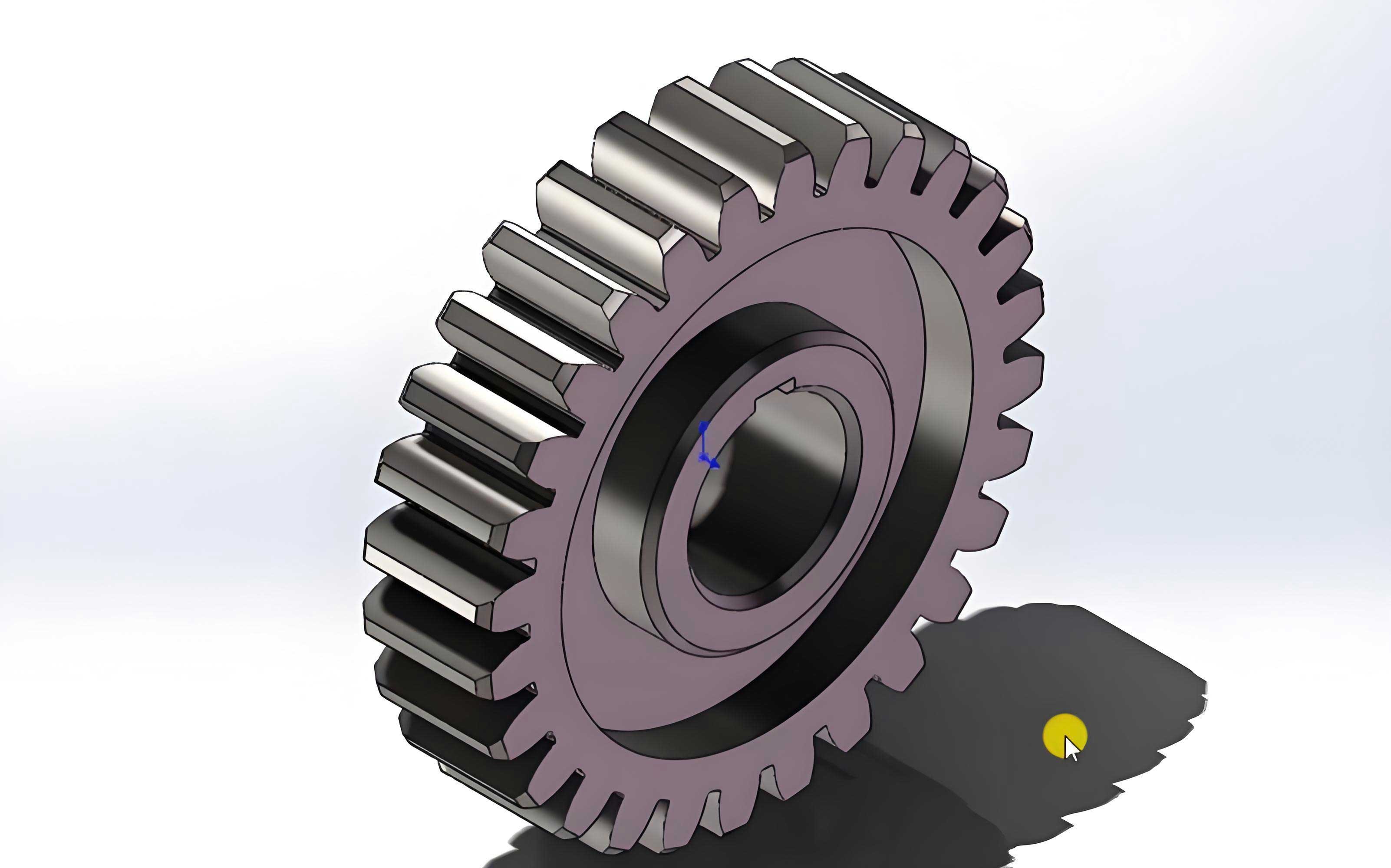
The evolution of CNC technology has made multi-axis milling with general-purpose tools a highly flexible and increasingly vital method for manufacturing and repairing spur gears. Compared to traditional processes like hobbing, milling offers distinct advantages for rapid prototyping, one-off production of large spur gears, and gear restoration tasks. Given the multi-axis nature of the operation, rational tool path generation is the key to ensuring both the precision and efficiency of gear machining. This work proposes a comprehensive methodology for generating interference-free tool paths for the finish milling of spur gears using a ball-end mill, focusing on accurate geometric modeling, scallop-height controlled tool path calculation, and robust interference detection and avoidance.
Kinematic and Geometric Foundation
The success of any tool path planning algorithm rests on a precise mathematical description of the machining kinematics and the workpiece geometry. For milling spur gears, this involves defining the relative motion between the tool and the gear blank and establishing an exact model of the gear tooth profile.
Machining Kinematics and Coordinate Systems
A typical four-axis CNC setup for gear milling is considered. The workpiece (gear blank) is mounted on a rotary B-axis, which performs intermittent indexing. A ball-end mill is held in the main spindle (S-axis) and positioned via linear X, Y, and Z-axis motions to perform material removal. To mathematically describe this, several coordinate systems are established:
- Machine Coordinate System (MCS) \(O_M – X_M Y_M Z_M\): Fixed to the machine bed. The \(Z_M\)-axis coincides with the gear’s axis of rotation.
- Workpiece Coordinate System (WCS) \(O_W – X_W Y_W Z_W\): Fixed to the workpiece. Its \(Y_W\)-axis aligns with the tooth centerline. It rotates about the MCS’s \(Z_M\)-axis by an angle \(\varphi\).
- Cutter Coordinate System (CCS) \(O_T – X_T Y_T Z_T\): Fixed to the ball-end mill, with its origin \(O_T\) at the ball center. The \(Z_T\)-axis aligns with the spindle axis.
- Tooth Profile Coordinate System (PCS) \(O_G – X_G Y_G Z_G\): Used to define the mathematical model of a single tooth profile. Its \(Y_G\)-axis aligns with the tooth centerline. When \(\varphi = 0\), the PCS coincides with the WCS.
The transformation from the PCS to the MCS is a sequence of rotations:
$$ \mathbf{M}_{M}^{G} = \mathbf{M}_{M}^{W} \mathbf{M}_{W}^{G} $$
where \(\mathbf{M}_{W}^{G}\) rotates the profile into the workpiece orientation, and \(\mathbf{M}_{M}^{W}\) rotates the workpiece into the machine coordinate system. These transformations are crucial for positioning the tool relative to the evolving tooth space during machining.
Mathematical Model of the Spur Gear Tooth Profile
A precise model of the standard involute spur gear tooth profile, including the involute segment, root fillet, and dedendum circle, is essential. The profile is defined by key parameters: number of teeth \(z\), module \(m_n\), pressure angle \(\alpha_n\), addendum coefficient \(h_a^*\), dedendum coefficient \(c^*\), and profile shift coefficient \(x\). From these, fundamental circle radii are calculated: base circle radius \(r_b\), pitch circle radius \(r\), addendum circle radius \(r_a\), and dedendum circle radius \(r_f\).
1. Involute Segment (\(A \rightarrow B\)): Any point on the true involute flank of the spur gear is parameterized by the pressure angle \(\alpha\):
$$ \mathbf{r}_G(\alpha) =
\begin{bmatrix}
\frac{r_b}{\cos\alpha} \sin(\Omega – \tan\alpha + \alpha) \\
\frac{r_b}{\cos\alpha} \cos(\Omega – \tan\alpha + \alpha) \\
0
\end{bmatrix}, \quad 0 \leq \alpha \leq \arccos\left(\frac{r_b}{r_a}\right) $$
Here, \(\Omega = \pi/(2z) + \theta_n\) and \(\theta_n = \tan\alpha_n – \alpha_n\) (the involute roll angle at the pitch circle). The unit normal vector on the involute is:
$$ \mathbf{n}_G(\alpha) =
\begin{bmatrix}
\cos(\tan\alpha – \Omega) \\
\sin(\tan\alpha – \Omega) \\
0
\end{bmatrix} $$
2. Root Fillet Segment (\(B \rightarrow D\)): A circular arc of radius \(r_t\) is used, tangent to the involute at point \(B\) and to the dedendum circle at point \(D\). The center \(E\) of this arc can be derived geometrically. Let \(\zeta = \cos^{-1}\left( \frac{2 r_b r_f}{r_b^2 + r_f^2} \right)\). The coordinates of \(B\) and \(E\) are:
$$ \mathbf{r}_{G,B} = [r_b \sin\Omega,\; r_b \cos\Omega]^T $$
$$ \mathbf{r}_{G,E} = \left[ \frac{r_b}{\cos\zeta} \sin(\Omega + \zeta),\; \frac{r_b}{\cos\zeta} \cos(\Omega + \zeta) \right]^T $$
The fillet radius is \(r_t = \|\mathbf{r}_{G,E} – \mathbf{r}_{G,B}\|\). A point on the fillet is given by:
$$ \mathbf{r}_G(\theta_t) = \mathbf{R}(\theta_t) (\mathbf{r}_{G,B} – \mathbf{r}_{G,E}) + \mathbf{r}_{G,E}, \quad 0 \leq \theta_t \leq \pi/2 – \zeta $$
where \(\mathbf{R}(\theta_t)\) is a 2D rotation matrix. Its normal vector is:
$$ \mathbf{n}_G(\theta_t) = \mathbf{R}(\theta_t) (\mathbf{r}_{G,B} – \mathbf{r}_{G,E}) / r_t $$
3. Dedendum Circle Segment (\(D \rightarrow F\)): This is a simple circular arc:
$$ \mathbf{r}_G(\theta_r) = [ r_f \sin\theta_r,\; r_f \cos\theta_r ]^T, \quad \Omega+\zeta \leq \theta_r \leq \beta $$
where \(\beta = \pi / z\). Its normal vector is:
$$ \mathbf{n}_G(\theta_r) = [ \sin\theta_r,\; \cos\theta_r ]^T $$
This complete and continuous model allows for exact calculation of tool engagement for spur gears.
Tool Path Generation Based on Scallop Height Control
The primary goal in finish machining is to achieve a specified surface quality, characterized by the maximum allowable scallop height \(h\). The tool path is generated by calculating a series of Cutter Location (CL) points such that the material left between adjacent tool passes does not exceed \(h\).
Constant Scallop Height Method for Involute Flanks
For the convex involute flank of spur gears, the constant scallop height method is highly effective. The fundamental idea is to position successive tool passes so that the scallop point (the point of maximum remaining material between passes) lies exactly on a curve offset from the design surface by the distance \(h\).
Let \(\varepsilon_1\) be the design involute curve (the surface to be machined). Let \(\varepsilon_2\) be the scallop curve, offset from \(\varepsilon_1\) by distance \(h\) along the normal direction:
$$ \mathbf{r}_G^h(\alpha) = \mathbf{r}_G(\alpha) + \mathbf{n}_G(\alpha) \cdot h $$
Let \(\varepsilon_3\) be the tool path curve, offset from \(\varepsilon_1\) by the ball-end mill radius \(R\):
$$ \mathbf{r}_G^R(\alpha) = \mathbf{r}_G(\alpha) + \mathbf{n}_G(\alpha) \cdot R $$
Assume the current CL point \(\mathbf{L}_{G,K}\) and its corresponding cutter contact (CC) point \(\mathbf{C}_{G,K}\) on \(\varepsilon_1\) are known, corresponding to a pressure angle \(\alpha_K\):
$$ \mathbf{C}_{G,K} = \mathbf{r}_G(\alpha_K), \quad \mathbf{L}_{G,K} = \mathbf{r}_G^R(\alpha_K) $$
The tool’s cutting edge at this location is a circular arc of radius \(R\) in the plane defined by the surface normal. The scallop point \(\mathbf{G}_K\) is defined as the intersection of this tool arc (from pass \(K\)) and the scallop curve \(\varepsilon_2\) (for pass \(K+1\)). Finding \(\mathbf{G}_K\) involves solving a system of non-linear equations, typically using a numerical method like the Newton-Raphson or bisection method to find the parameter \(\theta_h\) on the tool arc where the distance to \(\varepsilon_2\) is minimized to zero.
Once \(\mathbf{G}_K\) is found, the next CL point \(\mathbf{L}_{G,K+1}\) is determined by the condition that the distance from \(\mathbf{G}_K\) to \(\mathbf{L}_{G,K+1}\) must equal the tool radius \(R\), and \(\mathbf{L}_{G,K+1}\) must lie on the tool path curve \(\varepsilon_3\). This leads to another numerical search for the pressure angle \(\alpha_{K+1}\) that satisfies:
$$ \|\mathbf{G}_K – \mathbf{r}_G^R(\alpha_{K+1})\| = 0 $$
This iterative process, starting from the tooth tip (\(\alpha = \alpha_{\text{tip}}\)), generates all CL points along the involute flank of the spur gear, guaranteeing the resulting scallop height is exactly \(h\).
Alternative Feeding Strategies
While constant scallop height is optimal for surface finish, other strategies like constant arc-length or constant radial feed might be preferred for machine dynamics or simplicity. These can be derived from the constant scallop height solution.
From the set of \(n\) constant scallop height CL points, calculate the arc length \(\Delta S_K\) and radial distance \(\Delta y_K\) between successive CC points \(K\) and \(K+1\):
$$ \Delta S_K = \frac{r_b}{2} \left( \frac{1}{\cos^2 \alpha_{K+1}} – \frac{1}{\cos^2 \alpha_K} \right) $$
$$ \Delta y_K = \frac{r_b}{\cos \alpha_K} \cos \varphi_K – \frac{r_b}{\cos \alpha_{K+1}} \cos \varphi_{K+1} $$
where \(\varphi_K = \Omega – \tan\alpha_K + \alpha_K\).
To maintain the scallop height constraint \(h\), the minimum values from the constant scallop height solution must be used as the fixed step:
$$ \Delta S_{\text{min}} = \min(\Delta S_1, \Delta S_2, …, \Delta S_{n-1}) $$
$$ \Delta y_{\text{min}} = \min(\Delta y_1, \Delta y_2, …, \Delta y_{n-1}) $$
For constant arc-length feed, the pressure angle for the \(K+1\)-th point is found analytically:
$$ \alpha_{K+1} = \arccos\left( \frac{r_b \cos^2 \alpha_A}{\sqrt{2 (S_{AB} – K \Delta S_{\text{min}}) \cos^2 \alpha_A + r_b^2}} \right) $$
where \(S_{AB}\) is the total arc length of the involute from tip to start-of-active-profile.
For constant radial feed, \(\alpha_{K+1}\) is found by solving numerically:
$$ y_{G,A} – K \Delta y_{\text{min}} = \frac{r_b}{\cos \alpha_{K+1}} \cos( \Omega – \tan\alpha_{K+1} + \alpha_{K+1} ) $$
where \(y_{G,A}\) is the Y-coordinate of the tooth tip. The corresponding CL point is then \(\mathbf{L}_{G,K+1} = \mathbf{r}_G^R(\alpha_{K+1})\).
| Feeding Strategy | Primary Control Parameter | Advantage | Disadvantage |
|---|---|---|---|
| Constant Scallop Height | Surface finish (scallop height \(h\)) | Optimal, uniform surface finish. | Variable stepover; computationally intensive. |
| Constant Arc-Length | Step along involute curve (\(\Delta S\)) | Constant material removal rate; simpler interpolation. | Variable scallop height; finish may not meet spec everywhere. |
| Constant Radial Feed | Step in radial direction (\(\Delta y\)) | Simple to program; constant radial depth. | Highly variable scallop height and material removal rate. |
Tool Path for Root Fillet and Dedendum Circle
For the circular segments (fillet and dedendum) of the spur gear, the constant scallop height CL points can be calculated analytically using geometric relations.
For the concave root fillet (radius \(r_t\)), the angular increment \(\delta_1\) between CL points is:
$$ \delta_1 = 2 \arccos\left( \frac{(r_t – R)^2 + (r_t – h)^2 – R^2}{2 (r_t – R)(r_t – h)} \right) $$
The \(K\)-th CL point is then:
$$ \mathbf{L}_{G,K} = \mathbf{R}(K \delta_1) \cdot \frac{\mathbf{r}_{G,B} – \mathbf{r}_{G,E}}{\|\mathbf{r}_{G,B} – \mathbf{r}_{G,E}\|} \cdot (r_t – R) + \mathbf{r}_{G,E} $$
For the convex dedendum circle (radius \(r_f\)), the angular increment \(\delta_2\) is:
$$ \delta_2 = 2 \arccos\left( \frac{(r_f + R)^2 + (r_f + h)^2 – R^2}{2 (r_f + R)(r_f + h)} \right) $$
The \(K\)-th CL point is:
$$ \mathbf{L}_{G,K} = \mathbf{R}(-K \delta_2) \cdot \frac{\mathbf{r}_{G,D}}{\|\mathbf{r}_{G,D}\|} \cdot (r_f + R) $$
These formulas provide a complete and efficient tool path for the entire tooth profile of the spur gear.
Interference Detection and Cutter Orientation
A critical aspect of multi-axis milling for complex geometries like spur gears is avoiding collisions (global interference) and overcutting (local interference).
Local Interference (Overcutting)
Local interference, or gouging, occurs when the cutter radius exceeds the local concave curvature of the surface, causing unwanted removal of material. For spur gears, this is primarily a risk in the concave root fillet region. The condition to avoid local interference is straightforward:
$$ R \le r_t $$
where \(r_t\) is the radius of the root fillet. Selecting a ball-end mill with a radius smaller than the fillet radius of the spur gear inherently prevents local gouging on this segment. The involute and dedendum circle are convex surfaces and are not susceptible to this type of local interference.
Global Interference (Collision)
Global interference occurs when parts of the cutter shank or holder collide with other sections of the gear tooth or adjacent teeth. This is avoided by strategically tilting the tool axis. We define the cutter inclination angle \(\lambda\) as the angle between the surface normal vector \(\mathbf{n}_{W,K}\) at the CC point (in WCS) and the tool axis vector \(\mathbf{t}_{W,\lambda}\). By convention, \(\lambda\) is positive for counter-clockwise rotation from the normal.
The tool axis vector for a given \(\lambda\) is:
$$ \mathbf{t}_{W,\lambda} = \mathbf{R}(\lambda) \cdot \mathbf{n}_{W,K} $$
where \(\mathbf{R}(\lambda)\) is a 2D rotation matrix. The required workpiece rotation angle \(\varphi\) is then calculated such that the tool axis \(\mathbf{t}_{W,\lambda}\) aligns with the machine’s vertical spindle axis (e.g., \(Z_M\)). This angle is found from the components of \(\mathbf{t}_{W,\lambda}\).
To find the feasible range of \(\lambda\) that avoids collision, a minimum distance calculation method is employed. The tool is modeled as a line segment (the tool axis) of length \(L\) (from ball center to holder). A point on this axis is:
$$ \mathbf{p}_G(\zeta) = \mathbf{L}_{G,K} + \zeta \cdot \mathbf{t}_{G,\lambda}, \quad 0 \le \zeta \le L $$
where \(\mathbf{t}_{G,\lambda}\) is the tool axis in the PCS. The minimum distance between this line segment and the entire gear tooth surface (including adjacent flanks) is computed numerically:
$$ d_{\min}(\lambda) = \min_{\zeta, \, \text{surface param}} \| \mathbf{p}_G(\zeta) – \mathbf{r}_G(\text{param}) \| $$
Avoidance of global interference requires that this minimum distance is always greater than or equal to the tool radius \(R\):
$$ d_{\min}(\lambda) \ge R $$
The solver finds the critical inclination \(\lambda_{\min}\) where \(d_{\min}(\lambda_{\min}) = R\). For safe machining, the chosen inclination angle must satisfy \(\lambda \ge \lambda_{\min}\). If an initial guess for \(\lambda\) causes interference (\(d_{\min} < R\)), the adjustment \(\Delta \lambda\) can be estimated from the geometry of the near-collision points to find a safe orientation.
Simulation and Verification
The proposed methodology was validated through numerical simulation and virtual machining. A standard spur gear was defined with the parameters: module \(m_n = 6\) mm, teeth \(z = 30\), pressure angle \(\alpha_n = 20^\circ\), addendum coefficient \(h_a^* = 1\), dedendum coefficient \(c^* = 0.25\), and zero profile shift. A ball-end mill radius of \(R = 2\) mm and a maximum scallop height of \(h = 0.03\) mm were specified.
The tool path was generated using the constant scallop height method. The feasible cutter inclination angle \(\lambda\) was calculated for each CL point along the profile. Results showed that the involute segment allowed for a wide range of \(\lambda\) (e.g., up to \(60^\circ\)), while the access to the root fillet and dedendum circle was more restricted, often requiring a negative \(\lambda\) (e.g., \(-20^\circ\)) to avoid shank collision with the opposite flank of the spur gear tooth space.
Virtual material removal simulation, employing both CAD-based Boolean operations and dedicated CNC simulation software (e.g., VERICUT), was performed. The simulation confirmed:
- Surface Accuracy: The measured scallop height on the simulated machined spur gear tooth was consistently at or below the specified \(0.03\) mm limit across all profile segments, validating the tool path calculation.
- Interference Avoidance: With \(\lambda = 60^\circ\) on the involute and \(\lambda = -20^\circ\) on the root segments, no global collisions or local gouging were detected. A separate test with an intentionally incorrect \(\lambda = -25.71^\circ\) for the root clearly demonstrated a global collision in the simulation, highlighting the necessity of the interference check.
- Process Feasibility: The entire tool path, including coordinated linear axes motion and rotary B-axis positioning, was proven to be executable on a simulated 4-axis machining center, confirming the practical viability of the planned operations for manufacturing spur gears.
Conclusion
This work presents a comprehensive and systematic framework for interference-free tool path planning in the multi-axis ball-end milling of spur gears. The cornerstone of the method is the precise geometric modeling of the complete spur gear tooth profile, encompassing the involute, fillet, and dedendum circle. The tool path generation is driven by a rigorous constant scallop height criterion, ensuring superior surface finish. This method is further extended to derive practical constant arc-length and constant radial feed strategies under the same quality constraint. A critical component of the planning process is the robust interference management system, which uses a minimum distance calculation to determine safe ranges for the cutter orientation angle, effectively preventing both local gouging and global collisions. The validity and effectiveness of the entire methodology, from geometric calculation to collision-free machine motion, have been successfully demonstrated through detailed numerical simulations. This approach provides a reliable and flexible solution for the high-precision, flexible manufacturing and repair of spur gears using modern multi-axis CNC milling centers.