
In my extensive involvement with gear design and manufacturing, I have consistently observed that the generation method for cutting involute spur gears, while highly efficient, is susceptible to various forms of interference. These phenomena, primarily gear cutting interference and meshing interference, pose significant challenges to gear performance and longevity. Gear cutting, the fundamental process of forming gear teeth, is particularly critical where improper parameters lead to material removal beyond the intended profile, weakening the tooth. This article delves into the root causes of these interferences, starting from the very shape of the tooth flank, and explores practical pathways to prevent them, with a constant focus on the implications for the gear cutting process.
The effective portion of an involute gear tooth profile is not necessarily entirely composed of an involute curve. The active profile participating in meshing lies between the addendum circle of diameter $d_a$ and the dedendum circle of diameter $d_f$. For the entire active profile to be a true involute, the condition must be met that the involute curve originates from the base circle. If the dedendum circle falls inside the base circle, the portion of the tooth between the dedendum circle and the base circle is not an involute but a trochoid or a fillet curve generated by the cutting tool. The mathematical condition for the active profile to be purely involute is that the base circle radius $r_b$ is less than or equal to the dedendum circle radius $r_f$ plus a clearance term. From fundamental gear geometry:
$$r_b = \frac{m z}{2} \cos\alpha$$
$$r_f = \frac{m z}{2} – (h_a^* + c^*)m$$
where $m$ is the module, $z$ is the number of teeth, $\alpha$ is the pressure angle, $h_a^*$ is the addendum coefficient, and $c^*$ is the clearance coefficient. For the dedendum circle to be at or outside the base circle ($r_f \geq r_b$), we derive:
$$\frac{m z}{2} – (h_a^* + c^*)m \geq \frac{m z}{2} \cos\alpha$$
$$z – z \cos\alpha \geq 2(h_a^* + c^*)$$
For standard gears with $\alpha = 20^\circ$, $h_a^* = 1$, and $c^* = 0.25$, the condition becomes $z(1 – \cos20^\circ) \geq 2.5$. Calculating $1 – \cos20^\circ \approx 0.0603$, we find $z \geq \frac{2.5}{0.0603} \approx 41.5$. Thus, for gears with $z \geq 42$, the entire active tooth profile from dedendum to addendum is a true involute. For gears with $z < 42$, the root portion of the tooth profile is not an involute. This fundamental characteristic of the tooth flank shape is the primary contributor to potential interference during both gear cutting and subsequent meshing.
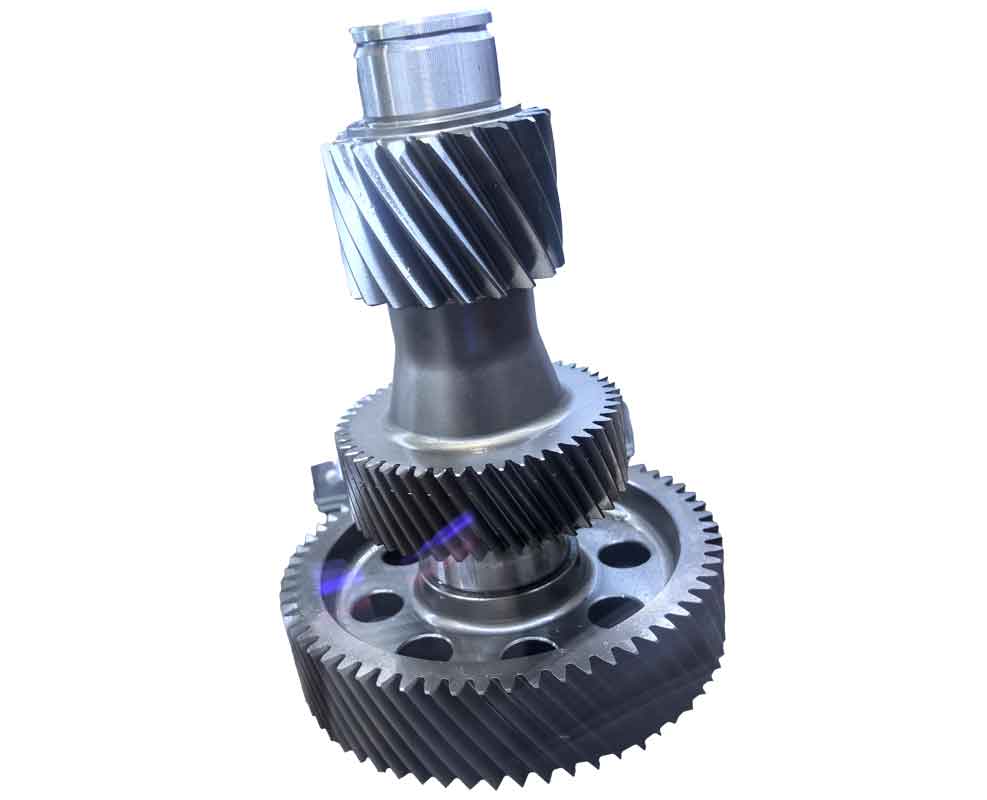
Gear cutting interference occurs during the manufacturing process itself when the cutting tool removes material from the non-involute portion of the gear tooth or encroaches upon the intended involute profile. The two main types are undercutting (root cutting) and tip cutting. Undercutting, often simply called “root cut,” happens when the tool’s tip cuts into the dedendum region of the workpiece gear, removing material from the tooth root and weakening it. This is a prevalent issue in gear cutting, especially when machining gears with low tooth counts.
Undercutting with a Rack-Type Cutter in Gear Cutting
When using a rack-type cutter for generating standard gears, undercutting occurs if the addendum line of the rack tool extends beyond the theoretical limit point of contact $N_1$ on the line of action. Point $N_1$ is the intersection of the line of action and the base circle of the gear being cut. The condition to avoid undercutting is that the addendum line of the tool must pass through or below point $N_1$. The limiting case is when the tool addendum line passes exactly through $N_1$. From this geometry, we can derive the minimum number of teeth for a standard gear cut by a standard rack to avoid undercutting:
$$h_a^* m \leq r_b \sin\alpha = \frac{m z}{2} \cos\alpha \sin\alpha = \frac{m z}{2} \sin\alpha \cos\alpha$$
$$h_a^* \leq \frac{z}{2} \sin^2\alpha$$
$$z_{min} \geq \frac{2h_a^*}{\sin^2\alpha}$$
For $\alpha=20^\circ$ and $h_a^*=1$, this yields $z_{min} \geq \frac{2}{(\sin20^\circ)^2} \approx \frac{2}{0.1170} \approx 17.1$. Therefore, the theoretical minimum number of teeth to avoid undercutting with a standard rack cutter is 17. In practical gear cutting, a tooth count of 17 or more is recommended to prevent root interference during generation. This is a foundational rule in gear cutting design.
Interference with a Gear-Type Cutter (Gear Shaper) in Gear Cutting
Gear cutting with a pinion-type cutter, such as a gear shaper, introduces more complex interference possibilities because both the cutter and the workpiece are gears. Two distinct interferences can occur: undercutting of the workpiece and tip cutting of the workpiece.
- Undercutting of Workpiece: This happens if the addendum circle of the cutting tool intersects the line of action beyond the limit point $N_1$ of the workpiece. The tool’s tip then cuts into the root of the workpiece tooth during the gear cutting process.
- Tip Cutting of Workgear: Conversely, if the addendum circle of the workgear extends beyond the limit point $N_2$ of the cutter, the dedendum of the cutter will interfere with and cut away the tip of the workgear tooth. This is also known as “peeling” or “top cut.”
The condition to avoid undercutting of the workpiece (gear 1) by the cutter (gear 2) is that the addendum radius of the cutter, $r_{a2}$, must not exceed the distance from the cutter center $O_2$ to the limit point $N_1$. This leads to a formula involving the tooth numbers of the workpiece ($z_1$) and the cutter ($z_2$), pressure angle ($\alpha$), and addendum coefficient ($h_a^*$).
$$r_{a2} \leq \sqrt{(O_1O_2 – O_1N_1 \cos\alpha)^2 + (O_1N_1 \sin\alpha)^2}$$
Where $O_1O_2 = \frac{m}{2}(z_1 + z_2)$, $O_1N_1 = r_{b1} = \frac{m z_1}{2} \cos\alpha$, and $r_{a2} = \frac{m z_2}{2} + h_a^* m$. Substituting and simplifying (assuming no profile shift), we derive a relationship to ensure no undercutting occurs during this gear cutting operation:
$$\left(\frac{z_2}{2} + h_a^*\right)^2 \leq \left(\frac{z_1 + z_2}{2} – \frac{z_1}{2}\cos^2\alpha\right)^2 + \left(\frac{z_1}{2}\cos\alpha \sin\alpha\right)^2$$
A more workable inequality can be obtained for standard parameters. For $\alpha=20^\circ$ and $h_a^*=1$, the condition to avoid undercutting simplifies approximately to:
$$4z_2 + 8 \leq (2z_2 z_1 + z_1^2)\sin^2\alpha$$
This can be rearranged to define the permissible range of cutter tooth numbers $z_2$ for a given workpiece tooth number $z_1$ to avoid undercutting in gear cutting:
$$ (34.2 – 2z_1)z_2 \leq z_1^2 – 34.2 $$
where the constant 34.2 arises from the specific trigonometric values for $20^\circ$. Analyzing this inequality:
- When $34.2 – 2z_1 > 0$ (i.e., $z_1 < 17.1$), then $z_2 \leq \frac{z_1^2 – 34.2}{34.2 – 2z_1}$. This defines an upper limit for the cutter’s tooth number to prevent undercutting a low-tooth-count workpiece.
- When $34.2 – 2z_1 < 0$ (i.e., $z_1 > 17.1$), the inequality sign flips upon division, giving $z_2 \geq \frac{z_1^2 – 34.2}{34.2 – 2z_1}$. Since the right-hand side becomes negative for a range of $z_1$, and $z_2$ is a positive integer, this condition is automatically satisfied for many combinations. Essentially, for $z_1 > 18$, undercutting by a standard gear shaper is generally not a concern in gear cutting.
Permissible Tooth Number Pairing to Avoid All Interference
To ensure a pair of gears will mesh without interference and, if used as a cutter-workpiece pair, will not cause cutting interference, we must consider both undercutting and tip cutting conditions. The following table summarizes safe pairing ranges for standard gears ($\alpha=20^\circ$, $h_a^*=1$, $c^*=0.25$) to avoid both meshing interference and gear cutting interference. The table assumes Gear 1 is the pinion (with lower tooth count) and Gear 2 is the gear. If Gear 2 is used as a cutter to generate Gear 1, the conditions also indicate the feasibility of the gear cutting process without tip or root cutting.
| Pinion Teeth ($z_1$) | Gear Teeth ($z_2$) Range for Safe Meshing | Max $z_2$ as Cutter to Avoid Undercut on $z_1$ | Min $z_2$ as Cutter to Avoid Tip Cut on $z_1$ | Overall Safe for Gear Cutting (Yes/No) |
|---|---|---|---|---|
| 13 | 13 – 16 | 7 | 38 | No* |
| 14 | 14 – 27 | 11 | 32 | Conditional |
| 15 | 15 – 45 | 17 | 28 | Conditional |
| 16 | 16 – 100+ | 28 | 25 | Conditional |
| 17 | 17 – 100+ | Any | 23 | Yes (if $z_2 \geq 23$) |
| 18 | 18 – 100+ | Any | 21 | Yes (if $z_2 \geq 21$) |
| 19 | 19 – 100+ | Any | 19 | Yes |
| 20+ | Any > $z_1$ | Any | Any $\geq z_1$ | Yes |
*For $z_1=13$, no standard gear cutter with integer teeth can simultaneously satisfy both undercut and tip cut avoidance conditions, making interference-free gear cutting impossible with standard parameters. Profile modification (addendum modification) is required.
The table clearly shows that for pinions with $z_1 < 17$, the range of compatible gear teeth $z_2$ is severely restricted to avoid meshing interference. Furthermore, when considering gear cutting where one gear acts as the cutter, the permissible cutter tooth numbers are narrowly constrained. This underscores the importance of careful selection of tooth numbers in both gear design and gear cutting process planning. The gear cutting operation imposes additional constraints beyond simple meshing requirements.
Mathematical Formulation for Interference Limits
The general condition for the absence of meshing interference between two gears is that the actual limit of contact does not exceed the theoretical limit points $N_1$ and $N_2$ on the line of action. For two gears in mesh, the addendum circles must not intersect the line of action beyond these points. The equations governing this are:
$$ \sqrt{r_{a1}^2 – r_{b1}^2} + \sqrt{r_{a2}^2 – r_{b2}^2} \leq a \sin\alpha $$
where $r_{a1}, r_{a2}$ are addendum radii, $r_{b1}, r_{b2}$ are base circle radii, $a$ is the center distance, and $\alpha$ is the operating pressure angle. For standard gears cut without shift, $a = \frac{m}{2}(z_1+z_2)$ and $r_a = \frac{m z}{2} + h_a^* m$. Substituting and squaring, we can derive a comprehensive inequality that must hold for interference-free operation and, by extension, for simulating a gear cutting process without physical collision:
$$ \left( z_1 + 2h_a^* \right)^2 – \left( z_1 \cos\alpha \right)^2 + \left( z_2 + 2h_a^* \right)^2 – \left( z_2 \cos\alpha \right)^2 \leq (z_1 + z_2)^2 \sin^2\alpha $$
This can be rearranged into a quadratic form in terms of $z_1$ and $z_2$. Solving for $z_2$ given a specific $z_1$ provides the range shown in the table. This mathematical framework is essential for developing automated gear cutting software and simulation tools.
Practical Implications for Gear Cutting Process Design
In my practice of gear cutting, several key principles emerge from this analysis. First, the number of teeth on the workpiece gear dictates the allowable parameters for the cutting tool. When using a gear shaper, the tooth count of the cutter is not arbitrary; it must be chosen within a specific window to avoid both undercutting and tip cutting during the gear cutting cycle. For instance, cutting a gear with $z_1=15$ requires a cutter with a tooth count between 17 and 28 (from the derived formulas and table) to prevent both types of cutting interference. This directly impacts tool inventory and process planning in gear manufacturing.
Second, the concept of “undercut” in gear cutting should be precisely defined. It is not merely the removal of material from the root, but specifically the removal of part of the active profile—the portion that could potentially participate in meshing. This removed portion may include both the non-involute fillet region and part of the involute profile itself. Avoiding this is paramount for maintaining tooth strength and smooth motion transmission.
Third, for gears intended to transmit significant power or operate at high speeds, it is advisable to design with pinion tooth counts of 18 or more. This not only avoids meshing interference with a wide range of gear teeth but also simplifies the gear cutting process by removing strict constraints on cutter tooth count. When lower tooth counts are unavoidable due to size or ratio constraints, profile shifting (addendum modification) becomes a necessary strategy. Profile shifting effectively moves the tool relative to the workpiece during gear cutting, altering the tooth thickness and root geometry to avoid interference while maintaining the same module and center distance. The mathematics of profile shifting modifies all the previously stated inequalities by introducing a shift coefficient $x$ for each gear. The condition to avoid undercutting with a rack cutter, for example, becomes:
$$ h_a^* – x m \leq \frac{m z}{2} \sin^2\alpha $$
$$ x \geq h_a^* – \frac{z}{2} \sin^2\alpha $$
This allows gears with $z < 17$ to be cut without undercut by using a positive profile shift. The analysis of interference with gear-type cutters similarly expands to include shift coefficients for both workpiece and cutter, providing the gear cutting engineer with a powerful design toolbox.
Extended Analysis: Impact on Gear Train Design
The interference constraints also limit viable transmission ratios in compact gear trains using standard gears. For a pinion with $z_1=13$, the table indicates a maximum safe mating gear tooth count of $z_2=16$ to avoid meshing interference. This yields a maximum speed ratio of $i_{12} = z_2 / z_1 \approx 1.23$. If a higher ratio is needed from such a small pinion, profile-shifted gears or non-standard tooth forms must be employed. This is a critical consideration in gear cutting for applications like planetary gearboxes, watch mechanisms, and small appliances where space is limited. The gear cutting process for such specialized gears often requires custom tooling or precise control of tool positioning.
Furthermore, the phenomenon of tip cutting interference has significant implications for gear hobbing and shaping processes where the cutter and workpiece rotate in a timed relationship. If the cutter’s dedendum radius is too large relative to the workpiece’s addendum radius, the cutter will continuously shave off the tips of the workpiece teeth, producing a gear with reduced addendum circle diameter and potentially incorrect tooth action. This type of gear cutting failure is often detected late, leading to scrap parts. Therefore, pre-validation of tooth number pairing using the derived formulas or tables is an essential step in process design for any gear cutting operation involving generating tools.
Conclusion
Through this detailed examination, it is evident that interference in involute spur gears—whether during meshing or during the gear cutting manufacturing process—stems from the fundamental geometry of the involute tooth profile and its generation. The key to avoidance lies in understanding the relationship between tooth numbers, tool geometry, and the limiting points of contact. For reliable and efficient gear cutting, designers and manufacturing engineers must adhere to the following guidelines: prioritize pinion tooth counts of 18 or higher when possible; carefully select cutter tooth numbers within the safe ranges when using gear-type cutters; and employ profile modification for designs requiring lower tooth counts. The mathematical models and tables provided here offer a direct reference for making these decisions. Ultimately, successful gear cutting produces gears that are free from interference, ensuring strong, quiet, and efficient power transmission. The continuous refinement of these principles remains at the heart of advanced gear manufacturing technology.