
This study investigates the effects of manufacturing and assembly errors on internal excitation mechanisms and dynamic responses in spur gear pairs. A comprehensive error tooth surface model incorporating pitch deviations, profile errors, and misalignment effects is established to quantify time-varying mesh stiffness (TVMS) and composite meshing error (CME). A load distribution algorithm combining slice discretization and contact detection enables precise calculation of coupled stiffness-error dynamics under realistic operating conditions.
1. Error Tooth Surface Modeling
The spur gear tooth surface is discretized into $n_1 \times n_2$ elements with parametric coordinates:
$$
\begin{cases}
X_{nij}^{ME(L/R)} = \cos(\Delta\theta_{nij}^{ME(L/R)})X_{1ij}^{(L/R)} + \sin(\Delta\theta_{nij}^{ME(L/R)})Y_{1ij}^{(L/R)} \\
Y_{nij}^{ME(L/R)} = -\sin(\Delta\theta_{nij}^{ME(L/R)})X_{1ij}^{(L/R)} + \cos(\Delta\theta_{nij}^{ME(L/R)})Y_{1ij}^{(L/R)} \\
Z_{nij}^{ME(L/R)} = Z_{1ij}^{(L/R)}
\end{cases}
$$
where $\Delta\theta$ represents accumulated angular deviations from manufacturing errors:
$$
\Delta\theta_{nij}^{ME(L)} = \frac{2\pi(n-1)}{z} + \frac{\sum_{z=1}^n f_{pt}^z + F_{\alpha}^{nij(L)}}{r_b}
$$
| Parameter | Pinion/Gear |
|---|---|
| Number of Teeth | 25 |
| Module (mm) | 2 |
| Pressure Angle (°) | 20 |
| Face Width (mm) | 20 |
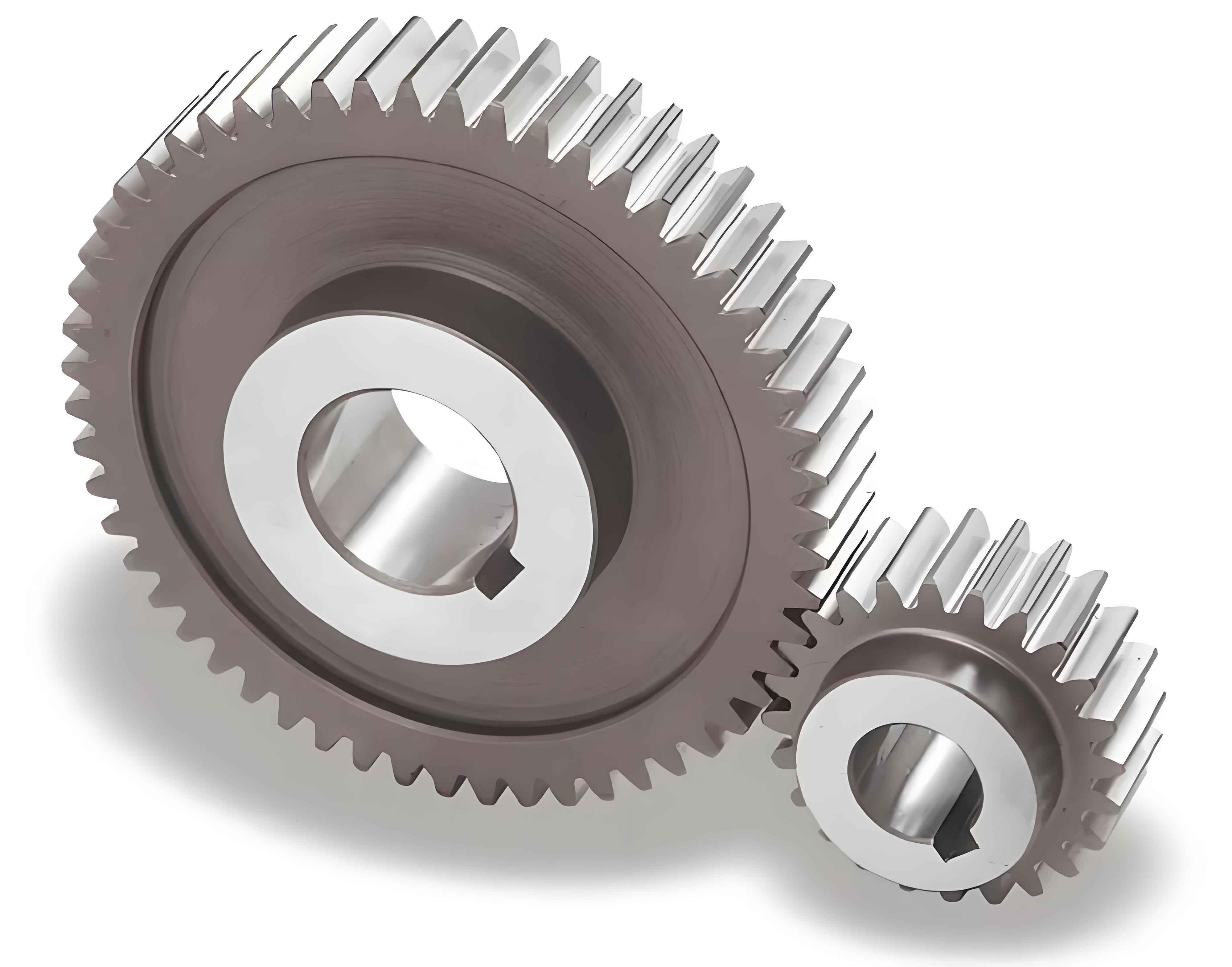
2. Load Distribution Algorithm
The nominal slice method calculates equivalent stiffness considering adjacent non-contact slices:
$$
K_{ic}^t = \frac{1}{ \left( \sum_{i=i_g-n_{gl}}^{i_g+n_{gn}} \frac{1}{K_{Gg}^i} + \sum_{i=i_p-n_{pl}}^{i_p+n_{pn}} \frac{1}{K_{Gp}^i} + \frac{1}{K_h^{i_gi_p} } \right) }
$$
Where global deformation stiffness combines bending, shear, and foundation components:
$$
K_G^i = \frac{1}{ \frac{1}{K_b^{ij}} + \frac{1}{K_s^{ij}} + \frac{1}{K_a^{ij}} + \frac{1}{K_f^{ij}} }
$$
3. Dynamic Modeling
The coupled bending-torsion dynamic model for spur gear pairs is established as:
$$
\begin{cases}
m_p\ddot{y}_p + c_{py}\dot{y}_p + k_{py}y_p – [c_m\dot{\delta} + k_m(t)\delta] = 0 \\
I_p\ddot{\theta}_p – [c_m\dot{\delta} + k_m(t)\delta]r_{bp} + T_p = 0 \\
m_g\ddot{y}_g + c_{gy}\dot{y}_g + k_{gy}y_g + [c_m\dot{\delta} + k_m(t)\delta] = 0 \\
I_g\ddot{\theta}_g – [c_m\dot{\delta} + k_m(t)\delta]r_{bg} + T_g = 0
\end{cases}
$$
| Error Type | Tolerance (μm) |
|---|---|
| Single Pitch Deviation | ±5.0 |
| Total Profile Deviation | 5.0 |
| Cumulative Pitch Error | 14.0 |
4. Key Findings
The parametric study reveals critical relationships between error types and spur gear dynamics:
Pitch Deviation Effects:
$$
\Delta K_{mesh} = 12.7\% \text{ reduction at } \theta = 0.932\text{rad}
$$
$$
CME_{step} = 5.58\mu m \text{ (23\% of nominal mesh stiffness period)}
$$
Assembly Error Impacts:
$$
\frac{\partial K_{mesh}}{\partial \Delta y} = -18.6\text{N/mm/μm} \text{ (center distance variation)}
$$
$$
\gamma = 0.1^\circ \Rightarrow 33\% \text{ contact loss}
$$
Dynamic Response Characteristics:
$$
DTE_{p-p} =
\begin{cases}
4.16\mu m & \text{(Ideal)} \\
7.44\mu m & \text{(With errors)}
\end{cases}
$$
5. Design Guidelines
Optimal spur gear performance requires:
- Pitch deviation allocation considering load distribution
- Avoidance of $\phi > 0.05^\circ$ axis misalignment
- Center distance control within $-0.1\text{mm} \leq \Delta y \leq +0.05\text{mm}$
- Profile error compensation through lead crowning
This systematic approach enables accurate prediction of spur gear dynamic behavior under realistic error conditions, providing essential guidance for high-performance gear design and manufacturing tolerance allocation.