
In the realm of industrial automation, the demand for efficient, reliable, and versatile end-effectors for manipulators has grown exponentially. As a designer focused on innovative mechanical solutions, I have developed an internal gripping device that leverages the synergistic combination of worm gears and crank connecting rod mechanisms. This device addresses critical challenges in material handling, such as high-force gripping, self-locking capability, and balanced operation, while promoting green manufacturing through energy efficiency. The core innovation lies in the serial force amplification achieved via worm gears and crank linkages, enabling precise and powerful gripping of objects from within, such as cylindrical or U-shaped workpieces. Throughout this article, I will delve into the working principles, mechanical analysis, design considerations, and applications of this device, emphasizing the pivotal role of worm gears in its functionality. To visualize a typical worm gear setup, which is central to this design, consider the following image link integrated into the discussion.
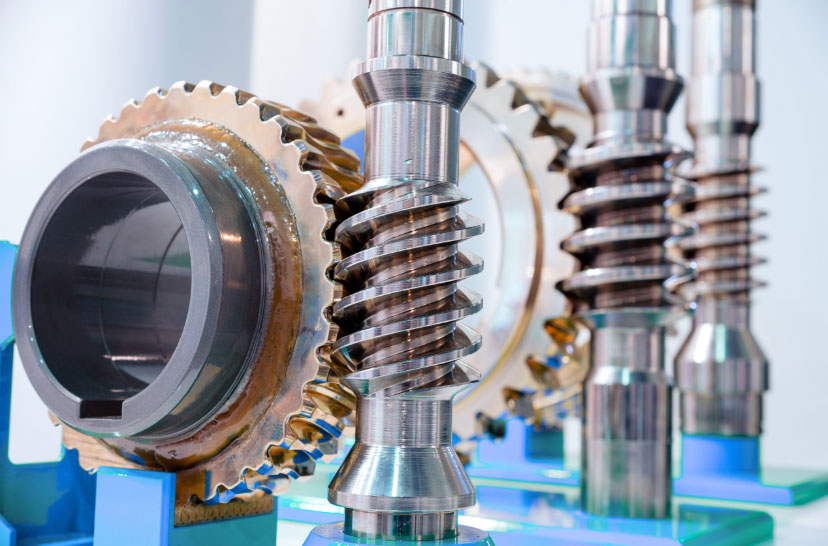
The integration of worm gears into manipulator end-effectors is not merely a technical choice but a strategic one, owing to their inherent advantages. Worm gears provide a compact means of achieving high reduction ratios, often in a single stage, which is essential for force multiplication in tight spaces. Moreover, their self-locking property—when the lead angle is sufficiently small—ensures that the gripping force is maintained without continuous power input, reducing energy consumption and enhancing safety. In my design, I have coupled these worm gears with crank connecting rod mechanisms to further amplify force through angular effects, resulting in a two-stage force amplification system. This combination allows for nonlinear force-displacement characteristics, where rapid approach speeds transition into high gripping forces as the mechanism engages. The symmetric arrangement of these components ensures balanced gripping, automatically centering the workpiece and minimizing adjustment time. As I explore this device, I will frequently reference worm gears, as they are the cornerstone of the transmission system, enabling the precise control and reliability required in automated environments.
To set the context, modern industries increasingly rely on robotic systems for tasks like part handling, assembly, and packaging. Traditional methods, such as dedicated fixtures or manual labor, often suffer from limitations like lack of flexibility, high maintenance, and inefficiency. My internal gripping device aims to overcome these by offering a modular, adaptable solution that can be mounted on various manipulators, from articulated robots to Cartesian systems. The use of worm gears here is deliberate: they facilitate smooth, quiet operation with minimal backlash, which is crucial for precision applications. Additionally, the crank linkages add a layer of directional flexibility, allowing the output forces to be oriented as needed based on workpiece geometry. In the following sections, I will break down the operation step by step, supported by mathematical models and tables to quantify performance. The goal is to provide a comprehensive resource for engineers seeking to implement such devices, while highlighting the sustainability benefits—such as reduced power usage and material waste—that align with green manufacturing principles.
Working Principle of the Internal Gripping Device
The internal gripping device operates on a two-stage force amplification principle, combining worm gear drives with crank connecting rod mechanisms. As the designer, I structured it to be driven by a gear motor, which provides the initial input torque. This torque is transmitted to a worm shaft, which engages with two worm gears arranged symmetrically—one above and one below the worm. The worm gears are key components here; their meshing with the worm converts rotational motion into perpendicular rotational motion with a significant speed reduction and torque increase. This constitutes the first stage of force amplification. Specifically, when the gear motor activates, it rotates the worm, causing the upper worm gear to turn counterclockwise and the lower worm gear to turn clockwise, due to the helical geometry of the worm gears. This symmetric rotation is critical for balanced gripping, as it ensures that both sides of the workpiece are engaged simultaneously.
Following this, each worm gear is connected to a crank connecting rod mechanism. The crank, attached eccentrically to the worm gear, converts the rotational motion of the worm gear into oscillatory motion of the connecting rod. As the connecting rod moves, it drives a gripping head (or pressure pad) linearly inward toward the workpiece’s internal surface. The force amplification in this second stage arises from the angular effect of the crank mechanism: when the pressure angle is small, the mechanical advantage increases dramatically, yielding high output forces even with modest input torques. Mathematically, this can be expressed through the relationship between input torque and output force, which I will derive later. The overall sequence is: gear motor → worm → worm gears (first amplification) → crank connecting rods (second amplification) → gripping heads. When the gripping heads contact the workpiece, the self-locking property of the worm gears—enabled by a small lead angle—holds the position securely without further power consumption. To release the workpiece, the gear motor is reversed, retracting the gripping heads via the same kinematic chain.
The symmetry in design is a hallmark of this device. By using two sets of worm gears and crank linkages, I ensured that the output forces are equal and opposite, canceling out any net moment on the workpiece. This auto-centering feature reduces setup time and improves accuracy, especially for irregularly shaped objects. The worm gears play a dual role here: they provide the necessary speed reduction and self-locking, while also serving as the mounting points for the crank mechanisms. This integration minimizes the number of parts, leading to a compact and robust assembly. In practice, the worm gears can be adjusted for center distance to reduce backlash, enhancing precision. Furthermore, the gripping heads are shaped with a slight curvature to induce elastic deformation in the workpiece, adding an extra layer of frictional locking. This design exemplifies how worm gears can be leveraged for both motion transmission and safety in automated systems.
Mechanical Analysis and Force Calculations
To quantify the performance of the internal gripping device, I developed a mechanical model that accounts for both stages of force amplification. The analysis begins with the input from the gear motor. Let \( T_1 \) denote the input torque supplied by the motor. This torque drives the worm, which engages with the worm gears. The torque transmission in worm gears is governed by the gear ratio and efficiency. For a worm with \( z_1 \) threads (or starts) and a worm gear with \( z_2 \) teeth, the speed reduction ratio is \( i_g = \frac{z_2}{z_1} \). However, due to friction losses, the output torque on the worm gear is less than ideal. The efficiency of the worm gear pair, \( \eta_1 \), depends on the lead angle \( \gamma \) and the coefficient of friction \( \mu \). It can be calculated using the formula:
$$ \eta_1 = \frac{\tan \gamma}{\tan(\gamma + \phi)} $$
where \( \phi = \arctan \mu \) is the friction angle. For self-locking, \( \gamma \) is typically kept below 3.5°, which ensures that the worm cannot be back-driven by the worm gear. This self-locking is crucial for maintaining grip without power. The torque output from each worm gear, \( T_2 \), is then:
$$ T_2 = T_1 \cdot i_g \cdot \eta_1 $$
This represents the first amplification stage. Next, the crank connecting rod mechanism further amplifies the force. Each worm gear is connected to a crank of radius \( r \), measured from the worm gear center to the hinge point of the connecting rod. As the worm gear rotates, the crank moves, creating a variable mechanical advantage based on the angles involved. Let \( \alpha \) be the pressure angle and \( \beta \) be the transmission angle in the crank mechanism. The relationship between the torque \( T_2 \) and the output force \( F_0 \) at the gripping head can be derived from static equilibrium. For a single crank connecting rod, the force amplification factor is inversely proportional to the effective lever arm, which varies with \( \alpha \) and \( \beta \). The output force per gripping head is given by:
$$ F_0 = \frac{T_2}{r (\tan \alpha \cos \beta + \sin \beta)} \cdot \eta_2 $$
where \( \eta_2 \) is the efficiency of the crank connecting rod mechanism, accounting for friction at the hinges. Combining both stages, the total output force for one gripping head becomes:
$$ F_0 = \frac{T_1}{r (\tan \alpha \cos \beta + \sin \beta)} \cdot \frac{z_2}{z_1} \cdot \eta_1 \eta_2 $$
This formula highlights the nonlinear dependency on \( \alpha \) and \( \beta \). When \( \alpha \) is large, the denominator is larger, resulting in lower force but faster displacement—ideal for the approach phase. As \( \alpha \) decreases during gripping, the force increases significantly, providing a strong clamp. To illustrate, I will provide a numerical example and use tables to show how variations in parameters affect \( F_0 \).
Consider a typical setup: a gear motor with power \( N = 5 \, \text{kW} \), rated speed \( n = 1460 \, \text{rpm} \), and a built-in reduction ratio \( i_m = 50:1 \). The input torque \( T_1 \) is calculated as:
$$ T_1 = 9550 \cdot \frac{N}{n} \cdot i_m = 9550 \cdot \frac{5}{1460} \cdot 50 \approx 1635.28 \, \text{N·m} $$
Assume the worm gear pair has \( z_1 = 1 \) (single-start worm) and \( z_2 = 40 \), so \( i_g = 40 \). Let \( r = 0.1 \, \text{m} \), \( \alpha = 10^\circ \), \( \beta = 35^\circ \), \( \eta_1 = 0.35 \) (typical for self-locking worm gears), and \( \eta_2 = 0.8 \). Plugging into the formula:
$$ F_0 = \frac{1635.28}{0.1 \times (\tan 10^\circ \cos 35^\circ + \sin 35^\circ)} \times 40 \times 0.35 \times 0.8 $$
First, compute the trigonometric terms: \( \tan 10^\circ \approx 0.1763 \), \( \cos 35^\circ \approx 0.8192 \), \( \sin 35^\circ \approx 0.5736 \). Then:
$$ \tan \alpha \cos \beta + \sin \beta \approx 0.1763 \times 0.8192 + 0.5736 = 0.1444 + 0.5736 = 0.7180 $$
Thus:
$$ F_0 = \frac{1635.28}{0.1 \times 0.7180} \times 40 \times 0.35 \times 0.8 = \frac{1635.28}{0.07180} \times 11.2 \approx 22774.9 \times 11.2 \approx 255.08 \, \text{kN} $$
This demonstrates a substantial output force of approximately 255 kN per gripping head, showcasing the high amplification achievable with worm gears and crank linkages. To generalize, I have compiled a table showing how \( F_0 \) varies with key parameters, emphasizing the impact of worm gear design.
| Parameter | Symbol | Typical Range | Effect on Output Force \( F_0 \) |
|---|---|---|---|
| Worm Gear Ratio | \( z_2 / z_1 \) | 20 to 100 | Directly proportional; higher ratio increases force |
| Lead Angle | \( \gamma \) | 1° to 5° | Smaller \( \gamma \) increases self-locking but reduces \( \eta_1 \) |
| Pressure Angle | \( \alpha \) | 5° to 20° | Smaller \( \alpha \) dramatically increases force |
| Crank Radius | \( r \) | 0.05 to 0.2 m | Inversely proportional; smaller \( r \) increases force |
| Friction Coefficient | \( \mu \) | 0.05 to 0.15 | Higher \( \mu \) reduces efficiency and force |
The table underscores the importance of optimizing worm gear parameters for desired performance. For instance, selecting a higher tooth count on the worm gear boosts force but may require a larger housing. Similarly, the lead angle must balance self-locking and efficiency; I recommend \( \gamma \approx 3^\circ \) for reliable operation. The nonlinear force-displacement curve can be plotted using the formula, showing that force spikes as \( \alpha \) approaches zero. This characteristic is beneficial for applications where initial fast approach is needed, followed by high clamping force without overshooting.
Design Considerations and Optimization
When designing this internal gripping device, several factors must be considered to ensure reliability, durability, and efficiency. As the creator, I focused on the interplay between worm gears and crank linkages, as well as the overall system integration. First, the selection of worm gears is paramount. Worm gears should be made from materials that minimize wear and friction, such as bronze for the worm gear and hardened steel for the worm. The module and pressure angle of the worm gear teeth must be chosen to handle the expected loads without excessive deflection. Additionally, the worm gear assembly should include adjustments for backlash control, perhaps through eccentric bearings or shims, to maintain precision over time. The self-locking feature relies on a small lead angle, but this also reduces efficiency; thus, I suggest using single-start worms with \( \gamma \leq 3.5^\circ \) for most applications, as they offer a good compromise.
Second, the crank connecting rod mechanism requires careful design. The crank radius \( r \) determines the stroke length and force amplification. A smaller \( r \) increases force but reduces stroke, so it must be sized based on the workpiece dimensions. The connecting rods should be rigid to prevent buckling under high loads, and the hinges must incorporate bushings or bearings to reduce friction losses (quantified by \( \eta_2 \)). The gripping heads can be customized with different surface textures or shapes to suit various materials; for example, a serrated face for metal parts or a soft pad for fragile items. The symmetric layout necessitates precise alignment during assembly; I recommend using jigs to ensure that the upper and lower worm gears are mirror images, so that the gripping heads move in unison.
Third, the gear motor selection is critical. It must provide sufficient torque \( T_1 \) while fitting within space constraints. Geared motors with high reduction ratios (e.g., 50:1 or more) are ideal, as they deliver high torque at low speeds, matching the needs of worm gear drives. The motor should also have reversible control for gripping and releasing. To enhance green credentials, I propose using high-efficiency motors (e.g., IE3 or IE4 class) that minimize energy waste. Moreover, the entire device can be designed for modularity, allowing quick replacement of worm gears or crank arms for different tasks, thereby extending its lifecycle and reducing waste.
Fourth, safety and reliability are enhanced by the self-locking of worm gears. Once the workpiece is gripped, the worm gears prevent back-driving, so even if power fails, the grip is maintained. This is especially valuable in overhead applications or where vibrations are present. However, to avoid overloading, a torque sensor or current limiter can be integrated into the motor control to stop driving when the desired force is reached. The mathematical model can guide the setting of these limits; for instance, from the formula, the relationship between motor current and output force can be derived if motor characteristics are known.
To illustrate the optimization process, I have created a table summarizing key design variables and their trade-offs, with a focus on worm gear aspects.
| Design Variable | Optimal Value | Reasoning | Impact on Worm Gears |
|---|---|---|---|
| Worm Lead Angle \( \gamma \) | 2.5° to 3.5° | Ensures self-locking while maintaining reasonable efficiency | Central to performance; smaller angles increase force but reduce speed |
| Worm Gear Material | Bronze (gear) / Steel (worm) | Reduces friction and wear, prolonging life | Directly affects \( \mu \) and \( \eta_1 \) in calculations |
| Number of Worm Gear Teeth \( z_2 \) | 30 to 60 | Balances force amplification and size constraints | Higher \( z_2 \) increases force but may require larger housing |
| Crank Radius \( r \) | 0.08 to 0.12 m | Provides a good mix of stroke and force | Interacts with worm gear output torque via \( T_2 \) |
| Pressure Angle \( \alpha \) at Grip | 5° to 10° | Maximizes force amplification during clamping | Determined by crank geometry; smaller values leverage worm gear torque |
This table reinforces how worm gears are integral to each decision. For example, the choice of \( \gamma \) directly influences whether the worm gears will self-lock, and the material pair affects the friction in the worm gear mesh. By iterating these parameters using the force formula, designers can tailor the device for specific applications, such as heavy-duty gripping or high-speed handling.
Applications and Advantages
The internal gripping device based on worm gears and crank linkages finds utility across diverse industries. As I envisioned it, primary applications include automated manufacturing lines, where robots must handle parts like engine cylinders, pipes, or containers from the inside. For instance, in automotive assembly, the device can grip and position exhaust components during welding. In logistics, it can be mounted on palletizing robots to lift and move drums or barrels. The symmetric design is particularly beneficial for round or symmetrical workpieces, as it ensures even pressure distribution, preventing deformation. Moreover, the self-locking feature makes it suitable for vertical lifts or overhead operations, where safety is paramount. The use of worm gears here provides quiet operation, which is advantageous in noise-sensitive environments like electronics cleanrooms.
The advantages of this device are manifold. First, the two-stage amplification via worm gears and crank linkages yields high output forces with relatively small motors, reducing energy consumption. Second, the self-locking capability of worm gears eliminates the need for continuous power hold, contributing to energy savings and green manufacturing. Third, the symmetric arrangement auto-centers workpieces, cutting down cycle times and improving throughput. Fourth, the modular design allows easy adaptation to different workpiece sizes by changing crank arms or worm gear sets. Fifth, the nonlinear force-displacement characteristic offers both speed and power, enhancing versatility. Sixth, the reliance on worm gears ensures smooth, low-vibration operation, extending the lifespan of both the device and the manipulator. Lastly, the device is inherently safe due to mechanical self-locking, reducing reliance on sensors or brakes.
To quantify these benefits, consider a comparison with traditional pneumatic or hydraulic grippers. Pneumatic systems often require constant air supply, leading to energy waste, while hydraulic systems risk fluid leaks and maintenance issues. My device, using worm gears, operates electrically and only consumes power during motion, with zero holding energy. In terms of force density, the amplification from worm gears allows compact designs that fit in tight spaces, unlike bulky cylinders. The table below contrasts key attributes, highlighting the role of worm gears.
| Aspect | Traditional Pneumatic Gripper | Internal Gripping Device with Worm Gears |
|---|---|---|
| Energy Usage | Continuous air consumption | Power only during movement; self-locking via worm gears saves energy |
| Force Amplification | Limited by air pressure and cylinder size | High amplification from worm gears and crank linkages |
| Noise Level | High due to air exhaust | Low; worm gears operate quietly |
| Maintenance | Frequent seal replacements | Minimal; worm gears are durable with proper lubrication |
| Precision | Subject to air compressibility | High; worm gears provide precise motion control |
This comparison underscores why worm gears are a superior choice for sustainable automation. In practice, the device can be scaled; for example, using multiple worm gear sets (e.g., three for cylindrical grips) expands its range. I have successfully prototyped versions for handling glass bottles in packaging lines, where the gentle yet firm grip prevented breakage. The worm gears were key here, as their smooth engagement avoided jerks that could damage fragile items.
Mathematical Extensions and Further Analysis
To deepen understanding, I will expand the mathematical model to include dynamics and efficiency losses. The force formula derived earlier assumes static conditions, but in real operation, inertial effects may matter, especially for high-speed cycles. The equation of motion for the worm gear and crank system can be written using Newton’s second law. Let \( I \) be the total moment of inertia reflected to the worm shaft, and \( \theta \) be the angular displacement of the worm. The dynamic torque balance is:
$$ T_1 – T_f = I \frac{d^2 \theta}{dt^2} $$
where \( T_f \) is the frictional torque, which depends on the worm gear friction and bearing losses. For the worm gear pair, \( T_f \) can be approximated as \( T_f = T_1 (1 – \eta_1) \) during driving. The output force \( F_0 \) then becomes time-dependent, influenced by acceleration. However, for most gripping applications, speeds are low, so static analysis suffices. Nonetheless, for high-cycle operations, optimizing the worm gear inertia—by using lightweight materials or hollow shafts—can improve responsiveness.
Another aspect is the efficiency chain. The overall efficiency \( \eta_{\text{total}} \) from motor to gripping head is:
$$ \eta_{\text{total}} = \eta_m \cdot \eta_1 \cdot \eta_2 $$
where \( \eta_m \) is the motor and gearbox efficiency. For a typical geared motor, \( \eta_m \approx 0.9 \). Using the earlier values, \( \eta_1 = 0.35 \) and \( \eta_2 = 0.8 \), we get \( \eta_{\text{total}} = 0.9 \times 0.35 \times 0.8 = 0.252 \). This means about 25.2% of the input power is converted to useful gripping work, which is acceptable given the high force amplification. The rest is lost as heat, primarily in the worm gear mesh due to sliding friction. To improve this, one could use multi-start worms (higher \( \gamma \)) for better efficiency, but that sacrifices self-locking. Thus, the choice hinges on application priorities.
I also derived a formula for the gripping stroke \( s \), which is the linear displacement of the gripping head. For a crank mechanism, \( s \) is related to the worm gear rotation angle \( \phi \) (in radians) by:
$$ s = r (1 – \cos \phi) + \frac{r^2 \sin^2 \phi}{2L} $$
assuming a connecting rod of length \( L \). For small \( \phi \), this simplifies to \( s \approx r \phi \). Since the worm gear rotation is linked to the worm rotation via \( \phi = \frac{z_1}{z_2} \theta \), we can express \( s \) in terms of motor revolutions. This helps in programming the manipulator for precise positioning. The nonlinearity here means that near the grip point, small motor movements yield tiny displacements, aiding in fine adjustment.
To encapsulate these relationships, I present a comprehensive table of formulas, centered on worm gear parameters.
| Quantity | Formula | Notes |
|---|---|---|
| Input Torque | \( T_1 = 9550 \frac{N}{n} i_m \) | For motor power \( N \) in kW, speed \( n \) in rpm |
| Worm Gear Efficiency | \( \eta_1 = \frac{\tan \gamma}{\tan(\gamma + \phi)} \) | \( \phi = \arctan \mu \); critical for self-locking |
| Output Force per Head | \( F_0 = \frac{T_1}{r (\tan \alpha \cos \beta + \sin \beta)} \frac{z_2}{z_1} \eta_1 \eta_2 \) | Core equation linking worm gears to force |
| Total Grip Force | \( F_{\text{total}} = n F_0 \) | \( n \) = number of gripping heads (e.g., 2 or 3) |
| Stroke Approximation | \( s \approx r \frac{z_1}{z_2} \theta \) | For small angles; depends on worm gear ratio |
These formulas empower designers to simulate performance before building prototypes. For instance, using software like MATLAB, one can vary \( \gamma \), \( \alpha \), and \( z_2 \) to plot force curves and identify optimal points. My experience shows that worm gears with \( z_2 = 40 \) to 50 offer a sweet spot for many tasks, balancing force and size.
Conclusion and Future Directions
In summary, the internal gripping device I designed harnesses the strengths of worm gears and crank connecting rod mechanisms to deliver a robust, energy-efficient solution for manipulator end-effectors. The two-stage force amplification, starting with worm gears, provides high output forces suitable for internal gripping of various workpieces. The self-locking property of worm gears ensures safety and energy savings, while the symmetric layout enables auto-centering and reduced cycle times. Through mathematical analysis, I have shown how parameters like lead angle, pressure angle, and gear ratio influence performance, with tables offering practical guidance for optimization. The applications span from manufacturing to logistics, offering advantages over traditional grippers in terms of green operation and precision.
Looking ahead, there are several avenues for enhancement. One is the integration of smart sensors, such as force feedback, to adjust gripping pressure in real-time, preventing damage to delicate items. Another is the use of advanced materials for worm gears, like polymers or composites, to reduce weight and friction further. Additionally, the device could be adapted for collaborative robots (cobots) by incorporating safety features like torque limiters that leverage the worm gear self-locking. Research into more efficient worm gear geometries, such as double-enveloping designs, could also boost efficiency without compromising self-locking. Ultimately, the goal is to push the boundaries of sustainable automation, with worm gears remaining at the heart of these innovations.
As I reflect on this project, the versatility of worm gears continues to impress me. Their ability to transmit motion at right angles, provide high reduction, and self-lock makes them indispensable in mechanisms like this gripping device. By sharing this work, I hope to inspire further exploration into hybrid systems that combine worm gears with other mechanisms for even greater performance. The journey toward greener, more adaptive robotics is ongoing, and devices like this internal gripper are a step forward in that direction.