
In modern transmission systems, such as those used in electric vehicles and wind turbine gearboxes, internal helical gears play a critical role due to their compact size, high reduction ratios, and efficient power transmission. However, the sharp edges formed at the tooth tips after gear grinding processes can lead to stress concentration, increased noise, and reduced service life. To address these issues, tooth chamfering is essential. Traditional chamfering methods often rely on manual labor or specialized equipment, which increases costs and reduces efficiency. This paper proposes a precision chamfering method for internal helical gears using a CNC profile grinding machine, leveraging the grinding wheel’s transition arc surface. By establishing mathematical models for tooth chamfering, we derive key parameters such as the retraction amount T and the rotation angle θ2, enabling quantitative control over the chamfering process. The method is validated through simulations and experimental machining, demonstrating improved accuracy and efficiency in gear grinding operations.
The gear grinding process, particularly gear profile grinding, is widely used to achieve high-precision tooth surfaces. However, improper grinding parameters can lead to grinding cracks, which compromise gear integrity. Our approach integrates chamfering into the gear profile grinding cycle, minimizing the risk of grinding cracks by optimizing the wheel path and engagement. The mathematical foundation for internal helical gear tooth chamfering begins with defining the tooth root transition curve in the gear’s end section. Consider an internal helical gear with parameters such as module, number of teeth, pressure angle, and helix angle. The coordinate system {S0} is established with its origin at the base circle center, and the tooth profile consists of an involute segment, a transition arc, and a straight line. The equation for any point M on the involute segment in {S0} is given by:
$$ r_1(u) = \begin{bmatrix} r_b u \cos(u – q) + r_b \sin(u – q) \\ r_b u \cos(u – q) – r_b \sin(u – q) \\ 0 \\ 1 \end{bmatrix} $$
where $u = \theta_k + \alpha_k$ and $q = \alpha_i + \frac{\pi}{2z}$. Here, $r_b$ is the base radius, $\theta_k$ is the unwinding angle, $\alpha_k$ is the pressure angle, $\alpha_i$ is the angle at the pitch circle, and $z$ is the number of teeth. The tangent line t-t at the junction point K between the involute and the transition curve has an angle $\theta_t$ with the X-axis, calculated as $\theta_t = \arctan\left(\frac{y_k}{x_t – x_k}\right)$. The radius of the transition arc r is derived from the gear root radius $r_f$ and the coordinates of point K:
$$ r = \frac{r_f – y_k}{1 – \sin \theta_t} $$
The center point A of the transition arc in {S0} has coordinates:
$$ r_A = \begin{bmatrix} \frac{2r_f – r}{2} \\ \frac{2y_k – r \cos \theta_t}{2} \\ 0 \\ 1 \end{bmatrix} $$
For chamfering, the grinding wheel is retracted by an amount T along the tooth slot centerline, and the gear is rotated by an angle θ2 around the base circle center. This ensures that the midpoint of the wheel’s transition arc coincides with the tooth tip point B at the end section, creating the desired chamfer. The retraction amount T and rotation angle θ2 are given by:
$$ T = x_A – \sqrt{r_a^2 – y_A^2} $$
$$ \theta_2 = \left( \arctan\left(\frac{x_B}{y_B}\right) – \arcsin\left(\frac{y_A}{r_a}\right) \right) \times \frac{\pi}{180} $$
where $r_a$ is the tip radius, and $x_A, y_A, x_B, y_B$ are coordinates of points A and B. To model the helical motion along the tooth direction, coordinate transformations are applied. The transformation from gear coordinate system {S1} to grinding wheel system {S2} involves a rotation by the helix angle β and a translation by the center distance a:
$$ M_{21} = \begin{bmatrix} \cos \beta & -\sin \beta & 0 & 0 \\ \sin \beta & \cos \beta & 0 & 0 \\ 0 & 0 & 1 & a \\ 0 & 0 & 0 & 1 \end{bmatrix} $$
After transformation, point A in {S2} is expressed as:
$$ r_2 = M_{21} r_A = \begin{bmatrix} \frac{(2r_f – r) \cos \beta – (2y_k – r \cos \theta_t) \sin \beta}{2} \\ \frac{(2r_f – r) \sin \beta + (2y_k – r \cos \theta_t) \cos \beta}{2} \\ a \\ 1 \end{bmatrix} $$
The helical motion is described by a rotation φ and axial displacement h, related by $\phi = \frac{2h \sin \beta}{m z}$, where m is the module. The tooth chamfering equation in the moving coordinate system {S3} is:
$$ r_3 = M_{34} r_2 = \begin{bmatrix} \frac{(2r_f – r) \cos(\beta + \phi) – (2y_k – r \cos \theta_t) \sin(\beta – \phi)}{2} \\ \frac{(2r_f – r) \sin(\beta – \phi) – (2y_k – r \cos \theta_t) \cos(\beta + \phi)}{2} \\ a + h \\ 1 \end{bmatrix} $$
This equation defines the path of the grinding wheel during chamfering, ensuring consistent material removal along the tooth edge. The integration of gear profile grinding with chamfering reduces the likelihood of grinding cracks by maintaining controlled wheel engagement. To illustrate, consider an internal helical gear with parameters listed in Table 1.
| Parameter | Value |
|---|---|
| Normal Module (mm) | 2.75 |
| Number of Teeth | 86 |
| Pressure Angle (°) | 20 |
| Helix Angle (°) | 12 |
| Helix Direction | Left |
| Profile Shift Coefficient | -0.3555 |
| Pitch Diameter (mm) | 241.782 |
| Tip Diameter (mm) | 238.741 (+0.51/-0.324) |
| Root Diameter (mm) | 250.614 (+0.398/-0.261) |
Using these parameters, the retraction amount T and rotation angle θ2 are calculated. For instance, with a transition arc radius r derived from the root geometry, T is computed to be approximately 0.5 mm, and θ2 is 1.2 degrees. These values are critical for programming the CNC profile grinding machine. The gear grinding process must be optimized to prevent grinding cracks, which can occur due to excessive heat or stress during machining. By incorporating chamfering into the grinding cycle, we reduce sharp transitions that often initiate cracks.
To validate the mathematical model, a simulation was conducted in Vericut software. A 3D model of a five-axis CNC grinding machine was built, and the gear model was imported. The NC program, based on the derived equations, controlled the wheel path. After simulation, the chamfered gear was compared to a standard model with a 0.3 mm chamfer. The results showed overcut errors of 0.02–0.05 mm and residual errors of 0.02–0.03 mm, within acceptable limits for gear grinding applications. The simulation confirmed the feasibility of the method, though minor discrepancies arose from model import precision. This step is crucial in gear profile grinding to avoid defects like grinding cracks.
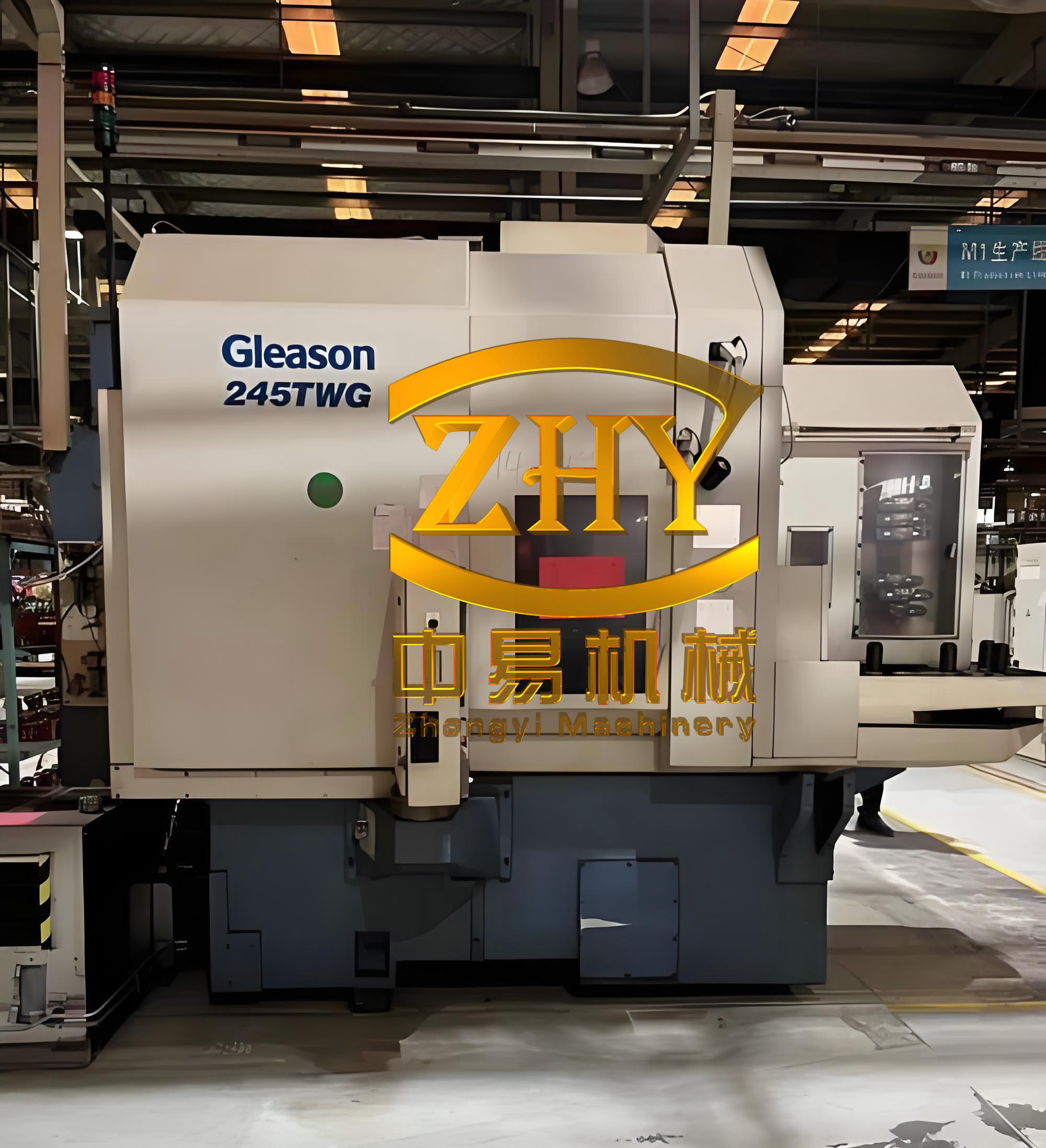
Experimental machining was performed on a CNC profile grinding machine to verify the simulation. The NC program was generated using the calculated T and θ2 values. The grinding wheel, with a specified transition arc, was aligned with the gear, and the chamfering process was executed along the tooth direction. The gear was rotated incrementally for each tooth slot, and the wheel moved helically to complete the chamfer. Post-machining inspection using a gear measurement center compared the chamfered profile to the theoretical one. The actual tooth profile deviated from the theoretical at the tip, with an angle θ_P between the tangents, calculated as:
$$ \theta_P = \arctan\left(\frac{\delta_{GJ}}{\delta_{PJ}}\right) $$
where $\delta_{GJ}$ and $\delta_{PJ}$ are proportional lengths in the grid. Measurements across multiple tooth profiles showed θ_P values with a range of 0.1 degrees, indicating consistent chamfering. This demonstrates the method’s effectiveness in achieving uniform chamfers while minimizing grinding cracks. The integration of chamfering into gear profile grinding streamlines production, reducing the need for secondary operations.
In conclusion, the proposed method for internal helical gear tooth chamfering using a CNC profile grinding machine provides a precise and efficient solution. By deriving mathematical models for wheel retraction and gear rotation, we enable quantitative control over the chamfer dimensions. Simulations and experiments confirm the method’s validity, with errors within practical limits. This approach enhances gear performance by eliminating sharp edges and reducing stress concentrations, ultimately extending service life. Future work could focus on optimizing grinding parameters to further prevent grinding cracks and improve surface quality in gear grinding applications.
The advantages of this method are numerous. First, it eliminates the need for dedicated chamfering equipment, reducing costs and setup time. Second, by performing chamfering within the same setup as gear profile grinding, it ensures higher accuracy and repeatability. Third, the controlled chamfering process minimizes the risk of grinding cracks, which are a common issue in aggressive grinding operations. The mathematical models presented here can be adapted to other gear types, making this approach versatile. In industrial applications, where gear grinding is a critical step, incorporating chamfering can lead to significant productivity gains. For instance, in automotive transmissions, where internal helical gears are prevalent, this method can enhance durability and noise performance. The use of CNC profile grinding machines allows for easy integration into existing production lines, with minimal modifications required.
To further illustrate the computational aspects, consider the derivation of the transition arc radius r. From the geometry, the distance from the root circle to point K is $r_f – y_k$, and the vertical component of the arc center is adjusted by $\sin \theta_t$. Thus, r ensures a smooth transition between the involute and root. In practice, the grinding wheel’s profile must match this arc to avoid undercutting or overcutting. During gear grinding, the wheel’s wear and tear must be monitored to maintain accuracy. Regular dressing of the wheel is necessary to preserve the transition arc geometry. The chamfering process also involves iterative adjustments based on real-time measurements. For example, if grinding cracks are detected, parameters like wheel speed or feed rate can be optimized. The table below summarizes key formulas used in the chamfering calculation.
| Parameter | Formula |
|---|---|
| Transition Arc Radius | $r = \frac{r_f – y_k}{1 – \sin \theta_t}$ |
| Retraction Amount | $T = x_A – \sqrt{r_a^2 – y_A^2}$ |
| Rotation Angle | $\theta_2 = \left( \arctan\left(\frac{x_B}{y_B}\right) – \arcsin\left(\frac{y_A}{r_a}\right) \right) \times \frac{\pi}{180}$ |
| Helical Motion Relation | $\phi = \frac{2h \sin \beta}{m z}$ |
In summary, the integration of tooth chamfering into gear profile grinding represents a significant advancement in gear manufacturing. By addressing issues like grinding cracks and edge sharpness, this method improves overall gear quality. The mathematical models and simulation tools provide a robust framework for implementation. As industries demand higher efficiency and reliability, such innovations in gear grinding will become increasingly important. The continued development of CNC technologies will further enhance the precision and capabilities of profile grinding machines, making them indispensable in modern gear production.