
The pursuit of high-performance, low-noise, and reliable power transmission systems places significant emphasis on understanding the dynamic behavior of gear drives. Among the critical parameters governing this behavior, mesh stiffness stands out as a primary source of excitation and a key indicator of a gear pair’s resistance to deformation under load. Traditionally, mesh stiffness is calculated using static or quasi-static methods such as the potential energy method, finite element analysis (FEA), or hybrid approaches. These methods typically yield a stiffness value that is a function solely of the gear’s angular position or the contact point along the path of contact, implicitly assuming the gear system is stationary or rotating at negligible speed.
However, the operational reality of cylindrical gear systems involves significant rotational speeds. This speed is not merely a scaling factor for input torque or output power; it fundamentally alters the dynamic interaction between mating teeth. The inertia of the gear bodies, the time-dependent application of load as teeth engage and disengage, and the transient vibrational response of the tooth structure itself are all influenced by rotational velocity. Ignoring this effect in stiffness calculation introduces a discrepancy between the modeled excitation and the physical system, potentially leading to inaccurate predictions of dynamic transmission error (DTE), resonance frequencies, and overall vibration levels. Therefore, developing and implementing a methodology to calculate a speed-dependent, or dynamic, mesh stiffness is crucial for advancing the fidelity of cylindrical gear dynamics models.
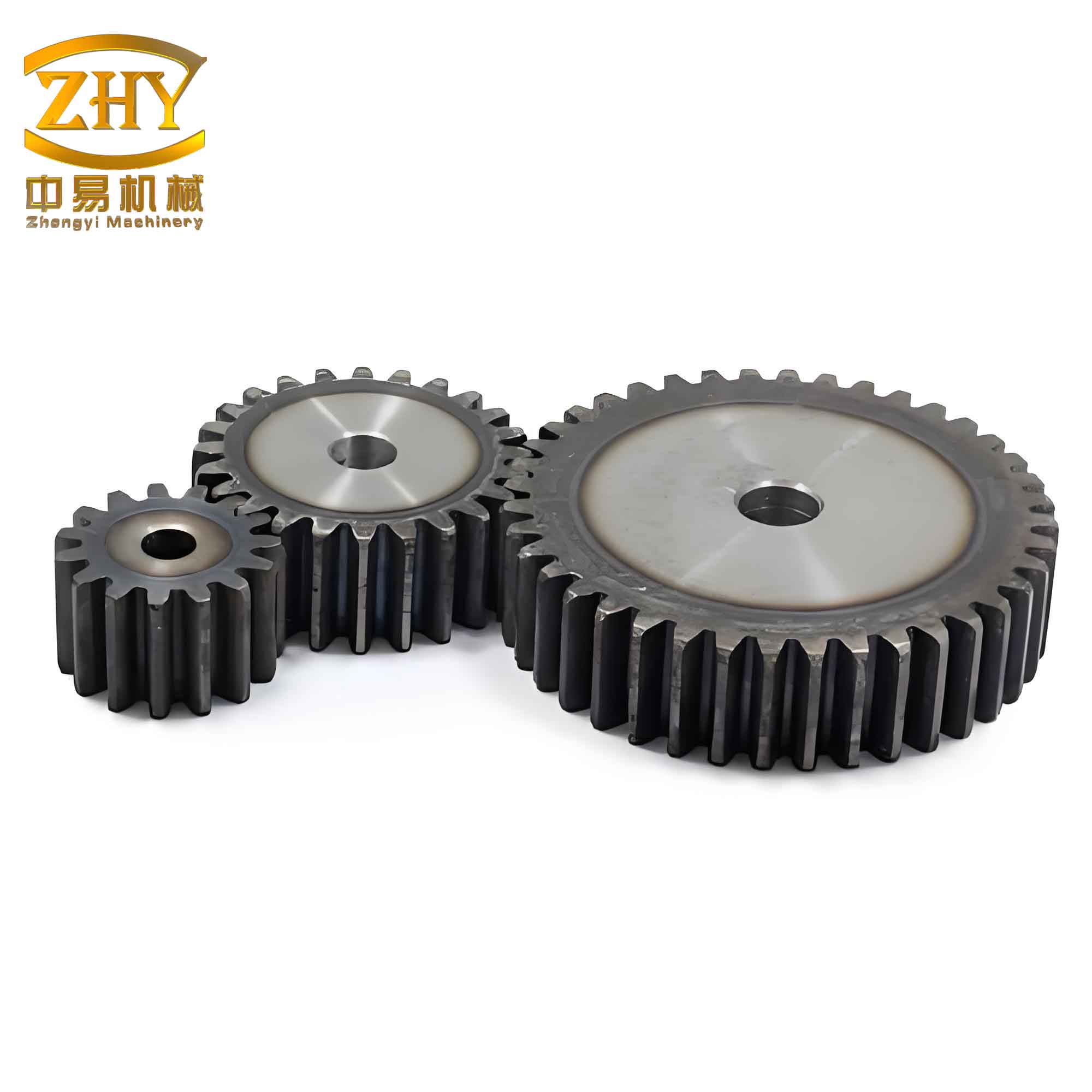
This work presents a comprehensive investigation into the dynamic characteristics of spur gears by explicitly incorporating the effect of rotational speed into the calculation of mesh stiffness. We propose a novel algorithm, grounded in the finite element framework, that utilizes the average acceleration method to solve for the dynamic elastic deformation of gear teeth under operational speeds. This allows for the direct computation of a Dynamic Mesh Stiffness (DTMS). We will systematically analyze how this DTMS varies with speed, contrasting it with the classical Static Mesh Stiffness (STMS). Subsequently, we integrate both stiffness models into a nonlinear, two-degree-of-freedom (2-DOF) lumped parameter dynamic model of a spur gear pair to quantify their impact on key dynamic responses, including DTE amplitude, frequency spectrum, and system bifurcation behavior.
1. Computational Methodology for Speed-Dependent Dynamic Mesh Stiffness
The core of this study lies in the calculation of mesh stiffness that is inherently coupled with the rotational speed of the gear system. Traditional static FEA applies a load and solves for equilibrium deformation. To capture dynamic effects, we must solve the equations of motion for the gear tooth structure as the point of load application moves along the tooth flank at a speed dictated by the gear’s rotation.
1.1. Finite Element Formulation and Dynamic Solution
We begin with a simplified yet representative model: a single gear tooth fixed at the root (simulating connection to the gear body) and free along the involute profile. The governing equation for the dynamic response of this finite element model under a moving load is:
$$ \mathbf{M} \ddot{\mathbf{X}}_i + \mathbf{C} \dot{\mathbf{X}}_i + \mathbf{K} \mathbf{X}_i = \mathbf{F}_i $$
where, for the i-th meshing point:
- $\mathbf{X}_i$, $\dot{\mathbf{X}}_i$, and $\ddot{\mathbf{X}}_i$ are the nodal displacement, velocity, and acceleration vectors, respectively.
- $\mathbf{M}$ and $\mathbf{K}$ are the global mass and stiffness matrices, assembled using standard finite element procedures for plane stress/strain quadrilateral isoparametric elements.
- $\mathbf{C}$ is the damping matrix, modeled using Rayleigh damping: $\mathbf{C} = \alpha \mathbf{M} + \beta \mathbf{K}$, where $\alpha$ and $\beta$ are the mass and stiffness proportional damping coefficients.
- $\mathbf{F}_i$ is the time-varying force vector. Only the degrees of freedom corresponding to the current contact point $i$ are loaded with the mesh force $F$. The force direction is along the line of action, making an angle $\beta_i$ with the vertical axis:
$$ \beta_i = \arccos\left(\frac{R_{bp}}{\sqrt{x_i^2 + y_i^2}}\right) – \arctan\left(\frac{y_i}{x_i}\right) $$
Here, $(x_i, y_i)$ are the coordinates of the i-th discretized point on the involute profile, and $R_{bp}$ is the base circle radius of the pinion (driving gear).
The critical innovation is linking the load application speed to the gear’s rotational speed, $\dot{\theta}_p$. The tangential velocity $v_i$ of a point on the involute profile at radius $\sqrt{x_i^2 + y_i^2}$ is:
$$ v_i = \frac{\pi \dot{\theta}_p \sqrt{x_i^2 + y_i^2}}{30} $$
As the load moves from point $i$ to $i+1$, the average meshing velocity $v_a$ is used:
$$ v_a = \frac{v_i + v_{i+1}}{2} $$
The time interval $\Delta t_i$ for the load to traverse between these points becomes the essential load step for the dynamic solver:
$$ \Delta t_i = \frac{2 \sqrt{(x_{i+1} – x_i)^2 + (y_{i+1} – y_i)^2}}{v_a} $$
This $\Delta t_i$ is inversely proportional to the rotational speed $\dot{\theta}_p$. A higher speed results in a shorter load application time at each discrete point, fundamentally changing the dynamic deformation response compared to a quasi-static load.
1.2. Algorithm Implementation using the Average Acceleration Method
To solve Equation (1) iteratively as the load moves, we employ the unconditionally stable average acceleration method (a type of Newmark-β method with β=1/4, γ=1/2). The procedure is as follows:
- Initialization: For the first meshing point ($i=1$), set initial dynamic conditions: $\dot{\mathbf{X}}_1 = \mathbf{0}$, $\ddot{\mathbf{X}}_1 = \mathbf{0}$. The initial displacement $\mathbf{X}_1$ is found from the static solution: $\mathbf{X}_1 = \mathbf{K}^{-1} \mathbf{F}_1$.
- Iteration: For each subsequent meshing point $i$ (from 2 to N):
- Compute the time step $\Delta t_{i-1}$ using the velocity from the previous segment.
- Using the known state vectors $\mathbf{X}_{i-1}$, $\dot{\mathbf{X}}_{i-1}$, $\ddot{\mathbf{X}}_{i-1}$ at time $t$, calculate the predictors for time $t+\Delta t$.
- Solve for the acceleration $\ddot{\mathbf{X}}_i$ at the new time using the equation of motion.
- Update the velocity and displacement vectors to obtain $\dot{\mathbf{X}}_i$ and $\mathbf{X}_i$.
- Deformation Extraction: From the final dynamic displacement vector $\mathbf{X}_i$, extract the x and y components ($\Delta x_i$, $\Delta y_i$) for the loaded node at the i-th contact point.
The dynamic single-tooth stiffness for the pinion $k_{p}^{d}(i)$ at point $i$ is then calculated from the deflection along the line of action:
$$ k_{p}^{d}(i) = \frac{F}{ \Delta x_i \cos(\pi/2 – \beta_i) + \Delta y_i \cos(\beta_i) } $$
A similar process is conducted for the gear tooth model to obtain $k_{g}^{d}(i)$. The total dynamic mesh stiffness for a single tooth pair $k_{ms}^{d}(i)$ is:
$$ k_{ms}^{d}(i) = \left( \frac{1}{k_{p}^{d}(i)} + \frac{1}{k_{g}^{d}(i)} \right)^{-1} $$
Finally, the total effective mesh stiffness $K_m^{d}(t)$ over a mesh cycle is assembled by superimposing the stiffness of simultaneously engaged tooth pairs according to the contact ratio, following the same logic as static models but using the speed-dependent $k_{ms}^{d}$ values. The algorithm’s logic flow is encapsulated in the process below.
| Step | Action | Key Equation / Output |
|---|---|---|
| 1 | Discretize tooth profile into N points. | Generate $(x_i, y_i)$ for i=1…N |
| 2 | For given speed $\dot{\theta}_p$, compute meshing velocity $v_i$ and time step $\Delta t_i$. | $v_a = \frac{v_i+v_{i+1}}{2}$; $\Delta t_i = 2 \cdot \text{distance} / v_a$ |
| 3 | Initialize dynamic solver with static solution at first point. | $\mathbf{X}_1 = \mathbf{K}^{-1}\mathbf{F}_1$ |
| 4 | Iterate using average acceleration method for i=2 to N. | Solve Eq.(1) to find $\mathbf{X}_i$, $\dot{\mathbf{X}}_i$, $\ddot{\mathbf{X}}_i$ |
| 5 | Extract deformation and compute single-point dynamic stiffness. | $k_{p}^{d}(i)$, $k_{g}^{d}(i)$ from Eq.(7) |
| 6 | Compute single-pair stiffness and assemble total mesh stiffness over cycle. | $K_m^{d}(t)$ from Eq.(8) and contact ratio |
2. Dynamic Modeling of a Spur Gear System
To assess the impact of the computed Dynamic Mesh Stiffness (DTMS) on system behavior, we employ a well-established nonlinear 2-DOF torsional model of a spur gear pair. The model considers gears as rigid disks connected by a nonlinear spring-damper element representing the gear mesh, which includes time-varying stiffness, viscous damping, and sliding friction.
The equations of motion are derived from Newton’s second law:
$$
\begin{aligned}
J_p \ddot{\theta}_p + R_{bp} \sum_{j=1}^{n} F_m^j – \sum_{j=1}^{n} R_{fp}^j F_f^j &= T_p \\
J_g \ddot{\theta}_g + R_{bg} \sum_{j=1}^{n} F_m^j + \sum_{j=1}^{n} R_{fg}^j F_f^j &= -T_g
\end{aligned}
$$
where:
- $J_p$, $J_g$: Mass moments of inertia of pinion and gear.
- $\theta_p$, $\theta_g$: Angular displacements.
- $R_{bp}$, $R_{bg}$: Base circle radii.
- $n$: Number of tooth pairs in contact (1 or 2).
- $T_p$, $T_g$: Input and output torques.
- $R_{fp}^j$, $R_{fg}^j$: Friction arms for the j-th tooth pair.
- $F_f^j$: Sliding friction force on the j-th tooth pair, $F_f^j = \mu F_m^j \text{sign}(u_s)$, where $\mu$ is a friction coefficient and $u_s$ is the sliding velocity.
The central component is the dynamic mesh force $F_m^j$ for the j-th tooth pair:
$$ F_m^j = k_m^j(t) \delta(t) + c_m^j \dot{\delta}(t) $$
Here, $\delta(t)$ is the Dynamic Transmission Error (DTE), defined as the relative displacement of the gears along the line of action:
$$ \delta(t) = R_{bp} \theta_p(t) – R_{bg} \theta_g(t) $$
The mesh damping $c_m$ is calculated using an empirical formula related to the mesh stiffness and system inertias:
$$ c_m = 2 \zeta \sqrt{ \frac{k_m R_{bp}^2 R_{bg}^2 J_p J_g}{R_{bp}^2 J_p + R_{bg}^2 J_g} } $$
where $\zeta$ is the damping ratio. The key variable is $k_m^j(t)$, the mesh stiffness. In this study, we compare two cases:
- STMS Model: $k_m^j(t)$ is the traditional static, position-only-dependent stiffness.
- DTMS Model: $k_m^j(t)$ is the speed-dependent dynamic stiffness computed via the algorithm in Section 1.
By integrating these two stiffness models into the same dynamic equations, we can isolate and analyze the effect of speed-dependent stiffness on the system’s nonlinear response. The parameters for the example gear pair used in this analysis are summarized below.
| Parameter | Pinion (Driving Gear) | Gear (Driven Gear) |
|---|---|---|
| Number of Teeth | 23 | 47 |
| Module (mm) | 2.5 | |
| Pressure Angle (°) | 20 | |
| Face Width (mm) | 10 | |
| Base Circle Radius (mm) | 27.02 | 55.21 |
| Mass Moment of Inertia (kg·m²) | 2.1e-4 | 3.7e-4 |
| Young’s Modulus (GPa) | 211 | |
| Poisson’s Ratio | 0.3 | |
3. Analysis of Speed-Dependent Dynamic Mesh Stiffness
3.1. Validation of the Computational Method
To verify the proposed algorithm, we first compare its results under a quasi-static condition ($\dot{\theta}_p = 0.01 \text{ r/min}$) with results from a commercial static FEA solver and the analytical potential energy method (PEM). The single-tooth stiffness and the complete mesh stiffness over one engagement cycle are examined.
Under quasi-static conditions, the dynamic algorithm’s output converges to the static solution, with excellent agreement against the PEM reference. The minor discrepancies with the commercial FEA results are attributed to differences in numerical integration schemes for element stiffness matrices. At an operational speed (e.g., $\dot{\theta}_p = 1300 \text{ r/min}$), the algorithm produces a dynamically fluctuating stiffness, which is the primary focus. This validates the algorithm’s capability to transition from static to dynamic regimes.
3.2. Influence of Rotational Speed on Mesh Stiffness
The computed Dynamic Mesh Stiffness (DTMS) reveals a fundamental characteristic: it oscillates around the static stiffness (STMS) trajectory. The amplitude and frequency of this oscillation are direct functions of the pinion’s rotational speed, $\dot{\theta}_p$.
$$ K_m^{d}(t, \dot{\theta}_p) = K_m^{s}(t) + A(\dot{\theta}_p) \cdot \sin(2\pi f(\dot{\theta}_p) t + \phi) $$
where $A(\dot{\theta}_p)$ is the oscillation amplitude and $f(\dot{\theta}_p)$ is a frequency related to the meshing impact and the system’s natural frequencies.
Table 3 summarizes the observed trends from simulations across a speed range:
| Rotational Speed $\dot{\theta}_p$ | Oscillation Amplitude $A$ | Oscillation Frequency | Phase Shift vs. STMS | Primary Affected Zone |
|---|---|---|---|---|
| Low (e.g., 500 rpm) | Small | Relatively High | Minor | Single & Double Contact |
| Medium (e.g., 2500 rpm) | Moderate | Medium | Noticeable | Predominantly Double Contact |
| High (e.g., 6000 rpm) | Large | Lower | Significant | Strongly in Double Contact |
The physical explanation is rooted in forced vibration dynamics. At higher speeds, the load application time $\Delta t_i$ per discrete point decreases. The elastic deformation from the previous contact point does not have sufficient time to fully recover before the load moves to the next point, leading to a cumulative effect and larger amplitude oscillations. Furthermore, the dynamic interaction excites different modal responses of the tooth structure, which depend on the excitation frequency (linked to $v_a$). This causes the observed shift in the phase and the number of oscillations per mesh cycle. Critically, the double-tooth contact region shows more pronounced dynamic variation because the stiffness there is a superposition of two individual tooth stiffnesses, each undergoing its own dynamic fluctuation.
4. Dynamic Response of the Gear System with DTMS
Integrating the DTMS into the nonlinear dynamic model yields significant differences in predicted system behavior compared to the traditional STMS model. A primary control parameter is the pinion speed, $\dot{\theta}_p$.
4.1. Dynamic Transmission Error and Resonance Analysis
A speed sweep analysis from 500 to 8000 rpm was conducted, and the maximum DTE amplitude for each speed was recorded for both stiffness models. The results, plotted as a frequency response curve, show that while both models predict a similar number of primary resonance peaks, the resonant speed intervals are shifted.
$$ \Omega_{res}^{DTMS} = \Omega_{res}^{STMS} \pm \Delta \Omega(\dot{\theta}_p) $$
Where $\Delta \Omega(\dot{\theta}_p)$ is a speed-dependent shift. This shift can be positive (resonance at a higher speed for DTMS) or negative (resonance at a lower speed). This is a direct consequence of the phase and amplitude modulation of the stiffness excitation described earlier. Furthermore, the peak DTE amplitude at a given resonance can be larger or smaller for the DTMS model, indicating that the speed-dependent stiffness can either amplify or attenuate vibration depending on the specific speed range. This non-monotonic relationship underscores the complexity introduced by dynamic stiffness.
4.2. Time-Domain, Frequency-Domain, and Phase Portrait Comparison
Detailed comparisons at selected speeds (e.g., 2050, 3700, 6140 rpm) reveal further insights:
- Time-Domain DTE: The waveform periodicity is similar, but the instantaneous amplitude differs. The DTMS model often shows sharper transitions corresponding to the dynamic stiffness fluctuations during tooth engagement/disengagement events.
- Velocity Jumps: Sudden changes in the DTE velocity ($\dot{\delta}$) are more pronounced in the DTMS model, correlating with the rapid changes in the instantaneous dynamic stiffness value.
- Frequency Spectrum: Both models show mesh frequency harmonics. However, the DTMS model consistently exhibits stronger super-harmonic and sub-harmonic components, especially at higher speeds. This indicates that the nonlinearity due to parametric excitation is enriched by the speed-coupled stiffness variation. The spectrum for the DTMS model can be represented as containing additional components:
$$ \text{FFT}(DTE_{DTMS}) \approx \text{FFT}(DTE_{STMS}) + \sum B_n(\dot{\theta}_p) \cdot \delta(f – n \cdot f_m \pm f_d) $$
where $f_m$ is the mesh frequency, $f_d$ is a frequency related to the stiffness oscillation, and $B_n$ are amplitudes. - Phase Portraits: Both models exhibit periodic ($n$-P) motions at the selected speeds. The phase trajectories for the DTMS model may appear slightly “rougher” or more distorted due to the higher frequency content present in the excitation, but the fundamental periodic structure remains.
4.3. Bifurcation and Periodicity Analysis
The most profound effect of DTMS is observed in the long-term dynamic regime, analyzed via bifurcation diagrams. The diagram plots local maxima of DTE against the control parameter $\dot{\theta}_p$. The number of distinct points at a given speed indicates the period of the motion (e.g., 1 point for period-1, 5 points for period-5).
Comparison of bifurcation diagrams reveals that the DTMS alters the speed boundaries of different periodic regimes. For instance, a period-5 motion might exist in the speed range $[\Omega_1^{STMS}, \Omega_2^{STMS}]$ for the static model, but in the range $[\Omega_1^{DTMS}, \Omega_2^{DTMS}]$ for the dynamic model, where $\Omega_1^{DTMS} \neq \Omega_1^{STMS}$ and $\Omega_2^{DTMS} \neq \Omega_2^{STMS}$. The shift is not uniform; some periodic windows widen, others narrow, and transition speeds change. This implies that predicting stability and vibration period based on a static stiffness model can be erroneous at specific operational speeds. The table below contrasts a sample of periodic windows.
| Periodic Motion | Speed Range (STMS Model) | Speed Range (DTMS Model) | Observation |
|---|---|---|---|
| 5-P | 3349 – 4356 rpm | 3301 – 4325 rpm | Window slightly shifted and narrowed. |
| 4-P | 4357 – 5023 rpm | 4326 – 4999 rpm | Lower bound decreased, upper bound slightly decreased. |
| 3-P | 5024 – 6821 rpm | 5120 – 7059 rpm | Window shifted to higher speeds and widened. |
| 2-P (Stable) | > 6821 rpm | > 7059 rpm | Onset of stable 2-P motion occurs at a higher speed with DTMS. |
The overall trend shows that the system’s route to simpler periodic motion (like 2-P) as speed increases is modified when dynamic stiffness effects are considered, highlighting the importance of this factor for accurate dynamic design and avoidance of undesirable vibrational states in high-speed cylindrical gear applications.
5. Discussion and Implications
The findings of this study demonstrate that rotational speed is not merely an independent variable scaling the forcing frequency but is intrinsically coupled with the primary internal excitation parameter—mesh stiffness—in cylindrical gear systems. The proposed dynamic mesh stiffness (DTMS) model captures forced vibrational effects in the tooth structure itself, which are absent in static calculations.
The practical implications are significant for gear design and analysis:
- Resonance Prediction: Designers relying on static stiffness may misidentify critical speeds. The DTMS model shows that resonance zones can shift forward or backward on the speed axis. This is crucial for defining “green zones” for operation and avoiding resonant conditions in variable-speed drives.
- Vibration Amplitude Estimation: The DTE amplitude, a primary source of noise and housing vibration, can be either under- or over-estimated by static models depending on the speed. Accurate prediction requires the coupled speed-stiffness analysis provided by the DTMS approach.
- Nonlinear Dynamics Mapping: The changes in bifurcation structure and periodic windows indicate that the global dynamic landscape of the gear system is altered. This affects predictions related to sub-harmonic vibrations, chaos, and the stability of periodic motions, which are important for long-term reliability.
- High-Speed Applications: The effects are particularly pronounced at medium to high speeds. For aerospace, automotive, or high-performance industrial gearboxes, incorporating dynamic stiffness effects is essential for predictive accuracy.
Future work could extend this methodology to helical cylindrical gears, where the contact line moves diagonally, adding spatial complexity. Furthermore, coupling the tooth dynamics model with gear body dynamics (shafts, bearings) in a full multi-body simulation would provide a complete system-level view. Investigating the interaction between dynamic stiffness and other nonlinearities like backlash, tooth profile modifications, and defects (cracks, spalls) is another promising direction.
6. Conclusion
This investigation has established a clear link between the rotational speed of spur gears and their effective mesh stiffness, leading to a more comprehensive understanding of gear dynamics. The key conclusions are:
- A novel computational algorithm based on the finite element method and the average acceleration technique was successfully developed to calculate a speed-dependent Dynamic Mesh Stiffness (DTMS). This stiffness oscillates around the classic Static Mesh Stiffness (STMS), with amplitude and phase that are direct functions of rotational speed.
- As rotational speed increases, the fluctuation amplitude of the DTMS relative to the STMS increases, while the number of oscillations per mesh cycle may decrease, due to the cumulative effect of transient tooth deformation under rapidly moving load.
- The dynamic response of the gear system is significantly affected by using DTMS. Resonant speed intervals are shifted, and the relationship between DTE amplitude and speed differs from the STMS prediction. Super-harmonic responses are more pronounced in the DTMS model at higher speeds.
- The bifurcation behavior of the nonlinear system is altered. The speed ranges corresponding to specific $n$-periodic motions change when DTMS is considered, affecting the prediction of vibration periodicity and stability thresholds.
In summary, for an accurate dynamic analysis of cylindrical gear systems, especially those operating at medium to high speeds, the dependence of mesh stiffness on rotational speed must be accounted for. The methodology and findings presented here provide a foundation for improving the design, performance prediction, and noise-vibration-harshness (NVH) optimization of gear transmissions, contributing to the development of more efficient and reliable mechanical systems.