
In the field of power transmission, the performance and longevity of geared systems are paramount. Among various gear types, the helical spur gear stands out due to its smooth operation, high load-carrying capacity, and suitability for high-speed applications. However, these advantages are intrinsically linked to the lubrication conditions between the meshing teeth. The lubrication regime, particularly Elastohydrodynamic Lubrication (EHL), plays a critical role in preventing surface failures like scuffing, pitting, and wear, thereby dictating the overall efficiency and service life of a helical spur gear transmission. This article delves into a comprehensive analysis of how key geometric and operational parameters of a helical spur gear influence the crucial parameter of minimum oil film thickness within the EHL regime.
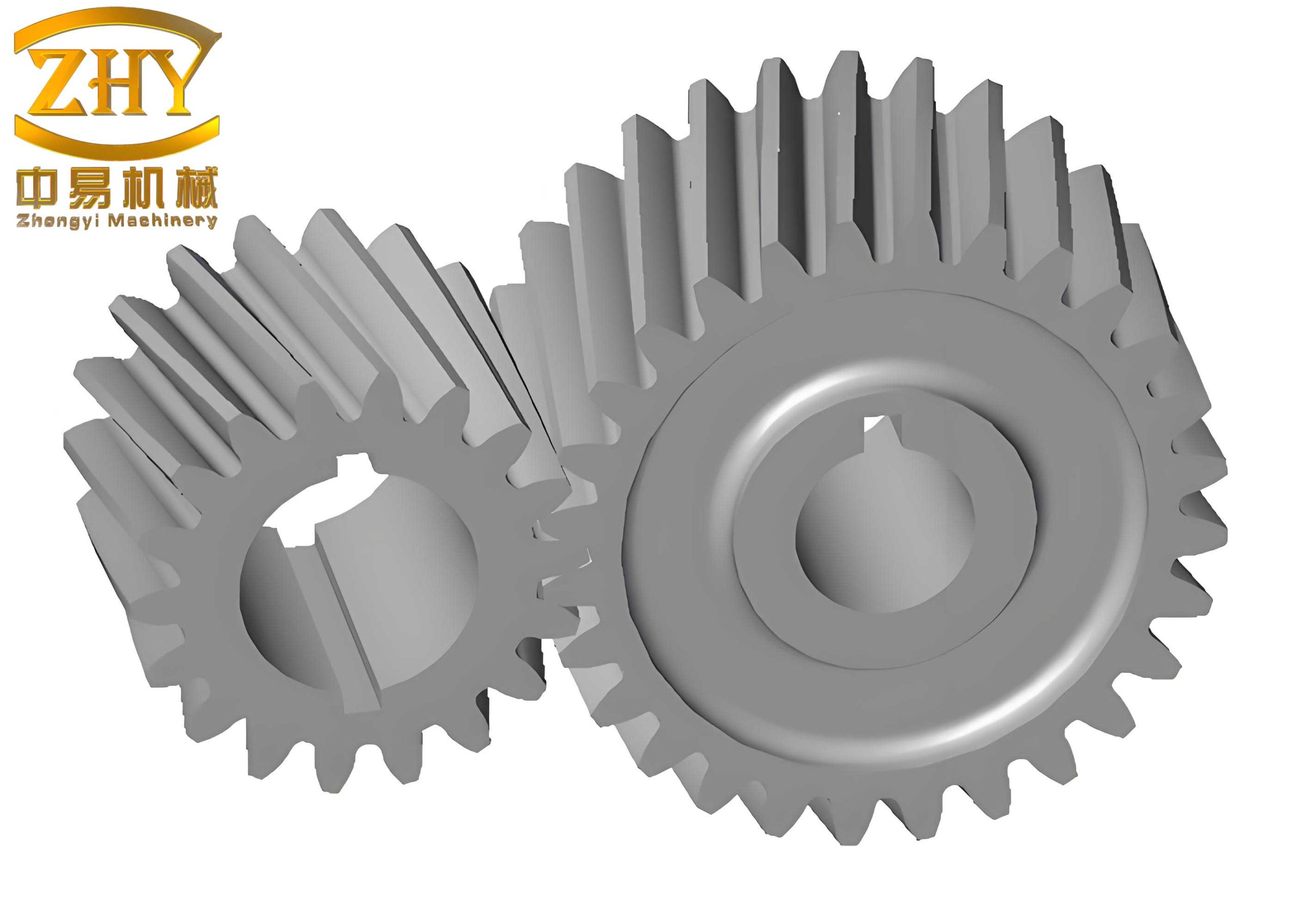
The study of gear lubrication has evolved significantly since Martin first applied Reynolds’ equations in 1916. Modern EHL theory provides a robust framework for modeling the highly stressed, conformal contact found in gear meshes. For a helical spur gear pair, the contact conditions are transient and complex. As the teeth roll and slide along the path of contact, the instantaneous radii of curvature, the entrainment velocity, and the load per unit length vary continuously, leading to a dynamically changing oil film profile. Understanding this variation and the factors that control it is essential for optimal helical spur gear design. In our investigation, we leverage established EHL theory coupled with computational analysis to systematically explore the impact of design parameters—transmission ratio, module, pressure angle, helix angle, and face width factor—on the lubricant film separating helical spur gear teeth.
Theoretical Framework for Helical Spur Gear EHL Analysis
The contact between meshing gear teeth can be effectively modeled as the contact between two equivalent cylinders in pure rolling. This analogy allows the application of classical EHL formulas. For our analysis of the helical spur gear, we employ a refined minimum film thickness formula derived from a full numerical solution using the Roelands viscosity-pressure relationship. This formula is considered more accurate across a wide range of operating conditions compared to the classic Dowson-Higginson equation. The fundamental equation for calculating the minimum EHL film thickness in a helical spur gear contact is given by:
$$ h_{min} = 6.76 \, \alpha^{0.53} \, \eta_0^{0.75} \, {E’}^{-0.06} \, R^{0.41} \, U^{0.75} \, {W’}^{-0.16} $$
In this equation, $\alpha$ is the pressure-viscosity coefficient of the lubricant, $\eta_0$ is the dynamic viscosity at atmospheric pressure, and $E’$ is the effective elastic modulus of the gear material. The parameters $R$, $U$, and $W’$ are dynamic and depend directly on the geometry and loading of the helical spur gear pair at any given point along the meshing path.
Derivation of Gear-Dependent EHL Parameters
1. Equivalent Radius of Curvature, $R$:
For an external helical spur gear pair with center distance $a$ and gear ratio $i = z_2/z_1$, the pitch radii are $r_1 = a/(1+i)$ and $r_2 = a \cdot i/(1+i)$. At a generic contact point located a distance $x$ from the pitch point along the line of action, the radii of curvature for the pinion and gear are $R_1 = r_1 \sin\alpha_n + x$ and $R_2 = r_2 \sin\alpha_n – x$, where $\alpha_n$ is the normal pressure angle. The equivalent radius of curvature for the helical spur gear, accounting for the helix angle $\beta$, is:
$$ R = \frac{R_1 R_2}{(R_1 + R_2) \cos^2\beta} = \frac{(r_1 \sin\alpha_n + x)(r_2 \sin\alpha_n – x)}{(r_1 + r_2) \sin\alpha_n \cos^2\beta} $$
This shows that $R$ increases with both the normal pressure angle $\alpha_n$ and the helix angle $\beta$.
2. Entrainment Velocity, $U$:
The surface velocities of the pinion and gear relative to the contact point are $U_1 = (\pi n_1/30) (r_1 \sin\alpha_n + x)/\cos\beta$ and $U_2 = (\pi n_2/30) (r_2 \sin\alpha_n – x)/\cos\beta$, where $n_1$ and $n_2$ are rotational speeds. The entrainment velocity, which is the average speed drawing lubricant into the contact, is:
$$ U = \frac{U_1 + U_2}{2} = \frac{\pi n_1}{30 \cos\beta} \left( r_1 \sin\alpha_n + \frac{x}{2}(1 – \frac{1}{i}) \right) $$
It is clear from this equation that the entrainment velocity in a helical spur gear increases with the helix angle $\beta$ and the transmission ratio $i$.
3. Load per Unit Length, $W’$:
The load distribution along the contact line of a helical spur gear is complex due to the overlapping, angled contact lines. For simplification in analytical studies, the load distribution along the path of contact is often approximated similarly to spur gears, but scaled by the helical geometry. The total normal load $F_n$ at the pitch point is $F_n = F_t / (\cos\alpha_n \cos\beta)$, where $F_t = 2T_1 / d_1$ is the tangential force. The face width is $b = \psi_d \cdot d_1$, where $\psi_d$ is the face width factor. The load per unit length at the pitch point, $W$, is then:
$$ W = \frac{F_n}{b / \cos\beta} = \frac{2 T_1 \cos\beta_b}{\psi_d d_1^2 \cos\beta \cos\alpha_n} $$
Along the path of contact, $W’$ varies. In double-tooth contact zones, the load is shared, leading to a lower $W’$, while in the single-tooth contact zone, $W’$ equals $W$. This can be modeled piecewise based on the distances to the start and end of single-pair contact.
4. Composite Film Thickness Equation:
Substituting the expressions for $R$, $U$, and $W’$ into the base film thickness formula yields a comprehensive equation for the minimum oil film thickness at any point $x$ along the meshing path of a helical spur gear:
$$ h_{min}(x) = 6.76 \, \alpha^{0.53} \, \eta_0^{0.75} \, {E’}^{-0.06} \, \left( \frac{\pi n_1}{30\cos \beta} \right)^{0.75} \, \left( r_1\sin \alpha_n + \frac{x}{2}\left(1-\frac{1}{i}\right) \right)^{0.75} \, \left[ \frac{( r_1\sin \alpha_n + x)( r_2\sin \alpha_n – x)}{( r_1+ r_2)\sin \alpha_n \cos^2\beta} \right]^{0.41} \, {W'(x)}^{-0.16} $$
The lubrication state is commonly assessed using the specific film thickness or lambda ratio, $\lambda = h_{min} / \sigma$, where $\sigma$ is the composite root-mean-square surface roughness. A $\lambda > 3$ indicates full-film EHL, $1 < \lambda < 3$ indicates mixed lubrication, and $\lambda < 1$ signifies boundary lubrication with high risk of surface damage.
Parametric Study and Discussion of Results
To systematically analyze the influence of helical spur gear parameters, we define a base case and then vary one parameter at a time. Computational analysis is employed to solve the film thickness equation along the entire path of contact and particularly at the pitch point, which offers a representative average value.
| Parameter | Base Case Value |
|---|---|
| Pinion Teeth, $z_1$ | 22 |
| Gear Teeth, $z_2$ | 77 |
| Normal Module, $m_n$ (mm) | 3 |
| Normal Pressure Angle, $\alpha_n$ | 20° |
| Helix Angle, $\beta$ | 8° |
| Face Width Factor, $\psi_d$ | 1.0 |
| Center Distance, $a$ (mm) | Derived |
| Pinion Speed, $n_1$ (rpm) | 1000 |
| Input Torque, $T_1$ (N·mm) | 1×10⁵ |
| Lubricant $\alpha$ (mm²/N) | 2.272×10⁻² |
| Lubricant $\eta_0$ (N·s/mm²) | 5.4×10⁻⁸ |
| Effective Modulus, $E’$ (N/mm²) | 2.3×10⁵ |
Film Thickness Variation Along the Path of Contact
Analysis of the helical spur gear base case reveals that the minimum oil film thickness is not constant during mesh. It follows a distinct profile where the film is thinnest near the point where the gear tooth tip engages with the pinion tooth root (start of single-pair contact for that tooth pair). The film thickness gradually increases, reaching a maximum near the point where the pinion tooth tip disengages from the gear tooth root. The film thickness at the pitch point is close to the average value across the mesh cycle. This profile underscores the critical nature of the engagement region for potential lubrication failure in a helical spur gear. Furthermore, a higher contact ratio, often achieved with a larger helix angle or more teeth, tends to increase the average film thickness by better distributing the load.
Influence of Transmission Ratio and Module
Varying the transmission ratio $i$ (gear ratio) from low (speed-increasing) to high (speed-reducing) values shows a consistent trend. The pitch point film thickness increases with the transmission ratio. This increase is more pronounced in the speed-increasing range ($i < 1$) and becomes gradual in the speed-reducing range ($i > 1$). The primary reason is the growth in the equivalent radius of curvature $R$ as $i$ increases. When examining the effect of the normal module $m_n$, a significant finding emerges. For a fixed center distance, increasing the module (resulting in fewer teeth) decreases the film thickness. Conversely, choosing a smaller module (more teeth) enhances the film thickness. This is attributed to the increase in the equivalent radius $R$ and the contact ratio associated with a higher tooth count. The relationship can be summarized as follows for a helical spur gear with constant center distance:
$$ \text{Smaller } m_n \rightarrow \text{More Teeth} \rightarrow \text{Larger } R \text{ and Higher } \epsilon \rightarrow \text{Thicker } h_{min} $$
| Parameter Change | Effect on $R$ | Effect on $U$ | Effect on $W’$ | Net Effect on $h_{min}$ |
|---|---|---|---|---|
| Increase Module ($m_n$), fixed $a$ | Decreases | Minor Change | Increases | Decrease |
| Increase Trans. Ratio ($i$) | Increases | Increases | Minor Change | Increase |
Influence of Normal Pressure Angle
The normal pressure angle $\alpha_n$ is a fundamental design parameter for a helical spur gear. Our analysis considers common values: 14.5°, 20°, and 25°. The results indicate a strong positive correlation: the minimum oil film thickness increases significantly with an increase in the normal pressure angle. This is directly linked to the geometry; a larger pressure angle increases the radius of curvature of the tooth profile at the pitch point, thereby increasing the equivalent radius $R$ in the EHL formula. This result aligns with mechanical strength considerations, where a larger pressure angle improves the bending strength of the gear tooth. The use of 25° pressure angle in aerospace helical spur gear applications is thus justified not only by strength but also by improved inherent lubrication conditions.
Influence of Helix Angle
The helix angle $\beta$ is the defining feature that differentiates a helical spur gear from a spur gear. Its influence on EHL film thickness is multifaceted and profoundly positive. As the helix angle increases:
- Entrainment Velocity ($U$): Increases proportionally to $1/\cos\beta$.
- Equivalent Radius ($R$): Increases proportionally to $1/\cos^2\beta$.
- Load per Unit Length ($W’$): Decreases due to the longer contact line and increased total contact ratio ($\epsilon_\gamma = \epsilon_\alpha + \epsilon_\beta$).
All three effects contribute to a thicker EHL film. Our parametric study, comparing $\beta = 0°$ (spur), $8°$, and $20°$, confirms a substantial increase in $h_{min}$ with $\beta$. However, very large helix angles introduce high axial thrust loads. Therefore, for optimal helical spur gear design balancing lubrication, load capacity, and efficiency, a helix angle in the range of $8°$ to $20°$ is typically recommended.
$$ h_{min} \propto U^{0.75} R^{0.41} {W’}^{-0.16} \propto (\cos\beta)^{-0.75} (\cos\beta)^{-0.82} (\text{Decreasing function}) \approx (\cos\beta)^{-1.57} $$
This simplified proportionality highlights the strong inverse relationship with $\cos\beta$.
Influence of Face Width Factor
The face width factor $\psi_d$ determines the face width relative to the pinion pitch diameter ($b = \psi_d \cdot d_1$). Analysis shows that increasing $\psi_d$ leads to an increase in the minimum oil film thickness. The mechanism is straightforward: a wider face increases the total length of the contact lines, which reduces the load carried per unit length ($W’$). Since $h_{min} \propto {W’}^{-0.16}$, a reduction in $W’$ results in a thicker, though not dramatically thicker, film. This indicates that from a purely lubrication perspective, a wider helical spur gear is beneficial. However, this must be balanced against manufacturing constraints, weight, and the need to ensure uniform load distribution across the face width.
| Design Parameter | Primary Effect on EHL Drivers | Overall Trend for $h_{min}$ |
|---|---|---|
| Normal Pressure Angle ($\alpha_n$) | Strongly increases equivalent radius ($R$). | Significant Increase |
| Helix Angle ($\beta$) | Increases $R$ and $U$; decreases $W’$. | Strong Increase |
| Module ($m_n$), fixed $a$ | Larger $m_n$ decreases $R$ and contact ratio. | Decrease (favors finer teeth) |
| Face Width Factor ($\psi_d$) | Increases face width, decreasing $W’$. | Moderate Increase |
| Transmission Ratio ($i$) | Increases $R$ and slightly increases $U$. | Increase |
Conclusions and Engineering Implications
This comprehensive parametric investigation, grounded in EHL theory, elucidates the clear and quantifiable relationships between key design parameters of a helical spur gear and its lubrication performance, characterized by the minimum EHL film thickness. The findings provide valuable guidelines for designers aiming to enhance the reliability and durability of helical spur gear transmissions.
The helix angle emerges as the most powerful single parameter for improving EHL conditions, significantly boosting film thickness through multiple synergistic mechanisms. The normal pressure angle also offers a strong positive influence on film thickness, corroborating its selection for high-performance applications. Notably, for a given center distance, the traditional strength-driven approach of selecting a larger module may be detrimental to lubrication; a design with a finer pitch (smaller module, more teeth) promotes a thicker oil film. Furthermore, increasing the face width and operating at higher reduction ratios generally improve the lubrication regime.
For practical helical spur gear design, these insights advocate for a holistic approach that integrates tribological considerations with traditional strength and dynamic analyses. Optimizing a helical spur gear for longevity requires selecting a combination of parameters—such as a moderate-to-high helix angle (e.g., 12°-18°), a standard or slightly increased pressure angle (20°-25°), a finer tooth pitch where feasible, and an adequate face width—that collectively maximize the specific film thickness ($\lambda$). This ensures operation in the protective full-film EHL regime, minimizing wear and surface fatigue, and ultimately leading to more efficient, reliable, and durable gear drives. Future work could integrate this EHL analysis with gear tooth bending and contact stress models to create a true multi-objective optimization framework for helical spur gear design.