
In the field of mechanical engineering, the dynamic behavior of gear transmission systems is paramount for ensuring efficiency, durability, and noise reduction. Among various gear types, the cylindrical gear, particularly the spur variant, is fundamental due to its simplicity and widespread application. However, inherent internal excitations, primarily stemming from time-varying meshing stiffness (TVMS), often lead to vibrations and acoustic emissions. To mitigate these issues, tooth profile modification, commonly referred to as “deflection” or “shift,” is employed. This practice involves deliberately altering the standard involute profile to optimize performance. In this study, I aim to delve deeply into the effects of such modifications on the meshing dynamics of cylindrical spur gears. By establishing a comprehensive analytical model and employing numerical simulations, I explore how single and compound profile shifts influence TVMS and subsequent dynamic responses. The findings presented here contribute to a refined understanding of design parameters for enhanced cylindrical gear systems.
The significance of cylindrical gear systems in power transmission cannot be overstated. They are the backbone of countless industrial machines, automotive drivetrains, and precision instruments. A key challenge in their design is managing the dynamic interactions between meshing teeth. The time-varying nature of meshing stiffness acts as a primary internal excitation source, inducing vibrations that can lead to noise, fatigue, and premature failure. Tooth profile modification emerges as a strategic design tool to control these dynamics. By adjusting the tooth geometry—through positive or negative shifts—engineers can tailor the stiffness characteristics and contact conditions. Previous research has extensively focused on TVMS calculation methods and dynamic analyses for standard gears. However, the distinct geometric and dynamic implications of modified cylindrical spur gears warrant a dedicated investigation. My work builds upon the foundation of potential energy methods and dynamic modeling to systematically analyze these effects, offering insights that can guide the design of quieter, more resilient cylindrical gear transmissions.
To accurately capture the meshing behavior, I developed a detailed analytical model for a cylindrical spur gear pair with tooth profile modification. The core of this model is the calculation of TVMS using the potential energy method. In this approach, a gear tooth is idealized as a non-uniform cantilever beam rooted at the fillet circle. The total potential energy stored during deformation comprises several components: Hertzian contact energy, bending energy, shear energy, axial compression energy, and the energy due to fillet foundation deformation. The stiffness associated with each energy component is derived, and the inverse of the total stiffness yields the meshing stiffness for a tooth pair. For a cylindrical gear pair, the combined TVMS during engagement is the sum of stiffnesses from all simultaneously contacting tooth pairs. The fundamental expressions are given below.
The potential energies are expressed as functions of the meshing force \( F \) and individual stiffness components:
$$ U_h = \frac{F^2}{2k_h}, \quad U_b = \frac{F^2}{2k_b}, \quad U_s = \frac{F^2}{2k_s}, \quad U_a = \frac{F^2}{2k_a}, \quad U_f = \frac{F^2}{2k_f} $$
Here, the subscripts \(h\), \(b\), \(s\), \(a\), and \(f\) denote Hertzian contact, bending, shear, axial compression, and fillet foundation, respectively. For a single gear, the total potential energy is:
$$ U = \frac{F^2}{2k} = U_h + U_{b1} + U_{s1} + U_{a1} + U_{f1} + U_{b2} + U_{s2} + U_{a2} + U_{f2} $$
The indices 1 and 2 refer to the driving pinion and driven cylindrical gear. Consequently, the total TVMS for a meshing pair is:
$$ k = \begin{cases}
1 / \left( \frac{1}{k_h} + \frac{1}{k_{b1}} + \frac{1}{k_{s1}} + \frac{1}{k_{a1}} + \frac{1}{k_{f1}} + \frac{1}{k_{b2}} + \frac{1}{k_{s2}} + \frac{1}{k_{a2}} + \frac{1}{k_{f2}} \right), & \text{single-tooth-pair contact} \\
\sum_{i=1}^{2} 1 / \left( \frac{1}{k_{h,i}} + \frac{1}{k_{b1,i}} + \frac{1}{k_{s1,i}} + \frac{1}{k_{a1,i}} + \frac{1}{k_{f1,i}} + \frac{1}{k_{b2,i}} + \frac{1}{k_{s2,i}} + \frac{1}{k_{a2,i}} + \frac{1}{k_{f2,i}} \right), & \text{double-tooth-pair contact}
\end{cases} $$
The geometric parameters for a modified cylindrical gear tooth depend crucially on the relationship between the root circle and the base circle. Two distinct cases arise. In Case 1, where the root circle radius \(R_f\) is smaller than the base circle radius \(R_b\), the tooth profile consists of an involute segment from the tip to the base circle and a transition curve from the base circle to the root. In Case 2, where \(R_f > R_b\), the entire active profile is involute from tip to root. The geometric derivation for Case 1 is more complex due to the transition curve. The following parameters and integrals define the stiffness components.
For the bending, shear, and axial compression stiffness in Case 1, the integrals account for both involute and transition sections. Let \(\phi\) be the roll angle, \(\phi_1\) the angle from the start of engagement, \(\phi_2\) a parameter related to tooth geometry, and \(\phi_3\) defining the transition end. The effective distances and angles are derived from gear geometry. The stiffness contributions are:
$$ \frac{1}{k_b} = -\int_{\phi_2}^{\phi_3} \frac{3 a_x [R_b – R_f \cos \phi_3 \cos \phi_1 – a_x \phi \cos \phi_1 – b_x \cos \phi_1]^2}{E L \left[ R_b \sin \phi_2 + r_f – \sqrt{r_f^2 – (x – d_1)^2} \right]^3} d\phi + \int_{-\phi_1}^{\phi_2} \frac{3\left\{1 + \cos \phi_1[(\phi_2 – \phi) \sin \phi – \cos \phi]\right\}^2 (\phi_2 – \phi) \cos \phi}{2 E L [\sin \phi_2 + (\phi_2 – \phi) \cos \phi]^3} d\phi $$
$$ \frac{1}{k_s} = -\int_{\phi_2}^{\phi_3} \frac{1.2 a_x (1 + \nu) \cos^2 \phi_1}{E L \left[ R_b \sin \phi_2 + r_f – \sqrt{r_f^2 – (x – d_1)^2} \right]} d\phi + \int_{-\phi_1}^{\phi_2} \frac{1.2 (1 + \nu) (\phi_2 – \phi) \cos \phi \cos^2 \phi_1}{E L [\sin \phi_2 + (\phi_2 – \phi) \cos \phi]} d\phi $$
$$ \frac{1}{k_a} = -\int_{\phi_2}^{\phi_3} \frac{a_x \sin^2 \phi_1}{2 E L \left[ R_b \sin \phi_2 + r_f – \sqrt{r_f^2 – (x – d_1)^2} \right]} d\phi + \int_{-\phi_1}^{\phi_2} \frac{(\phi_2 – \phi) \cos \phi \sin^2 \phi_1}{E L [\sin \phi_2 + (\phi_2 – \phi) \cos \phi]} d\phi $$
Here, \(E\) is Young’s modulus, \(L\) is the face width of the cylindrical gear, \(\nu\) is Poisson’s ratio, \(a_x\) and \(b_x\) are coefficients defining the transition curve, and other terms are geometric parameters derived from the gear’s basic dimensions and modification coefficients.
The Hertzian contact stiffness for a cylindrical gear pair is given by the classic formula:
$$ k_h = \frac{\pi E L}{4(1 – \nu^2)} $$
The fillet foundation stiffness, which accounts for the flexibility of the tooth root region, is modeled using an empirical formula:
$$ \frac{1}{k_f} = \frac{\cos^2 \beta}{E L} \left[ L^* \left( \frac{u_f}{S_f} \right)^2 + M^* \left( \frac{u_f}{S_f} \right) + P^* (1 + Q^* \tan^2 \phi_1) \right] $$
The coefficients \(L^*, M^*, P^*, Q^*\), along with \(u_f\), \(S_f\), and angle \(\beta\), are adopted from established literature to accurately represent the foundation deformation.
For Case 2 geometry, where the entire profile is involute, the integrals simplify as they span only the involute section from \(-\phi_1\) to \(\phi_5\), where \(\phi_5\) is determined by solving the geometric coupling equations between the base and root circles.
$$ \frac{1}{k_b} = \int_{-\phi_1}^{\phi_5} \frac{3\left\{1 + \cos \phi_1[(\phi_2 – \phi) \sin \phi – \cos \phi]\right\}^2 (\phi_2 – \phi) \cos \phi}{2 E L [\sin \phi_2 + (\phi_2 – \phi) \cos \phi]^3} d\phi $$
$$ \frac{1}{k_s} = \int_{-\phi_1}^{\phi_5} \frac{1.2 (1 + \nu) (\phi_2 – \phi) \cos \phi \cos^2 \phi_1}{E L [\sin \phi_2 + (\phi_2 – \phi) \cos \phi]} d\phi $$
$$ \frac{1}{k_a} = \int_{-\phi_1}^{\phi_5} \frac{(\phi_2 – \phi) \cos \phi \sin^2 \phi_1}{E L [\sin \phi_2 + (\phi_2 – \phi) \cos \phi]} d\phi $$
The geometric relationships for a modified cylindrical gear pair are crucial for determining the limits of integration, such as \(\phi_1\) and \(\phi_2\). For gears with unequal modification coefficients, the operating pitch circles differ from the standard pitch circles. The angles defining the start and end of active profile are recalculated based on the modified center distance \(a’\), base radii \(R_{b,p}\) and \(R_{b,g}\), tip radii \(R_{a,p}\) and \(R_{a,g}\), and the pressure angles. The formulas involve inverse involute functions and are solved iteratively to establish precise engagement conditions for the cylindrical gear set.
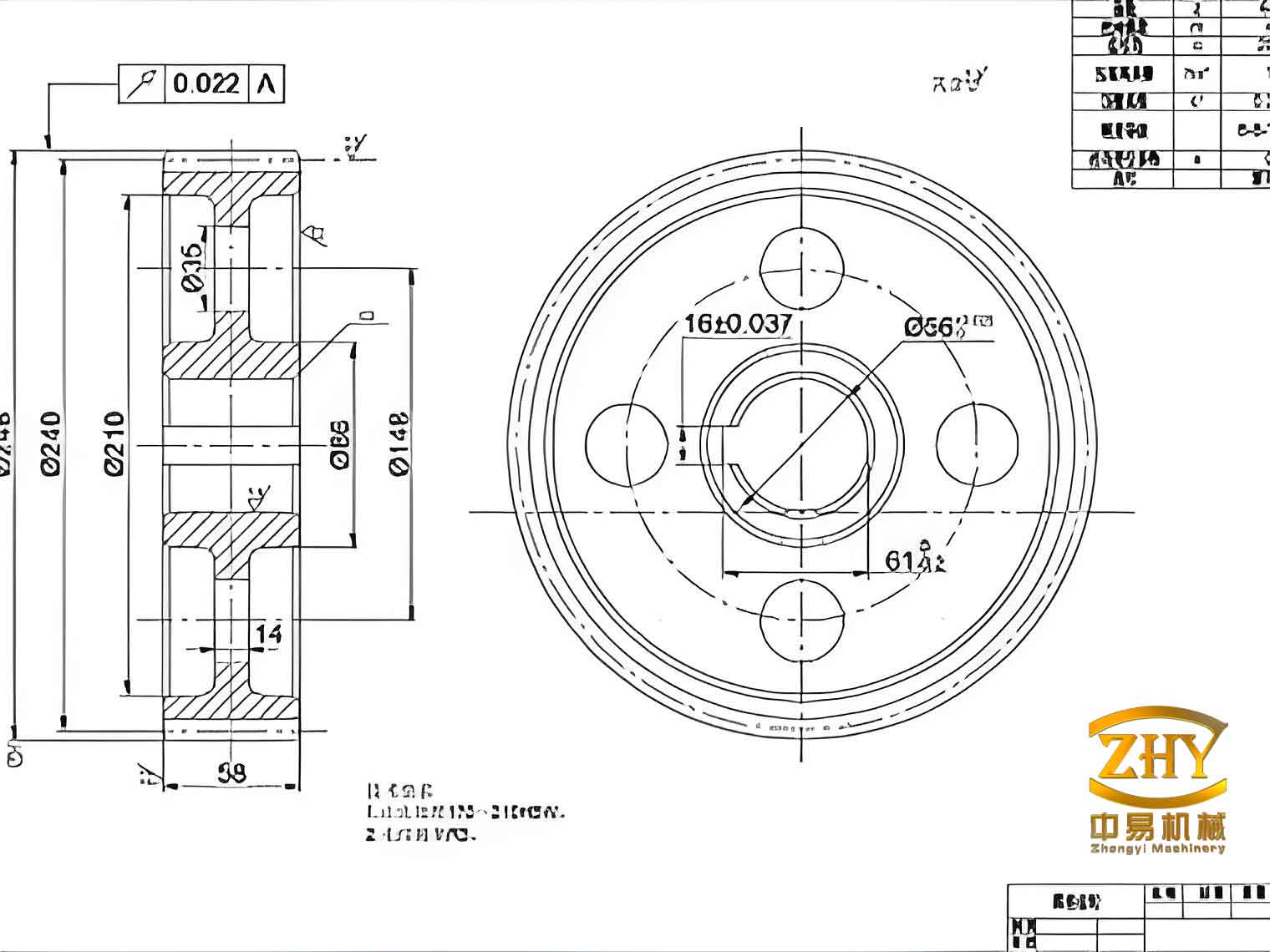
To systematically investigate the impact of tooth profile modification, I established a research framework centered on the TVMS model. This framework involves two main branches: analyzing single profile modification (applied to either pinion or gear alone) and analyzing compound modification (applied to both members of the cylindrical gear pair). For each configuration, the TVMS is computed using the derived analytical expressions. Subsequently, this TVMS serves as a key input into a dynamic model of the gear transmission system to predict vibration responses. The dynamic model is a lumped-parameter, six-degree-of-freedom system that accounts for translations along the line of action and perpendicular to it, as well as rotations for both the pinion and the cylindrical gear. The equations of motion are:
$$ m_p \ddot{x}_p + c_b \dot{x}_p + k_b x_p = -F_m $$
$$ m_p \ddot{y}_p + c_b \dot{y}_p + k_b y_p = -F_f $$
$$ I_p \ddot{\beta}_p = -F_m R_{b,p} – T_p $$
$$ m_g \ddot{x}_g + c_b \dot{x}_g + k_b x_g = F_m $$
$$ m_g \ddot{y}_g + c_b \dot{y}_g + k_b y_g = F_f $$
$$ I_g \ddot{\beta}_g = -F_m R_{b,g} – T_g $$
Here, \(m\) and \(I\) denote mass and mass moment of inertia, \(c_b\) and \(k_b\) are bearing damping and stiffness, \(T\) is torque, and \(\beta\) is rotational displacement. The meshing force \(F_m\) and friction force \(F_f\) are defined as:
$$ F_m = k(t) \left[ x_p – x_g + R_{b,g} \beta_g – R_{b,p} \beta_p – e(t) \right] + c_m \left[ \dot{x}_p – \dot{x}_g + R_{b,g} \dot{\beta}_g – R_{b,p} \dot{\beta}_p – \dot{e}(t) \right] $$
$$ F_f = -\mu F_m $$
The term \(e(t)\) is the static transmission error, \(\mu\) is the friction coefficient, and \(c_m\) is the meshing damping coefficient calculated from the average meshing stiffness \(\bar{k}_m\) and equivalent mass \(m_e = m_p m_g / (m_p + m_g)\): \(c_m = 2 \zeta \sqrt{\bar{k}_m m_e}\), with \(\zeta\) as the damping ratio. The primary output for dynamic analysis is the Dynamic Transmission Error (DTE), calculated as \(DTE = x_p – x_g + R_{b,p} \beta_p + R_{b,g} \beta_g – e(t)\). To evaluate vibration severity, I employ statistical indicators in the time domain: Root Mean Square (RMS), Square Root of Amplitude (SRA), Peak-to-Peak Value (PPV), and Kurtosis Value (KV).
The baseline parameters for the cylindrical spur gear pair studied in this work are summarized in the table below. These parameters are typical for a medium-size power transmission application and serve as the reference for all modification studies.
| Parameter | Pinion | Gear |
|---|---|---|
| Number of Teeth, \(N\) | 22 | 133 |
| Module, \(m_n\) (mm) | 5 | 5 |
| Face Width, \(L\) (mm) | 70 | 70 |
| Pressure Angle, \(\alpha\) (°) | 20 | 20 |
| Addendum Coefficient, \(h_a^*\) | 1.1 | 1.1 |
| Dedendum Coefficient, \(c^*\) | 0.25 | 0.25 |
| Young’s Modulus, \(E\) (GPa) | 206 | 206 |
| Poisson’s Ratio, \(\nu\) | 0.3 | 0.3 |
| Density, \(\rho\) (kg/m³) | 7850 | 7850 |
| Bearing Stiffness, \(k_b\) (N/m) | 1.0 × 10¹⁰ | |
| Mass, \(m\) (kg) | 3.08 | 147.61 |
| Moment of Inertia, \(I\) (kg·m²) | 6.66 × 10⁻³ | 8.936 |
Proceeding with the case studies, I first examine the influence of single profile modification. This involves applying a modification coefficient \(x_p\) to the pinion while keeping the gear unmodified (\(x_g = 0\)). The modification coefficient is defined such that a positive value indicates outward shift (thicker tooth at the pitch circle), and a negative value indicates inward shift (thinner tooth). For positive modification, I analyzed coefficients \(x_p = 0, 0.1, 0.2, 0.3, 0.4, 0.5\). The primary observation is that while positive modification increases the tooth thickness near the pitch line, it paradoxically reduces the overall tooth stiffness of the cylindrical gear pinion, especially near the end of the engagement cycle. The single tooth stiffness \(k_{tooth}\) as a function of roll angle demonstrates this trend. To quantify the change, a relative stiffness ratio is defined: \( \bar{k}_{p,i} = (k_i – k_0) / k_0 \), where \(k_i\) is the stiffness for modified pinion and \(k_0\) is for the standard pinion (\(x_p=0\)). The results show that at the start of engagement, positive modification slightly increases stiffness, but as the contact point moves towards the tooth root, the stiffness drops significantly below the standard value. This leads to a steeper stiffness curve during the meshing cycle.
The TVMS for the entire cylindrical gear pair under positive pinion modification is calculated next. The overall TVMS decreases as the positive modification coefficient increases. Furthermore, the contact ratio—the average number of tooth pairs in contact—also diminishes. This reduction in both average stiffness and contact ratio exacerbates the dynamic excitation. The mean value and standard deviation of TVMS over one mesh cycle are computed. The mean TVMS shows a slow initial decline with small positive \(x_p\), followed by an accelerated decrease for larger values. The standard deviation, representing fluctuation intensity, increases sharply for small modifications but the rate of increase slows for larger shifts. These TVMS characteristics directly feed into the dynamic model. I simulated the dynamic response for damping ratios \(\zeta = 0.07, 0.08, 0.09, 0.10\) to assess sensitivity. The statistical indicators of DTE (RMS, SRA, PPV, KV) are extracted and compared relative to the standard cylindrical gear pair. The results, summarized conceptually below, indicate a monotonic increase in RMS, SRA, and generally PPV with increasing \(x_p\), confirming that positive single profile modification intensifies vibration. Kurtosis values become negative for small shifts, indicating a flattening of the waveform peaks, but turn positive for larger shifts, indicating sharper peaks.
| Modification Coefficient \(x_p\) | TVMS Mean Trend | TVMS Std. Dev. Trend | DTE RMS Trend | DTE SRA Trend | DTE PPV Trend | DTE KV Trend |
|---|---|---|---|---|---|---|
| 0.0 (Reference) | Reference | Reference | Reference | Reference | Reference | Reference |
| 0.1 | Slight Decrease | Sharp Increase | Increase | Increase | Variable | Decrease (Negative) |
| 0.2 | Decrease | Increase | Increase | Increase | Increase | Transition |
| 0.3 | Moderate Decrease | Increase | Increase | Increase | Increase | Increase (Positive) |
| 0.4 | Significant Decrease | Increase (Slowing) | Increase | Increase | Increase | Increase |
| 0.5 | Pronounced Decrease | Increase (Slowing) | Increase | Increase | Increase | Increase |
The analysis for negative single profile modification follows a similar procedure, with coefficients \(x_p = 0, -0.1, -0.2, -0.3, -0.4, -0.5\). Contrary to positive shift, negative modification makes the cylindrical gear tooth thinner at the pitch line but enhances its stiffness, particularly in the middle of the engagement cycle. The single tooth stiffness ratio shows that the maximum stiffness loss occurs near the pitch point, but the overall effect is an increase in average tooth stiffness. The TVMS for the gear pair under negative modification exhibits an interesting behavior: during initial engagement, TVMS is lower than the standard, but it surpasses the standard value as meshing progresses. Importantly, the contact ratio increases with negative modification, promoting smoother load sharing between tooth pairs. The mean TVMS increases almost linearly with decreasing (more negative) \(x_p\), while the standard deviation decreases linearly. This suggests a simultaneous enhancement in average load capacity and a reduction in stiffness fluctuation amplitude.
The dynamic analysis for negative modification reveals beneficial effects. The statistical indicators of DTE show a monotonic decrease in RMS and SRA as the modification becomes more negative, indicating effective vibration suppression. The PPV changes marginally, while KV shows a slow improvement (decrease in value). The damping ratio \(\zeta\) has minimal influence on these relative trends. The summary is presented below.
| Modification Coefficient \(x_p\) | TVMS Mean Trend | TVMS Std. Dev. Trend | DTE RMS Trend | DTE SRA Trend | DTE PPV Trend | DTE KV Trend |
|---|---|---|---|---|---|---|
| 0.0 (Reference) | Reference | Reference | Reference | Reference | Reference | Reference |
| -0.1 | Increase | Decrease | Decrease | Decrease | Minor Change | Slight Decrease |
| -0.2 | Increase | Decrease | Decrease | Decrease | Minor Change | Decrease |
| -0.3 | Increase | Decrease | Decrease | Decrease | Minor Change | Decrease |
| -0.4 | Increase | Decrease | Decrease | Decrease | Minor Change | Decrease |
| -0.5 | Increase | Decrease | Decrease | Decrease | Minor Change | Decrease |
The second major part of the investigation focuses on compound modification, where both the pinion and the cylindrical gear are modified. Two common design philosophies are examined: the “S0 gear drive” where the sum of modification coefficients is zero (\(x_p + x_g = 0\)), and the “S gear drive” where the sum is non-zero. For S gear drives, both positive-total-sum and negative-total-sum cases are considered. I analyzed five specific compound sets:
1. Group 1 (S+): \(x_p=0.4, x_g=0.1\) (Total \(X_{\Sigma}=0.5\))
2. Group 2 (S+): \(x_p=0.2, x_g=0.1\) (Total \(X_{\Sigma}=0.3\))
3. Group 3 (S-): \(x_p=0.1, x_g=-0.6\) (Total \(X_{\Sigma}=-0.5\))
4. Group 4 (S-): \(x_p=0.1, x_g=-0.4\) (Total \(X_{\Sigma}=-0.3\))
5. Group 5 (S0): \(x_p=0.1, x_g=-0.1\) (Total \(X_{\Sigma}=0.0\))
6. Group 6: Standard gears (\(x_p=0, x_g=0\)) as reference.
The TVMS results are striking. Cylindrical gear pairs with a negative total modification (Groups 3 & 4) exhibit significantly higher TVMS and a larger contact ratio compared to the standard pair. Conversely, pairs with a positive total modification (Groups 1 & 2) show markedly reduced TVMS and a smaller contact ratio. The S0 gear pair (Group 5) demonstrates a TVMS curve very close to the standard, indicating minimal impact on the stiffness characteristic from a global perspective. The mean and standard deviation of TVMS across these groups clearly illustrate this dichotomy: negative-total-sum increases mean stiffness and reduces fluctuation, while positive-total-sum does the opposite.
The dynamic performance under compound modification aligns with the TVMS trends. For the cylindrical gear system with negative-total-sum S drive, the vibration indicators (RMS, SRA) are substantially lower than the standard, sometimes by up to 15% in relative terms. This signifies excellent vibration suppression. The positive-total-sum S drive, however, leads to higher vibration levels. The S0 drive, while having little effect on TVMS, shows noticeable differences in dynamic indicators compared to the standard, underscoring that even symmetric modification alters the load distribution and dynamic response. The kurtosis values for S drives tend to form a V-shaped curve relative to the total sum, suggesting that compound modification can make the time-domain waveform sharper. The damping ratio, again, does not alter the comparative conclusions among different modification types. The essence of these findings is consolidated in the following table.
| Compound Modification Group | Type | Total Sum \(X_{\Sigma}\) | TVMS Mean Relative to Std. | TVMS Fluctuation Relative to Std. | DTE Vibration Level (RMS/SRA) | Key Dynamic Implication |
|---|---|---|---|---|---|---|
| Group 1 (x_p=0.4, x_g=0.1) | S+ Drive | +0.5 | Significantly Lower | Higher | Substantially Higher | Aggravated Vibration |
| Group 2 (x_p=0.2, x_g=0.1) | S+ Drive | +0.3 | Lower | Higher | Higher | Increased Vibration |
| Group 3 (x_p=0.1, x_g=-0.6) | S- Drive | -0.5 | Significantly Higher | Lower | Substantially Lower | Excellent Vibration Suppression |
| Group 4 (x_p=0.1, x_g=-0.4) | S- Drive | -0.3 | Higher | Lower | Lower | Reduced Vibration |
| Group 5 (x_p=0.1, x_g=-0.1) | S0 Drive | 0.0 | Very Similar | Similar | Moderately Different | Altered Dynamics despite Similar Stiffness |
| Group 6 (Standard) | Reference | 0.0 | Baseline | Baseline | Baseline | Baseline Performance |
In conclusion, this comprehensive investigation into the meshing dynamic characteristics of cylindrical spur gears with tooth profile modification yields several critical insights. The developed analytical model, rooted in the potential energy method and encompassing detailed geometric cases for modified teeth, provides an effective tool for predicting TVMS. The application of this model to single and compound modifications reveals distinct patterns. For single profile modification applied to a cylindrical gear pinion, positive shifts, despite increasing tooth thickness, generally degrade performance by reducing tooth stiffness and contact ratio, thereby intensifying system vibration. Negative shifts, on the other hand, enhance tooth stiffness and increase contact ratio, leading to smoother operation and lower vibration levels. When considering compound modification for the entire cylindrical gear pair, the sign of the total modification sum becomes paramount. A negative total sum (S- drive) elevates the TVMS and markedly improves dynamic stability by damping vibrations. A positive total sum (S+ drive) reduces TVMS and exacerbates dynamic excitations. Interestingly, the S0 drive, with a zero total sum, has a minimal impact on the TVMS profile but still induces measurable changes in the dynamic response, indicating that the individual modification coefficients independently influence the load sharing and dynamic behavior beyond mere stiffness averages. These findings underscore the importance of a holistic design approach when applying tooth profile modification to cylindrical gear systems. The choice of modification coefficients should be guided not only by geometric and strength considerations but also by a thorough dynamic analysis to achieve optimal noise, vibration, and harshness (NVH) performance. Future work could extend this model to include effects of manufacturing errors, thermal loads, and lubricant films to further refine the understanding of cylindrical gear dynamics in practical operating conditions.